
Infrared Detector Market Outlook: Size, Share, Trends, Growth Analysis, Competitive Landscape & Forecast, 2026-2033

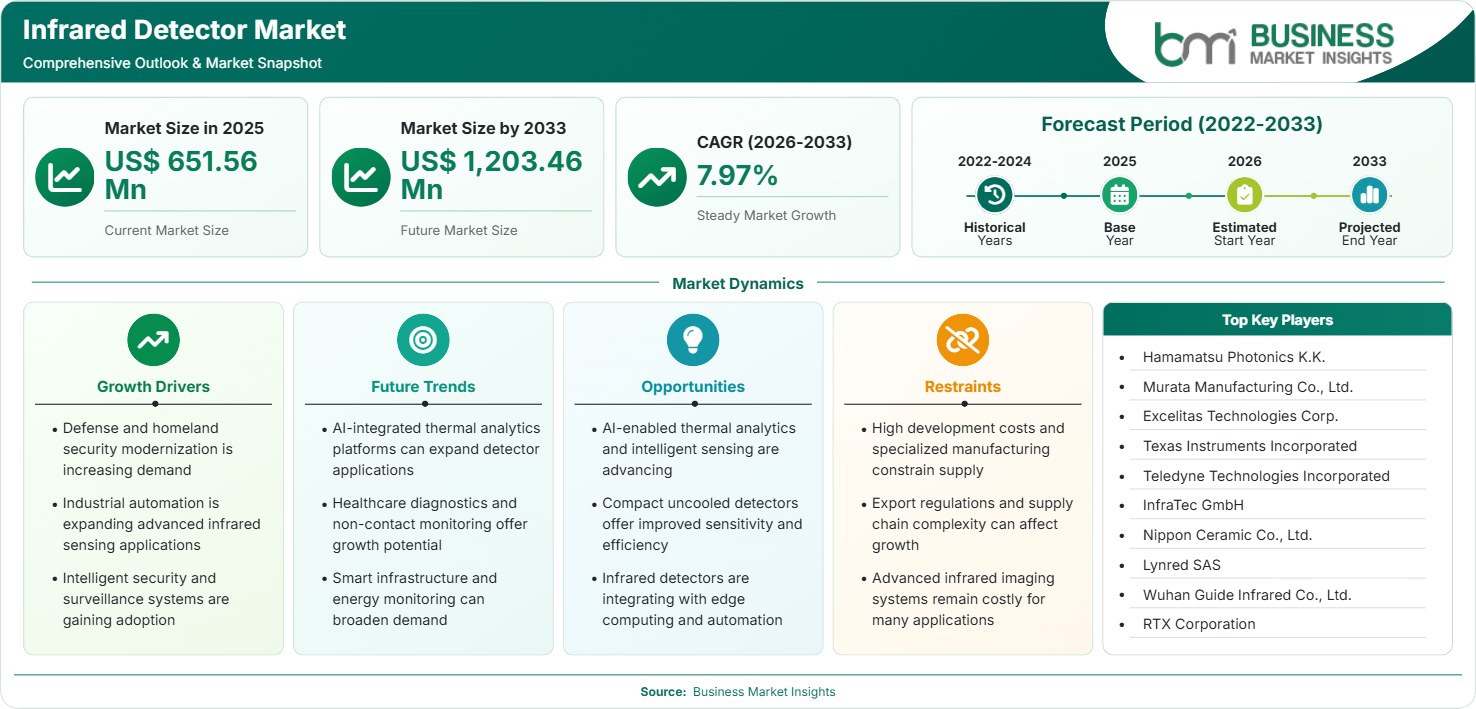
The Infrared Detector Market size was valued at US$ 651.56 Million in 2025 and is projected to reach US$ 1203.46 Million by 2033, growing at a CAGR of 7.97% during 2026–2033. Rising defense modernization, thermal imaging adoption, industrial automation expansion, smart surveillance deployment, and increasing demand for non-contact sensing technologies are creating sustained growth opportunities across global markets.

Report Coverage
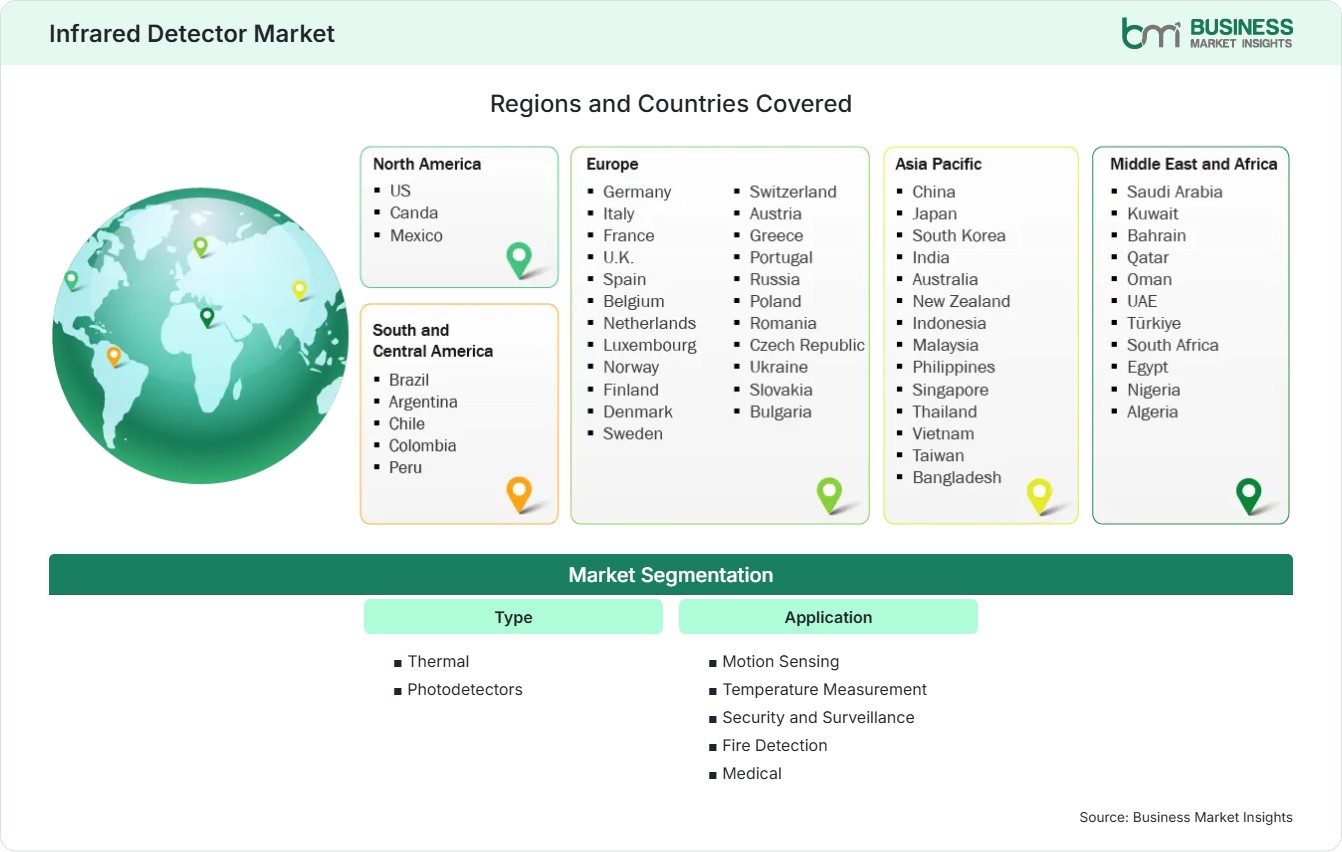
  • Type: Thermal, Photodetectors
  • Application: Motion Sensing, Temperature Measurement, Security and Surveillance, Fire Detection, Medical
US$ 651.56 Mn Market size in 2025
US$ 1,203.46 Mn Market Size by 2033
7.97% CAGR, 2026 - 2033
2026-2033 Forecast Period

AI Overview

Infrared Detector Market Summary

  • North America Region: North America holds a market share of 37%–40% in 2025, growing with a CAGR of 6.8%–7.4% during 2026–2033. Defense modernization, border surveillance upgrades, industrial thermography adoption, and healthcare imaging investments continue driving demand. Emerging opportunities include AI-enabled thermal analytics and smart infrastructure monitoring. The U.S. market benefits from defense procurement programs, aerospace innovation, and expanding thermal imaging deployment, advancing at a CAGR of 6.9%–7.5%.
  • Fastest Growing Region: Asia Pacific accounts for 28%–31% share in 2025 and is expected to expand at a CAGR of 9.2%–10.1% during 2026–2033. Manufacturing expansion, smart city investments, defense spending growth, semiconductor development, and industrial automation initiatives support strong regional demand across multiple end-use sectors.
  • Leading Segment: Thermal detectors represent 63%–67% share in 2025 and are forecast to grow at a CAGR of 7.3%–8.1% during 2026–2033. Cost-effective deployment, widespread surveillance applications, fire detection requirements, industrial monitoring needs, and increasing smart building installations continue strengthening segment leadership.
  • High Growth Segment: Security and Surveillance contributes 28%–32% share in 2025 and is projected to register a CAGR of 9.1%–10.0% during 2026–2033. Critical infrastructure protection, border monitoring investments, urban security initiatives, intelligent video analytics integration, and defense modernization programs continue accelerating adoption worldwide.
  • Key Market Opportunity: Growing integration of infrared sensing with artificial intelligence platforms enables predictive monitoring, autonomous inspection, perimeter security enhancement, industrial diagnostics, and advanced thermal analytics, creating substantial commercial opportunities across industries.
  • Major Market Players: Hamamatsu Photonics K.K., Murata Manufacturing Co., Ltd., Excelitas Technologies Corp., Texas Instruments Incorporated, Teledyne Technologies Incorporated, InfraTec GmbH, Nippon Ceramic Co., Ltd., Lynred SAS, Wuhan Guide Infrared Co., Ltd., and RTX Corporation.
Strategic Insights

Infrared Detector Market: Strategic Insights

Infrared Detector Market Strategic Framework
FREE PDF
Request your free sample
Request free sample
Stakeholder View

Key Takeaways

  • The value chain is increasingly integrating semiconductor fabrication, thermal imaging modules, AI software, and system-level analytics, creating stronger collaboration between detector manufacturers and solution providers.
  • Security surveillance, intelligent perimeter protection, and industrial condition-monitoring applications present the most attractive commercial opportunities due to increasing demand for continuous monitoring capabilities.
  • Product innovation is moving toward compact uncooled detectors, improved thermal resolution, lower power consumption, and AI-enabled thermal analytics capable of supporting autonomous decision-making.
  • Asia Pacific offers a compelling investment case because of manufacturing expansion, defense procurement growth, and increasing government support for semiconductor ecosystem development.
  • Strategic acquisitions and technology partnerships are becoming common as companies seek access to advanced sensing technologies, proprietary detector materials, and high-growth application segments.
  • Healthcare diagnostics and contactless temperature measurement applications continue creating specialized demand for highly sensitive and accurate sensing platforms.
Geographic Outlook

Infrared Detector Market Regional Highlights

North America Infrared Detector Market

North America accounted for approximately 37%–40% of global revenue in 2025 and is expected to expand at a CAGR of 6.8%–7.4% through 2033. Strong defense spending, advanced aerospace programs, and extensive deployment of thermal imaging systems support regional leadership. Government investments in border security, critical infrastructure protection, and intelligent monitoring solutions continue stimulating demand. The region also benefits from a mature technology ecosystem, substantial research funding, and widespread adoption across industrial inspection, healthcare diagnostics, and smart building applications. The Infrared Detector Market share remains the highest globally.

  • Defense modernization programs continue increasing procurement of thermal imaging systems for surveillance, targeting, and reconnaissance applications across military and homeland security operations.
  • Industrial facilities are deploying thermal monitoring technologies to improve equipment reliability, predictive maintenance efficiency, and operational safety performance.
  • Smart infrastructure projects increasingly incorporate thermal sensing capabilities for traffic management, energy efficiency optimization, and public safety monitoring.
  • Healthcare providers continue adopting contactless thermal imaging systems for screening, diagnostics, and advanced medical imaging applications.
  • AI-enabled thermal analytics platforms are creating new commercial opportunities across security, industrial, and transportation sectors.

US Infrared Detector Market

The United States represents approximately 78%–82% of North American Infrared Detector Market demand and is projected to expand at a CAGR of 6.9%–7.5% through 2033. Defense procurement programs, aerospace innovation, and advanced manufacturing capabilities continue supporting market expansion. Federal investments in surveillance systems, border monitoring, and next-generation sensing technologies strengthen domestic demand. Significant research activity and strong participation from leading technology developers further enhance competitiveness across military, industrial, and commercial applications.

  • Defense agencies remain major adopters of advanced thermal imaging and infrared sensing technologies for mission-critical operational requirements.
  • Aerospace manufacturers continue integrating high-performance detectors into navigation, targeting, and situational awareness systems.
  • Industrial automation initiatives support increasing deployment of thermal inspection technologies across manufacturing facilities.
  • Healthcare organizations are expanding use of non-contact diagnostic and temperature monitoring solutions.

Regional Trends and Share Analysis (Continued)

Europe Infrared Detector Market

Europe represented approximately 24%–27% of global Infrared Detector Market revenue in 2025 and is anticipated to expand at a CAGR of 7.1%–7.8% through 2033. Strong defense electronics manufacturing, automotive innovation, industrial automation, and environmental monitoring initiatives support demand. The region benefits from substantial investments in thermal imaging technologies for aerospace, border security, and smart manufacturing applications. Germany remains the leading market, while France demonstrates the fastest growth due to defense modernization programs and advanced sensor technology investments across multiple industries.

  • Germany maintains regional leadership through its strong industrial automation ecosystem, advanced manufacturing capabilities, and increasing deployment of thermal monitoring solutions across energy, automotive, and industrial sectors.
  • France is emerging as the fastest-growing national market, supported by defense procurement initiatives, aerospace technology investments, and increasing demand for sophisticated surveillance systems.
  • European Union energy-efficiency regulations continue encouraging adoption of thermal inspection technologies for building diagnostics and industrial process optimization.
  • Environmental monitoring programs increasingly utilize infrared sensing technologies for emissions detection, climate observation, and infrastructure condition assessment.
  • Collaborative research projects across the region support innovation in detector materials, thermal imaging performance, and miniaturized sensing platforms.

Asia Pacific Infrared Detector Market

Asia Pacific accounted for approximately 28%–31% of global Infrared Detector Market revenue in 2025 and is projected to register the fastest expansion with a CAGR of 9.2%–10.1% through 2033. Rapid industrialization, expanding semiconductor manufacturing, smart city investments, and increasing defense expenditures continue accelerating demand. China remains the largest regional market due to extensive manufacturing capacity and surveillance infrastructure deployment, while India demonstrates the highest growth trajectory driven by defense modernization, industrial automation initiatives, and expanding electronics production capabilities.

  • China leads regional demand through large-scale surveillance deployment, semiconductor manufacturing investments, and expanding adoption of thermal imaging technologies across industrial applications.
  • India records the strongest growth outlook, supported by defense procurement programs, smart infrastructure projects, and increasing localization of electronics manufacturing activities.
  • Japan continues contributing significant technological innovation through advanced sensor development, miniaturization expertise, and high-performance imaging solutions.
  • Growing adoption of predictive maintenance technologies across manufacturing industries is strengthening demand for thermal monitoring systems throughout the region.
  • Smart city initiatives are accelerating deployment of intelligent surveillance networks incorporating advanced thermal imaging and sensing capabilities.

Rest of World Infrared Detector Market

Rest of World accounted for approximately 8%–11% of global revenue in 2025 and is forecast to expand at a CAGR of 7.8%–8.6% through 2033. Rising investments in security infrastructure, industrial modernization, and energy sector development continue supporting adoption.

South and Central America are experiencing increasing demand for industrial inspection and security monitoring applications, with Brazil leading regional deployment. Meanwhile, the Middle East and Africa benefit from defense investments, critical infrastructure protection initiatives, and smart city developments. Saudi Arabia demonstrates the strongest growth within the Middle East, while South Africa remains a key African market for industrial thermal imaging solutions.

  • Energy infrastructure investments across the Middle East are supporting deployment of thermal monitoring technologies for asset protection and operational reliability.
  • Brazil leads regional adoption through industrial modernization efforts and increasing utilization of predictive maintenance technologies.
  • Gulf countries continue investing in advanced surveillance and border monitoring systems to strengthen national security capabilities.
  • Mining operations across Africa increasingly employ thermal sensing solutions for equipment monitoring, worker safety, and operational efficiency enhancement.
  • Infrastructure development projects are creating new opportunities for thermal inspection technologies across transportation and utility sectors.
Global Market Geography
FREE PDF
Request your free sample
Request free sample
Segment Analysis

Infrared Detector Market Segmentation

Type

The thermal category accounted for approximately 63%–67% market share in 2025 and is expected to grow at a CAGR of 7.3%–8.1% through 2033. Demand is driven by surveillance, industrial monitoring, and fire detection applications. Photodetectors continue gaining traction in high-precision applications requiring faster response times and enhanced sensitivity. The Infrared Detector Market scope continues expanding as advanced sensing technologies penetrate new commercial and industrial environments.

  • Thermal: Thermal detectors benefit from cost-effective operation, broad deployment across surveillance and industrial monitoring applications, and increasing adoption in smart infrastructure projects requiring reliable non-contact sensing capabilities.
  • Photodetectors: Photodetectors are increasingly utilized in advanced defense systems, scientific instrumentation, healthcare diagnostics, and industrial process control applications where speed and precision are critical requirements.

Application

Security and Surveillance represented approximately 28%–32% market share in 2025 and is projected to achieve a CAGR of 9.1%–10.0% through 2033, making it the fastest-growing application category. Increasing investments in border protection, smart city infrastructure, and critical asset monitoring support adoption. Infrared Detector Market trends indicate growing integration of AI-enabled analytics with thermal imaging systems across multiple end-use industries.

  • Motion Sensing: Motion sensing applications continue expanding within smart homes, automated lighting systems, occupancy monitoring platforms, and industrial automation environments seeking enhanced operational efficiency.
  • Temperature Measurement: Temperature measurement solutions are widely deployed in healthcare screening, manufacturing processes, energy infrastructure monitoring, and predictive maintenance programs requiring accurate non-contact measurements.
  • Security and Surveillance: Security and surveillance applications benefit from increasing deployment of intelligent monitoring systems, critical infrastructure protection requirements, and advanced thermal imaging capabilities for low-visibility environments.
  • Fire Detection: Fire detection systems leverage thermal sensing technologies to identify abnormal heat signatures rapidly, supporting improved safety performance across industrial, commercial, and public infrastructure environments.
  • Medical: Medical applications utilize infrared sensing for diagnostics, patient monitoring, physiological assessments, and emerging imaging techniques that enhance clinical decision-making and healthcare efficiency.
Market Forces

Infrared Detector Market Dynamics

Key Market Drivers

Rising Defense and Homeland Security Modernization

Governments worldwide are increasing investments in advanced surveillance, reconnaissance, targeting, and border protection systems that rely heavily on thermal imaging technologies. Infrared sensors have operational benefits when visibility is poor and during nighttime, hence their importance in contemporary defense structures. Countries that are members of NATO, as well as several nations in Asia Pacific, keep increasing their military modernization budget. The growing adoption of unmanned aerial vehicles, autonomous defense platforms, and intelligent surveillance networks further strengthens demand. Infrared Detector Market growth is increasingly supported by national security priorities, while evolving threat environments encourage deployment of high-performance sensing technologies across military, aerospace, and homeland security applications globally.

Expansion of Industrial Automation and Predictive Maintenance

Factories have begun to increase their investments in the technologies associated with Industry 4.0 that increase efficiency and decrease downtime. Thermal management technology allows one to detect overheating, electrical problems, and mechanical breakdowns at an earlier stage than when any interruption occurs. Infrared sensing technologies are being widely used by industrial companies in the automotive industry, semiconductor, power generation, and process industries as part of their preventive maintenance practices. Infrared Detector Market trends indicate show an increase in use of thermal analytics technologies that can help in automation of inspection procedures, increase productivity, lower maintenance costs, and ensure workplace safety.

Growing Demand for Intelligent Security and Surveillance Systems

Technological advances in urbanization, critical infrastructure security requirements, and smart city development have increased the use of high-tech surveillance systems. The technology of thermal imaging provides reliable detection in conditions when ordinary camera systems can be less effective because of weather conditions. Infrared technology is widely used in airports, transport networks, industries, and infrastructure systems. Video analytics using artificial intelligence increases the level of situational awareness. Investments in further enhancing perimeter security, public safety, and infrastructure will continue to drive the development. The increasing demand for infrared sensing technologies from commercial, governmental, and industrial applications will help improve the outlook.

Key Market Opportunities

AI-Integrated Thermal Analytics Platforms

Through artificial intelligence, thermal imaging is evolving from being a monitoring application to becoming a decision support system that uses predictions. Analytics can detect anomalies and classify the thermal signatures and perform actions based on that. Companies are looking for solutions that combine thermal imaging and analytics in order to increase efficiency and reduce human errors. Infrared Detector Market Forecasts increasingly reflect growing opportunities for software-enabled sensing ecosystems rather than standalone hardware products. Vendors capable of combining detector technologies with machine learning algorithms, edge computing capabilities, and cloud-based analytics platforms are expected to capture substantial value as intelligent monitoring becomes a strategic enterprise priority.

Healthcare Diagnostics and Non-Contact Monitoring Expansion

Healthcare providers continue exploring advanced imaging technologies that improve patient assessment, disease detection, and physiological monitoring. The infrared sensing technologies are beneficial for temperature detection, blood vessel visualization, inflammation detection, and patient monitoring applications. The high demand for non-invasive diagnostics and telemedicine makes the market environment attractive for the technology implementation. The investments in the healthcare digitalization and medical imaging innovations increase the commercial opportunities for the technology. The infrared detectors companies have started cooperating with the healthcare technology suppliers in order to produce specialized solutions.

Smart Infrastructure and Energy Monitoring Applications

Governments and utilities are investing heavily in infrastructure modernization programs focused on resilience, efficiency, and sustainability. Thermal sensors can help to monitor power distribution networks, vehicles, factories and urban infrastructure. Early fault detection ensures increased asset reliability along with lowered maintenance expenses. The current focus on energy efficiency and process optimization makes it easier to justify the need for thermal inspection tools. Smart cities are now generating the demand for sensing platforms which would be able to perform infrastructure management, environment monitoring and other tasks related to public safety. There is great potential for growth in this field.

Market Restraints and Challenges

High Development Costs and Specialized Manufacturing Requirements

Factor: The development and production of such detectors is associated with high costs owing to the special fabrication methods needed for the creation of the necessary semiconductors and other detector components.

Impact: Higher costs may hinder usage by cost-conscious consumers as well as pose difficulties to entry into the market by new competitors. The procurement process in commercial areas can choose cheaper products due to relaxed performance specifications. Businesses should always find themselves juggling the process of innovating and remaining cost-effective.

Export Regulations and Supply Chain Complexity

Factor: Infrared sensing technologies tend to be covered by export control laws due to the defense and security uses of such technologies. Supply chains are also dependent on materials and manufacturing that are located in a very specific part of the world.

Impact: Regulatory limitations can lead to delays in foreign dealings, restrictions on the markets that can be served, and increased compliance costs. The disruptions within the supply chain can have an impact on the manufacturing schedule, product availability, and prices. There are constant issues with the sourcing of critical parts for the manufacturer’s flexibility.

Company Analysis

Competitive Landscape

The competitive environment remains characterized by technological innovation, vertical integration, and application-specific product development. Infrared Detector Market analysis indicates that leading participants are focusing on detector sensitivity improvements, thermal imaging performance, miniaturization, and AI-enabled sensing platforms to strengthen market positioning.

Company Name

Overview

Products and Services relevant to this market

Hamamatsu Photonics K.K.

Global photonics technology leader with strong expertise in optical sensors, imaging systems, and semiconductor solutions.

Infrared sensors, photodetectors, thermal imaging components, optical sensing modules, and advanced photonics technologies.

Murata Manufacturing Co., Ltd.

Major electronics manufacturer specializing in sensing technologies, electronic components, and industrial solutions.

Infrared sensors, motion detection modules, temperature sensing technologies, and integrated electronic sensing solutions.

Excelitas Technologies Corp.

Developer of photonic technologies serving industrial, healthcare, aerospace, and defense sectors.

Infrared detectors, thermal imaging components, sensing systems, and optoelectronic technologies.

Texas Instruments Incorporated

Leading semiconductor company providing sensing and embedded processing technologies globally.

Infrared sensing solutions, thermal monitoring devices, motion detection sensors, and integrated semiconductor platforms.

Teledyne Technologies Incorporated

Diversified technology provider serving defense, industrial, and scientific markets.

Thermal imaging cameras, infrared detector modules, surveillance systems, and scientific imaging technologies.

InfraTec GmbH

Specialized thermal imaging company with strong expertise in industrial thermography solutions.

Infrared detectors, thermal imaging cameras, temperature monitoring systems, and industrial inspection technologies.

Nippon Ceramic Co., Ltd.

Sensor technology manufacturer focused on motion detection and infrared sensing applications.

Pyroelectric infrared sensors, motion detection devices, and industrial sensing technologies.

Lynred SAS

European specialist in advanced infrared technologies and defense-grade detector solutions.

Thermal imaging detectors, infrared focal plane arrays, surveillance technologies, and aerospace sensing systems.

Wuhan Guide Infrared Co., Ltd.

Chinese thermal imaging technology provider serving commercial and defense applications.

Infrared imaging equipment, detector modules, surveillance systems, and industrial thermal solutions.

RTX Corporation

Aerospace and defense technology company with advanced sensing and surveillance capabilities.

Infrared sensing systems, targeting technologies, surveillance solutions, and defense imaging platforms.

Trust & Transparency

Research Methodology

The market analysis combines proprietary research with secondary data from government agencies, company disclosures, regulatory filings, industry databases and expert interviews. Market estimates are validated through data triangulation, cross-market benchmarking and analyst review.

View Full Research Methodology

Questions Answered

Frequently Asked Questions

What does an Infrared Detector Market Report typically evaluate?

An Infrared Detector Market Report generally assesses technology trends, competitive positioning, regional demand patterns, application opportunities, investment activity, regulatory influences, and future commercial prospects.___________________________________________________________________________

How is artificial intelligence influencing industry development?

AI improves thermal image interpretation, anomaly detection, predictive analytics, and automated monitoring capabilities, enabling organizations to extract greater operational value from thermal sensing systems.__________________________________________________________________________

Why are thermal detectors leading the market?

Thermal detectors offer cost advantages, broad application compatibility, reliable performance in low-visibility environments, and strong suitability for surveillance, industrial monitoring, and fire detection applications.__________________________________________________________________________

Which region is expected to experience the fastest expansion?

Asia Pacific is projected to record the highest growth due to expanding manufacturing activities, semiconductor investments, defense spending increases, and rapid implementation of smart city and industrial automation projects._________________________________________________________________________

What are the primary factors driving demand for infrared detectors?

Demand is primarily supported by defense modernization, industrial automation, predictive maintenance programs, intelligent surveillance systems, healthcare diagnostics, and growing adoption of smart infrastructure monitoring technologies across global markets.___________________________________________________________________________

Access the Full Infrared Detector Market Report

Get segment-level forecasts, regional estimates, competitive benchmarking, company profiles and downloadable Excel datasets.

Access the full Infrared Detector Market Report
350 pages PDF & Excel | 2026-09-02