
Propane Market Size, Share, Trends & Forecast Report, 2026–2033

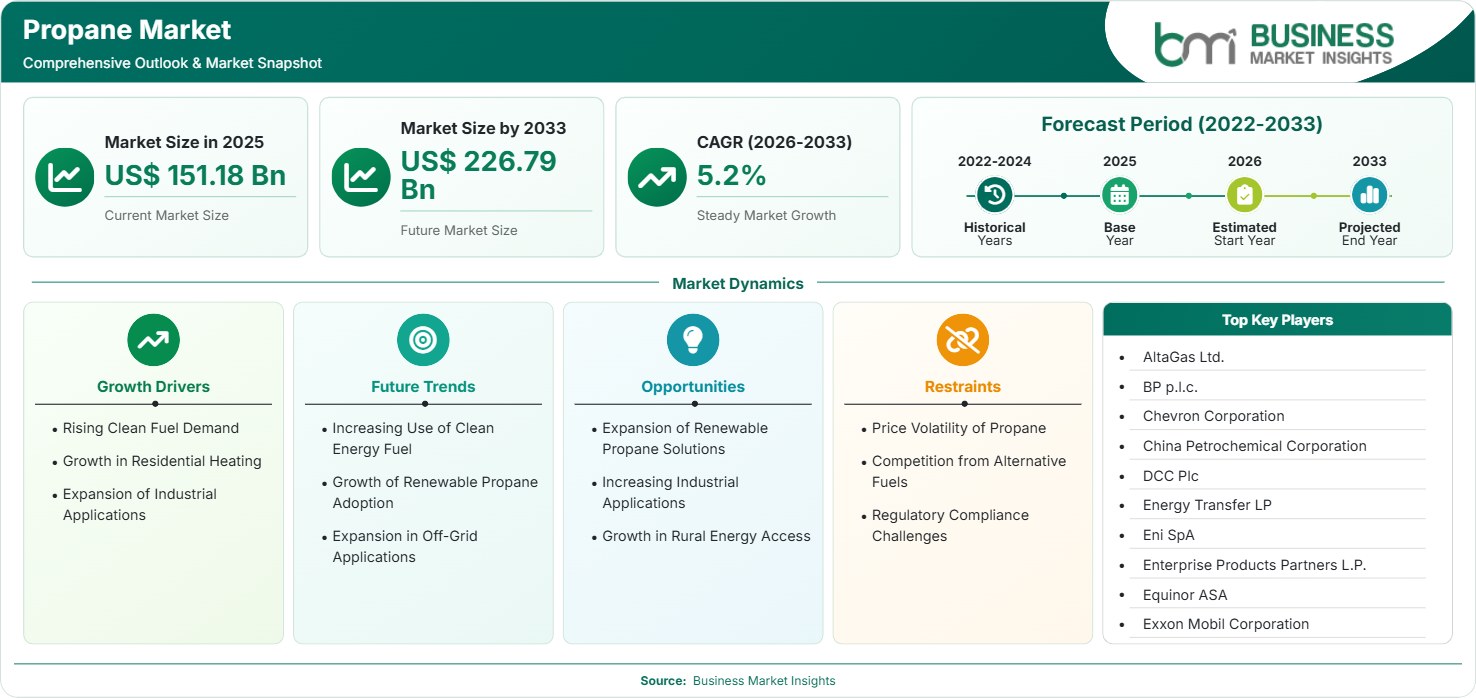
The Propane Market size was valued at US$ 151.18 Billion in 2025 and is projected to reach US$ 226.79 Billion by 2033, growing at a CAGR of 5.2% during 2026–2033, driven by rising clean fuel demand, residential heating adoption, industrial applications expansion, renewable propane development, and increasing energy access across underserved regions.

Report Coverage
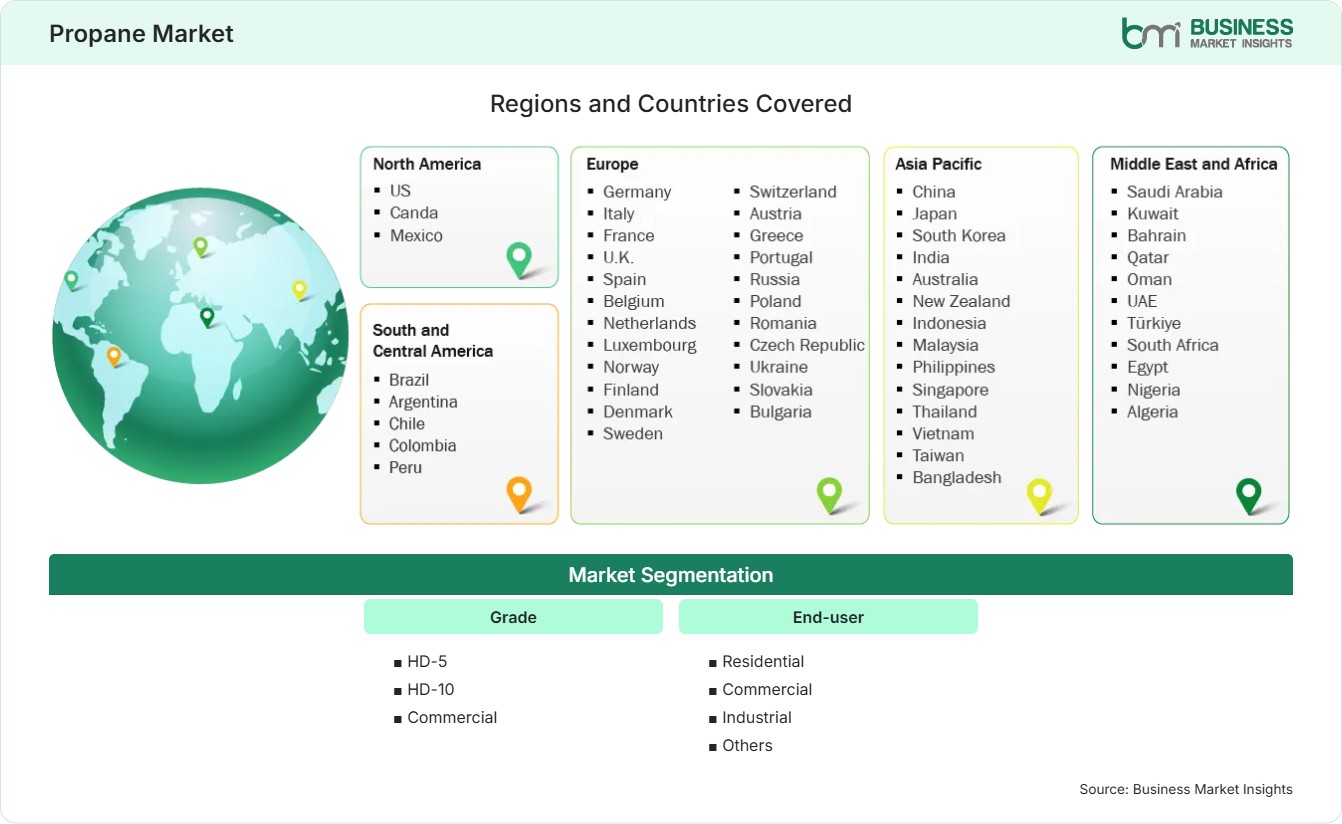
  • Grade: HD-5, HD-10, Commercial
  • End-user: Residential, Commercial, Industrial, Others
US$ 151.18 Bn Market size in 2025
US$ 226.79 Bn Market Size by 2033
5.2% CAGR, 2026 - 2033
2026-2033 Forecast Period

01 AI Overview

Propane Market Summary

  • North America Region: North America holds a market share of 38%–42% in 2025, growing with a CAGR of 4.8%–5.4%, influenced by residential heating demand, established distribution networks, industrial consumption, and cleaner energy transition initiatives. The US market demonstrates steady growth with a CAGR of 4.9%–5.3% from 2026–2033, supported by widespread propane infrastructure, rural energy requirements, and commercial applications.
  • Fastest Growing Region: Asia Pacific holds market share of 24%–28% in 2025, growing with a CAGR of 6.0%–6.6% influenced by industrial expansion, rising energy demand, urban development, and increasing adoption of liquefied petroleum gas solutions across emerging economies.
  • Leading Segment: HD-5 grade holds market share of 55%–59% in 2025, growing with a CAGR of 5.1%–5.6% influenced by residential heating requirements, automotive applications, fuel quality standards, and broad consumer adoption.
  • High Growth Segment: Industrial end-user segment holds market share of 27%–31% in 2025, growing with a CAGR of 5.8%–6.4% influenced by manufacturing activities, process heating demand, and expanding industrial energy applications.
  • Key Market Opportunity: Renewable propane development, industrial application expansion, and rural energy access initiatives create opportunities through lower-carbon fuel alternatives, improved distribution networks, and increased adoption across emerging energy markets.
  • Major Market Players: AltaGas Ltd., BP p.l.c., Chevron Corporation, China Petrochemical Corporation, DCC Plc, Energy Transfer LP, Eni SpA, Enterprise Products Partners L.P., Equinor ASA, and Exxon Mobil Corporation.
02 Strategic Insights

Propane Market: Strategic Insights

propane-market-market-strategic-framework
FREE PDF
Request your free sample
Request free sample
03 Stakeholder View

Key Takeaways

  • The market value chain includes producers, gas processors, storage operators, distributors, and end users, with infrastructure efficiency playing a critical role in ensuring reliable propane availability across regions.
  • Industrial applications, renewable propane solutions, and rural energy access programs represent major growth opportunities as businesses and communities seek flexible and cleaner energy sources.
  • Innovation is shifting toward renewable propane production, improved storage technologies, digital supply chain management, and enhanced fuel efficiency solutions supporting long-term sustainability objectives.
  • Asia Pacific provides strong expansion potential due to industrialization, increasing energy demand, infrastructure development, and government initiatives focused on improving access to reliable energy sources.
  • Strategic partnerships, acquisitions, and infrastructure investments are shaping competitive positioning as companies expand production capacity, distribution networks, and renewable energy capabilities.
  • Energy diversification strategies are increasing propane adoption as industries and households evaluate alternatives that provide operational flexibility, cost efficiency, and reduced environmental impact compared with conventional fuels.
04 Geographic Outlook

Propane Market Regional Highlights

North America Propane Market

North America market accounted for a 38%–42% share in 2025 and is projected to expand at a CAGR of 4.8%–5.4% during 2026–2033. The region maintains a leading position due to established production infrastructure, extensive distribution networks, and strong residential heating demand. The US and Canada remain major contributors with significant consumption across households, agriculture, commercial facilities, and industrial applications.

  • Residential heating demand remains a major contributor due to widespread propane usage in areas with limited natural gas infrastructure.
  • Industrial users are adopting propane for process heating, manufacturing operations, and energy backup applications.
  • Established storage and transportation networks support consistent supply availability across rural and remote locations.
  • Renewable propane initiatives are gaining attention as companies pursue lower-carbon energy alternatives.
  • Commercial sectors are utilizing propane for heating, cooking, and operational energy requirements.

US Propane Market

US Propane Market represented a 34%–38% share in 2025 and is estimated to grow at a CAGR of 4.9%–5.3% between 2026–2033. The country remains a major market due to extensive propane production, mature infrastructure, and strong demand from residential, agricultural, commercial, and industrial users. Rural communities and off-grid locations continue supporting propane adoption for reliable energy access.

  • Residential heating applications continue driving consumption due to propane availability across rural housing markets.
  • Agricultural operations use propane for crop drying, heating, and equipment-related energy requirements.
  • Industrial facilities are increasing propane adoption for flexible and efficient process energy applications.
  • Distribution companies are improving logistics systems to enhance supply reliability and customer accessibility.

Europe Propane Market

Europe Propane Market share held a 18%–22% share in 2025 and is forecast to register a CAGR of 4.6%–5.2% during 2026–2033. The region benefits from energy diversification strategies, industrial applications, and demand for cleaner combustion fuels. Germany, France, Italy, and the UK represent leading markets, while Eastern European countries demonstrate growth potential due to rural energy requirements and infrastructure development initiatives.

  • European energy transition policies are encouraging adoption of lower-emission fuels for heating and industrial applications.
  • France and Germany maintain demand through commercial heating and industrial energy consumption.
  • Rural European communities continue relying on propane where pipeline gas availability remains limited.
  • Renewable propane development is gaining interest among energy companies seeking sustainable fuel alternatives.
  • Industrial users are evaluating propane for efficient thermal applications and operational flexibility.

Asia Pacific Propane Market

Asia Pacific market accounted for a 24%–28% share in 2025 and is expected to expand at the fastest CAGR of 6.0%–6.6% between 2026–2033. Rapid industrialization, urbanization, and rising energy consumption are supporting regional growth. China, India, Japan, South Korea, and Southeast Asian countries represent important markets, with India and Southeast Asia showing strong expansion opportunities through growing energy access initiatives.

  • Industrial development is increasing propane demand for manufacturing, processing, and commercial energy applications.
  • India and China are expanding LPG-related infrastructure to support rising household and industrial consumption.
  • Urbanization is increasing demand for convenient and efficient cooking and heating fuels.
  • Emerging economies are investing in energy distribution networks to improve rural fuel accessibility.
  • Manufacturers are expanding regional supply chains to meet growing propane requirements.

Rest of World Propane Market

Rest of World market represented a 10%–14% share in 2025 and is projected to grow at a CAGR of 5.5%–6.1% from 2026–2033. Latin America, Middle East, and Africa markets are supported by increasing energy demand, industrial development, and rural access initiatives. Brazil, Mexico, South Africa, and Middle Eastern countries represent key opportunity markets due to expanding energy infrastructure and diverse fuel requirements.

  • Latin American countries are increasing propane usage for residential, agricultural, and commercial energy applications.
  • Brazil and Mexico are supporting demand through industrial activities and expanding energy distribution networks.
  • Middle Eastern markets benefit from regional production capabilities and established hydrocarbon infrastructure.
  • African countries are adopting propane solutions to improve access to reliable household and commercial energy.
  • Energy companies are developing partnerships to strengthen storage, transportation, and distribution capabilities across emerging markets.
global-market-geography
FREE PDF
Request your free sample
Request free sample
05 Segment Analysis

Propane Market Segmentation

Grade

Grade segmentation represents an important component of the market, with HD-5 maintaining the leading position in 2025 due to broad residential, commercial, and automotive applications. The segment accounted for a 55%–59% share and is expected to grow at a CAGR of 5.1%–5.6% from 2026–2034, supported by fuel quality standards, heating requirements, and widespread distribution availability.

  • HD-5: HD-5 propane is widely preferred due to higher purity levels, residential heating compatibility, and suitability for multiple fuel applications.
  • HD-10: HD-10 propane supports specific industrial and commercial uses where fuel specifications align with operational requirements.
  • Commercial: Commercial-grade propane serves diverse business applications including heating, cooking, and operational energy needs across multiple industries.

End-user

End-user segmentation highlights demand from residential, commercial, industrial, and other applications. Residential users represent a significant share due to heating requirements and accessibility in areas without natural gas infrastructure. Industrial applications are expected to record a CAGR of 5.8%–6.4% from 2026–2034, supported by manufacturing expansion, process heating demand, and energy diversification strategies.

  • Residential: Residential applications drive demand through heating, cooking, and energy requirements in rural and off-grid locations.
  • Commercial: Commercial users adopt propane for restaurants, hospitality facilities, retail operations, and building energy requirements.
  • Industrial: Industrial applications utilize propane for process heating, manufacturing operations, material handling, and backup energy systems.
  • Others: Other applications include agricultural, transportation, and specialized energy uses requiring flexible propane-based solutions.
06 Market Forces

Propane Market Dynamics

Key Market Drivers

Rising Clean Fuel Demand

Growing demand for clean energy has resulted in increased use of propane, owing to its efficiency and less emission as compared to other traditional fuels. High energy density, portability, and flexibility in storage make propane appropriate for energy purposes such as heating and industrial uses. The Propane Market growth is fueled by the growing need for diversification in the use of energy and clean-burning techniques. Growing market trends suggest increased investment in the production of renewable propane and other sustainable fuel sources. Energy providers are diversifying their cleaner energy supply options in order to meet both environmental and energy requirements.

Growth in Residential Heating

The increase in residential heating use has resulted in an increase in demand for propane, especially in the rural and remote regions where access to natural gas pipelines is poor. Propane is used in homes for heating, cooking, and energy security because of its efficient combustion nature. The market growth is driven by replacement demand, residential constructions, and consumer desire for energy security. The Propane Market trends are characterized by increased use of energy-efficient appliances, better storage facilities, and cleaner fuels.

Expansion of Industrial Applications

The rise in the use of propane for industrial purposes has resulted in an increase in the usage of propane in various industries. Industrial consumers prefer propane because of its efficiency and ease of use. In addition, the market is expected to grow due to rising industrial activities, energy security, and demand for process fuels. It can be seen from the current trends in the Propane Market that there is increased usage in thermal processing, backup power, and specialized industrial uses. Companies are incorporating propane as part of their energy strategies in light of the evolving energy markets.

Key Market Opportunities

Expansion of Renewable Propane Solutions

The Propane Market Forecast is driven by the development of renewable propane options, which generate new possibilities for producers that are interested in fuels with reduced carbon footprints. Renewable propane made out of bio-based raw materials assists in reducing carbon emissions, being at the same time fully integrated into the existing network of distribution, storage, and transportation of propane. Energy providers are increasingly involved in developing their production processes, establishing strategic partnerships, and improving the supply chain to make renewable propane more available. Such developments generate new opportunities for companies in enhancing their sustainable production, implementing carbon reduction measures, and building a portfolio of renewable energy sources.

Increasing Industrial Applications

Growth is evident in the increasing industrial uses where there are opportunities for companies that can provide flexible energy sources for heating processes, operating machinery, and managing energy. Propane gives benefits such as being portable, combustible, and appropriate for places without pipeline connections. Increased manufacturing operations, food processing, and other commercial activities have led to increased demand from various sectors. There are opportunities for companies to take advantage of these trends through the provision of tailored propane solutions, improving logistics, and better services for industrial clients.

Growth in Rural Energy Access

Growth in rural energy access is creating opportunities for propane adoption in regions where traditional energy infrastructure remains limited. Both governments and energy companies are concentrating their efforts on increasing energy supply to households and businesses via flexible modes of distribution. The advantage of propane for increasing accessibility of energy lies in its ability to be transported and stored, and being convenient for use in remote areas. The growing development of rural areas, agriculture, and decentralized energy sources is likely to increase demand.

Market Restraints and Challenges

Price Volatility of Propane

Factor: Price volatility of propane caused by fluctuations in crude oil and natural gas markets, seasonal demand changes, and supply chain conditions creates uncertainty for consumers and businesses.

Impact: Variable pricing might impact the buying decision, operating costs, and planning of households, businesses, and industries. It is up to the propane producers to handle their inventory management and costs associated with transportation, among other things, in order to keep their pricing at competitive levels. Even though the propane fuel is versatile, unstable pricing will push some users to look for alternatives.

Competition from Alternative Fuels

Factor: Competition from alternative fuels, including natural gas, electricity, renewable energy sources, and emerging low-carbon technologies, creates challenges for propane adoption.

07 Company Analysis

Competitive Landscape

The Propane Market analysis highlights competition among integrated energy companies, gas processors, distributors, and fuel suppliers. Market participants are focusing on production expansion, renewable propane development, supply chain optimization, and strategic partnerships to strengthen their positions. Companies are investing in cleaner fuel technologies and infrastructure improvements to address evolving energy demand patterns.

Company Name

Overview

Products and Services relevant to this market

AltaGas Ltd.

Energy infrastructure company involved in natural gas liquids and distribution.

Propane supply, natural gas liquids processing, storage, and distribution services.

BP p.l.c.

Global energy company operating across integrated energy markets.

Propane production, natural gas liquids, trading, and energy solutions.

Chevron Corporation

Integrated energy company with global fuel operations.

Propane, natural gas liquids, processing, and energy supply solutions.

China Petrochemical Corporation

Major energy company serving global fuel markets.

Propane production, refining, petrochemical operations, and distribution.

DCC Plc

International energy distribution company operating across regions.

LPG distribution, propane supply, and energy services.

Energy Transfer LP

Energy infrastructure company specializing in pipelines and storage.

Propane transportation, storage, natural gas liquids, and logistics services.

Eni SpA

Global energy company with diversified operations.

Propane supply, natural gas liquids, refining, and energy solutions.

Enterprise Products Partners L.P.

Midstream energy company focused on natural gas liquids infrastructure.

Propane processing, storage, transportation, and export services.

Equinor ASA

International energy company transitioning toward diversified energy solutions.

Propane supply, natural gas liquids, and energy infrastructure services.

Exxon Mobil Corporation

Global energy producer with extensive fuel operations.

Propane production, processing, distribution, and integrated energy solutions.

08 Industry Activity

Recent Developments

January 2026

Suburban Propane Partners, L.P. expanded its downstream propane business through acquisitions of two propane companies in California during its fiscal first quarter of 2026. The acquisitions strengthened the company’s customer base and regional propane distribution operations.

December 2025

CHS Inc. opened a new propane terminal in Missoula, Montana, to strengthen regional propane supply reliability and distribution capacity. The facility supports retail and wholesale propane markets by providing additional storage and logistics infrastructure for customers across western Montana and central Idaho.

July 2025

AltaGas Ltd. signed a long-term supply agreement with BASF for butane exports through the Ridley Island Energy Export Facility (REEF) in Canada. The agreement strengthens AltaGas’s LPG export infrastructure and supports its broader North American natural gas liquids (NGL) logistics network, which includes propane and related products.

February 2025

Bharat Petroleum Corporation Limited (BPCL) entered into a strategic agreement with Equinor India Pvt. Ltd. for the purchase of propane and butane for a one-year period. The agreement supports BPCL’s effort to secure reliable LPG feedstock supplies for India’s growing energy and petrochemical demand.

10 Trust & Transparency

Research Methodology

The market analysis combines proprietary research with secondary data from government agencies, company disclosures, regulatory filings, industry databases and expert interviews. Market estimates are validated through data triangulation, cross-market benchmarking and analyst review.

View Full Research Methodology

11 Questions Answered

Frequently Asked Questions

What does the Propane Market Report indicate about future industry development?

The report indicates future growth through renewable propane expansion, industrial application development, improved distribution infrastructure, and increasing adoption of cleaner fuel solutions across global energy markets.

How does propane support rural energy access?

Propane supports rural energy access through flexible transportation, convenient storage, and availability in areas without extensive pipeline infrastructure. It provides households, farms, and businesses with reliable energy for heating and operational needs.

Which end-user segment contributes significantly to propane demand?

Residential applications represent a major demand segment due to heating and cooking requirements, particularly in rural areas. Industrial users are also increasing adoption for process heating, manufacturing operations, and energy diversification purposes.

Why is renewable propane gaining attention?

Renewable propane is gaining attention because it supports lower-carbon energy strategies while utilizing existing storage and distribution infrastructure. Companies are exploring bio-based production methods to provide sustainable fuel alternatives for residential, commercial, and industrial users.

What factors are driving growth in the Propane Market?

Growth is driven by rising clean fuel demand, residential heating requirements, industrial applications, and increasing energy access initiatives. Propane adoption is supported by its portability, efficient combustion characteristics, and suitability for locations with limited natural gas infrastructure.

Access the Full Propane Market Report

Get segment-level forecasts, regional estimates, competitive benchmarking, company profiles and downloadable Excel datasets.

Access the full Propane Market Report
350 pages PDF & Excel | 2026-07-31