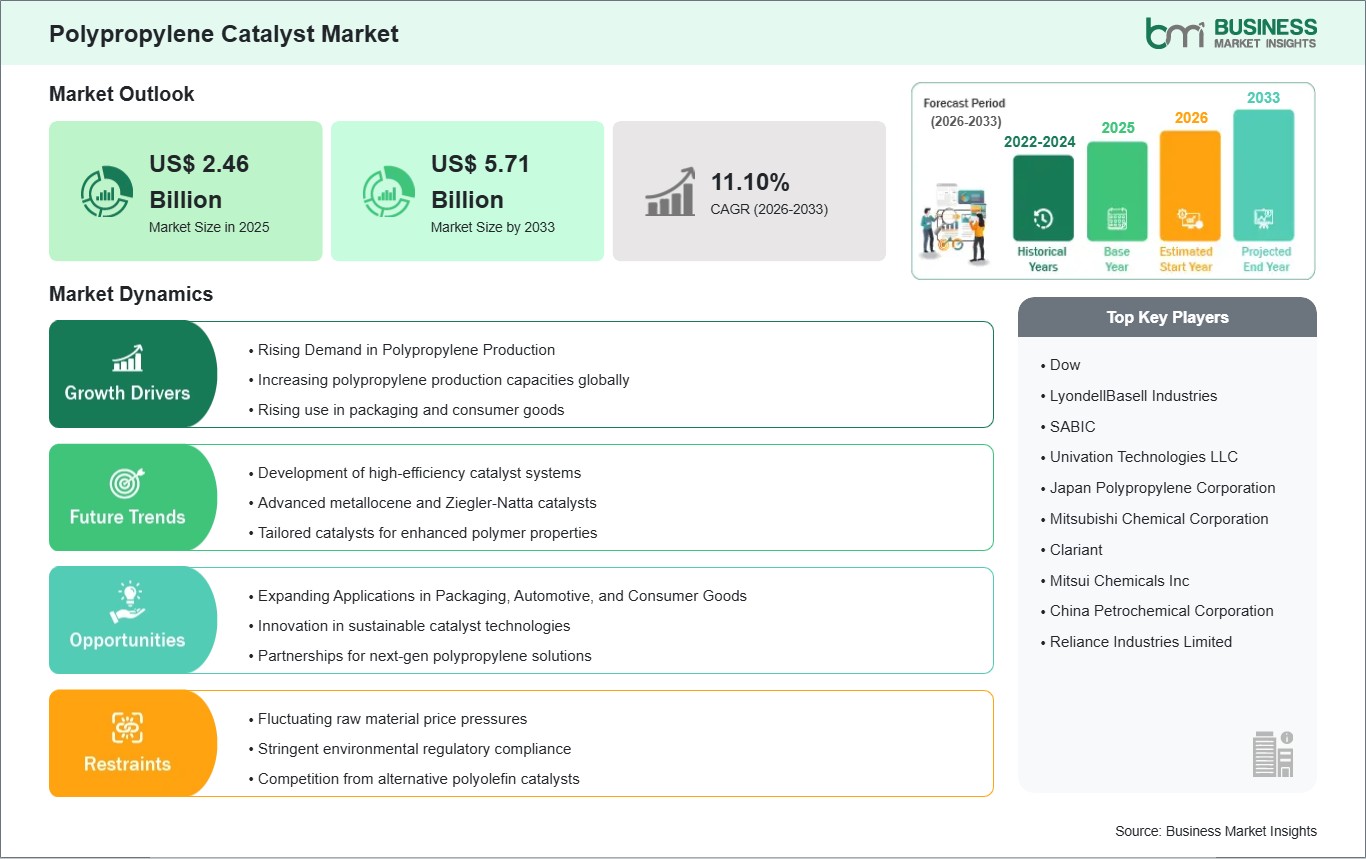
The Polypropylene Catalyst Market size is expected to reach US$ 5.71 billion by 2033 from US$ 2.46 billion in 2025. The market is estimated to record a CAGR of 11.10% from 2026 to 2033.
The polypropylene catalyst market is witnessing substantial growth, driven by the increasing global demand for polypropylene (PP) across industries such as packaging, automotive, construction, and consumer goods. Catalysts, including Ziegler-Natta, metallocene, and chromium-based systems, are critical for controlling polymerization, molecular weight distribution, isotacticity, and mechanical properties of polypropylene, thereby ensuring high-quality end products with desired performance characteristics.
The surge in lightweight automotive components, flexible and rigid packaging, and demand for durable industrial materials is fueling the adoption of advanced catalyst technologies. Technological innovations in catalyst design, such as single-site catalysts and high-activity formulations, allow manufacturers to improve polymer yield, process efficiency, and material uniformity while reducing energy consumption and production costs.
The market is highly competitive, with global chemical players investing in research and development to produce catalysts that meet stringent regulatory standards, environmental compliance, and sustainability goals. Challenges include the high cost of advanced catalysts, sensitivity to impurities, and the need for precise process control. Overall, the polypropylene catalyst market reflects a synergy of technological innovation, industrial growth, and the rising demand for high-performance polypropylene applications across multiple sectors.

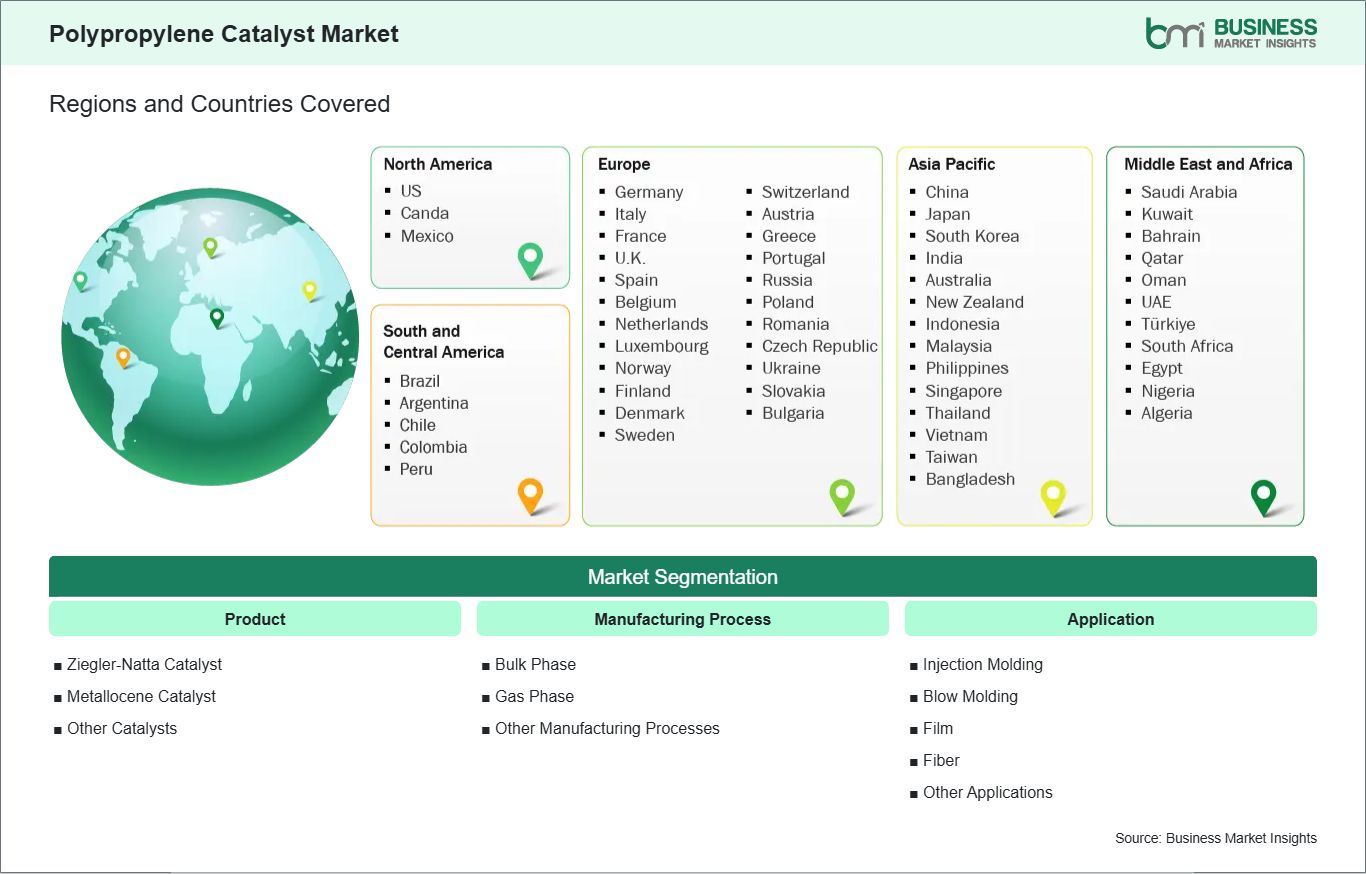
Key segments that contributed to the derivation of the polypropylene catalyst market analysis are product, manufacturing process, and application.
The market for the catalyst in the production of polypropylene is showing rapid growth due to the increasing demand for the product in various industries across the world. Polypropylene is one of the most widely used thermoplastics in the world, which is utilized in various applications including packaging, automobiles, textiles, etc. Catalysts are the most significant factors in the polymerization process, as the catalysts determine the structure, molecular weight, and isotacticity of the polymer, which further affects the mechanical properties, transparency, etc., of the resultant product. With the growth in industrialization, urbanization, and the use of various consumer goods, manufacturers are showing interest in using efficient catalysts in the production process to obtain high-quality polypropylene.
Along with the conventional polypropylene product, catalysts are also required for the production of various specialty grades of the product, which include random copolymers, impact copolymers, high-crystallinity grades, etc. The catalysts required for the production process are efficient enough to control the quality of the product as per the changing market requirements. The versatility in the production process is one of the factors driving the market for the catalyst in the production of the product.
Sustainability considerations are further fueling market growth. High-efficiency catalysts reduce monomer wastage and energy consumption during polymerization, supporting environmentally friendly production practices. Combined with innovations in catalyst design for improved selectivity and faster reaction rates, polypropylene catalysts are emerging as a crucial component in modern polymer manufacturing. The ability to enhance production efficiency, material performance, and sustainability positions this market for continued growth worldwide.
Polypropylene catalysts are increasingly adopted in packaging applications due to their ability to produce polymers with high clarity, stiffness, and barrier properties. These polymers are widely used in flexible films, rigid containers, caps, and closures for food, beverages, and consumer products. Catalysts ensure uniform polymerization and consistent quality, which is critical for meeting global regulatory standards and consumer expectations. Rising demand for lightweight, durable, and recyclable packaging materials is driving the consumption of advanced polypropylene catalysts.
In the automotive sector, polypropylene is used in interior panels, bumpers, battery casings, and under-the-hood components. Catalysts enable the production of high-impact and heat-resistant polypropylene grades suitable for these demanding applications. The growing automotive industry, coupled with increasing emphasis on lightweight materials to improve fuel efficiency, is boosting catalyst adoption. Similarly, in consumer goods, polypropylene is used in household appliances, storage containers, and textiles. Catalysts facilitate the production of polymers with desired flexibility, gloss, and durability, meeting the high-quality standards of modern products.
Technological advancements in catalyst formulations are further expanding market potential. Innovations include metallocene catalysts for precise control over polymer architecture, dual-site catalysts for enhanced performance, and environmentally friendly variants for sustainable production. As industries worldwide continue to demand high-performance polypropylene with consistent quality, polypropylene catalysts are positioned as an essential enabler of efficiency, sustainability, and versatility across packaging, automotive, and consumer applications.

The polypropylene catalyst market demonstrates steady growth, with size and share analysis highlighting evolving trends and competitive dynamics among key players. The report examines subsegments categorized within product, manufacturing process, and application, offering insights into their contribution to overall market performance.
By Product, the Ziegler‑Natta catalyst subsegment dominated the market in 2025, driven by its widespread adoption for producing isotactic polypropylene with high crystallinity and cost‑effective production performance.
Based on Manufacturing Process, the gas phase subsegment dominated the market in 2025, supported by its ability to consistently deliver uniform particle size and narrow molecular weight distribution in polypropylene production.
On the Basis of Application, the injection molding subsegment dominated the market in 2025, owing to extensive use of catalyst‑derived polypropylene resins in automotive components, consumer goods, and packaging applications.
| Report Attribute | Details |
|---|---|
| Market size in 2025 | US$ 2.46 Billion |
| Market Size by 2033 | US$ 5.71 Billion |
| Global CAGR (2026 - 2033) | 11.10% |
| Historical Data | 2022-2024 |
| Forecast period | 2026-2033 |
| Segments Covered | By Product
|
|
Regions and Countries Covered
| |
| North America | US, Canada, Mexico |
| Europe | Belgium, Austria, Finland, Denmark, Greece, Poland, Romania, Russia, Ukraine, Czech Republic, Slovakia, Bulgaria, Italy, Luxembourg, Germany, Switzerland, France, Netherlands, Norway, Portugal, Spain, Sweden, United Kingdom |
| Asia-Pacific | Australia, China, India, Japan, South Korea, Indonesia, Malaysia, Philippines, Singapore, Thailand, Vietnam, Bangladesh, New Zealand, Taiwan |
| South and Central America | Brazil, Argentina, Peru, Chile, Colombia |
| Middle East and Africa | Bahrain, Kuwait, Oman, Qatar, Saudi Arabia, United Arab Emirates, Turkiye, South Africa, Egypt, Algeria, Nigeria |
| Market leaders and key company profiles |
|
The "Polypropylene Catalyst Market Size and Forecast (2022 - 2033)" report provides a detailed analysis of the market covering below areas:
The geographical scope of the Polypropylene Catalyst Market report is divided into North America, Asia Pacific, Europe, Middle East & Africa, and South & Central America. North America held the largest share in 2025.
The polypropylene catalyst market exhibits strong regional variation, with North America dominating the market due to its mature polymer production infrastructure, high adoption of advanced catalyst technologies, and stringent quality standards in the United States and Canada.
In Asia Pacific, rapid industrialization, increasing polypropylene production capacity, and growing demand from packaging, automotive, and construction sectors in China, India, Japan, and South Korea are driving significant growth, supported by cost-effective local manufacturing and large-scale polymer consumption.
Europe represents a mature market, with Germany, France, and Italy leading adoption due to sustainability mandates, stringent environmental regulations, and demand for high-performance polymers in automotive, industrial, and consumer applications.
The Middle East & Africa region is gradually increasing adoption due to expanding chemical and polymer production capacities, infrastructure development, and industrial projects, with reliance on imports and partnerships to access advanced catalyst systems.
South & Central America shows steady growth, led by Brazil, Mexico, and neighboring countries, driven by packaging, automotive, and construction applications, although adoption is influenced by price sensitivity and limited local production capacities. Collectively, regional dynamics highlight the impact of industrial maturity, technological readiness, and application-specific requirements on the global polypropylene catalyst market.

The Polypropylene Catalyst Market is evaluated by gathering qualitative and quantitative data post primary and secondary research, which includes important corporate publications, association data, and databases. A few of the key developments in the polypropylene catalyst market are:
The Polypropylene Catalyst Market is valued at US$ 2.46 Billion in 2025, it is projected to reach US$ 5.71 Billion by 2033.
As per our report Polypropylene Catalyst Market, the market size is valued at US$ 2.46 Billion in 2025, projecting it to reach US$ 5.71 Billion by 2033. This translates to a CAGR of approximately 11.10% during the forecast period.
The Polypropylene Catalyst Market report typically cover these key segments-
The historic period, base year, and forecast period can vary slightly depending on the specific market research report. However, for the Polypropylene Catalyst Market report:
The Polypropylene Catalyst Market is populated by several key players, each contributing to its growth and innovation. Some of the major players include:
The Polypropylene Catalyst Market report is valuable for diverse stakeholders, including:
Essentially, anyone involved in or considering involvement in the Polypropylene Catalyst Market value chain can benefit from the information contained in a comprehensive market report.
Please tell us your area of interest
(Market Segments/ Regions and Countries/ Companies)