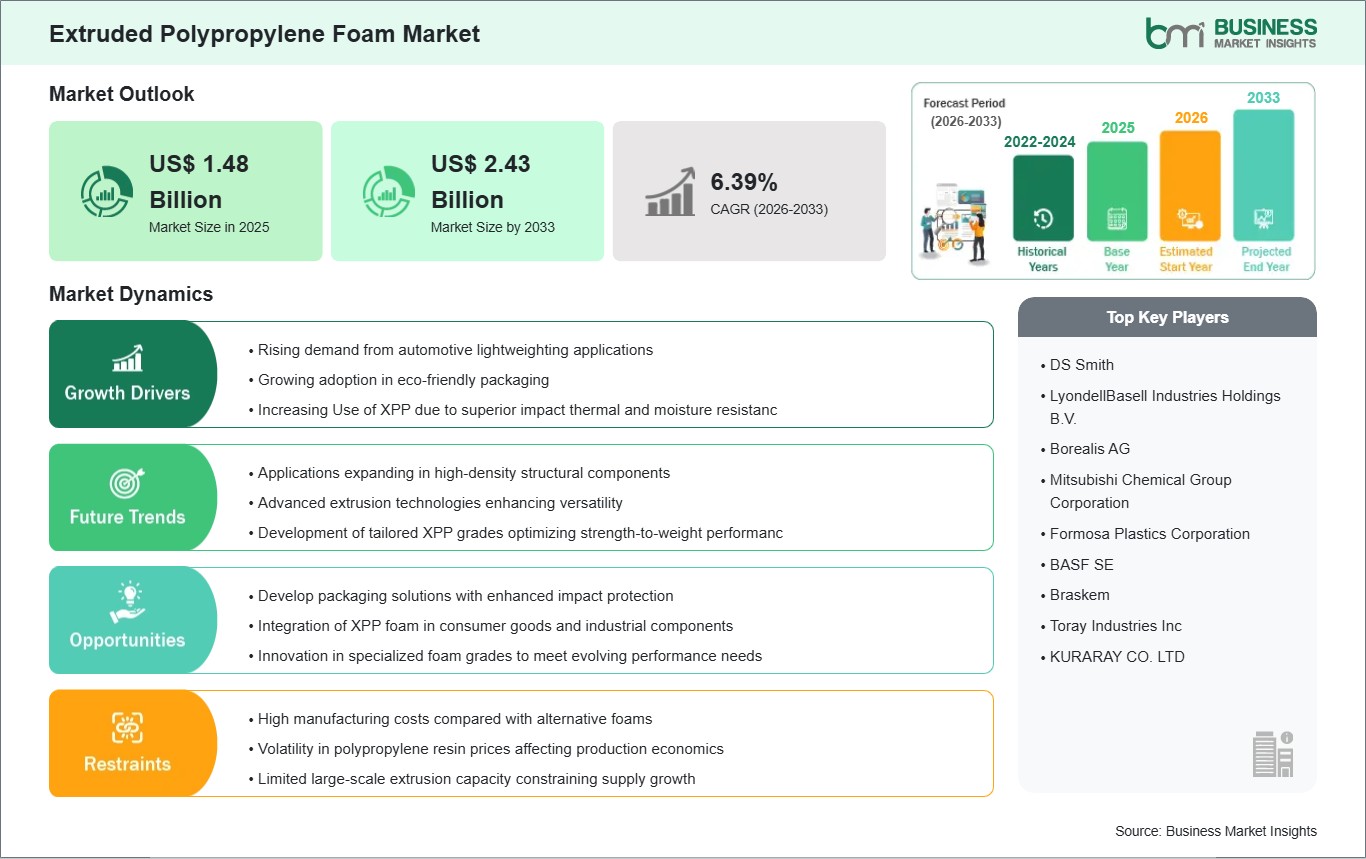
The Extruded Polypropylene Foam Market size is expected to reach US$ 2.43 Billion by 2033 from US$ 1.48 Billion in 2025. The market is estimated to record a CAGR of 6.39% from 2026 to 2033.
Extruded polypropylene (EPP) foam has gained international acceptance as a lightweight, tough, and incredibly versatile material, which provides a combination of strength and energy absorption. Unlike other conventional foam products, EPP does not lose its structure even after being compressed. This has led to its increased use in applications that require durability and resistance to compression. The lightweight, tough, and heat-resistant properties of EPP have led to its increased use in the automotive, packaging, consumer electronics, and industrial industries. In the automotive industry, it has been widely used in the manufacture of automotive parts, bumpers, and protective gear, which provide safety without compromising on the weight of the vehicles. Protective packaging has also been a driving force in the use of EPP, which provides a protective cover against shocks. Despite these advantages, there are some challenges that the market is facing. For instance, to make extruded foam, specialized equipment is required to control the density of the extruded foam. Furthermore, although EPP is recyclable, there is still limited awareness of how to recycle it. However, through constant innovations in the field of EPP, it is still considered one of the preferred materials for use in applications that require strength and durability.

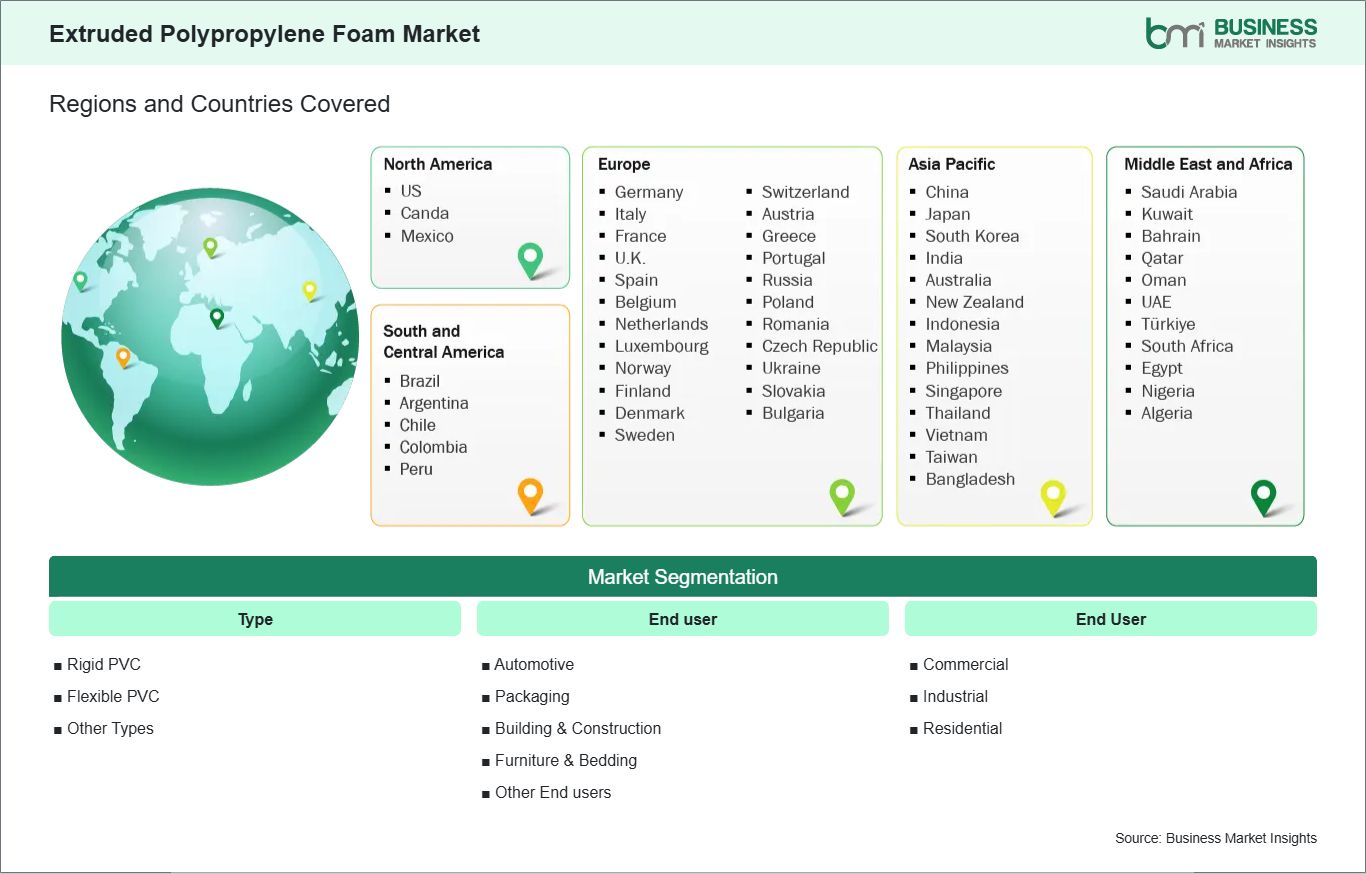
Key segments that contributed to the derivation of the extruded polypropylene foam market analysis are type and end user.
The demand for extruded polypropylene foam has been growing steadily due to its lightweight yet durable properties, which make it ideal for automotive applications. Vehicle manufacturers are increasingly looking for materials that reduce overall weight to improve fuel efficiency and lower emissions, without compromising safety or performance. EPP foam is particularly valued for energy absorption in bumpers, door panels, headrests, and seating components, where its combination of light weight, resilience, and impact resistance enhances both efficiency and occupant protection.
Beyond weight reduction, EPP foam contributes to improved design flexibility in automotive interiors and components. Its moldability allows complex shapes and integration with other materials, supporting modern vehicle designs that emphasize comfort, safety, and style. EPP also demonstrates excellent durability under repeated stress, maintaining shape and cushioning performance over the lifetime of the vehicle. These characteristics make it a material of choice for manufacturers seeking to meet evolving standards for efficiency, safety, and passenger experience.
Sustainability considerations further reinforce the adoption of EPP foam in automotive applications. The material is recyclable and contributes to lower vehicle energy consumption due to its lightweight nature. By combining environmental benefits with performance and durability, EPP foam is increasingly integrated into both structural and interior automotive components, supporting the ongoing shift toward lighter, more energy-efficient vehicles.
EPP Foam is being recognized in the packaging sector for offering impact protection that is unmatched without compromising the lightweight and affordable nature of the packaging. Products that are fragile, such as electronic items, medical equipment, and other delicate machines, require packaging that can withstand shocks without causing harm to the items being transported. EPP Foam is reliable for protecting items from damage since it is shock-absorbing and reverts to its original shape after compression.
EPP Foam is flexible to enable the manufacturing of customized packaging that suits the unique needs of certain products. Complex shapes and designs can be created to protect items without compromising their integrity. Besides offering impact protection, EPP Foam is also capable of offering insulation to the items being transported.
Increasing demand for sustainable and recyclable packaging solutions further drives the adoption of EPP foam. Unlike some traditional foams, EPP can be reused and recycled, supporting eco-conscious practices while maintaining protective performance. This combination of durability, design flexibility, and environmental responsibility makes EPP foam an attractive option for industries seeking packaging solutions that are both reliable and forward-looking, helping companies meet the growing expectations for safe and sustainable product delivery.

The extruded polypropylene foam market is experiencing steady growth, with market size and share analysis reflecting evolving treatment preferences and competitive dynamics among key players. The report evaluates important subsegments categorized within type and end user, highlighting their respective contributions to overall market performance.
By type, the Rigid PVC subsegment dominated the Extruded Polypropylene Foam market in 2025. Rigid PVC offers high strength, dimensional stability, and excellent insulation properties, making it highly suitable for a wide range of industrial and structural applications, which drives its widespread adoption.
Based on end user, the Automotive subsegment dominated the Extruded Polypropylene Foam market in 2025. Automotive applications demand lightweight, impact-resistant, and durable materials for components and interiors, reinforcing the dominance of this segment in the market.
| Report Attribute | Details |
|---|---|
| Market size in 2025 | US$ 1.48 Billion |
| Market Size by 2033 | US$ 2.43 Billion |
| Global CAGR (2026 - 2033) | 6.39% |
| Historical Data | 2022-2024 |
| Forecast period | 2026-2033 |
| Segments Covered | By Type
|
|
Regions and Countries Covered
| |
| North America | US, Canada, Mexico |
| Europe | Belgium, Austria, Finland, Denmark, Greece, Poland, Romania, Russia, Ukraine, Czech Republic, Slovakia, Bulgaria, Italy, Luxembourg, Germany, Switzerland, France, Netherlands, Norway, Portugal, Spain, Sweden, United Kingdom |
| Asia-Pacific | Australia, China, India, Japan, South Korea, Indonesia, Malaysia, Philippines, Singapore, Thailand, Vietnam, Bangladesh, New Zealand, Taiwan |
| South and Central America | Brazil, Argentina, Peru, Chile, Colombia |
| Middle East and Africa | Bahrain, Kuwait, Oman, Qatar, Saudi Arabia, United Arab Emirates, Turkiye, South Africa, Egypt, Algeria, Nigeria |
| Market leaders and key company profiles |
|
The "Extruded Polypropylene Foam Market Size and Forecast (2022 - 2033)" report provides a detailed analysis of the market covering below areas:
The geographical scope of the Extruded Polypropylene Foam market report is divided into five regions: North America, Asia Pacific, Europe, Middle East & Africa, and South & Central America. The Extruded Polypropylene Foam market in North America is expected to grow during the forecast period.
North America dominates the global extruded polypropylene foam market, mainly due to strong demand from the automotive, consumer goods, and protective packaging industries. The region`s automotive industry has been one of the significant adopters of EPP. EPP-based products are used for impact-absorbing parts, headrests, seating cores, and bumper cores. This is mainly because EPP retains shape even after being subjected to stress. This property of EPP-based products helps to meet increasing safety requirements while at the same time promoting lightweight designs to achieve greater fuel efficiency.
The protective packaging industry in the region is another significant area where EPP-based products are used. This industry benefits from the shock-absorbing property of EPP. Furthermore, EPP-based products are used for protecting electronic and other industrial goods. This again proves the shock-resistant property of EPP. The challenges facing the region include high initial investment costs in terms of machinery, as well as the need to have a skilled workforce to ensure product quality. Environmental issues are also driving innovation in the region, with North American manufacturers investing in recyclable EPP formulations to support product take-back schemes.

The extruded polypropylene foam market is evaluated by gathering qualitative and quantitative data post primary and secondary research, which includes important corporate publications, association data, and databases. A few of the key developments in the extruded polypropylene foam market are:
The Extruded Polypropylene Foam Market is valued at US$ 1.48 Billion in 2025, it is projected to reach US$ 2.43 Billion by 2033.
As per our report Extruded Polypropylene Foam Market, the market size is valued at US$ 1.48 Billion in 2025, projecting it to reach US$ 2.43 Billion by 2033. This translates to a CAGR of approximately 6.39% during the forecast period.
The Extruded Polypropylene Foam Market report typically cover these key segments-
The historic period, base year, and forecast period can vary slightly depending on the specific market research report. However, for the Extruded Polypropylene Foam Market report:
The Extruded Polypropylene Foam Market is populated by several key players, each contributing to its growth and innovation. Some of the major players include:
The Extruded Polypropylene Foam Market report is valuable for diverse stakeholders, including:
Essentially, anyone involved in or considering involvement in the Extruded Polypropylene Foam Market value chain can benefit from the information contained in a comprehensive market report.
Please tell us your area of interest
(Market Segments/ Regions and Countries/ Companies)