Market Summary
Executive Summary and Global Market Analysis
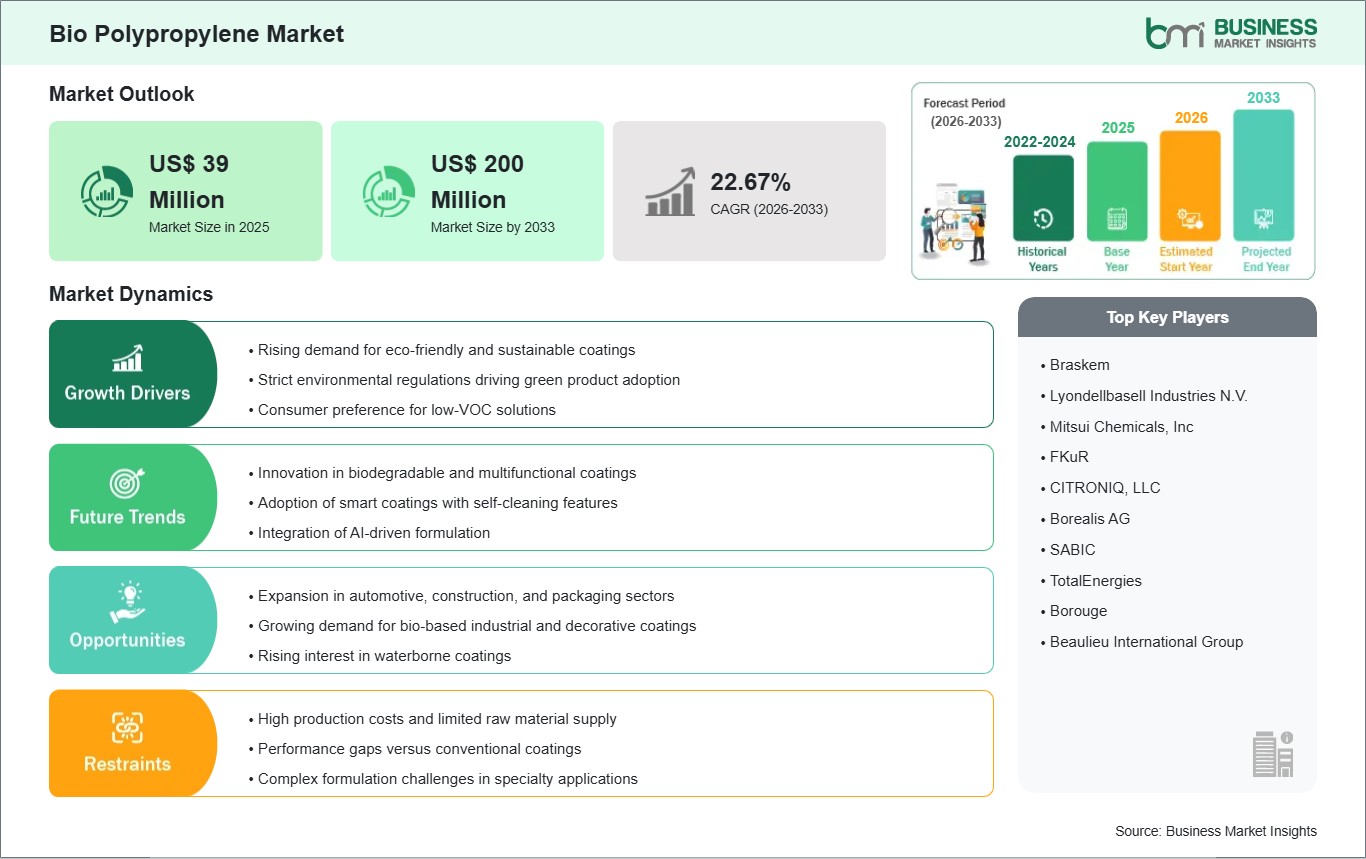
Bio Polypropylene is a sustainable, thermoplastic polymer derived from renewable resources such as corn, sugarcane, vegetable oils, and cellulosic biomass. As a drop-in replacement for conventional petroleum-based polypropylene, it offers identical mechanical properties, including high chemical resistance, stiffness, and durability, while significantly reducing lifecycle carbon emissions. Bio Polypropylene is essential for the automotive, industrial, and packaging sectors, where it supports global circular economy goals and corporate net zero commitments. Key advantages include its lightweight nature, which is critical for fuel efficiency, and its complete compatibility with existing plastic recycling streams. Increasing environmental regulations, such as the EU's Single-Use Plastics Directive and global carbon taxes, are fueling the market. Additionally, innovations in catalyst technology and bio-refining are enhancing production efficiency and performance.
However, several challenges can restrain market growth, such as higher production costs compared to virgin plastics and the volatility of agricultural feedstock prices. The industry also faces competition from other biopolymers like PLA and bio-PET, which are often available at lower price points. Despite these hurdles, the market holds significant opportunities driven by the rapid transition to electric vehicles (EVs), the demand for sustainable industrial components, and the expansion of eco-friendly flexible packaging. Investment in waste-to-polymer technologies and non-food biomass is expected to open new avenues for long-term market expansion.
Segment Analysis
Bio Polypropylene Market Segmentation
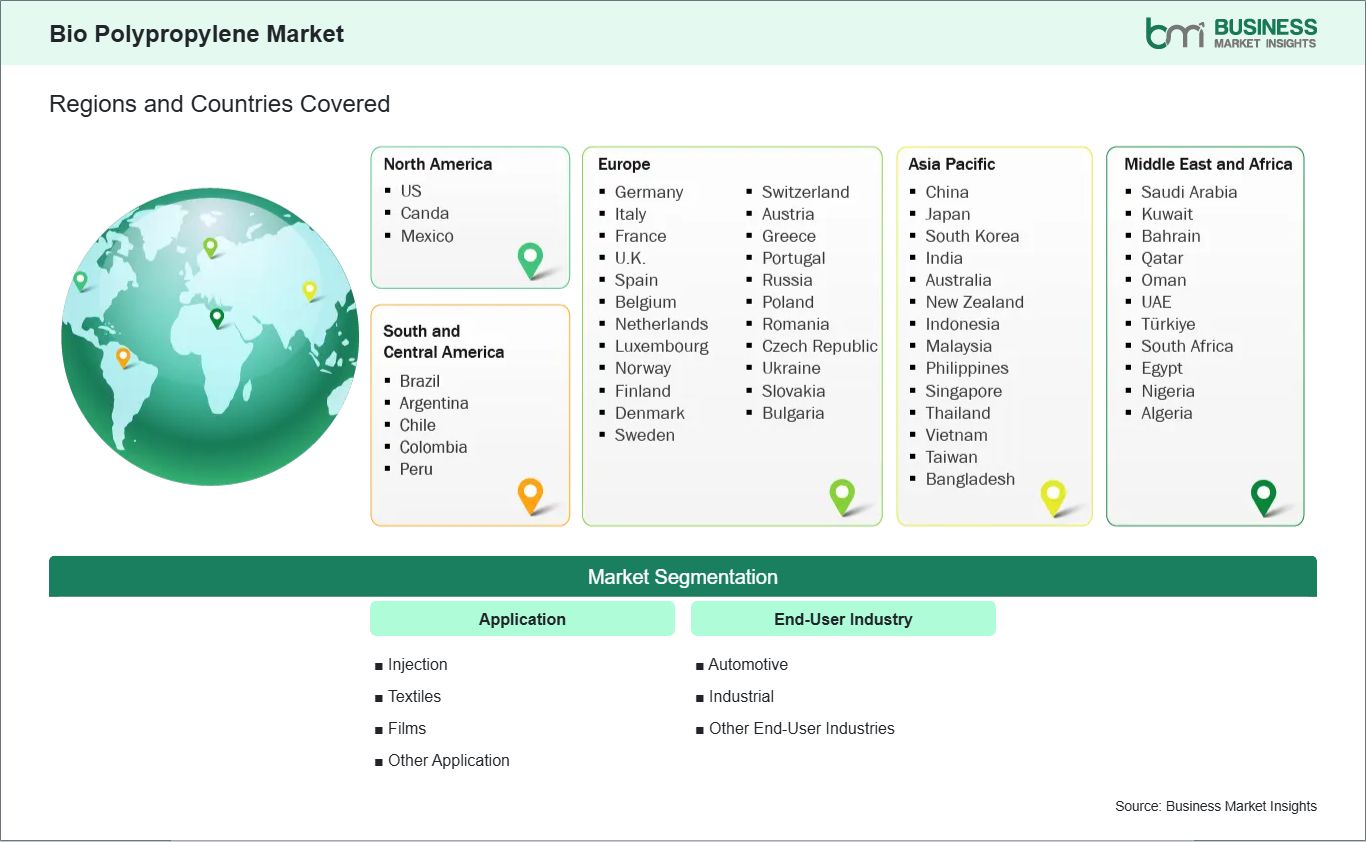
Key segments that contributed to the derivation of the Bio Polypropylene market analysis are the application and end-user industry.
- By Application, the market is segmented into Injection, Textiles, Films, and Others.
- By End-User Industry, the market is categorized into Automotive, Industrial, and Others.
Market Forces
Bio Polypropylene Market Drivers and Opportunities
Global Shift Toward Low-Carbon and Sustainable Industrial Materials
The increasing global demand for sustainable materials has emerged as a pivotal factor driving the bio polypropylene market. With the rapid digitalization of industrial supply chains and growing consumer preference for eco-friendly products, manufacturers are prioritizing low-carbon resins to comply with emerging ESG (Environmental, Social, and Governance) standards.
As the need for sustainable industrial components and protective packaging continues to increase to meet corporate sustainability mandates worldwide. Major industrial players are significantly influencing logistics and manufacturing models by demanding bio-based polymers that require no mold redesign. Unlike traditional resins, bio-PP enables the production of high-performance, durable goods with a drastically reduced carbon footprint, which is essential for sectors transitioning toward a circular economy model.
Automotive Lightweighting and Manufacturing Growth Opportunities
As international trade agreements expand and global supply chains become increasingly interconnected, businesses are more reliant than ever on fast, efficient, and reliable sustainable materials to move goods across borders.
In recent years, trade liberalization policies and the establishment of free trade zones have opened new markets for bio-based resins. High-value automotive parts, such as dashboards, door panels, and battery housings, are increasingly manufactured from bio-PP due to the mass reduction and impact resistance the material offers. These components are frequently sourced and manufactured in different regions, underscoring the need for a dependable global bio-polymer supply network. Moreover, multinational companies continue to diversify their sourcing strategies to remain resilient in the face of geopolitical shifts. This shift often involves the need for bio-based solutions that can support complex, time-critical supply chains spanning multiple continents to meet the growing demand for fuel-efficient and electric vehicles.
Size and Share Analysis
Bio Polypropylene Market Size and Share Analysis
The bio polypropylene market demonstrates steady growth, with size and share analysis revealing evolving trends and competitive positioning among key players. The report further examines subsegments categorized within application and end-user industry, offering insights into their contribution to overall market performance.
For instance, the Injection sub-segment is the dominant application. This is widely utilized due to its suitability for complex, thin-wall parts in the automotive and electronics sectors. The Automotive sub-segment led the end-user, driven by the need for lightweight materials that improve battery range in EVs. The Industrial sub- segment serving manufacturers who require durable technical components and sustainable industrial packaging.
Report Coverage
Bio Polypropylene Market Report Coverage and Deliverables
The "Bio Polypropylene Market Size and Forecast (2022 - 2033)" report provides a detailed analysis of the market covering below areas:
- Bio Polypropylene market size and forecast at global, regional, and country levels for all the key market segments covered under the scope
- Bio Polypropylene market trends, as well as market dynamics such as drivers, restraints, and key opportunities
- Bio Polypropylene market analysis covering key market trends, global and regional framework, major players, regulations, and recent developments
- Industry landscape and competition analysis covering market concentration, heat map analysis, prominent players, and recent developments for the Bio Polypropylene market
- Detailed company profiles, including SWOT analysis
Geographic Insights
Bio Polypropylene Market Geographic Insights
The geographical scope of the Bio Polypropylene market report is divided into five regions: North America, Asia Pacific, Europe, Middle East &Africa, and South &Central America.
Europe currently holds the largest revenue share, driven by the European Green Deal and stringent circular economy targets. The Asia-Pacific region is projected to be the fastest-growing market, and it will be primarily driven by the growing industries of China, India, and Japan. Such growth will be encouraged due to rising industrial production and the development of bio-refineries.
The area is experiencing the adoption of new technology, such as AI-based freight tracking and digital freight booking for the chemical industry. Bio-PP capacity expansion, together with fleet modernization by carriers and chemical companies in the region, is bringing about improvements in efficiencies. Additionally, the rise of regional trade agreements and strong infrastructure development across major logistics corridors further solidifies the region's dominant market position.
Industry Activity
Recent Developments
The Bio Polypropylene market is evaluated by gathering qualitative and quantitative data post primary and secondary research, which includes important corporate publications, association data, and databases. A few of the key developments in the bio polypropylene market are:
- In October 2025, Braskem showcased a new generation of bio-based and circular product solutions at K 2025, aimed at accelerating the transformation of the plastics industry. Under its sustainable portfolio, Braskem is revealing product launches and partnerships that bring sustainability and innovation to life across packaging, healthcare, hygiene, and consumer goods.
- In August 2025, ABB announced a collaboration with Citroniq to provide advanced automation, electrification, and digitalization solutions for a 100 percent biogenic polypropylene facility in Nebraska, US, aiming to be the world's first full commercial-scale facility of its kind. Polypropylene is used for many everyday items society relies on, including food and beverage packaging, automotive parts, consumer goods, and medical devices.
Trust & Transparency
Research Methodology
The market analysis combines proprietary research with secondary data from government agencies, company disclosures, regulatory filings, industry databases and expert interviews. Market estimates are validated through data triangulation, cross-market benchmarking and analyst
review.
View Full Research Methodology
Key Sources Referred:
International Energy Agency World Bank – Global Trade Indicators World Trade Organization (WTO) AFCOM Data Center Coalition Data Center Construction Alliance International Trade Administration (ITA) Company website Company annual reports Company investor presentations