Market Summary
Executive Summary and Global Market Analysis
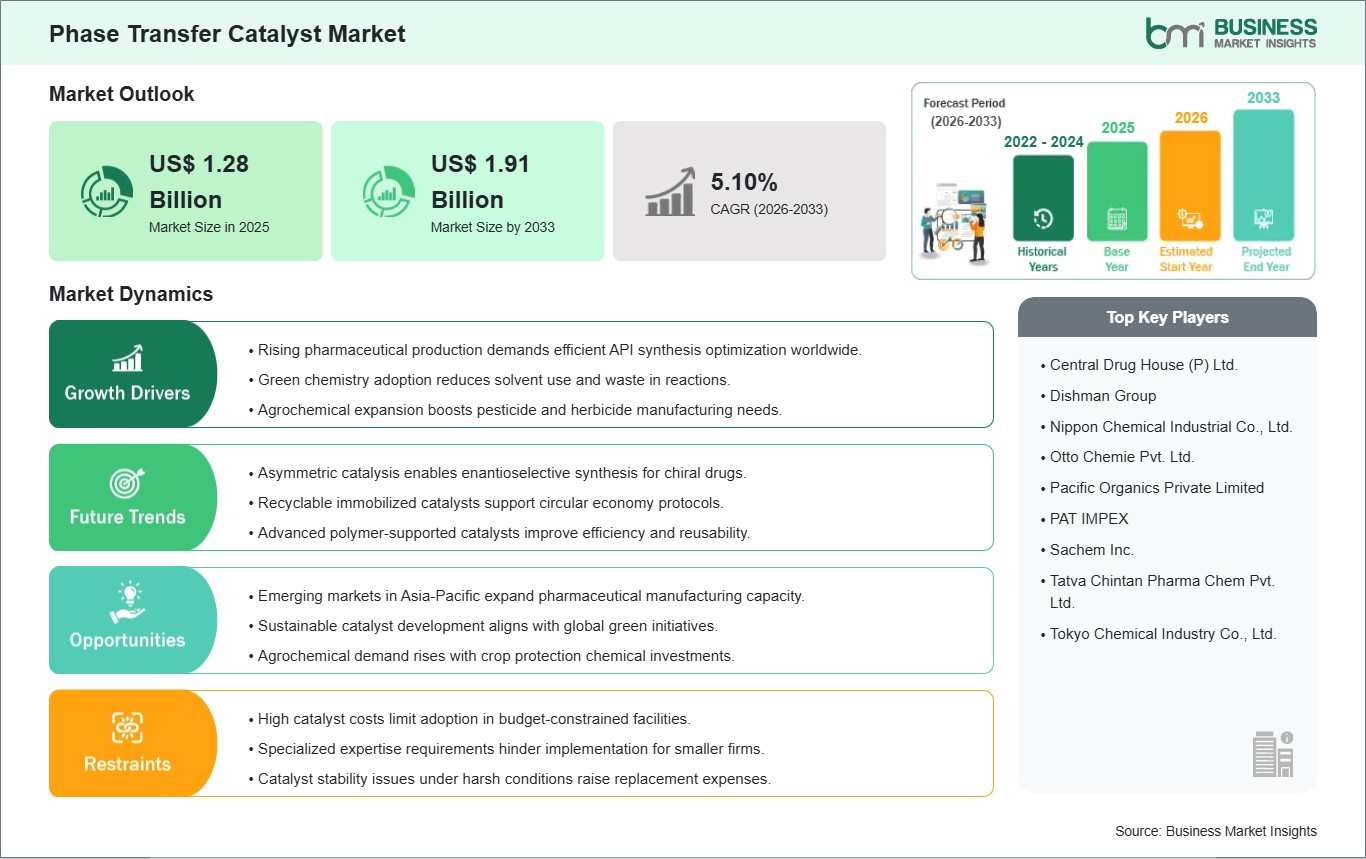
The phase transfer catalyst market is observed to be growing continuously, with the catalyst playing a vital role in improving the efficiency of the chemical reactions involved in the synthesis of chemicals, pharmaceuticals, and specialty materials. The catalyst helps in the transfer of the reacting compounds from one medium to another, thus improving the efficiency of the chemical reactions and the yield of the products. This has led to the wide acceptance of the catalyst in the manufacture of fine chemicals, agrochemicals, and polymer intermediates. One of the major trends observed in the market is the focus on the development of environmentally friendly and sustainable chemical processes. The catalyst helps in the reduction of the use of solvents and the conditions of the reactions, thus improving the scope of green chemistry. In this context, the use of low toxicity, biodegradable, and recyclable catalysts is becoming the focus of the major markets, including the pharmaceutical and agrochemical sectors. In addition, the use of multifunctional catalysts is also becoming prominent in the market, thus improving the efficiency of the chemical reactions. Technological innovation is shaping the market landscape. Quaternary ammonium salts, phosphonium salts, crown ethers, and polymer-supported PTCs are being optimized for reaction specificity, thermal stability, and reusability. Integration of PTCs in continuous-flow and process intensification systems further expands their industrial relevance by increasing throughput while minimizing environmental footprint. Competitive dynamics are characterized by global chemical companies and specialized catalyst producers investing in R&D and strategic partnerships with end-use industries. Customization of catalysts for specific processes, regulatory compliance, and technical support are key differentiators in a moderately consolidated market. Supply chain optimization, consistent quality, and cost-efficiency remain critical factors influencing adoption. The PTC market is defined by the convergence of process efficiency, environmental sustainability, and application versatility. Manufacturers that provide high-performance, environmentally compliant, and process-optimized PTC solutions are well-positioned to capture growth in fine chemicals, pharmaceuticals, agrochemicals, and specialty chemical sectors.
Segment Analysis
Phase Transfer Catalyst Market Segmentation
Key segments that contributed to the derivation of the phase‑transfer catalyst market analysis are catalyst type and end‑use.
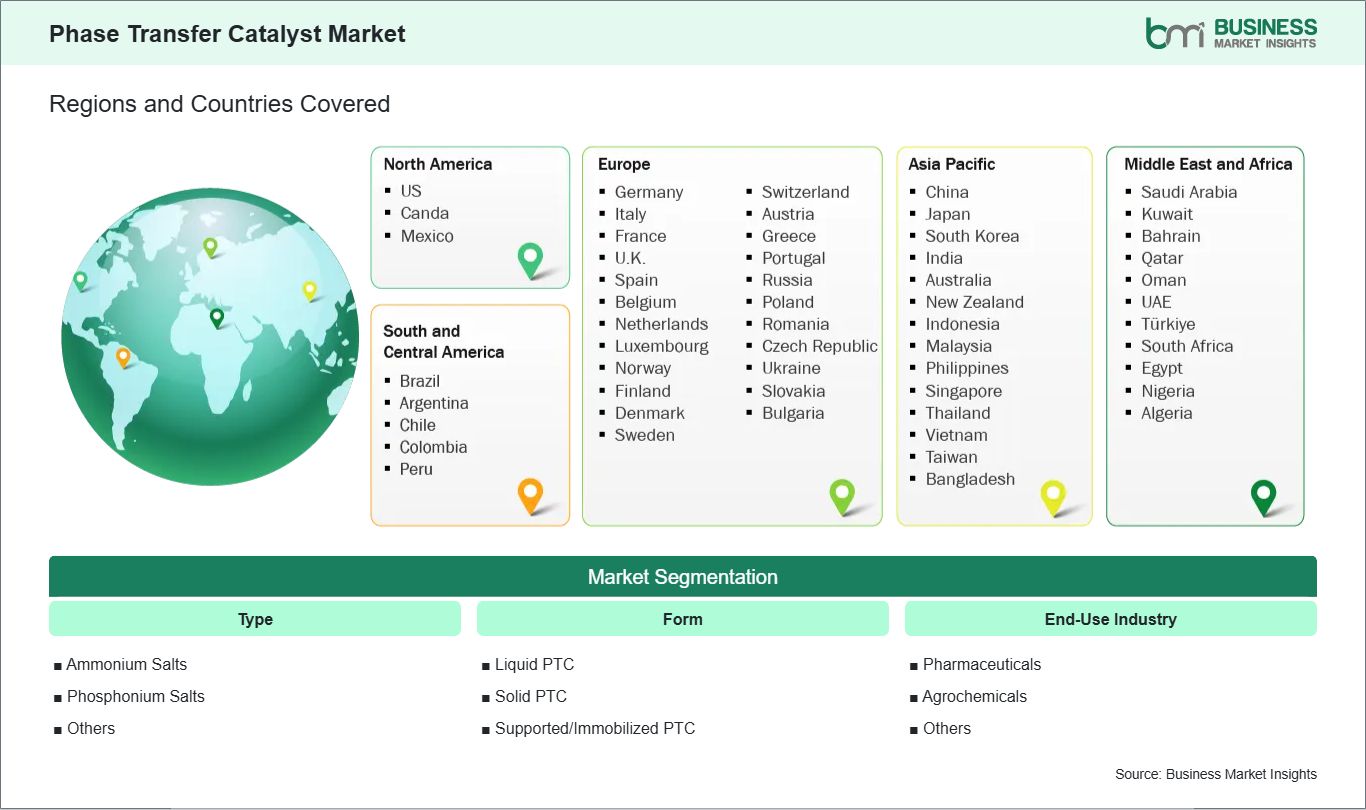
- By Catalyst Type, the phase‑transfer catalyst market is segmented into ammonium salts, potassium salts, and others. The ammonium salts segment dominated the market in 2025.
- Based on End‑Use, the phase‑transfer catalyst market is categorized into pharmaceuticals, agriculture, chemical, and others. The pharmaceuticals segment dominated the market in 2025.
Market Forces
Phase Transfer Catalyst Market Drivers and Opportunities
Rising demand for efficient chemical synthesis
The need for phase transfer catalysts has been growing as various industries are looking for efficient and cost-effective ways to carry out chemical reactions. Phase transfer catalysts are used to facilitate the transfer of chemicals between two immiscible liquids. This process helps to increase the rate of chemical reactions. Phase transfer catalysts are commonly used in the pharmaceutical, agrochemical, and specialty chemical industries. They are used to increase productivity and efficiency by minimizing energy consumption. Phase transfer catalysts help to simplify complex chemical reactions, allowing for faster production cycles.
Various manufacturers are using phase transfer catalysts to optimize chemical reactions and reduce the use of hazardous chemicals. The catalysts are used to carry out selective reactions, thereby maintaining the quality of the end products. Phase transfer catalysts are used to carry out various chemical reactions. They are used to make the manufacturing process more eco-friendly by minimizing the amount of waste generated.
In addition to that, innovation in terms of catalysts is also expanding the market potential. This is because modern catalysts are more efficient and can be reused. This has helped companies to be more efficient in their processes while still ensuring that they are safe and of high quality. In addition to that, chemical industries that require more efficient processes have seen phase transfer catalysts become more important in the global workflow.
Growth in eco-friendly and specialty catalyst solutions
The sustainability factor is another major driver for the phase transfer catalyst industry, with companies focusing on the development of eco-friendly and reusable catalysts. Such catalysts help to reduce the overall energy, waste, and solvent requirements, thereby promoting a more environmentally friendly approach to chemical reactions.
Specialty catalysts are also being developed to facilitate complex chemical reactions. Such catalysts are designed to provide high selectivity, increased activity, and stability to the catalyst, which can be utilized in a wide range of reaction conditions. Such advanced catalysts can provide better control over the reaction outcome, which is critical for the pharmaceutical and fine chemical industry.
Current efforts are being devoted to improving the efficiency of catalysts and broadening their scope. New developments are catalysts that can be easily recovered and reused, thus minimizing costs. With the increase of clean and efficient technologies used by industries, eco-friendly and specialty catalysts for phase transfer are projected to bring about a significant increase in the global catalysts market.
Size and Share Analysis
Phase Transfer Catalyst Market Size and Share Analysis
The phase‑transfer catalyst market demonstrates steady growth, with size and share analysis highlighting evolving trends and competitive dynamics among key players. The report examines subsegments categorized within catalyst type and end‑use, offering insights into their contribution to overall market performance.
By Catalyst Type, the ammonium salts subsegment dominated the market in 2025, driven by its broad applicability in chemical synthesis and pharmaceutical processes.
Based on End‑Use, the pharmaceuticals subsegment dominated the market in 2025, supported by growing demand for efficient synthesis catalysts in drug formulation and manufacturing.
Report Coverage
Phase Transfer Catalyst Market Report Coverage and Deliverables
The "Phase‑Transfer Catalyst Market Size and Forecast (2022 - 2033)" report provides a detailed analysis of the market covering below areas:
- Phase‑Transfer Catalyst Market size and forecast at global, regional, and country levels for all the key market segments covered under the scope
- Phase‑Transfer Catalyst Market trends, as well as drivers, restraints, and opportunities
- Phase‑Transfer Catalyst Market analysis covering key trends, global and regional framework, major players, regulations, and recent developments
- Industry landscape and competition analysis covering market concentration, heat map analysis, prominent players, and recent developments for the Phase‑Transfer Catalyst Market
- Detailed company profiles, including SWOT analysis
Geographic Insights
Phase Transfer Catalyst Market Geographic Insights
The geographical scope of the Phase‑Transfer Catalyst Market report is divided into North America, Asia Pacific, Europe, Middle East & Africa, and South & Central America. North America held the largest share in 2025.
Regional-level dynamics in the phase‑transfer catalyst market reveal distinct demand patterns shaped by chemical industry maturity, regulatory frameworks, and end-use sector growth. North America is the dominant market, driven by advanced chemical, pharmaceutical, and specialty material industries in the United States and Canada. Adoption of PTCs is supported by process optimization initiatives, stringent environmental regulations, and a strong focus on sustainable chemical manufacturing. High R&D investment and demand for high-value fine chemicals reinforce market leadership. Europe represents a mature and sustainability-driven market, with Germany, France, and Italy emphasizing eco-friendly catalysts and regulatory compliance. EU chemical regulations and green chemistry mandates accelerate the adoption of biodegradable and low-toxicity PTCs. Demand is particularly strong in pharmaceutical synthesis and specialty polymer manufacturing. Asia Pacific is experiencing rapid growth, led by China, India, and Japan, driven by expanding chemical manufacturing, pharmaceutical production, and polymer processing industries. Market expansion is facilitated by modernization of chemical plants, increased adoption of process intensification, and local production capabilities that support high-volume PTC usage while maintaining cost efficiency. Middle East & Africa is an emerging market, where investments in chemical and petrochemical industries drive demand for PTCs that enhance process efficiency and reduce operational costs. Adoption is concentrated in industrial hubs with growing manufacturing capabilities and expanding downstream chemical production. South & Central America shows steady growth, particularly in Brazil and Argentina, driven by the agrochemical, polymer, and specialty chemical sectors. Market adoption is influenced by cost sensitivity and evolving industrial standards, but rising demand for sustainable and process-efficient catalysts is gradually increasing PTC usage in the region.
Industry Activity
Recent Developments
The Phase‑Transfer Catalyst Market is evaluated by gathering qualitative and quantitative data post primary and secondary research, which includes important corporate publications, association data, and databases. A few of the key developments in the phase‑transfer catalyst market are:
- In June 2025, NAGASE & CO., LTD. announced that the acquisition of SACHEM’s high‑purity chemicals business for semiconductors in Asia was successfully completed, integrating five SACHEM subsidiaries into its operations, which supports expanded manufacturing and development capabilities for specialty chemicals and catalyst technologies across the region.
- In August 2023, SACHEM, Inc. announced that it unveiled its CleanFlex custom blending facility at its Cleburne, Texas plant, offering high‑volume, high‑purity blending and clean‑room capabilities to support expanded manufacturing and precision chemical services.
Trust & Transparency
Research Methodology
The market analysis combines proprietary research with secondary data from government agencies, company disclosures, regulatory filings, industry databases and expert interviews. Market estimates are validated through data triangulation, cross-market benchmarking and analyst
review.
View Full Research Methodology
Key Sources Referred:
International Organization for Standardization (ISO)American Society for Testing and Materials (ASTM International)Bureau of Indian Standards (BIS)Environmental Protection Agency (EPA), USAEuropean Chemicals Agency (ECHA)Central Pollution Control Board (CPCB), IndiaMinistry of Chemicals and Fertilizers, IndiaAmerican Chemistry Council (ACC)Indian Chemical Council (ICC)European Chemical Industry Council (Cefic)Specialty Chemical Association of India (SCAI)Company WebsitesCompany Annual ReportsCompany Investor Presentations