Market Summary
Executive Summary and Global Market Analysis
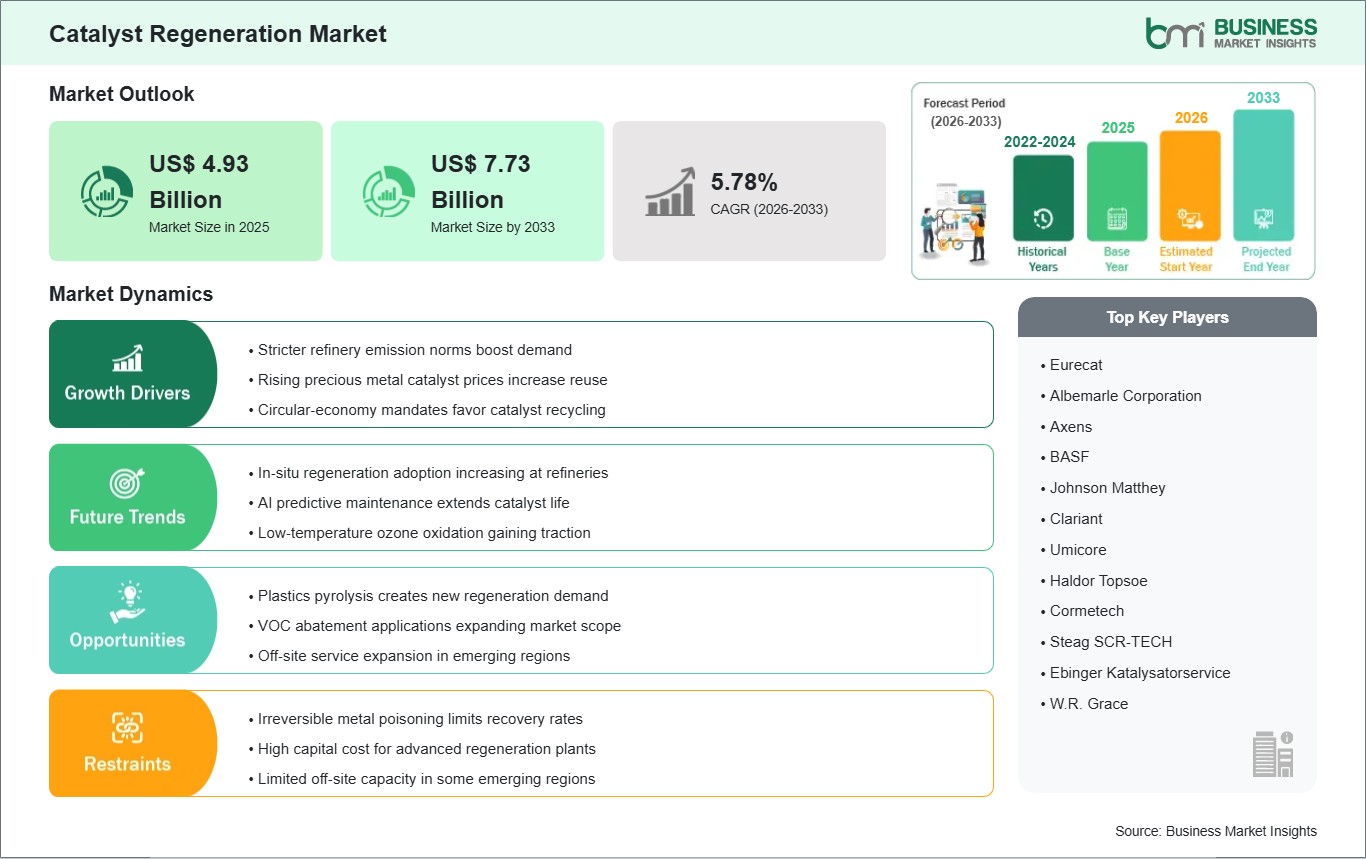
Catalyst regeneration is the process of restoring catalyst activity by removing contaminants and carbon deposits. These procedures extend the lifespan of catalysts, improve efficiency, and lower costs in refining, petrochemical, and industrial processing. Regeneration technologies help maintain production performance while reducing the need for replacements and cutting down on waste in processing facilities. There is growing pressure in the industry to optimize throughput and lower maintenance costs, leading to an increased reliance on regeneration services. Refinery operators are now focusing more on keeping processes running smoothly and making the best use of catalysts to stay profitable despite changes in feedstock quality.
Environmental regulations are also pushing facilities to use regeneration methods that minimize waste and promote sustainable operations. The market shows different demand patterns for various regeneration methods and end uses. Ex-situ regeneration is still the go-to choice for facilities that need extensive catalyst treatment in controlled environments. In-situ methods are becoming more popular where minimizing shutdowns and ensuring continuous operation is crucial. Refineries and petrochemical complexes are the main users due to their high catalyst consumption and ongoing regeneration needs.
Technological advancements are changing regeneration processes through better thermal treatment systems, improved contamination removal, and enhanced process monitoring. Service providers are using digital diagnostics and optimization tools to boost catalyst recovery rates and predict operations more accurately. More precise regeneration is gaining acceptance among facilities that deal with complex industrial processes and diverse feedstocks. Competitive dynamics in the industry are influenced by technical skills, efficiency in turnaround times, and long-term service partnerships. Market players are working on expanding service capabilities, ensuring consistent regeneration, and building stronger regional networks. Investments in advanced regeneration infrastructure and specialized technologies are helping companies stand out in the industrial market.
Segment Analysis
Catalyst Regeneration Market Segmentation
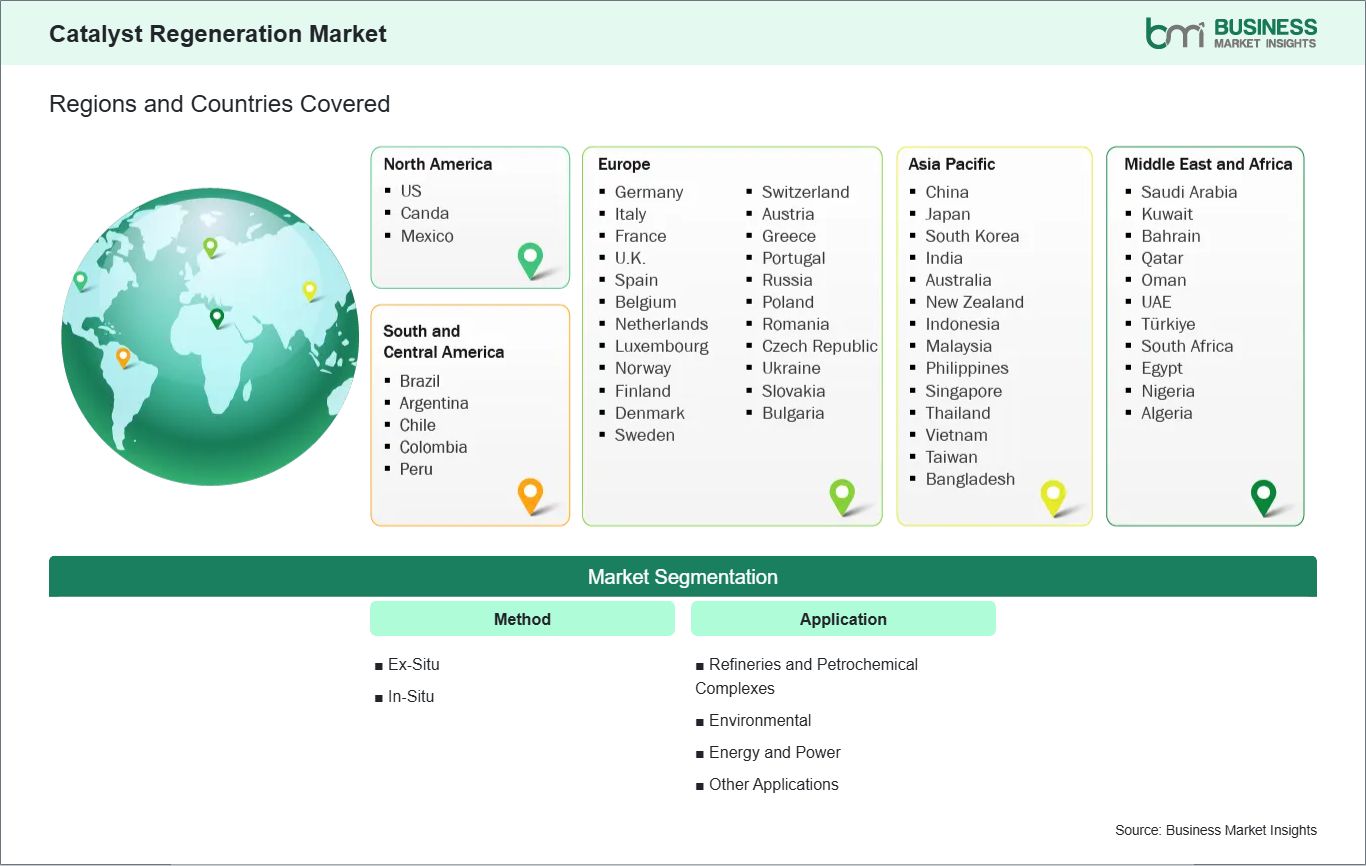
The catalyst regeneration market is segmented based on method and application, reflecting operational requirements across industrial processing environments.
By Method
- Ex-Situ – Preferred for intensive catalyst restoration requiring controlled processing conditions.
- In-Situ – Supports reduced downtime through on-site regeneration procedures.
By Application
- Refineries and Petrochemical Complexes – Account for substantial regeneration demand due to continuous catalyst utilization.
- Environmental – Utilized in emission control systems requiring sustained catalytic efficiency.
- Energy and Power – Applied in energy conversion systems emphasizing operational stability.
- Other Applications – Includes industrial processing sectors using specialized catalyst systems.
Market Forces
Catalyst Regeneration Market Drivers and Opportunities
Rising Focus on Catalyst Lifecycle Optimization
Industrial facilities are prioritizing catalyst lifecycle management to reduce replacement costs and maintain consistent operations. Regeneration solutions allow operators to restore catalyst activity without completely replacing the material. This improves resource efficiency in refining and chemical processing. The growing complexity of feedstocks has increased the need for reliable regeneration methods that can sustain processing performance over longer operational cycles. The benefits of catalyst recovery are driving its adoption in high-throughput industries. Facilities want regeneration services that reduce production downtime while also meeting environmental standards. This need is especially important for refineries and petrochemical plants, where catalyst performance directly affects processing yields, energy use, and maintenance plans.
Expansion of Advanced Regeneration Technologies
Innovation in regeneration systems is creating chances for better catalyst recovery and precision in processes. New thermal treatment methods, contamination removal technologies, and digital process monitoring systems are improving restoration results in various industrial applications. These advancements help service providers manage increasingly complex catalyst compositions and operational demands.
Future growth opportunities relate to broader efforts in industrial modernization and sustainability. Facilities are adopting regeneration processes that support resource conservation and operational improvement initiatives. The expansion of industrial infrastructure in developing areas is expected to boost demand for advanced catalyst management services, which help meet long-term production efficiency and environmental goals.
Size and Share Analysis
Catalyst Regeneration Market Size and Share Analysis
The Catalyst Regeneration Market is projected to grow from US$ 4.93 Billion in 2025 to US$ 7.73 Billion by 2033 , registering a CAGR of 5.78% from 2026 to 2033. Market expansion reflects sustained industrial emphasis on operational efficiency, catalyst recovery optimization, and maintenance cost management across refining and industrial processing facilities.
Ex-situ regeneration maintains a prominent market position due to its suitability for comprehensive catalyst restoration procedures and controlled treatment environments. Industrial operators favor this method for applications requiring extensive contaminant removal, process precision, and enhanced catalyst recovery consistency across large-scale processing operations.
Refineries and petrochemical complexes represent the leading application segment because of their continuous catalyst consumption and recurring maintenance requirements. These facilities rely on regeneration solutions to maintain production efficiency, improve catalyst utilization cycles, and support operational continuity within demanding industrial processing environments.
Report Coverage
Catalyst Regeneration Market Report Coverage and Deliverables
The "Catalyst Regeneration Market Size and Forecast (2022-2033)" report provides a detailed analysis of the market covering below areas:
- Market size and forecast at global, regional, and country levels for all market segments covered under the scope
- Market trends, as well as drivers, restraints, and opportunities
- Market analysis covering key trends, global and regional framework, major players, regulations, and recent developments
- Industry landscape and competition analysis covering market concentration, heat map analysis, prominent players, and recent developments for the Catalyst Regeneration market
- Detailed company profiles, including SWOT analysis
Geographic Insights
Catalyst Regeneration Market Geographic Insights
The catalyst regeneration market shows diverse regional adoption patterns influenced by industrial processing capacity, refinery modernization activities, environmental frameworks, and operational efficiency priorities. Mature industrial economies emphasize advanced regeneration technologies and process optimization, while developing regions focus on expanding industrial infrastructure and improving catalyst utilization practices across energy-intensive sectors.
North America maintains strong market participation due to its established refining infrastructure and extensive petrochemical processing operations. Industrial facilities across the region continue investing in catalyst management solutions that support operational reliability and maintenance efficiency. Regulatory emphasis on emissions management and sustainable industrial practices further strengthens the requirement for advanced regeneration services.
Asia Pacific demonstrates expanding deployment supported by industrial expansion, refinery upgrades, and rising energy processing activities. Countries across the region are increasing investments in petrochemical production and industrial processing capacity, creating sustained demand for catalyst recovery solutions. Market participants are also strengthening regional service capabilities to support large-scale industrial operations and evolving production requirements.
Europe continues emphasizing resource efficiency and environmental performance within industrial processing industries. Regeneration technologies are increasingly integrated into operational sustainability initiatives aimed at reducing waste generation and improving catalyst utilization rates. Emerging markets in the Middle East, Africa, and South and Central America are gradually enhancing industrial processing infrastructure, supporting broader utilization of catalyst regeneration services across refining and energy applications.
Industry Activity
Recent Developments
The Catalyst Regeneration market is evaluated by gathering qualitative and quantitative data post primary and secondary research, which includes important corporate publications, association data, and databases. A few of the key developments in the Catalyst Regeneration market are:
- In May 2026, BASF boosted refinery catalyst innovation with new RandD center in Attapulgus, Georgia. The facility is strategically co-located at BASF’s largest refinery catalyst production site globally, in Attapulgus, Georgia. Product development and advanced Fluid Catalytic Cracking (FCC) testing are at the core of the laboratory’s work and position BASF technologies as a critical enabler of refinery performance, improving process efficiency, product yields, and overall profitability.
- In February 2026, Axens announced the successful closing of the acquisition of 100% of Eurecat, following the completion of the required regulatory approvals. With this transaction, Axens becomes the sole owner of Eurecat, a world-leading provider of catalyst services, marking a significant milestone in Axens’ strategy to further strengthen catalysts circularity, ex situ activation, and metals reuse worldwide.
Trust & Transparency
Research Methodology
The market analysis combines proprietary research with secondary data from government agencies, company disclosures, regulatory filings, industry databases and expert interviews. Market estimates are validated through data triangulation, cross-market benchmarking and analyst
review.
View Full Research Methodology
Key Sources Referred:
World Bank – Global Trade Indicators
World Trade Organization (WTO)
International Monetary Fund (IMF)
International Trade Administration (ITA)
Company Websites
Company Annual Reports
Company Investor Presentations