
Fluid Catalyst Cracking Market Outlook: Size, Share, Trends, Growth Analysis, Competitive Landscape & Forecast, 2026-2033

Fluid Catalyst Cracking Market Size, Share, Trends & Forecast Report, 2026–2033

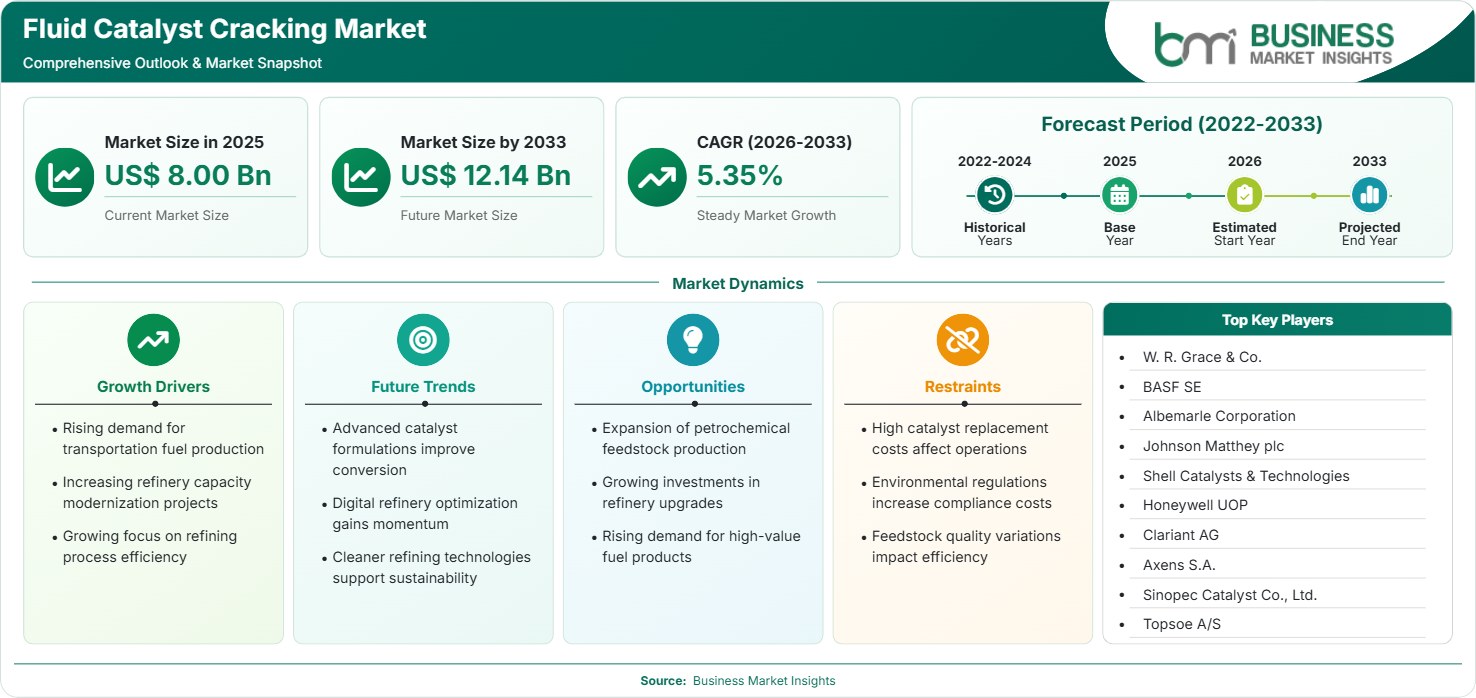
The Fluid Catalyst Cracking Market size was valued at US$ 8.00 billion in 2025 and is projected to reach US$ 12.14 billion by 2033, growing at a CAGR of 5.35% during 2026–2033. Rising demand for transportation fuel production, increasing refinery capacity modernization projects, and growing emphasis on refining process efficiency continue supporting market expansion, while refinery upgrades and petrochemical feedstock production create long-term growth opportunities.

Report Coverage
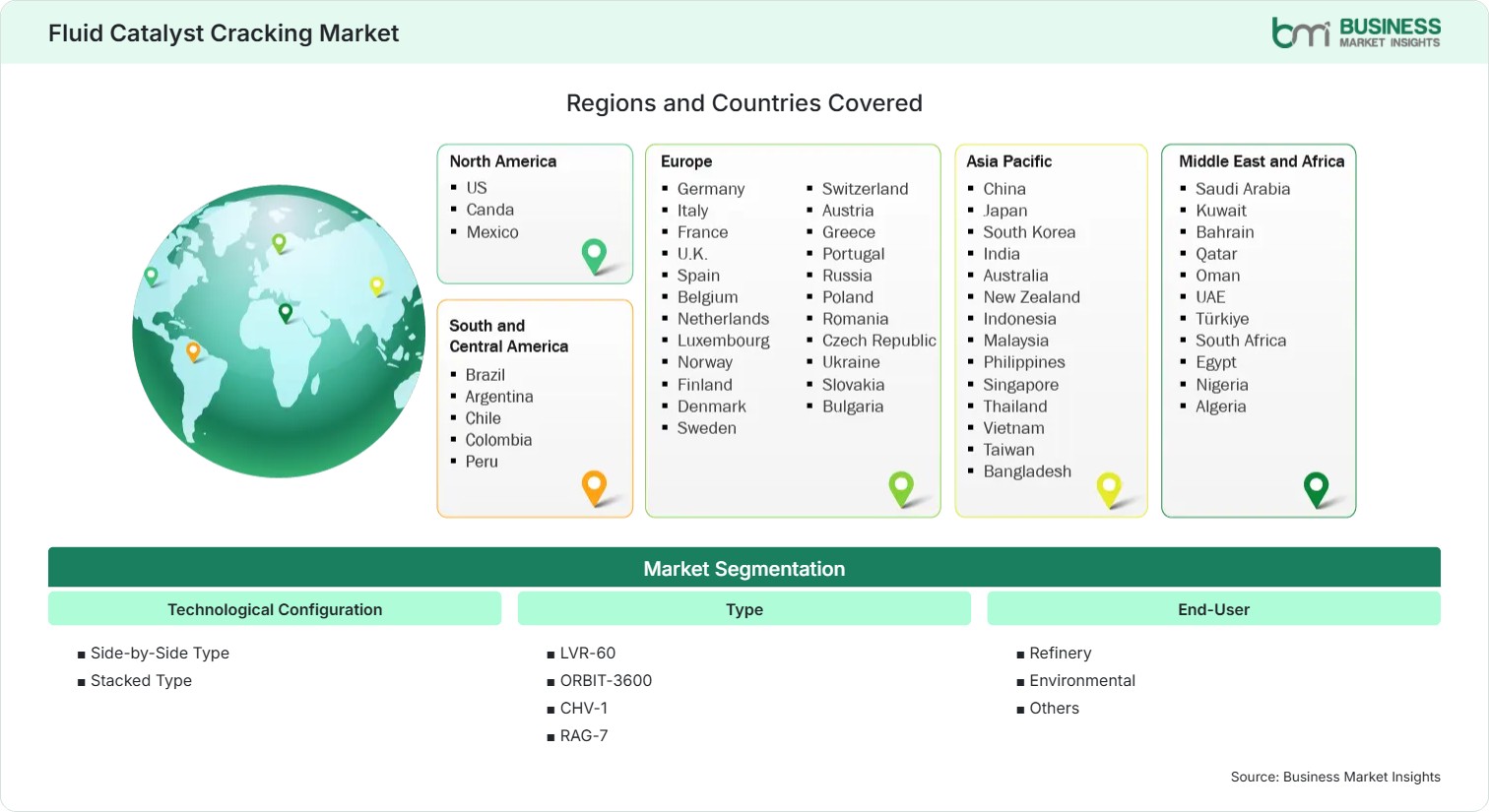
  • Technological Configuration: Side-by-Side Type, Stacked Type
  • Type: LVR-60, ORBIT-3600, CHV-1, RAG-7
  • End-User: Refinery, Environmental, Others
US$ 8.00 Bn Market size in 2025
US$ 12.14 Bn Market Size by 2033
5.35% CAGR, 2026 - 2033
2026-2033 Forecast Period

AI Overview

Fluid Catalyst Cracking Market Summary

  • North America Region: North America holds 31%–34% market share in 2025 and is projected to expand at a CAGR of 5.1%–5.4% during 2026–2033. Refinery modernization, strong transportation fuel demand, and investments in advanced catalyst technologies continue supporting regional growth. The U.S. dominates regional demand through large-scale refining operations, refinery optimization initiatives, and continuous catalyst technology adoption, advancing at an estimated CAGR of 5.2%–5.5% during 2026–2033.
  • Fastest Growing Region: Asia Pacific accounts for 37%–40% market share in 2025 and is expected to register a CAGR of 5.8%–6.2% during 2026–2033. Expanding refining capacity, rising fuel consumption, growing petrochemical production, and increasing investments in modern refinery infrastructure continue driving market expansion.
  • Leading Segment: Side-by-Side Type represents 57%–60% market share in 2025 and is anticipated to grow at a CAGR of 5.2%–5.5% owing to widespread deployment across large commercial refining facilities and operational flexibility.
  • High Growth Segment: Refinery accounts for 71%–74% market share in 2025 and is forecast to expand at a CAGR of 5.6%–5.9% as refiners increasingly optimize fuel yields, improve catalyst efficiency, and modernize processing units.
  • Key Market Opportunity: Growing refinery modernization projects, increasing production of petrochemical feedstocks, and rising demand for higher-value transportation fuels are creating attractive opportunities for catalyst manufacturers and technology providers.
  • Major Market Players: W. R. Grace & Co., BASF SE, Albemarle Corporation, Johnson Matthey plc, Shell Catalysts & Technologies, Honeywell UOP, Clariant AG, Axens S.A., Sinopec Catalyst Co., Ltd., and Topsoe A/S.
Strategic Insights

Fluid Catalyst Cracking Market: Strategic Insights

Fluid Catalyst Cracking Market Strategic Framework
FREE PDF
Request your free sample
Request free sample
Stakeholder View

Key Takeaways

  • Refinery modernization and catalyst technology advancements continue strengthening the market value chain by improving operational efficiency, conversion rates, and production flexibility across refining facilities.
  • Petrochemical feedstock production and refinery optimization projects represent the strongest commercial opportunities as refiners seek greater profitability through higher-value product output.
  • Continuous innovation in catalyst formulations, process optimization technologies, and digital refinery solutions is improving fuel yields while reducing operating costs and emissions.
  • Asia Pacific offers the strongest investment potential because of expanding refining capacity, increasing transportation fuel demand, and growing integration of refining and petrochemical operations.
  • Strategic partnerships between catalyst manufacturers, technology licensors, and refinery operators continue accelerating commercialization of advanced fluid catalytic cracking technologies while improving long-term operational performance.
Geographic Outlook

Fluid Catalyst Cracking Market Regional Highlights

North America Fluid Catalyst Cracking Market

North America accounted for 31%–34% of the Fluid Catalyst Cracking Market Share in 2025 and is projected to grow at a CAGR of 5.1%–5.4% during 2026–2033. Ongoing refinery modernization, increasing production of cleaner transportation fuels, and continued investment in catalyst performance optimization support steady regional demand across major refining hubs.

  • Refinery operators continue upgrading FCC units to improve gasoline yields, operational efficiency, and catalyst utilization.
  • Rising production of cleaner transportation fuels supports sustained demand for advanced catalyst technologies.
  • Digital refinery initiatives improve process monitoring, catalyst management, and overall operational performance.
  • Integration of refining and petrochemical operations strengthens long-term investment across large refinery complexes.

US Fluid Catalyst Cracking Market

The U.S. represented 76%–79% of the North American market in 2025 and is expected to expand at a CAGR of 5.2%–5.5% through 2033. Large refining capacity, continuous infrastructure upgrades, and increasing investments in process optimization continue supporting market growth.

  • Major refinery operators continue investing in catalyst technologies to maximize conversion efficiency.
  • Growing demand for premium transportation fuels supports modernization of FCC units.
  • Advanced automation improves operational reliability and production flexibility.
  • Refinery integration with petrochemical facilities increases catalyst consumption.

Europe Fluid Catalyst Cracking Market

Europe held 22%–25% market share in 2025 and is forecast to expand at a CAGR of 4.9%–5.2% during 2026–2033. Germany leads regional demand, while the Netherlands demonstrates the fastest growth because of refinery modernization, cleaner fuel production, and advanced process technology investments.

  • Fuel quality regulations encourage adoption of high-performance catalyst technologies.
  • Refinery efficiency improvement projects support replacement of aging processing units.
  • Petrochemical integration strengthens demand for advanced FCC catalysts.
  • Sustainability initiatives encourage development of lower-emission refining processes.

Asia Pacific Fluid Catalyst Cracking Market

Asia Pacific accounted for 37%–40% market share in 2025 and is projected to record the strongest Fluid Catalyst Cracking Market Forecasts, expanding at a CAGR of 5.8%–6.2% during 2026–2033. China leads regional revenue, while India records the fastest growth owing to expanding refinery capacity and increasing domestic fuel demand.

  • Large-scale refinery expansion projects continue increasing catalyst consumption.
  • Growing petrochemical production supports investment in advanced FCC technologies.
  • Rising transportation fuel demand accelerates refinery capacity modernization.
  • Government-backed energy infrastructure investments strengthen long-term market growth.
  • Increasing refinery integration improves production flexibility and product diversification.

Rest of World Fluid Catalyst Cracking Market

The Rest of World region represented 9%–12% market share in 2025 and is projected to expand at a CAGR of 5.3%–5.7% through 2033. Saudi Arabia leads demand across the Middle East, while Brazil demonstrates notable growth in South America through refinery expansion and fuel production investments.

  • National refinery expansion projects support increased catalyst utilization.
  • Rising fuel consumption encourages modernization of existing refining infrastructure.
  • Petrochemical diversification strengthens demand for efficient cracking technologies.
  • Investments in energy security continue supporting long-term refinery development.
Global Market Geography
FREE PDF
Request your free sample
Request free sample
Segment Analysis

Fluid Catalyst Cracking Market Segmentation

Technological Configuration

The Technological Configuration segment represents the largest, with Side-by-Side Type accounting for 57%–60% market share in 2025 and expanding at a CAGR of 5.2%–5.5%. The Fluid Catalyst Cracking Market Trends indicate growing adoption because of operational flexibility, simplified maintenance, and improved processing efficiency across commercial refinery operations.

  • Side-by-Side Type: Widely deployed in large refining complexes because of efficient catalyst circulation, operational reliability, and improved maintenance accessibility supporting high processing capacity.
  • Stacked Type: Preferred in facilities requiring compact layouts while delivering effective catalyst regeneration, efficient processing performance, and optimized space utilization.

Type

The Type segment continues evolving as refiners adopt advanced catalyst technologies to maximize product yield, improve conversion efficiency, and enhance refinery economics. Continuous catalyst innovation supports higher-quality transportation fuel and petrochemical production.

  • LVR-60: Utilized for improving gasoline yield and catalyst performance while supporting efficient heavy oil conversion.
  • ORBIT-3600: Designed to optimize catalyst activity, enhance selectivity, and improve refinery operational efficiency.
  • CHV-1: Applied in FCC operations requiring balanced conversion performance and improved processing stability.
  • RAG-7: Supports higher-value product recovery through improved cracking efficiency and enhanced catalyst effectiveness.

End-User

The End-user segment remains dominated by refinery applications because fluid catalytic cracking technologies are essential for maximizing fuel production and improving processing efficiency. Increasing refinery modernization continues supporting sustained adoption across the industry.

  • Refinery: Primary end user owing to continuous investments in fuel production optimization, catalyst performance improvement, and refinery capacity expansion.
  • Environmental: Increasing adoption for cleaner refining operations and emission reduction initiatives supporting sustainable processing objectives.
Market Forces

Fluid Catalyst Cracking Market Dynamics

Key Market Drivers

Rising Demand for Transportation Fuel Production

The increasing consumption of gasoline, diesel, and aviation fuels continues to drive the Fluid Catalyst Cracking Market Growth. Fluid catalytic cracking units play a critical role in converting heavy hydrocarbon feedstocks into higher-value transportation fuels while maximizing refinery output. The growing number of vehicles, rise in air transport, and growth in freight movement in developing countries is driving consistent refinery activities. Refiners are spending more on innovative catalyst technologies, which increase conversion efficiency, boost gasoline production, and minimize side products. The steady need for clean transportation fuels and favorable economics of refineries will bolster the use of fluid catalytic cracking catalysts during the forecast period.

Increasing Refinery Capacity Modernization Projects

Refinery operators worldwide are modernizing existing processing units to improve operational efficiency, increase throughput, and comply with evolving fuel quality requirements. Advancements in fluid catalytic cracking facilities have enabled refineries to use heavy crude feedstock without sacrificing the rate of conversion and product selectivity. The implementation of digital refineries and process automation has improved the reliability of operations and minimized downtime. Development of refining and petrochemical complexes is driving additional demand for advanced catalytic cracking technology. Such innovations keep supporting market development in the long run in developed and developing refining regions alike.

Growing Focus on Refining Process Efficiency

Improving refining efficiency has become a strategic priority as refiners seek to maximize profitability while reducing operating costs and energy consumption. Advanced fluid catalytic cracking catalysts improve hydrocarbon conversion, increase valuable product yields, and minimize catalyst deactivation. Improvements in catalyst formulations have also been contributing to reduction in coke formation and increase in processing flexibility depending on the type of crude oil being used. The increasing use of digital monitoring systems, predictive maintenance technology and process controls is enabling operators to improve the efficiency of catalysts used in their operations.

Key Market Opportunities

Expansion of Petrochemical Feedstock Production

Growing demand for petrochemical products is creating significant opportunities for fluid catalytic cracking technology providers. Modern refining complexes are increasingly designed to maximize production of propylene, butylene, and other valuable petrochemical feedstocks alongside conventional transportation fuels. The Fluid Catalyst Cracking Market Forecasts indicate that refinery operators will continue investing in catalyst technologies capable of improving olefin selectivity and production efficiency. Rising consumption of plastics, synthetic fibers, packaging materials, and specialty chemicals further strengthens the need for advanced cracking catalysts. These developments are expected to generate long-term commercial opportunities for catalyst manufacturers and refinery technology suppliers.

Growing Investments in Refinery Upgrades

National oil companies and private refinery operators continue investing in capacity expansion, equipment modernization, and process optimization projects to improve competitiveness and operational flexibility. Upgrading fluid catalytic cracking units enables refiners to process lower-quality crude oils while maintaining higher yields of premium fuel products. The incorporation of automation technology, process control systems, and catalyst management systems will continue to make refineries more efficient. These expenditures provide an opportunity for companies that produce catalysts that can improve the life span, selectivity, and reduce cost of operations.

Rising Demand for High-Value Fuel Products

Increasing consumption of premium gasoline, cleaner diesel, aviation fuels, and petrochemical intermediates continues encouraging refiners to adopt advanced catalyst technologies. Fluid catalytic cracking units equipped with high-performance catalysts improve conversion efficiency while increasing production of valuable refined products. Growing regulatory emphasis on cleaner fuel standards also encourages refiners to optimize processing performance through catalyst innovation. Continuous investments in refinery optimization, product diversification, and higher-value refining output are expected to create sustained commercial opportunities for technology providers serving the fluid catalytic cracking industry.

Market Restraints and Challenges

High Catalyst Replacement Costs Affect Operations

Fluid catalytic cracking catalysts require periodic replacement to maintain optimal conversion efficiency, product selectivity, and refinery performance, resulting in recurring operational expenditures for refinery operators.

Factor: High costs associated with catalyst replacement and lifecycle management.

Impact: Frequent catalyst replacement increases refinery operating expenses and may reduce profitability, particularly during periods of lower refining margins. Smaller refinery operators often delay catalyst replacement cycles to manage costs, potentially affecting processing efficiency, fuel yields, and overall operational performance while limiting adoption of premium catalyst technologies.

Environmental Regulations Increase Compliance Costs

Refineries operate under increasingly stringent environmental regulations governing emissions, waste management, sulfur content, and overall operational sustainability, requiring continuous investments in cleaner refining technologies.

Factor: Tightening environmental compliance requirements.

Impact: Compliance with evolving environmental regulations requires significant capital investment in emission control systems, catalyst optimization, monitoring technologies, and refinery upgrades. These additional expenditures increase operating costs and extend project implementation timelines, creating financial and operational challenges for refiners while influencing technology selection and long-term investment decisions.

Company Analysis

Competitive Landscape

The competitive environment of the Market is driven by continuous catalyst innovation, refinery process optimization, and strategic collaborations between catalyst manufacturers and refinery technology providers. The Fluid Catalyst Cracking Market Analysis highlights that leading companies are investing in advanced catalyst formulations, digital refinery solutions, emission reduction technologies, and refinery modernization projects to improve conversion efficiency and maximize production of transportation fuels and petrochemical feedstocks. Expansion of global manufacturing capacity, licensing agreements, and research partnerships also remains a key strategy for strengthening market presence.

Company Name

Overview

Products and Services Relevant to this Market

W. R. Grace & Co.

Leading specialty chemicals company recognized for advanced catalyst technologies serving global refining and petrochemical industries.

FCC catalysts, catalyst additives, refining process technologies, technical services, and refinery performance optimization solutions.

BASF SE

Global chemical company offering innovative catalyst technologies for refining, petrochemical processing, and sustainable industrial applications.

FCC catalysts, catalyst additives, process optimization technologies, emission reduction solutions, and refinery catalyst services.

Albemarle Corporation

Specialty chemicals manufacturer with extensive expertise in catalyst development for petroleum refining and petrochemical production.

Fluid catalytic cracking catalysts, hydroprocessing catalysts, catalyst performance solutions, and refinery technical support services.

Johnson Matthey plc

International sustainable technologies company delivering catalyst innovation for cleaner fuels and advanced refining operations.

FCC additives, catalyst technologies, emissions control solutions, refining process optimization, and sustainable catalyst systems.

Shell Catalysts & Technologies

Technology provider delivering advanced catalyst solutions and licensed process technologies for refinery modernization projects worldwide.

FCC technologies, catalyst systems, refinery licensing services, hydroprocessing technologies, and process engineering solutions.

Honeywell UOP

Global leader in refining process technologies supporting higher conversion efficiency and improved refinery economics.

FCC process technologies, catalyst systems, refinery automation, digital process optimization, and engineering services.

Clariant AG

Specialty chemicals company supplying catalyst technologies for refinery productivity and cleaner fuel manufacturing.

FCC catalysts, catalyst additives, refining chemicals, process improvement technologies, and technical consulting services.

Axens S.A.

International process technology provider serving refining and petrochemical industries through advanced licensing and catalyst solutions.

FCC technologies, catalyst products, process licensing, engineering support, and refinery modernization services.

Sinopec Catalyst Co., Ltd.

Major catalyst manufacturer supplying advanced refining catalysts across domestic and international refinery markets.

FCC catalysts, catalyst additives, refining technologies, petrochemical catalysts, and technical support services.

Topsoe A/S

Global technology company specializing in catalyst innovation and energy-efficient refinery processing solutions.

Refining catalysts, process technologies, catalyst optimization services, engineering support, and sustainable refinery solutions.

Trust & Transparency

Research Methodology

The market analysis combines proprietary research with secondary data from government agencies, company disclosures, regulatory filings, industry databases and expert interviews. Market estimates are validated through data triangulation, cross-market benchmarking and analyst review.

View Full Research Methodology

Questions Answered

Frequently Asked Questions

What does the Fluid Catalyst Cracking Market Report provide?

The Market Report delivers comprehensive insights into market size, competitive landscape, technology developments, segmentation, regional analysis, recent industry developments, growth opportunities, challenges, and long-term business outlook through 2033.

Which companies are leading innovation in this market?

Leading companies include W. R. Grace & Co., BASF SE, Albemarle Corporation, Johnson Matthey plc, Honeywell UOP, Shell Catalysts & Technologies, Clariant AG, Axens S.A., Sinopec Catalyst Co., Ltd., and Topsoe A/S.

What opportunities are expected to support future market expansion?

Expansion of petrochemical feedstock production, refinery modernization investments, increasing production of premium transportation fuels, and development of advanced catalyst technologies are expected to create significant long-term growth opportunities.

Which end-user dominates the Market?

Refineries represent the leading end-user segment because fluid catalytic cracking units are essential for converting heavy hydrocarbons into high-value gasoline, diesel, and petrochemical feedstocks while improving refinery profitability.

What is driving the Fluid Catalyst Cracking Market?

The market is primarily driven by increasing demand for transportation fuels, refinery modernization projects, growing focus on refining process efficiency, and continuous advancements in catalyst technologies that improve conversion rates and operational performance.

Access the Full Fluid Catalyst Cracking Market Report

Get segment-level forecasts, regional estimates, competitive benchmarking, company profiles and downloadable Excel datasets.

Access the full Fluid Catalyst Cracking Market Report
350 pages PDF & Excel | 2026-08-07