
Transmission Fluids Market Outlook: Size, Share, Trends, Growth Analysis, Competitive Landscape & Forecast, 2026-2033

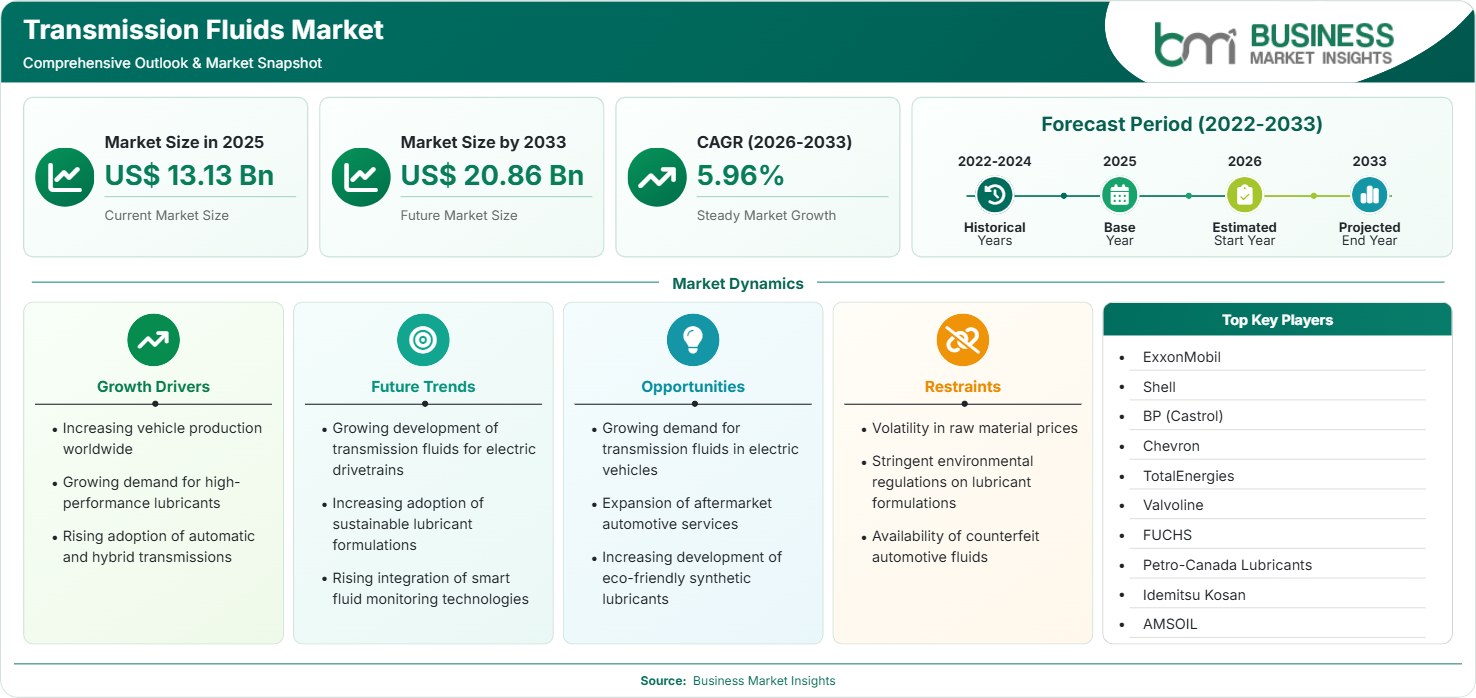
The Transmission Fluids Market size was valued at US$ 13.13 Billion in 2025 and is projected to reach US$ 20.86 Billion by 2033, growing at a CAGR of 5.96% from 2026 to 2033, driven by rising global vehicle production, increasing adoption of automatic and hybrid transmissions, demand for high-performance lubricants, and expanding automotive aftermarket services.

Report Coverage
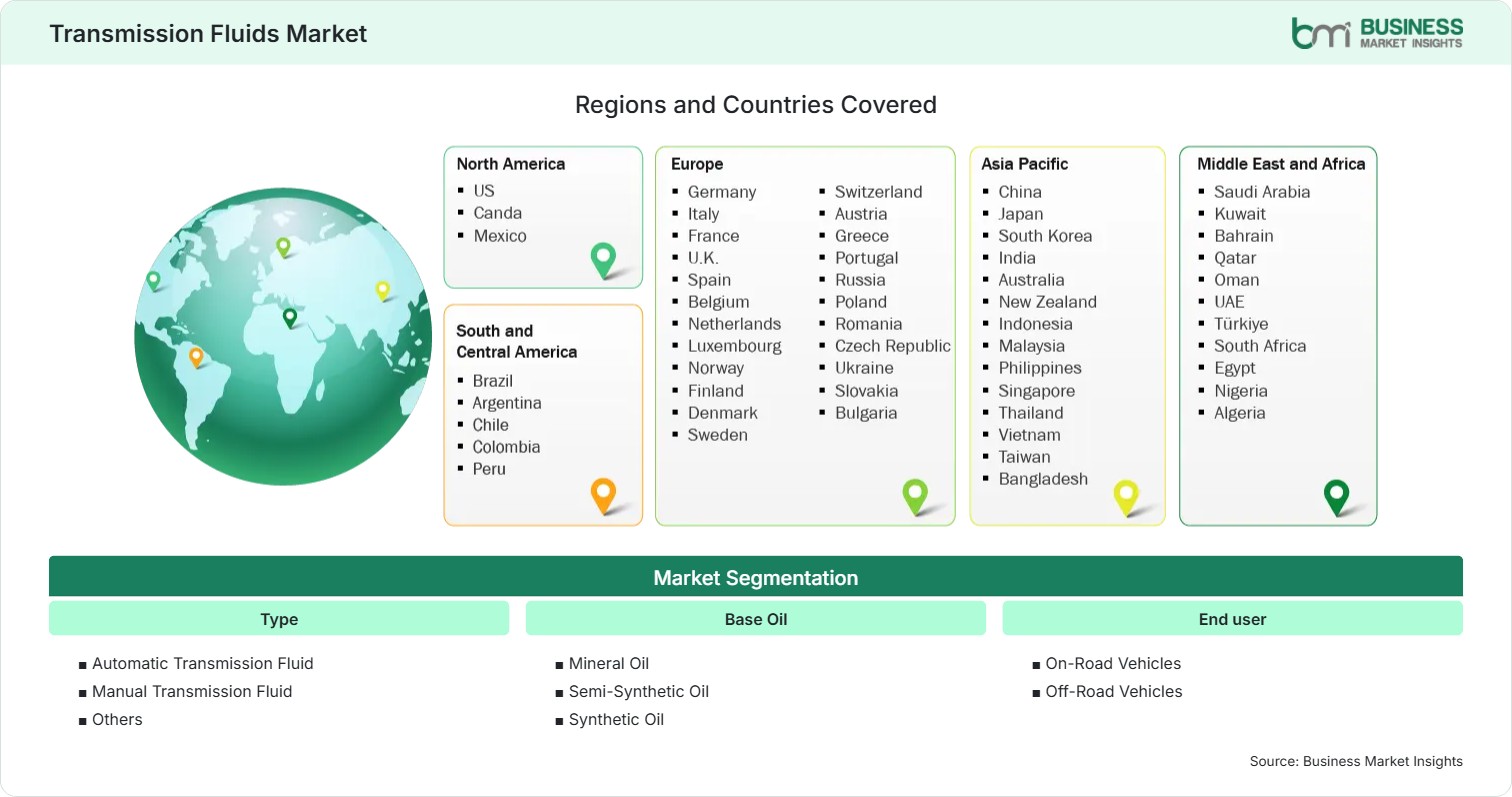
  • Type: Automatic Transmission Fluid, Manual Transmission Fluid, Others
  • Base Oil: Mineral Oil, Semi-Synthetic Oil, Synthetic Oil
  • End user: On-Road Vehicles, Off-Road Vehicles
US$ 13.13 Bn Market size in 2025
US$ 20.86 Bn Market Size by 2033
5.96% CAGR, 2026 - 2033
2026-2033 Forecast Period

01 AI Overview

Transmission Fluids Market Summary

  • North America Region: North America accounts for 30%–33% of the market in 2025 and is projected to grow at a CAGR of 5%–7% during 2026–2033. Strong automotive ownership, high automatic transmission penetration, and expanding aftermarket maintenance services continue supporting market demand. The US market is expected to register a CAGR of 5%–7% owing to sustained vehicle parc growth and increasing synthetic lubricant adoption.
  • Fastest Growing Region: Asia Pacific holds 37%–40% of the market in 2025 and is forecast to expand at a CAGR of 6%–8% through 2026–2033, supported by rising automobile production, expanding industrial activities, and increasing passenger vehicle ownership.
  • Leading Segment: Automatic Transmission Fluid (ATF) represents 52%–55% of the market in 2025 and is projected to grow at a CAGR of 6%–8%, driven by increasing automatic transmission adoption and demand for enhanced drivetrain efficiency.
  • High Growth Segment: Synthetic Oil accounts for 38%–41% market share in 2025 and is expected to expand at a CAGR of 7%–9% due to superior thermal stability, extended drain intervals, and compatibility with modern vehicle transmissions.
  • Key Market Opportunity: Electric vehicle transmission technologies, sustainable lubricant development, and expansion of global automotive aftermarket services are creating long-term commercial opportunities.
  • Major Market Players: ExxonMobil, Shell, BP (Castrol), Chevron, TotalEnergies, Valvoline, FUCHS, Petro-Canada Lubricants, Idemitsu Kosan, and AMSOIL.
02 Strategic Insights

Transmission Fluids Market: Strategic Insights

Transmission Fluids Market Strategic Framework
FREE PDF
Request your free sample
Request free sample
03 Stakeholder View

Key Takeaways

  • Advanced transmission technologies are increasing demand for premium lubricants with enhanced thermal stability and extended operational life.
  • Automatic transmission fluids remain the largest revenue contributor, while synthetic lubricants continue offering the strongest long-term growth potential.
  • Research focuses on low-viscosity formulations, sustainable additives, and EV-compatible lubrication technologies.
  • Asia Pacific remains the most attractive regional investment destination due to expanding automotive manufacturing and vehicle ownership.
  • Strategic acquisitions, refinery upgrades, and lubricant portfolio expansion continue strengthening competition among global manufacturers.
  • Automotive aftermarket expansion continues creating recurring revenue opportunities through replacement demand and preventive maintenance services.
04 Geographic Outlook

Transmission Fluids Market Regional Highlights

North America Transmission Fluids Market

North America accounted for 30%–33% of the market in 2025 and is projected to register a CAGR of 5%–7% through 2026–2033. High vehicle ownership, widespread automatic transmission adoption, and mature automotive service infrastructure continue supporting lubricant demand. The Transmission Fluids Market share remains significant because of increasing preference for premium synthetic lubricants and regular preventive vehicle maintenance.

  • Automotive service providers continue promoting premium synthetic transmission fluids to improve drivetrain performance, enhance fuel efficiency, and extend transmission life. Growing consumer awareness of preventive vehicle maintenance is supporting the adoption of high-performance lubricant solutions.
  • Fleet operators are increasingly adopting extended-drain lubricant technologies to reduce maintenance frequency, lower operating costs, and improve vehicle uptime across commercial fleets.
  • Vehicle manufacturers are recommending advanced transmission fluids specifically formulated for newer drivetrain systems, including automatic and continuously variable transmissions, to ensure optimal performance and durability.
  • The high penetration of automatic transmission vehicles continues to support recurring aftermarket demand for premium transmission fluids, driven by routine maintenance and replacement requirements.

US Transmission Fluids Market

The United States represented 25%–28% of the market in 2025 and is expected to expand at a CAGR of 5%–7% during 2026–2033. Demand is supported by a large vehicle fleet, increasing hybrid vehicle adoption, and widespread consumer awareness regarding preventive maintenance. The Transmission Fluids Market growth is also supported by premium lubricant adoption across passenger and commercial vehicles.

  • The use of synthetic transmission fluid is gaining popularity within passenger vehicles owing to its higher efficiency, greater resistance to temperature changes, increased wear protection, and capacity to increase the lifespan of the transmission system.
  • Commercial fleet maintenance programs continue supporting recurring lubricant demand by emphasizing preventive maintenance, extended service intervals, and reliable transmission performance to reduce vehicle downtime and operating costs.
  • Automotive repair networks are expanding premium maintenance services by offering high-quality synthetic transmission fluids, advanced diagnostic capabilities, and specialized vehicle servicing to meet evolving customer and manufacturer requirements.

Europe Transmission Fluids Market

Europe accounted for 27%–30% of the market in 2025 and is projected to grow at a CAGR of 5%–6% during 2026–2033. Increasing vehicle efficiency requirements, stringent emission regulations, and widespread adoption of advanced drivetrain technologies continue supporting lubricant innovation. Germany, France, and the United Kingdom remain key markets supported by strong automotive manufacturing and premium vehicle production.

  • Germany is ahead of other countries when it comes to the production of new lubricants due to its well-developed automotive industry, engineering skills, and innovations in the field of transmission fluid products. The collaboration between lubricant and vehicle producers helps create new formulations.
  • France is supporting sustainable lubricant innovation through environmental initiatives, stricter emission regulations, and growing adoption of eco-friendly lubricant technologies.
  • The United Kingdom continues expanding premium automotive servicing networks, increasing the availability of advanced transmission fluid replacement and maintenance services.
  • OEM partnerships are encouraging the development of next-generation transmission fluids designed to improve drivetrain efficiency, extend service intervals, and support modern automatic and hybrid vehicle systems.

Asia Pacific Transmission Fluids Market

Asia Pacific represented 37%–40% of the global market in 2025 and is forecast to register a CAGR of 6%–8% through 2026–2033. Strong automotive manufacturing, rising vehicle ownership, expanding industrialization, and increasing aftermarket service penetration continue driving regional demand. China, India, Japan, and South Korea remain leading contributors supported by vehicle production and lubricant consumption.

  • China dominates automotive production and lubricant consumption through its large vehicle manufacturing base, expanding passenger vehicle fleet, and strong demand for high-performance transmission fluids. Rising vehicle ownership and maintenance activities continue supporting lubricant market growth.
  • India is expanding passenger vehicle ownership and automotive servicing infrastructure, driving increasing demand for premium transmission lubricants across both organized service centers and independent workshops.
  • Japan supports advanced transmission lubricant innovation through strong automotive engineering capabilities, research expertise, and the development of high-performance synthetic lubricant technologies.
  • South Korea is strengthening lubricant demand through expanding automotive exports, advanced vehicle manufacturing, and increasing production of modern passenger and commercial vehicles requiring premium transmission fluids.

Rest of World Transmission Fluids Market

South and Central America accounted for 5%–7% of the market in 2025, while the Middle East and Africa represented 4%–6%. These regions are projected to register CAGRs of 5%–7% and 6%–7%, respectively, during 2026–2033. Rising commercial vehicle fleets, improving transportation infrastructure, increasing mining and agricultural activities, and expanding automotive aftermarket services continue supporting lubricant demand. Brazil, Mexico, Saudi Arabia, and South Africa remain key regional markets.

  • Brazil is strengthening lubricant demand through increasing automotive production, rising vehicle ownership, and the expansion of authorized service networks. Growing demand for high-performance transmission fluids is supported by regular vehicle maintenance and a developing aftermarket sector.
  • Mexico continues benefiting from automotive manufacturing growth, strong cross-border vehicle exports, and increasing production of passenger and commercial vehicles, driving consistent demand for advanced transmission lubricants.
  • Saudi Arabia is investing in transportation infrastructure and logistics development, supporting commercial vehicle operations and increasing demand for high-quality transmission lubricants across fleet applications.
  • South Africa is expanding aftermarket automotive services and industrial equipment maintenance activities, contributing to steady growth in lubricant consumption across automotive and commercial vehicle segments.
Global Market Geography
FREE PDF
Request your free sample
Request free sample
05 Segment Analysis

Transmission Fluids Market Segmentation

Type

Type segmentation is primarily influenced by increasing adoption of automatic transmissions, rising vehicle production, and demand for high-performance lubricants. Automatic Transmission Fluid (ATF) dominated with a 52%–55% market share in 2025 and is projected to grow at a CAGR of 6%–8% during 2026–2033. The Transmission Fluids Market scope continues expanding as vehicle manufacturers introduce advanced transmission technologies requiring specialized lubrication solutions.

  • Automatic Transmission Fluid (ATF): Dominates the market due to widespread adoption of automatic transmissions, superior friction control, and compatibility with modern passenger and commercial vehicles.
  • Manual Transmission Fluid (MTF): Supports efficient gear operation, wear protection, and smooth shifting in manual transmission systems across passenger and commercial vehicles.

Base Oil

Base Oil segmentation continues evolving as vehicle manufacturers recommend premium lubricant formulations for improved drivetrain performance. Synthetic Oil accounted for 38%–41% of the market in 2025 and is projected to register a CAGR of 7%–9% through 2026–2033. Superior oxidation resistance, enhanced thermal stability, extended drain intervals, and compatibility with modern transmissions continue supporting synthetic lubricant adoption.

  • Mineral Oil: Remains widely utilized in conventional vehicle applications due to cost-effectiveness and broad market availability.
  • Semi-Synthetic Oil: Provides balanced performance, improved oxidation resistance, and cost efficiency for modern transmission systems.
  • Synthetic Oil: Delivers superior thermal stability, wear protection, fuel efficiency, and extended service life for advanced transmission technologies.

End User

End-user segmentation reflects increasing lubricant demand across passenger transportation, freight mobility, agriculture, mining, and industrial equipment applications. On-Road Vehicles represented 78%–81% of the market in 2025 and are expected to grow at a CAGR of 6%–7% during 2026–2033. Expanding global vehicle ownership and regular maintenance requirements continue supporting long-term lubricant consumption.

  • On-Road Vehicles: Account for the largest demand through passenger cars, buses, and commercial vehicles requiring routine transmission fluid replacement.
  • Off-Road Vehicles: Generate steady demand from construction, mining, agriculture, and heavy industrial equipment operating under demanding environmental conditions.
06 Market Forces

Transmission Fluids Market Dynamics

Key Market Drivers

Increasing Vehicle Production Worldwide

Global vehicle production continues supporting sustained demand for transmission fluids across passenger, commercial, and industrial vehicle segments. According to the International Organization of Motor Vehicle Manufacturers (OICA), global automotive manufacturing continues expanding across emerging economies, creating consistent lubricant demand throughout vehicle lifecycles. Rising production of passenger vehicles, light commercial vehicles, and heavy-duty trucks increases both original equipment and aftermarket lubricant consumption. The Transmission Fluids Market trends indicate stable long-term demand as expanding vehicle fleets require periodic maintenance and fluid replacement to maintain transmission efficiency and durability.

Growing Demand for High-Performance Lubricants

Modern automobile transmissions require better lubricants that can perform under higher temperatures, increased torque demands, and longer service intervals. The industry is currently developing premium lubricants with improved oxidation and viscosity stability, as well as friction characteristics. Synthetic transmission fluids are being adopted as a replacement for ordinary fluids since they help in improving efficiency, reducing wear and tear of parts, and prolonging equipment life.

Rising Adoption of Automatic and Hybrid Transmissions

The sales and popularity of automatic transmissions will continue to grow because of consumers’ preference for ease of driving, improved fuel efficiency, and advances in technology. The hybrid vehicles also demand a special transmission fluid that is suitable for their drive system and higher temperatures. More complex transmission systems such as automatics, dual clutch transmissions, and continuously variable transmission are also being introduced by vehicle manufacturers. This trend has encouraged lubricant manufacturers to conduct further research on developing specialized fluids.

Key Market Opportunities

Growing Demand for Transmission Fluids in Electric Vehicles

Electric vehicles are creating new opportunities for lubricant manufacturers as next-generation electric drivetrains require specialized transmission fluids with superior thermal management, electrical compatibility, and component protection. Although EVs contain fewer moving drivetrain components than conventional vehicles, dedicated e-drive fluids are becoming increasingly important for gearbox efficiency and cooling performance. The Transmission Fluids Market Forecasts indicate growing investment in EV-specific lubricant technologies as global electrification accelerates. Manufacturers are developing advanced formulations that improve energy efficiency, extend component life, and support higher operating temperatures in electric propulsion systems.

Expansion of Aftermarket Automotive Services

The constant growth of global services for the automotive aftermarket is providing lucrative opportunities for manufacturers of transmission fluids. The increase in vehicle sales, old fleet vehicles, and the realization by consumers on the importance of maintaining vehicles through preventive measures are some of the factors contributing to the rising need for new lubricants. Independent repair shops, dealership service centers, and quick lubes are increasingly offering their services in transmission fluid replacement programs. Predictive maintenance techniques have further facilitated the process of lubricant replacement in vehicles.

Increasing Development of Eco-Friendly Synthetic Lubricants

Growing emphasis on sustainability is prompting lubricant producers to produce environment-friendly transmission fluids that have enhanced biodegradability, lower emissions, and increased life span. Synthetic lubricants can help achieve greater fuel efficiency and decrease lubricant use due to increased replacement periods. Research to develop renewable base oils, new additives, and less carbon-intensive production processes are fueling innovation within the industry. With tougher environmental legislation and greener mobility becoming priorities for automobile makers, eco-friendly transmission fluids are likely to become increasingly important in lubricant portfolios.

Market Restraints and Challenges

Volatility in Raw Material Prices

Factor: Transmission fluid production depends heavily on base oils, specialty additives, and petrochemical feedstocks whose prices fluctuate due to crude oil market dynamics, geopolitical events, and supply chain disruptions. Impact: Fluctuations in raw material prices will lead to higher production costs, reduced profit margins, and unpredictable prices for lubricant manufacturers. The manufacturers may be faced with a problem of ensuring that their products are affordable but at the same time maintaining high-quality standards.

Stringent Environmental Regulations on Lubricant Formulations

Factor: Governments and environmental agencies continue introducing stricter regulations regarding lubricant composition, emissions, chemical usage, disposal practices, and environmental impact. Impact: Compliance requirements increase research expenditure, product development complexity, certification costs, and reformulation efforts for lubricant manufacturers. Companies must continuously invest in sustainable additive technologies, environmentally compatible base oils, and regulatory testing programs to maintain market access. Regulatory evolution remains a significant challenge while simultaneously encouraging innovation toward cleaner and more sustainable lubricant technologies.

07 Company Analysis

Competitive Landscape

The competitive landscape is characterized by continuous investment in synthetic lubricant technologies, advanced additive chemistry, sustainable product development, and expansion of global distribution networks. Transmission Fluids Market analysis indicates that leading manufacturers are focusing on premium formulations, EV-compatible lubricants, strategic acquisitions, and long-term partnerships with automotive OEMs to strengthen their market positions.

Company Name

Overview

Products and Services Relevant to this Market

ExxonMobil

Global energy and lubricant manufacturer serving automotive and industrial sectors.

Automatic transmission fluids, synthetic lubricants, drivetrain fluids.

Shell

International energy company with extensive lubricant portfolio.

Transmission fluids, synthetic oils, automotive lubricants.

BP (Castrol)

Global lubricant producer specializing in automotive performance products.

ATF, MTF, synthetic transmission lubricants, premium vehicle fluids.

Chevron

Energy company supplying advanced lubricant technologies globally.

Transmission fluids, synthetic lubricants, industrial oils.

TotalEnergies

Global energy company developing high-performance lubricant solutions.

Automotive transmission fluids, synthetic oils, drivetrain lubricants.

Valvoline

Automotive lubricant company serving OEM and aftermarket customers.

Premium ATF, synthetic lubricants, maintenance solutions.

FUCHS

Global lubricant manufacturer focused on specialty lubrication technologies.

Transmission oils, industrial lubricants, specialty fluid solutions.

Petro-Canada Lubricants

Producer of premium lubricant products for automotive applications.

Automatic transmission fluids, synthetic drivetrain lubricants.

Idemitsu Kosan

Japanese energy company supplying advanced automotive lubricants.

OEM-approved transmission fluids and high-performance lubricants.

AMSOIL

Synthetic lubricant manufacturer focused on premium automotive products.

Synthetic ATF, drivetrain fluids, extended-drain lubricant solutions.

10 Trust & Transparency

Research Methodology

The market analysis combines proprietary research with secondary data from government agencies, company disclosures, regulatory filings, industry databases and expert interviews. Market estimates are validated through data triangulation, cross-market benchmarking and analyst review.

View Full Research Methodology

11 Questions Answered

Frequently Asked Questions

How are electric vehicles influencing transmission fluid development?

Electric vehicles are driving innovation in specialized e-drive fluids designed to improve thermal management, electrical compatibility, efficiency, and gearbox protection for electrified drivetrains.

What does the Transmission Fluids Market Report cover?

The report includes market size, segmentation, regional analysis, competitive landscape, technology trends, opportunities, restraints, and future industry outlook.

Why are synthetic transmission fluids gaining popularity?

Synthetic fluids offer superior thermal stability, oxidation resistance, fuel efficiency, longer service intervals, and compatibility with modern automatic and hybrid transmission systems.

Which transmission fluid type dominates the market?

Automatic Transmission Fluid (ATF) dominates due to widespread automatic transmission adoption, superior drivetrain performance, and increasing demand from passenger and commercial vehicles.

What factors are driving the Transmission Fluids Market growth?

The market is driven by increasing vehicle production, growing demand for premium lubricants, rising automatic transmission adoption, hybrid vehicle expansion, and strengthening automotive aftermarket services.

Access the Full Transmission Fluids Market Report

Get segment-level forecasts, regional estimates, competitive benchmarking, company profiles and downloadable Excel datasets.

Access the full Transmission Fluids Market Report
350 pages PDF & Excel | 2026-08-05