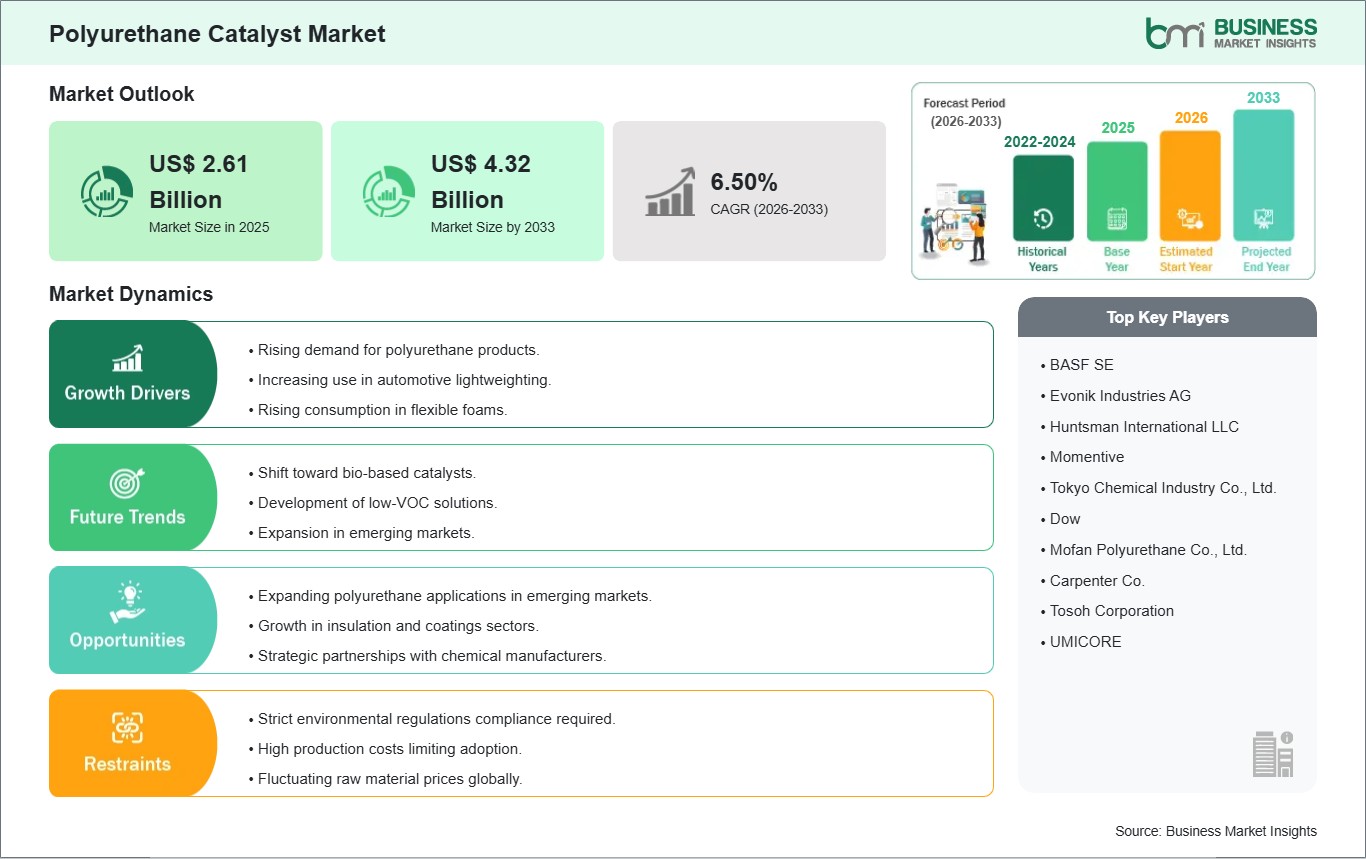
The Polyurethane Catalyst Market size is expected to reach US$ 4.32 billion by 2033 from US$ 2.61 billion in 2025. The market is estimated to record a CAGR of 6.50% from 2026 to 2033.
The polyurethane catalyst market is witnessing high momentum with industry participants and consumers aiming to seek more efficient and performance-driven chemical solutions in the production of polyurethane. Catalysts are the defining factor in the production of polyurethane, as they are used to influence the rate of reaction, strength, and quality of the final product used in the production of polyurethane-based materials. With the increasing demand for polyurethane-based products in diversified industry segments, especially automotive, construction, and consumer electronics, the market for catalysts is witnessing an expanded base.
The major factors driving the catalyst market are urbanization, construction activity, and the increasing need for catalyst-based materials with high functionality. On the supply side, innovation in catalyst-based materials, especially low-emission catalysts, is driving significant changes in the competitive landscape. Industry participants are focusing on developing catalyst-based materials with high reactivity at lower concentration levels. The need to comply with environmental regulations, especially in developed nations, is driving significant changes in the catalyst market, with industry participants shifting focus to more environmentally friendly catalysts, especially bismuth and zinc-based catalysts, thus catalyzing significant changes in the catalyst market. In addition, the development and application of advanced catalysts, especially in the production of high-resilience flexible foams and quick-curing coatings, have affected the product portfolios, especially in the upstream sector. The changing nature and extent of end-use market demand also highlight the importance of strategic segmentation. In the automotive sector, catalysts for the production of lightweight PU composites play an important role in the electrification and fuel efficiency drive.
Similarly, in the construction sector, catalysts that enhance the performance of rigid foam insulation are vital in the compliance drive with thermal efficiency standards. However, the market is also affected by challenges related to the volatility of raw material costs and the need to ensure compliance with safety standards. The market is also affected by the global supply chain realignment, especially in the post-COVID scenario, where the focus is on local production and inventory strategies. The market is shifting towards performance differentiation, sustainability compliance, and high-value customized solutions in the polyurethane catalyst market.
The market is characterized by high competitiveness, driven less by cost factors and more by technological capabilities, compliance with regulations, and innovation portfolio diversification.

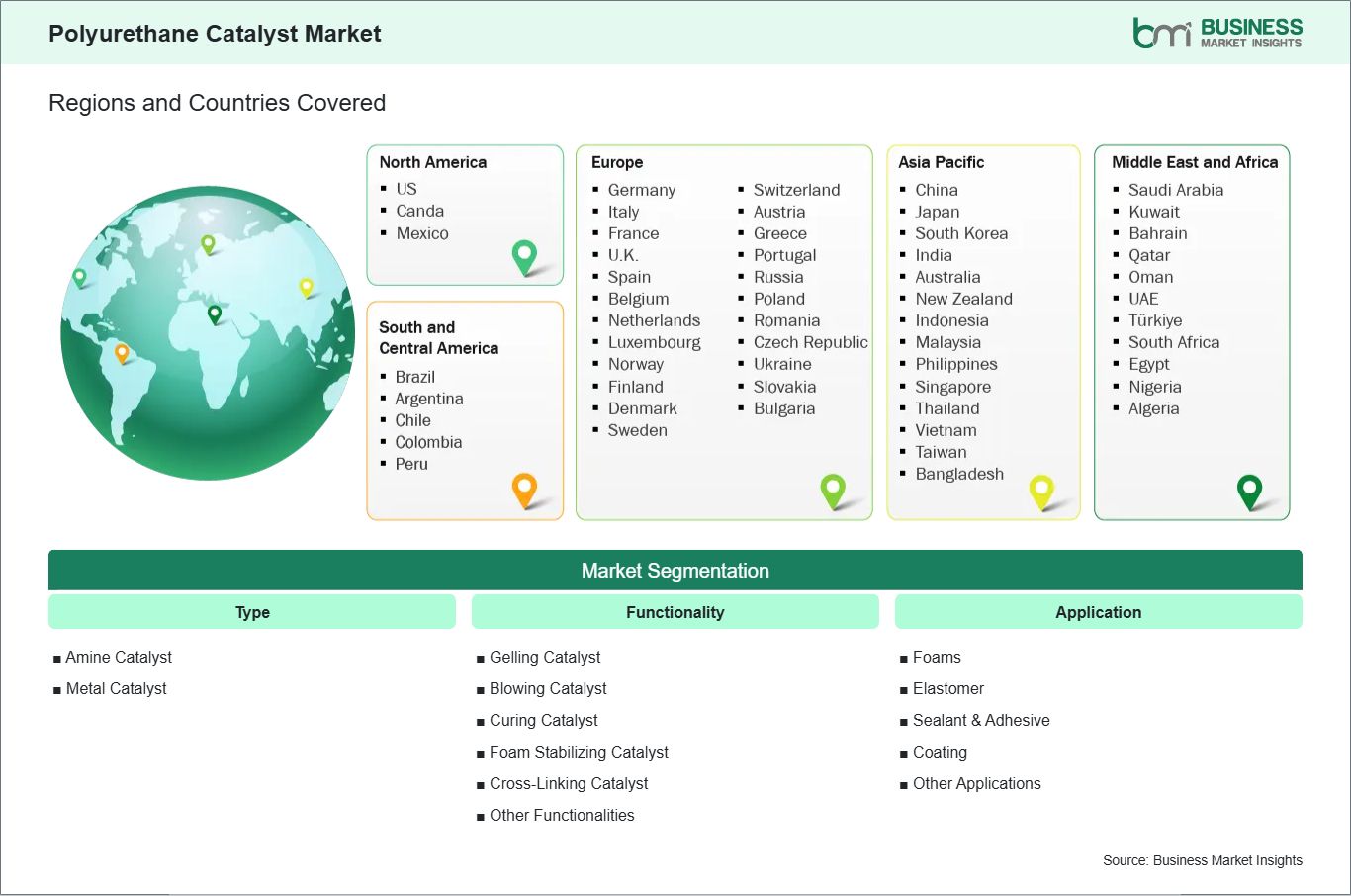
Key segments that contributed to the derivation of the polyurethane catalyst market analysis are type, functionality, and application.
The main driving factor for the market of polyurethane catalysts is the increasing demand for flexible and rigid polyurethane products. Polyurethane catalysts are required for speeding up chemical reactions for producing polyurethane-based foams, coatings, adhesives, and elastomers. Flexible foams are utilized for mattress comfort, furniture cushioning, and automotive interiors. Rigid foams are utilized for building insulation, refrigerator insulation, and cold storage. The increasing requirement for energy-efficient building insulation products and lightweight yet strong products is driving the market for PU catalysts, which help in producing high-quality products and reduce production time.
The construction industry's emphasis on green and energy-efficient buildings is another factor supporting this market driver. Polyurethane-based foams have high thermal insulation properties, and catalysts help in maintaining this property for building construction. In the automotive industry, lightweight PU-based products help in achieving better fuel efficiency and lowering emissions, thus supporting environmental regulations. The wide range of applications for PU-based products in various industries, along with global urbanization and industrialization trends, continues to support the market for catalysts for high-performance PU-based products.
Technological advancements in catalyst formulations also reinforce market growth. Modern PU catalysts allow precise control over reaction rates, reduce volatile organic compound emissions, and enhance foam properties such as density and resilience. These innovations make PU catalysts more attractive for large-scale industrial applications, including specialty coatings, adhesives, and high-performance elastomers. The combination of rising PU product demand, industrial adoption, and advanced catalyst technologies positions the growing need for polyurethane products as a major driver of the global polyurethane catalyst market.
The catalyst market for polyurethane is an opportunity, as the market for polyurethane is expected to increase in the Asia-Pacific, Latin American, and Middle Eastern regions. The urbanization and industrialization growth in these regions has led to an increase in the construction, automotive, and furniture industries. The growth in the construction, automotive, and furniture industries is expected to drive the market for polyurethane foams, coatings, and adhesives. The catalyst is very important in the production of high-quality PU materials, and the production is done in the most efficient way possible. The catalyst is important in the production of PU because it helps in faster curing and production yield.
Government policies are also an opportunity, as the government is giving incentives to companies to build energy-efficient buildings, and the use of rigid PU foams is on the rise. The government is also giving incentives to companies to make lighter automobiles, and this is driving the market for flexible PU foams. The companies can take advantage of the fact that the production cost is lower, and the supply chain is well-organized.
Innovations in catalyst technology, such as low-emission, bio-based, or specialty catalysts, allow manufacturers to meet environmental regulations while enabling advanced PU applications. By focusing on emerging markets and sustainable solutions, companies can capitalize on the growing adoption of polyurethane products and establish long-term growth opportunities. The combination of rising demand, supportive policies, and innovative catalysts positions emerging markets as a key growth avenue for the polyurethane catalyst industry.
The polyurethane catalyst market demonstrates steady growth, with size and share analysis highlighting evolving trends and competitive dynamics among key players. The report examines subsegments categorized within type, functionality, and application, offering insights into their contribution to overall market performance.
By Type, the amine catalyst subsegment dominated the market in 2025, driven by its high efficiency in polyurethane reactions and broad industrial applicability.
Based on Functionality, the gelling catalyst subsegment dominated the market in 2025, owing to its crucial role in controlling the reaction rate and properties of polyurethane products.
On the basis of Application, the foams subsegment dominated the market in 2025, propelled by the high demand for rigid and flexible polyurethane foams across construction, automotive, and furniture sectors.
| Report Attribute | Details |
|---|---|
| Market size in 2025 | US$ 2.61 Billion |
| Market Size by 2033 | US$ 4.32 Billion |
| Global CAGR (2026 - 2033) | 6.50% |
| Historical Data | 2022-2024 |
| Forecast period | 2026-2033 |
| Segments Covered | By Type
|
|
Regions and Countries Covered
| |
| North America | US, Canada, Mexico |
| Europe | Belgium, Austria, Finland, Denmark, Greece, Poland, Romania, Russia, Ukraine, Czech Republic, Slovakia, Bulgaria, Italy, Luxembourg, Germany, Switzerland, France, Netherlands, Norway, Portugal, Spain, Sweden, United Kingdom |
| Asia-Pacific | Australia, China, India, Japan, South Korea, Indonesia, Malaysia, Philippines, Singapore, Thailand, Vietnam, Bangladesh, New Zealand, Taiwan |
| South and Central America | Brazil, Argentina, Peru, Chile, Colombia |
| Middle East and Africa | Bahrain, Kuwait, Oman, Qatar, Saudi Arabia, United Arab Emirates, Turkiye, South Africa, Egypt, Algeria, Nigeria |
| Market leaders and key company profiles |
|
The "Polyurethane Catalyst Market Size and Forecast (2022 - 2033)" report provides a detailed analysis of the market covering below areas:
The geographical scope of the Polyurethane Catalyst Market report is divided into North America, Asia Pacific, Europe, Middle East & Africa, and South & Central America. North America held the largest share in 2025.
The global polyurethane catalyst market exhibits strong regional variation, with North America maintaining a dominant position due to its advanced industrial base, established chemical infrastructure, and high adoption across automotive, construction, and electronics industries. The region benefits from significant R&D capabilities, stringent regulatory standards, and growing demand for electric vehicles and energy-efficient construction materials, all of which drive the use of high-performance, low-VOC, and environmentally compliant catalysts.
North American manufacturers are increasingly investing in localized production, supply chain optimization, and collaborative innovation with end-users to create application-specific solutions that maximize performance and efficiency. Asia Pacific represents the fastest-growing regional market, driven by rapid industrialization, urbanization, and large-scale manufacturing in automotive, electronics, and construction sectors. Demand is supported by high-volume PU production, cost-sensitive markets, and increasing interest in eco-friendly catalysts, with local manufacturers expanding production capacities and forming strategic partnerships with global suppliers to meet domestic and international requirements.
In Europe, the market is shaped by stringent environmental regulations, sustainability mandates, and electrification trends in automotive and construction industries, leading to the adoption of high-precision, low-emission catalyst technologies that deliver consistent quality and regulatory compliance. Middle East & Africa is an emerging market, where growth is driven by infrastructure development, industrial diversification, and energy projects, particularly for PU insulation, corrosion-resistant coatings, and industrial foams. Limited local production and dependence on imports constrain market expansion, but ongoing investment in chemical manufacturing is gradually improving accessibility and adoption.
South & Central America shows moderate growth, with demand primarily from automotive, construction, and consumer goods sectors. Adoption is influenced by industrial investment cycles, economic conditions, and raw material availability, with manufacturers increasingly seeking catalysts that improve processing efficiency, mechanical performance, and thermal resistance. Overall, the global polyurethane catalyst market is characterized by regional specialization, where North America leads in technology and compliance, Asia Pacific drives volume growth, Europe emphasizes sustainability and precision, and emerging regions show gradual adoption aligned with industrial development and infrastructure investment.

The Polyurethane Catalyst Market is evaluated by gathering qualitative and quantitative data post primary and secondary research, which includes important corporate publications, association data, and databases. A few of the key developments in the polyurethane catalyst market are:
The Polyurethane Catalyst Market is valued at US$ 2.61 Billion in 2025, it is projected to reach US$ 4.32 Billion by 2033.
As per our report Polyurethane Catalyst Market, the market size is valued at US$ 2.61 Billion in 2025, projecting it to reach US$ 4.32 Billion by 2033. This translates to a CAGR of approximately 6.50% during the forecast period.
The Polyurethane Catalyst Market report typically cover these key segments-
The historic period, base year, and forecast period can vary slightly depending on the specific market research report. However, for the Polyurethane Catalyst Market report:
The Polyurethane Catalyst Market is populated by several key players, each contributing to its growth and innovation. Some of the major players include:
The Polyurethane Catalyst Market report is valuable for diverse stakeholders, including:
Essentially, anyone involved in or considering involvement in the Polyurethane Catalyst Market value chain can benefit from the information contained in a comprehensive market report.
Please tell us your area of interest
(Market Segments/ Regions and Countries/ Companies)