Precious Metal Catalysts Market Outlook (2022-2033)

Historic Data: 2022-2024   |   Base Year: 2025   |   Forecast Period: 2026-2033
Report Content: Market Scope, Market Segmentation, Market Dynamics, and Competitive Analysis

Report Coverage:
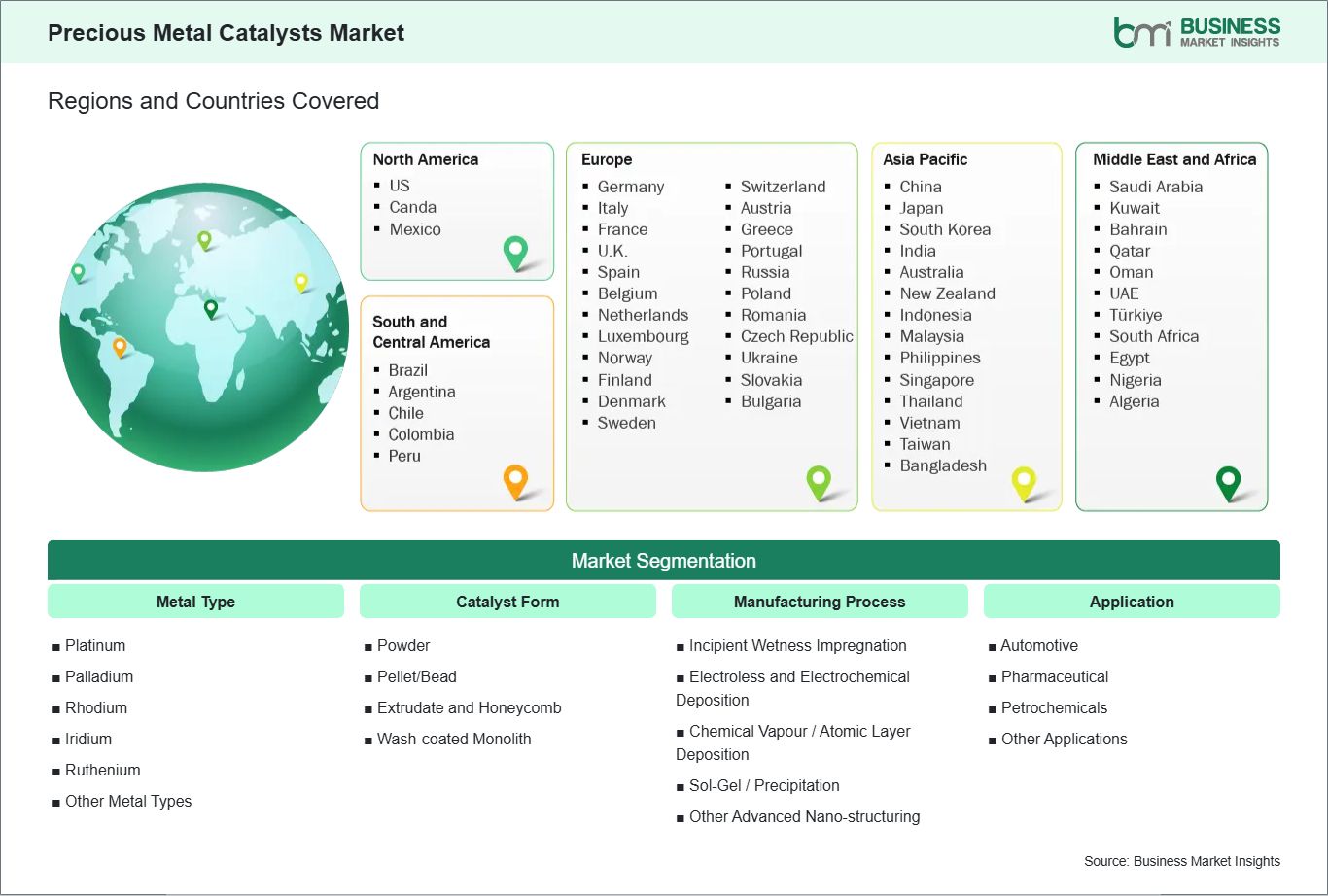
  • Metal Type (Platinum, Palladium, Rhodium, Iridium, Ruthenium, Other Metal Types)
  • Catalyst Form (Powder, Pellet/Bead, Extrudate and Honeycomb, Wash-coated Monolith)
  • Manufacturing Process (Incipient Wetness Impregnation, Electroless and Electrochemical Deposition, Chemical Vapour / Atomic Layer Deposition, Sol-Gel / Precipitation, Other Advanced Nano-structuring)
  • Application (Automotive, Pharmaceutical, Petrochemicals, Other Applications)

No. of Pages: 385
Report Code: BMIPUB00034210
Category: Chemicals and Materials
Precious Metal Catalysts Market

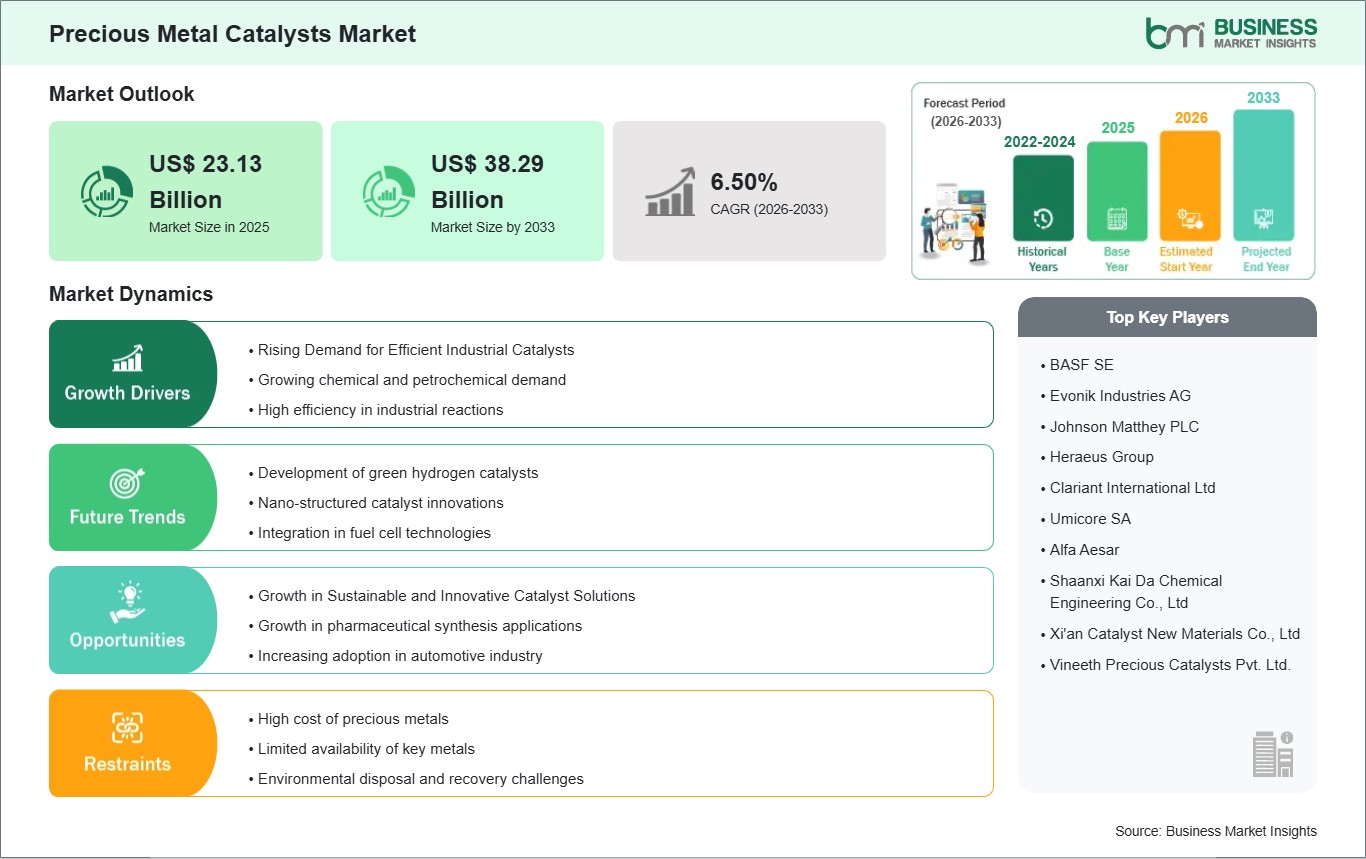
The Precious Metal Catalysts Market size is expected to reach US$ 38.29 billion by 2033 from US$ 23.13 billion in 2025. The market is estimated to record a CAGR of 6.50% from 2026 to 2033.

Executive Summary and Global Market Analysis:

The precious metal catalysts market is undergoing significant changes as industrial users focus on efficiency, sustainability, and following regulations in chemical processing, petrochemicals, and emission control. Precious metal catalysts mainly consist of platinum, palladium, rhodium, and other noble metals. They are essential for enabling selective reactions, increasing product yield, and reducing energy use in crucial industrial processes.

In the automotive sector, stricter global emissions regulations continue to boost demand for three-way and oxidation catalysts that lower NOx, CO, and hydrocarbon emissions. At the same time, refining and petrochemical operations are investing in catalytic solutions that aid in processing heavier crude and producing hydrogen. This highlights the important role of noble metal technologies in improving feedstock conversion and profit margins. From a competitive and innovation perspective, companies are concentrating on optimizing materials and improving manufacturing processes to reduce the effects of fluctuating metal prices and supply chain issues. Their strategies include developing alloys to enhance activity and durability, implementing catalyst recycling programs to recover and reuse precious metals, and integrating digital tools for process monitoring to maintain catalyst performance and manage their lifecycle.

Moreover, the shift towards clean energy technologies, like fuel cells and green hydrogen production, is increasing the need for specialized catalysts that facilitate low-temperature reforming and electrochemical reactions with high catalytic specificity. However, the market faces challenges related to rising raw material costs, geopolitical factors affecting metal supply, and the high costs of catalyst production facilities. Regulatory pressures concerning sustainable practices and waste management are also influencing product offerings, leading manufacturers to create recyclable and lower precious content formulations. Despite these challenges, key demand drivers such as decarbonization goals, improvements in industrial processes, and automotive emissions regulations support the ongoing importance of precious metal catalysts and hint at strong growth prospects for the market in the medium to long term.

Precious Metal Catalysts Market - Strategic Insights:

global-market-strategic-framework
Get more information on this report

Precious Metal Catalysts Market Segmentation Analysis:

Key segments that contributed to the derivation of the precious metal catalysts market analysis are metal type, catalyst form, manufacturing process, and application.

By Metal Type, the precious metal catalysts market is segmented into platinum, palladium, rhodium, iridium, ruthenium, and other metal types. The platinum segment dominated the market in 2025.

Based on Catalyst Form, the precious metal catalysts market is classified into powder, pellet/bead, extrudate and honeycomb, and wash‑coated monolith. The wash‑coated monolith segment dominated the market in 2025.

On the Basis of Manufacturing Process, the precious metal catalysts market is segmented into incipient wetness impregnation, electroless and electrochemical deposition, chemical vapour/atomic layer deposition, sol‑gel/precipitation, and other advanced nano‑structuring. The incipient wetness impregnation segment dominated the market in 2025.

In Terms of Application, the precious metal catalysts market is segmented into automotive, pharmaceutical, petrochemicals, and other applications. The automotive segment dominated the market in 2025.

Precious Metal Catalysts Market Drivers and Opportunities:

Rising Demand for Efficient Industrial Catalysts

The precious metal catalysts market is growing steadily because of the increasing demand for effective and high-performance catalysts in various industrial applications. Precious metal catalysts, which usually contain platinum, palladium, and rhodium, are vital for speeding up chemical reactions while staying stable under high temperature and pressure. Industries depend on these catalysts to improve process efficiency, lower energy use, and increase product yield. This makes them crucial in chemical manufacturing, petroleum refining, and environmental control technologies.

Besides improving efficiency, precious metal catalysts are appreciated for their durability and ability to work in tough operational settings. They are commonly used in automotive catalytic converters, fuel cells, and emission control systems to cut harmful emissions and meet strict environmental standards. The growing focus on cleaner technologies and energy-efficient operations has boosted the use of these catalysts. Industries look for materials that can maintain their performance over long periods while providing consistent and reliable results, which has further driven global demand.

Progress in industrial automation and chemical processing is also contributing to market growth. Manufacturers increasingly need catalysts that can provide predictable reaction rates, enhance selectivity, and minimize by-product formation. The unique chemical properties of precious metal catalysts allow them to meet these needs effectively. As companies prioritize efficiency, regulatory compliance, and sustainability, the demand for precious metal catalysts is expected to stay strong, leading to continued growth in the global industrial market.

Growth in Sustainable and Innovative Catalyst Solutions

The market for precious metal catalysts is gaining from new ideas aimed at sustainability, efficiency, and cost-effectiveness. Researchers and manufacturers are creating better catalyst formulations that optimize metal use, reduce waste, and extend product life. Innovations like supported catalysts, nanoparticle designs, and hybrid materials are helping to improve reaction efficiency and selectivity while lowering the environmental impact. These developments match the increasing focus on cleaner production methods and resource conservation in various industries.

There is growing interest in catalysts for renewable energy applications, such as fuel cells, hydrogen production, and biofuel processing. Precious metal catalysts play a vital role in driving chemical reactions in these new sectors, promoting both innovation and acceptance. New formulations that boost durability and lower the amount of precious metal needed are making broader applications and cost-effective scaling possible. Integrating advanced catalyst designs into industrial processes leads to better energy use and reduced emissions.

Sustainability is shaping production and application strategies. Companies are looking into recycling techniques, recovery methods, and better catalyst deployment to maximize efficiency and minimize environmental harm. The combination of performance, durability, and environmentally friendly design makes precious metal catalysts essential in today’s industrial operations. Continued emphasis on innovation and sustainability should create long-term growth opportunities, strengthening the market's position in global chemical, energy, and environmental sectors.

Precious Metal Catalysts Market Size and Share Analysis:

The precious metal catalysts market demonstrates steady growth, with size and share analysis highlighting evolving trends and competitive dynamics among key players. The report examines subsegments categorized within metal type, catalyst form, manufacturing process, and application, offering insights into their contribution to overall market performance.

By Metal Type, the platinum subsegment dominated the market in 2025, driven by its extensive use in catalytic converters and chemical reactions.

Based on Catalyst Form, the wash‑coated monolith subsegment dominated the market in 2025, owing to its efficiency and durability in automotive and industrial applications.

On the Basis of Manufacturing Process, the incipient wetness impregnation subsegment dominated the market in 2025, supported by its scalability and cost-effectiveness.

In Terms of Application, the automotive subsegment dominated the market in 2025, propelled by stringent emission regulations and high adoption of catalytic converters worldwide.

Precious Metal Catalysts Market Report Highlights:

Report Attribute Details
Market size in 2025 US$ 23.13 Billion
Market Size by 2033 US$ 38.29 Billion
Global CAGR (2026 - 2033)6.50%
Historical Data 2022-2024
Forecast period 2026-2033
Segments Covered By Metal Type
  • Platinum
  • Palladium
  • Rhodium
  • Iridium
  • Ruthenium
  • Other Metal Types
By Catalyst Form
  • Powder
  • Pellet/Bead
  • Extrudate and Honeycomb
  • Wash-coated Monolith
By Manufacturing Process
  • Incipient Wetness Impregnation
  • Electroless and Electrochemical Deposition
  • Chemical Vapour / Atomic Layer Deposition
  • Sol-Gel / Precipitation
  • Other Advanced Nano-structuring
By Application
  • Automotive
  • Pharmaceutical
  • Petrochemicals
  • Other Applications
Regions and Countries Covered
North America US, Canada, Mexico
Europe Belgium, Austria, Finland, Denmark, Greece, Poland, Romania, Russia, Ukraine, Czech Republic, Slovakia, Bulgaria, Italy, Luxembourg, Germany, Switzerland, France, Netherlands, Norway, Portugal, Spain, Sweden, United Kingdom
Asia-Pacific Australia, China, India, Japan, South Korea, Indonesia, Malaysia, Philippines, Singapore, Thailand, Vietnam, Bangladesh, New Zealand, Taiwan
South and Central America Brazil, Argentina, Peru, Chile, Colombia
Middle East and Africa Bahrain, Kuwait, Oman, Qatar, Saudi Arabia, United Arab Emirates, Turkiye, South Africa, Egypt, Algeria, Nigeria
Market leaders and key company profiles
  • BASF SE
  • Evonik Industries AG
  • Johnson Matthey PLC
  • Heraeus Group
  • Clariant International Ltd
  • Umicore SA
  • Alfa Aesar
  • Shaanxi Kai Da Chemical Engineering Co., Ltd
  • Xi’an Catalyst New Materials Co., Ltd
  • Vineeth Precious Catalysts Pvt. Ltd.
Get more information on this report

Precious Metal Catalysts Market Report Coverage and Deliverables:

The "Precious Metal Catalysts Market Size and Forecast (2022 - 2033)" report provides a detailed analysis of the market covering below areas:

  • Precious Metal Catalysts Market size and forecast at global, regional, and country levels for all the key market segments covered under the scope
  • Precious Metal Catalysts Market trends, as well as drivers, restraints, and opportunities
  • Precious Metal Catalysts Market analysis covering key trends, global and regional framework, major players, regulations, and recent developments
  • Industry landscape and competition analysis covering market concentration, heat map analysis, prominent players, and recent developments for the Precious Metal Catalysts Market
  • Detailed company profiles, including SWOT analysis

Precious Metal Catalysts Market Geographic Insights:

The geographical scope of the Precious Metal Catalysts Market report is divided into North America, Asia Pacific, Europe, Middle East & Africa, and South & Central America. North America held the largest share in 2025.

Regional‑level dynamics in the precious metal catalysts market reveal distinct patterns of demand, industrial focus, and regulatory influence across major geographies. In North America, the market maintains a strong leadership position supported by diversified industrial portfolios, advanced automotive manufacturing, and stringent environmental regulations driving adoption of high‑performance emission control catalysts. The USA, in particular, has benefited from the development of petrochemical clusters and the historic focus on catalyst development, which has enabled manufacturers to incorporate precision catalyst systems that improve reaction selectivity and equipment availability.

North America has also benefited from its well-developed service markets, recycling infrastructure, and the historic relationship between catalyst suppliers and end-users. Europe has benefited from steady demand driven by regulations such as the Euro emissions regulations and the circular economy initiatives that promote high-efficiency catalyst solutions and the recycling of precious metals. Germany, France, and the United Kingdom lead regional adoption, particularly in automotive exhaust systems, industrial oxidation processes, and chemical synthesis operations. European manufacturers are actively advancing low‑metal‑loading catalyst technologies to balance performance with cost pressures. In the Asia Pacific, rapid industrial growth, expanding automotive output, and burgeoning refining capacity in China, India, and South Korea are primary growth drivers. Government spending on emission reduction projects and renewable energy projects, including fuel cell and hydrogen-based economies, is creating regional demand for catalysts on a massive scale.

In the Middle East & Africa region, catalysts are linked with petrochemical production capacity additions, refinery upgrades, and gas-to-liquids projects at a measured pace due to infrastructure development in the region. Saudi Arabia, UAE, and South Africa form key contributors in this region. South & Central America, comprising countries such as Brazil and Mexico, represents moderate but increasing interest in catalyst technologies driven by emission compliance, industrialization, and refinery upgrades. Trade flows, currencies, and infrastructure development influence regional buying behavior, but a stable agricultural sector and automotive industry ensure consistent demand for precious metal-based catalysts. The above regions illustrate varying levels of maturity in the global precious metal-based catalysts market, driven by regional industrialization priorities, regulatory requirements, and opportunities.

global-market-geography
Get more information on this report

Precious Metal Catalysts Market Research Report Guidance:

  • The report includes qualitative and quantitative data in the Precious Metal Catalysts Market across metal type, catalyst form, manufacturing process, application, and geography.
  • The report starts with the key takeaways (chapter 2), highlighting key trends and outlook of the Precious Metal Catalysts Market.
  • Chapter 3 focuses on the research methodology of the study.
  • Chapter 4 includes ecosystem analysis.
  • Chapter 5 highlights the major industry dynamics in the Precious Metal Catalysts Market, including factors that are driving the market, prevailing deterrents, potential opportunities, as well as future trends. Impact analysis of these drivers and restraints is also covered in this section.
  • Chapter 6 discusses the Precious Metal Catalysts Market scenario, in terms of historical market revenues, and forecast till the year 2033.
  • Chapters 7 to 11 cover Precious Metal Catalysts Market segments across metal type, catalyst form, manufacturing process, application, and geography across North America, Asia Pacific, Europe, the Middle East & Africa, and South & Central America. They cover the market revenue forecast and factors driving the market.
  • Chapter 12 describes the competitive analysis along with the heat map analysis for the key players operating in the market.
  • Chapter 13 describes the industry landscape analysis. It provides detailed descriptions of business activities such as market initiatives, new developments, mergers, and joint ventures globally, along with a competitive landscape.
  • Chapter 14 provides detailed profiles of the major companies operating in the Precious Metal Catalysts Market. Companies have been profiled on the basis of their key facts, business descriptions, products, financial overview, SWOT analysis, and key developments.
  • Chapter 15, i.e., the appendix, is inclusive of a brief overview of the company, a list of abbreviations, and a disclaimer.

Precious Metal Catalysts Market News and Key Development:

The Precious Metal Catalysts Market is evaluated by gathering qualitative and quantitative data post primary and secondary research, which includes important corporate publications, association data, and databases. A few of the key developments in the precious metal catalysts market are:

  • In May 2025, Johnson Matthey announced it agreed to sell its Catalyst Technologies business to Honeywell International for US$2.4 billion a strategic move that will see the division integrated into Honeywell’s UOP unit, expanding its offerings in lower‑emission fuel and chemical catalyst solutions, while Johnson Matthey refocuses on core clean‑air and platinum‑group‑metal processing activities.
  • In November 2025, BASF Environmental Catalyst and Metal Solutions opened a new green hydrogen and fuel cell component production facility in Budenheim, Germany, enhancing its capacity in PEM electrolyzer and fuel cell catalysts which rely on precious metals for sustainable energy technologies.

Key Sources Referred:

  • International Organization for Standardization (ISO)
  • American Society for Testing and Materials (ASTM International)
  • Bureau of Indian Standards (BIS)
  • Environmental Protection Agency (EPA), USA
  • European Chemicals Agency (ECHA)
  • Central Pollution Control Board (CPCB), India
  • Ministry of Chemicals and Fertilizers, India
  • American Chemistry Council (ACC)
  • Indian Chemical Council (ICC)
  • European Chemical Industry Council (Cefic)
  • Specialty Chemical Association of India (SCAI)
  • Company Websites
  • Company Annual Reports
  • Company Investor Presentations
The List of Companies - Precious Metal Catalysts Market
  • BASF SE
  • Evonik Industries AG
  • Johnson Matthey PLC
  • Heraeus Group
  • Clariant International Ltd
  • Umicore SA
  • Alfa Aesar
  • Shaanxi Kai Da Chemical Engineering Co., Ltd
  • Xi’an Catalyst New Materials Co., Ltd
  • Vineeth Precious Catalysts Pvt. Ltd.
Frequently Asked Questions
How big is the Precious Metal Catalysts Market?

The Precious Metal Catalysts Market is valued at US$ 23.13 Billion in 2025, it is projected to reach US$ 38.29 Billion by 2033.

What is the CAGR for Precious Metal Catalysts Market by (2026 - 2033)?

As per our report Precious Metal Catalysts Market, the market size is valued at US$ 23.13 Billion in 2025, projecting it to reach US$ 38.29 Billion by 2033. This translates to a CAGR of approximately 6.50% during the forecast period.

What segments are covered in this report?

The Precious Metal Catalysts Market report typically cover these key segments-

  • Metal Type (Platinum, Palladium, Rhodium, Iridium, Ruthenium, Other Metal Types)
  • Catalyst Form (Powder, Pellet/Bead, Extrudate and Honeycomb, Wash-coated Monolith)
  • Manufacturing Process (Incipient Wetness Impregnation, Electroless and Electrochemical Deposition, Chemical Vapour / Atomic Layer Deposition, Sol-Gel / Precipitation, Other Advanced Nano-structuring)
  • Application (Automotive, Pharmaceutical, Petrochemicals, Other Applications)

What is the historic period, base year, and forecast period taken for Precious Metal Catalysts Market?

The historic period, base year, and forecast period can vary slightly depending on the specific market research report. However, for the Precious Metal Catalysts Market report:

  • Historic Period : 2022-2024
  • Base Year : 2025
  • Forecast Period : 2026-2033
  • Who are the major players in Precious Metal Catalysts Market?

    The Precious Metal Catalysts Market is populated by several key players, each contributing to its growth and innovation. Some of the major players include:

  • BASF SE
  • Evonik Industries AG
  • Johnson Matthey PLC
  • Heraeus Group
  • Clariant International Ltd
  • Umicore SA
  • Alfa Aesar
  • Shaanxi Kai Da Chemical Engineering Co., Ltd
  • Xi’an Catalyst New Materials Co., Ltd
  • Vineeth Precious Catalysts Pvt. Ltd.
  • Who should buy this report?

    The Precious Metal Catalysts Market report is valuable for diverse stakeholders, including:

    • Investors: Provides insights for investment decisions pertaining to market growth, companies, or industry insights. Helps assess market attractiveness and potential returns.
    • Industry Players: Offers competitive intelligence, market sizing, and trend analysis to inform strategic planning, product development, and sales strategies.
    • Suppliers and Manufacturers: Helps understand market demand for components, materials, and services related to concerned industry.
    • Researchers and Consultants: Provides data and analysis for academic research, consulting projects, and market studies.
    • Financial Institutions: Helps assess risks and opportunities associated with financing or investing in the concerned market.

    Essentially, anyone involved in or considering involvement in the Precious Metal Catalysts Market value chain can benefit from the information contained in a comprehensive market report.

    Available Report Formats

    pdf-format excel-format pptx-format
    Buy Now
    Sales Assistance
    +1 646 791 7070 (US & UK)
    Customization Form

    Please tell us your area of interest
    (Market Segments/ Regions and Countries/ Companies)