Market Summary
Executive Summary and Global Market Analysis
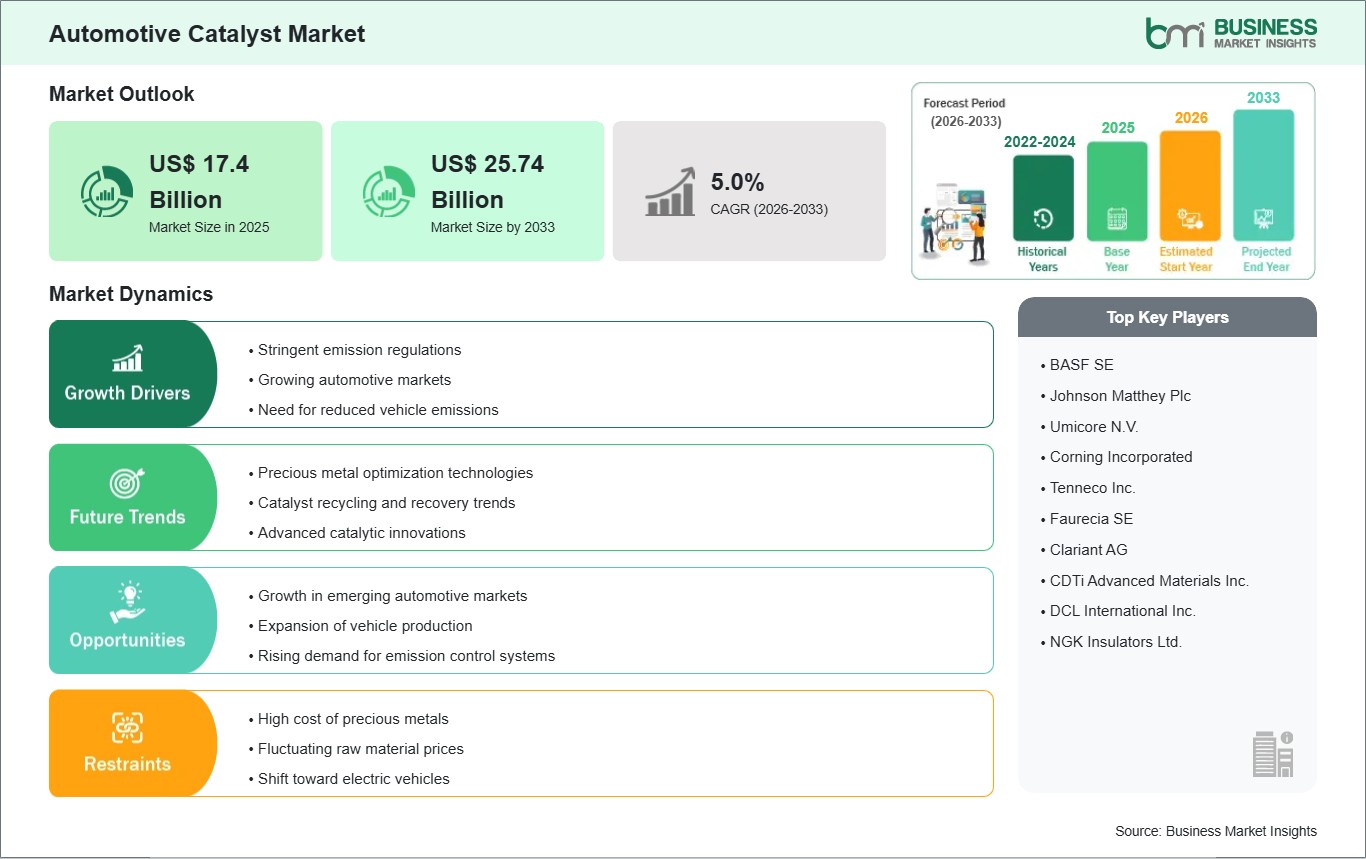
The global automotive catalyst market is defined by its critical role in reducing harmful emissions from internal combustion engine vehicles. Automotive catalysts are essential components of emission control systems, converting toxic gases such as carbon monoxide, hydrocarbons, and nitrogen oxides into less harmful substances. These catalysts primarily rely on precious metals such as platinum, palladium, and rhodium to facilitate chemical reactions within catalytic converters.
The market is experiencing steady growth driven by increasingly stringent emission regulations imposed by governments worldwide. Regulatory frameworks aimed at reducing air pollution and greenhouse gas emissions are compelling automakers to adopt advanced catalytic technologies. Additionally, the continued production and sales of internal combustion engine vehicles, particularly in emerging economies, are sustaining demand for automotive catalysts.
Competitive dynamics in the market are centered on precious metal optimization, cost efficiency, and technological innovation. Manufacturers are focusing on reducing the usage of expensive metals while maintaining catalytic efficiency. Recycling and recovery of precious metals from used catalysts are also gaining importance as a strategy to manage costs and ensure supply sustainability. Strategic collaborations between catalyst manufacturers and automotive OEMs are further shaping the competitive landscape.
Segment Analysis
Automotive Catalyst Market Segmentation
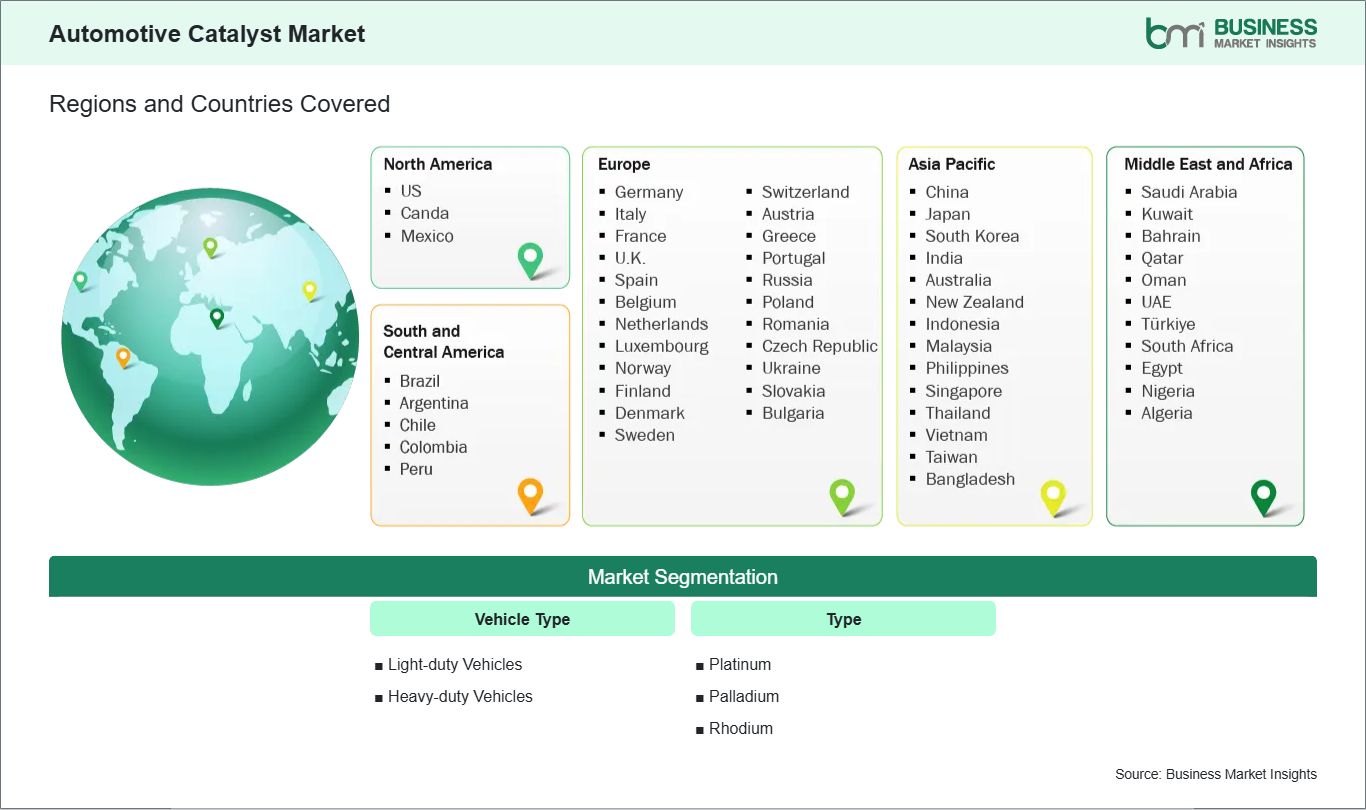
Key segments that contributed to the derivation of the automotive catalyst market analysis are vehicle type and type.
- Based on vehicle type, the automotive catalyst market is segmented into light-duty vehicles and heavy-duty vehicles. The light-duty vehicles segment dominated the market in 2025.
- Based on type, the automotive catalyst market is segmented into platinum, palladium, and rhodium. The palladium segment dominated the market in 2025.
Market Forces
Automotive Catalyst Market Drivers and Opportunities
Stringent Emission Regulations
Demand for automotive catalysts is driven largely by the worldwide implementation of strict emissions regulations. Governments and environmental agencies around the world have imposed stringent regulations on vehicle emissions in order to restrict harmful emissions into the atmosphere. The purpose of these regulations is to create a framework that encourages vehicle manufacturers to develop more sophisticated emissions control technologies. Automotive catalytic converters are an important technology for meeting regulatory requirements, converting toxic emission gases from gasoline and diesel engines into less toxic gases.
The implementation of automobile emission regulations such as Euro (EU) 6/7, Bharat Stage VI, and Tier 3 in the US has led to a significant increase in demand for high performance catalytic converters. As these regulations require higher levels of catalyst activity, the need for precious metals like platinum, palladium, and rhodium increases.
In addition to regulatory compliance, increased awareness among consumers regarding environmental issues is driving the adoption of cleaner automobile technology. As automakers continue to invest in advanced catalyst systems to improve their emissions performance and achieve sustainability goals, the automotive catalyst market will continue to grow at a steady pace in response to tightening global emissions standards.
Growth in Emerging Automotive Markets
The automotive catalyst market will grow significantly because of the increased volume of auto production in newly industrialized countries. Due to increased disposable income, urbanization, and economic development, there will be more vehicle ownership in Asia, Latin America and Africa. The increase in vehicle sales will require emission control systems, such as an automotive catalyst.
With emerging markets continuing to adopt stricter emission control regulations to meet global environmental programs, more automakers will incorporate the latest catalytic technology in vehicles sold and produced in these markets. The demand for heavy-duty vehicles continues to grow in the commercial transportation and logistics areas, which will continue to promote market growth.
The development of new materials and design technologies that increase the efficiency of catalysts will result in more manufacturers creating low-cost product solutions for low-priced markets. In addition to new technologies being developed, an increase in manufacturers' commitment to be sustainable will increase opportunities for investment in catalyst recycling and recovery processes. As emerging nations continue to become industrialized and urbanized, the automotive catalyst market is projected to grow significantly.
Size and Share Analysis
Automotive Catalyst Market Size and Share Analysis
The Automotive Catalyst Market demonstrates steady growth, with size and share analysis highlighting evolving trends and competitive dynamics among key players. The report examines subsegments categorized within vehicle type and type, offering insights into their contribution to overall market performance.
By vehicle type, the light-duty vehicles subsegment dominated the market in 2025, driven by high global production and sales of passenger vehicles.
Based on type, the palladium subsegment dominated the market in 2025, driven by its widespread use in gasoline-powered vehicle catalytic converters.
Report Coverage
Automotive Catalyst Market Report Coverage and Deliverables
The "Automotive Catalyst Market Size and Forecast (2022 - 2033)" report provides a detailed analysis of the market covering below areas:
- Automotive Catalyst Market size and forecast at global, regional, and country levels for all the key market segments covered under the scope
- Automotive Catalyst Market trends, as well as drivers, restraints, and opportunities
- Automotive Catalyst Market analysis covering key trends, global and regional framework, major players, regulations, and recent developments
- Industry landscape and competition analysis covering market concentration, heat map analysis, prominent players, and recent developments for the Automotive Catalyst Market
- Detailed company profiles, including SWOT analysis
Geographic Insights
Automotive Catalyst Market Geographic Insights
The geographical scope of the Automotive Catalyst Market report is divided into North America, Asia Pacific, Europe, Middle East & Africa, and South & Central America. North America held the largest share in 2025.
The adoption and demand for automotive catalysts vary across regions, influenced by vehicle production, regulatory frameworks, and environmental policies. In North America, stringent emission standards and advanced automotive technologies are driving the demand for high-performance catalysts.
In Europe, strict environmental regulations and a strong focus on sustainability are encouraging the adoption of advanced catalytic systems. The region is also witnessing a gradual transition toward electrification, which may impact long-term demand.
Asia Pacific is the dominant and fastest-growing region, driven by large-scale automotive production and increasing vehicle ownership. Countries such as China and India are implementing stricter emission norms, boosting demand for automotive catalysts.
The Middle East & Africa and South & Central America are experiencing moderate growth, supported by increasing vehicle sales and evolving regulatory frameworks. Across all regions, emission standards and automotive industry trends continue to shape market dynamics.
Industry Activity
Recent Developments
The Automotive Catalyst Market is evaluated by gathering qualitative and quantitative data post primary and secondary research, which includes important corporate publications, association data, and databases. A few of the key developments in the automotive catalyst market are:
- In October 2025, BASF SE announced the development of a new tri-metal catalyst system aimed at improving emission reduction efficiency while reducing reliance on high-cost precious metals.
- In June 2025, Johnson Matthey introduced advanced catalytic converter technologies designed to meet upcoming Euro 7 emission standards with enhanced durability and performance.
Trust & Transparency
Research Methodology
The market analysis combines proprietary research with secondary data from government agencies, company disclosures, regulatory filings, industry databases and expert interviews. Market estimates are validated through data triangulation, cross-market benchmarking and analyst
review.
View Full Research Methodology
Key Sources Referred:
International Energy Agency (IEA)Organisation Internationale des Constructeurs d'Automobiles (OICA)European Automobile Manufacturers Association (ACEA)United States Environmental Protection Agency (EPA)World Bank GroupInternational Trade Administration