Polyphenols Market Regional Highlights
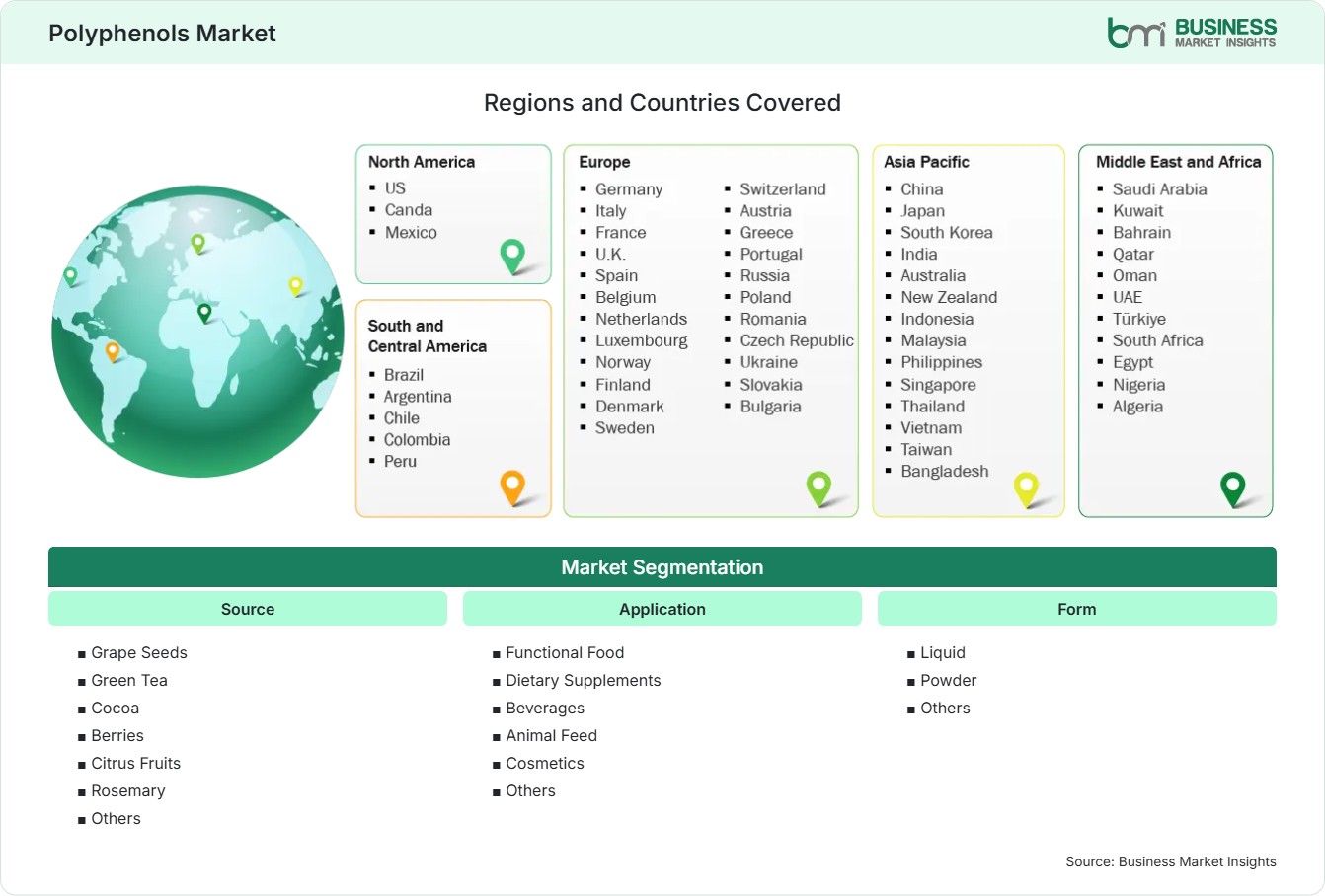
North America Polyphenols Market
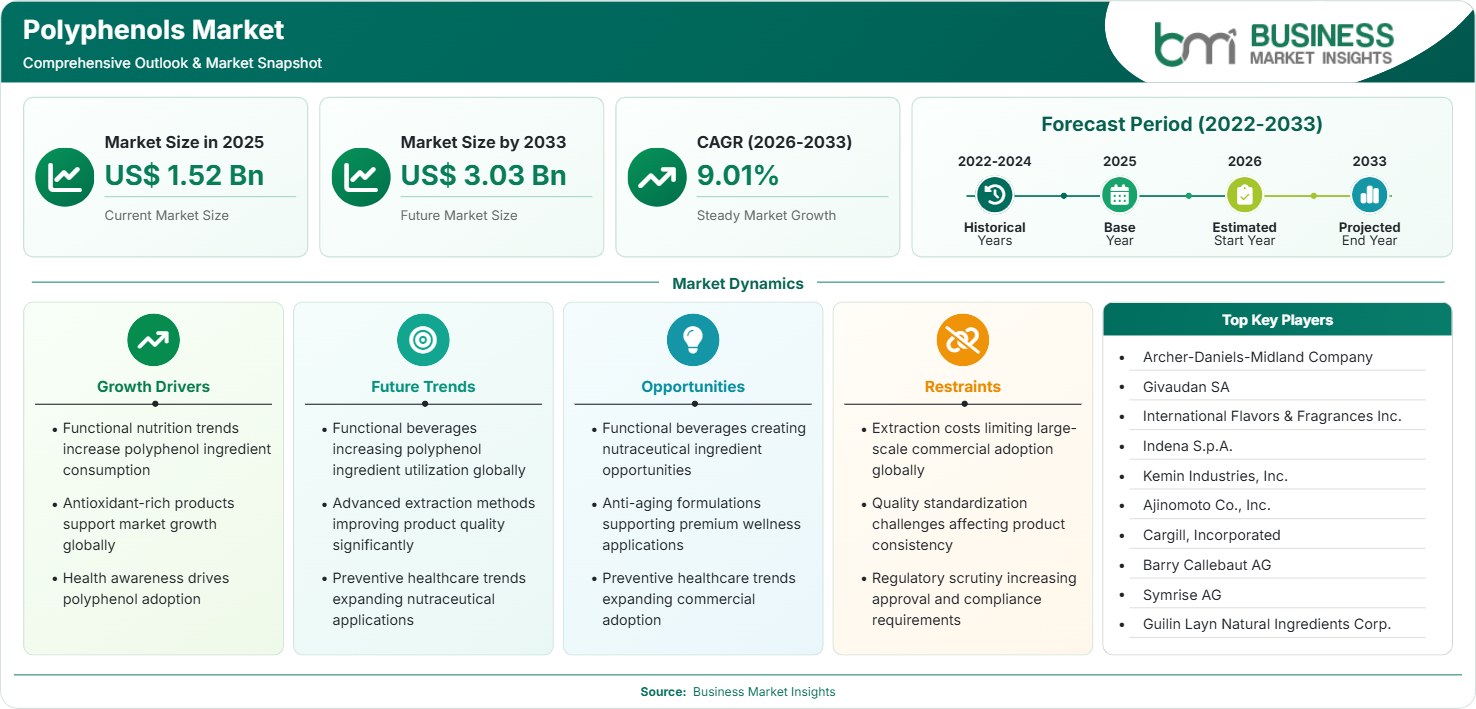
North America accounts for a 24%–27% Polyphenols Market share in 2025 and is projected to expand at a 7.8%–8.8% CAGR through 2033. The region benefits from established dietary supplement channels, sophisticated functional beverage brands, premium nutrition demand, and strong ingredient commercialization capabilities.
- Supplement companies are now adding more combinations of botanicals that link polyphenols with vitamins, minerals, fibers, and other plant-based ingredients, which provides opportunities for suppliers who are able to ensure consistent potency and sensory compatibility.
- The development of functional beverages is focusing on soluble and dispersible extracts since manufacturers are increasingly looking to achieve an antioxidant positioning without making substantial changes to the flavor, appearance, processing requirements, or the way consumers prepare the product.
- Cosmetic formulators are looking into compounds derived from grape, berry, green tea, and rosemary for use in skin-care products which are aimed at providing antioxidant benefits, and as a result there is an increased demand across sectors for standardized extracts and stable formulations.
- Interest in the recovery of agricultural by-products is increasing because of concerns about sustainability, especially in the case of grape seeds and other materials derived from fruit, so that processors can turn the residual biomass into more valuable functional ingredients.
US Polyphenols Market
The US represents approximately 20%–23% of global demand and records a 7.9%–8.9% CAGR during 2026–2033, supported by mature supplement distribution, functional beverages, sports nutrition, and premium personal care. Polyphenols Market share within North America remains dominant because brands can launch differentiated formulations across capsules, powders, gummies, beverages, bars, and beauty products.
- Increasingly, US brands are choosing concentrated botanical ingredients which can be used in gummies, sachets, ready-to-drink products, and capsules, thus increasing the demand for stable extracts with controlled levels of active compounds.
- As people look for plant-based ingredients that will help supplement their overall nutrition and wellness practices without requiring complicated preparation methods, there is an increased range of applications for sports and healthy-aging formulations.
- There is growing demand for botanical antioxidants among premium natural cosmetics, especially when suppliers are able to offer traceability, a standardized composition, formulation support, and sustainability credentials as well as the functional properties of the ingredients.
Europe Polyphenols Market
Europe holds a 22%–25% Polyphenols Market share in 2025 and is expected to advance at an 8.0%–9.0% CAGR through 2033. Germany, France, Italy, and the UK remain leading markets, while Spain and Italy offer strong botanical and agricultural processing ecosystems.
- Germany has a well-developed nutraceutical ecosystem, with an established practice of taking supplements and a specialized system for distributing ingredients, which enables standardized extracts to be used in capsules, powders, functional foods, and beverages.
- France offers a promising opportunity in the field of cosmetics since more high-end beauty manufacturers are increasingly using botanical actives, and advanced ingredient developers place a strong emphasis on traceable sourcing and on extracts that have been scientifically characterized.
- Italy combines its expertise in food processing with that in the development of botanical ingredients, thus creating opportunities for polyphenols obtained from grapes, citrus fruit, berries, and other agricultural sources.
- Spain provides an advantageous base for sourcing grape and citrus materials, since it enables local extraction and the value to be obtained from by-products and at the same time brings the supply chain closer to European ingredient manufacturers.
Asia Pacific Polyphenols Market
Asia Pacific represents a 39%–42% share in 2025 and is forecast to grow at a 10.0%–11.2% CAGR, making it the fastest-growing regional market. Polyphenols Market share is reinforced by regional botanical availability and increasingly sophisticated domestic ingredient suppliers.
- China is combining large-scale botanical processing with the growing production of functional foods and supplements, which creates opportunities for the development of high-volume standardized extracts and blends tailored to specific applications for both domestic and export brands.
- India has strong potential for growth due to the expansion of its nutraceutical manufacturing, its abilities in tea and spice processing, increasing health awareness, and the growing demand for cheap plant-based functional ingredients.
- Japan places a strong emphasis on quality, the accuracy of its formulations, and innovation in the development of functional foods, backing its premium standardized extracts with thorough analytical documentation and consistent sensory properties.
- South Korea offers a highly appealing route into the field of beauty and well-being, especially when it comes to botanical ingredients used in functional beverages, supplements, and sophisticated cosmetic formulations aimed at consumers interested in healthy aging.
Rest of World Polyphenols Market
Rest of World accounts for approximately 8%–11% of global Polyphenols Market demand in 2025 and expands at an 8.5%–9.7% CAGR through 2033. South and Central America benefit from agricultural resources, fruit processing, cocoa production, and expanding wellness consumption.
- By making use of the large amount of agricultural waste available in Brazil—such as that from grapes, citrus fruits, berries, and cocoa—local extraction can be enhanced, helping to promote the manufacture of ingredients locally and thus decreasing the need for imported concentrates.
- Mexico provides opportunities via innovation in beverages, by expanding its range of supplements, and because of its close proximity to customers in North America, enabling suppliers to create regional strategies for production and distribution.
- In the Gulf region, there is a preference for premium supplements and beauty products, which in turn leads to demand for botanical ingredients that are standardized, well documented, easily formulated, and have a clear natural image.
- South Africa has great potential in terms of obtaining and extracting plant-based materials, especially since its native botanical resources can be put to commercial use through responsible cultivation, processing, and international supply agreements.