
Medical Coatings Market Outlook: Size, Share, Trends, Growth Analysis, Competitive Landscape & Forecast, 2026-2033

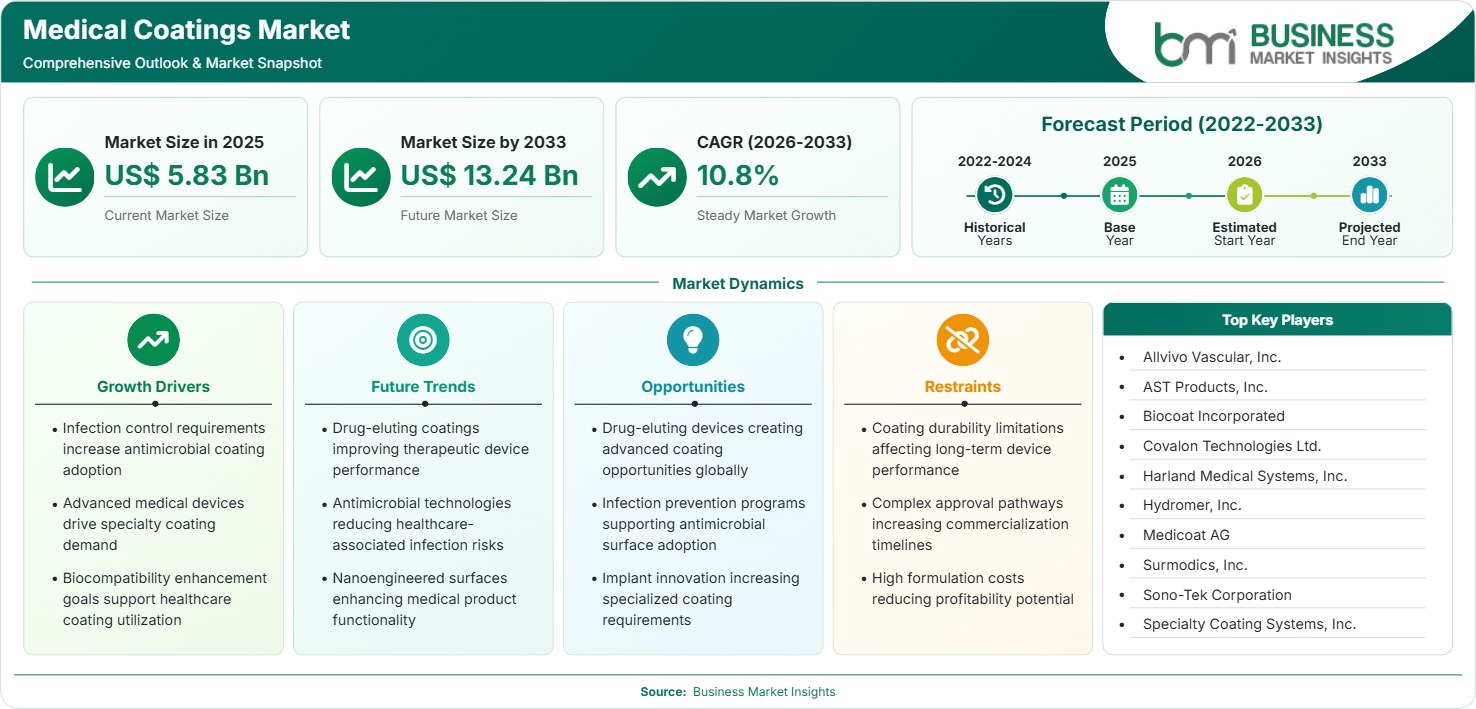
The Medical Coatings Market size was valued at US$ 5.83 Billion in 2025 and is projected to reach US$ 13.24 Billion by 2033, growing at a CAGR of 10.80% during 2026–2033, driven by minimally invasive procedures, infection prevention, implant longevity, surface engineering, and demand for multifunctional coatings.

Report Coverage
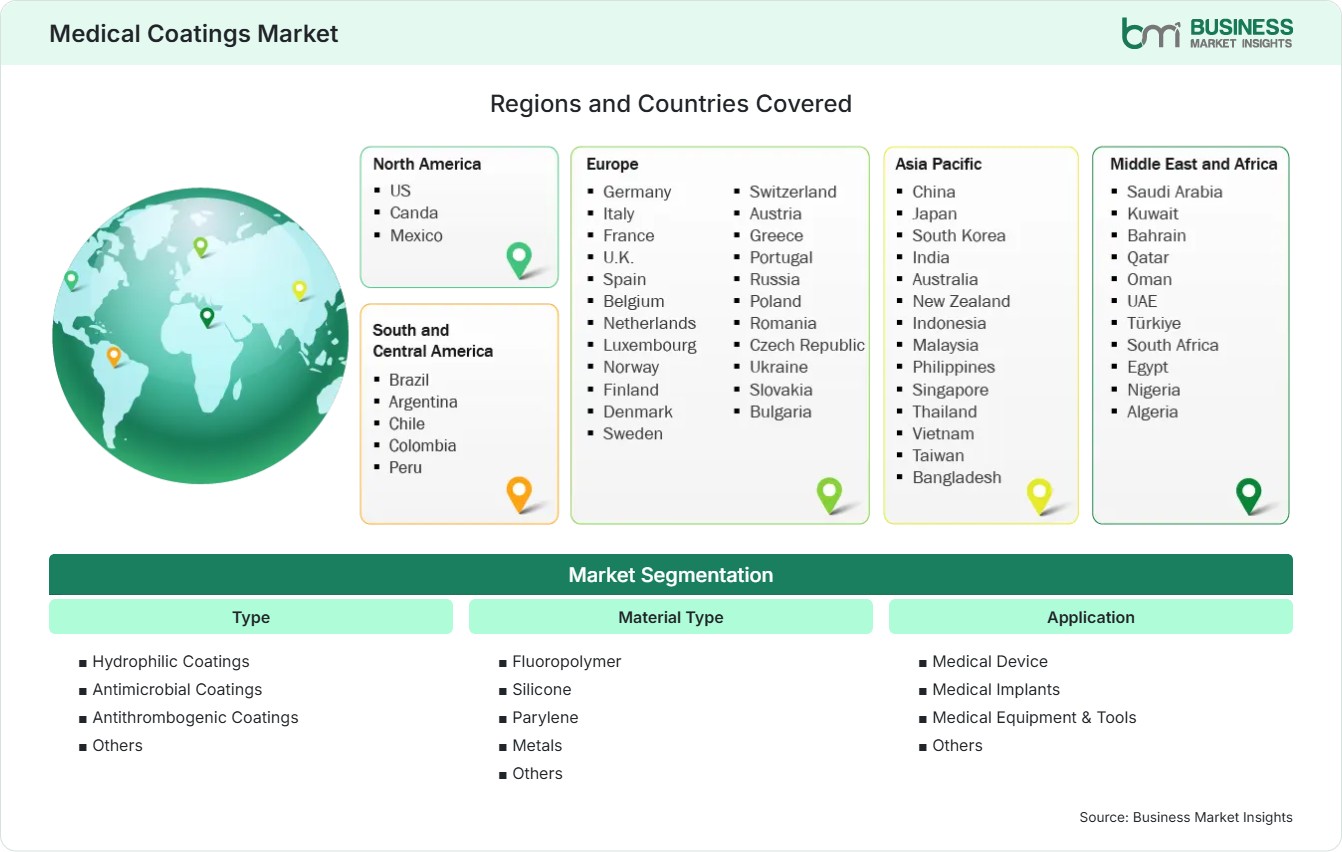
  • Type: Hydrophilic Coatings, Antimicrobial Coatings, Antithrombogenic Coatings, Others
  • Material Type: Fluoropolymer, Silicone, Parylene, Metals, Others
  • Application: Medical Device, Medical Implants, Medical Equipment & Tools, Others
US$ 5.83 Bn Market size in 2025
US$ 13.24 Bn Market Size by 2033
10.8% CAGR, 2026 - 2033
2026-2033 Forecast Period

AI Overview

Medical Coatings Market Summary

  • North America Region: North America holds a market Medical Coatings Market share of 39%–42% in 2025, growing at a CAGR of 10.20%–11.40%, influenced by advanced device manufacturing, strong regulatory infrastructure, coating outsourcing, antimicrobial innovation, and cardiovascular procedures. The US represents most regional demand, supported by sophisticated device manufacturing and extensive adoption of coated catheters and implants, with growth around 10.40%–11.60% during 2026–2033.
  • Fastest Growing Region: Asia Pacific holds a market share of 22%–25% in 2025, growing at a CAGR of 12.00%–14.00%, supported by expanding healthcare infrastructure, medical-device manufacturing, clinical procedure volumes, local production, and increasing investment in advanced surface technologies.
  • Leading Segment: Hydrophilic Coatings hold a market share of 32%–35% in 2025, growing at a CAGR of 10.70%–12.00%, supported by catheterization, guidewire navigation, neurovascular procedures, lower friction requirements, and demand for durable low-particulate surfaces.
  • High Growth Segment: Medical Implants hold a market share of 18%–21% in 2025, growing at a CAGR of 12.20%–14.00%, driven by implant longevity, osseointegration, infection control, corrosion resistance, biocompatibility, and increasing development of multifunctional implant surfaces.
  • Key Market Opportunity: Multifunctional coatings combining lubricity, antimicrobial protection, hemocompatibility, corrosion resistance, and controlled drug release create premium opportunities as device manufacturers seek fewer process steps and stronger clinical performance.
  • Major Market Players: Allvivo Vascular, Inc.; AST Products, Inc.; Biocoat Incorporated; Covalon Technologies Ltd.; Harland Medical Systems, Inc.; Hydromer, Inc.; Medicoat AG; Surmodics, Inc.; Sono-Tek Corporation; Specialty Coating Systems, Inc.
Strategic Insights

Medical Coatings Market: Strategic Insights

Medical Coatings Market Strategic Framework
FREE PDF
Request your free sample
Request free sample
Stakeholder View

Key Takeaways

  • The value chain is increasingly organized around formulation developers, specialty material suppliers, coating equipment providers, contract coating organizations, device manufacturers, testing laboratories, and regulatory specialists.
  • Hydrophilic surfaces remain central to catheter and guidewire performance, while implant applications provide additional upside through antimicrobial, corrosion-resistant, bioactive, and drug-delivery functionality.
  • Coating development is moving toward lower particulate generation, rapid curing, improved substrate adhesion, multifunctional surfaces, PFAS-conscious formulations, and coating architectures engineered around specific device geometries.
  • Asia Pacific presents an important investment opportunity because medical-device manufacturing capacity, healthcare infrastructure, and minimally invasive procedure volumes are expanding simultaneously.
  • Strategic transactions and organizational combinations are strengthening access to coating technologies, engineering capabilities, and commercial manufacturing infrastructure.
  • Early coating selection can influence validation timelines, sterilization compatibility, particulate performance, device shelf life, and manufacturing economics.
Geographic Outlook

Medical Coatings Market Regional Highlights

North America Medical Coatings Market

North America accounts for 39%–42% Medical Coatings Market share in 2025 and records 10.20%–11.40% CAGR through 2033. These aspects include medical devices manufacturing expertise, procedure intensity, coating manufacturers, contract manufacturing, and quality standards. USA continues to be the major country market, while Canada is represented by the special devices manufacturing and healthcare innovations.

  • Advanced catheter and guidewire manufacturing supports sustained demand for low-friction surfaces, while increasingly complex device geometries encourage specialized coating-process development and application engineering.
  • Antimicrobial technologies are receiving attention as manufacturers seek infection-control solutions that preserve lubricity, durability, particulate performance, and compatibility with existing production systems.
  • Outsourced coating services reduce capital requirements for device companies and provide access to established quality systems, process validation, analytical characterization, and production scale-up capabilities.
  • The US remains the principal regional demand center, supported by cardiovascular, neurovascular, orthopedic, and minimally invasive procedures requiring coated devices.

US Medical Coatings Market

The US represents approximately 82%–86% of North American Medical Coatings Market demand in 2025 and is projected to grow at 10.40%–11.60% CAGR through 2033. The market benefits from sophisticated device manufacturing, extensive outsourcing, advanced clinical procedures, and regulatory emphasis on coating integrity.

  • Device manufacturers increasingly evaluate coating performance during early feasibility because substrate selection, geometry, curing method, and sterilization can materially influence validation requirements and commercialization timelines.
  • Infection prevention supports investment in antimicrobial surfaces, particularly for long-dwell and vascular-access devices where biofilm formation can create substantial clinical and economic consequences.
  • Contract coating models allow smaller and emerging device developers to access specialized production infrastructure without building dedicated coating facilities.

Europe Medical Coatings Market

Europe represents 24%–27% Medical Coatings Market share in 2025 and records 9.60%–10.90% CAGR through 2033. Germany, the United Kingdom, France, Italy, and Switzerland provide established medical-device ecosystems, while Ireland and the Netherlands contribute specialized manufacturing and life-sciences capabilities. Germany leads regional demand through advanced device manufacturing, whereas Ireland remains important for multinational medical-device production.

  • Germany combines a large medical-device manufacturing base with strong engineering capabilities, supporting demand for precision coatings used in implants, surgical tools, and minimally invasive systems.
  • Ireland benefits from concentration of multinational medical-technology manufacturing and provides opportunities for coating suppliers positioned near high-volume production operations.
  • European manufacturers are placing greater emphasis on chemical characterization, biocompatibility, sustainability, and process reproducibility, encouraging innovation in coating formulation and application.
  • Investment in specialized production infrastructure is increasing the ability of regional suppliers to support technology transfer, validation, and commercial-scale coating programs.

Asia Pacific Medical Coatings Market

Asia Pacific represents 22%–25% Medical Coatings Market share in 2025 and records the fastest regional CAGR of 12.00%–14.00% through 2033. China, Japan, South Korea, and India form the principal demand centers, while Southeast Asian manufacturing hubs provide additional opportunities.

  • China provides substantial manufacturing scale and expanding domestic medical-device production, creating opportunities for localized coating chemistry, equipment, process development, and contract manufacturing.
  • India offers strong long-term demand as healthcare infrastructure expands and domestic manufacturers increase production of catheters, implants, surgical instruments, and diagnostic equipment.
  • Japan emphasizes precision, reliability, and advanced biomaterials, supporting demand for highly controlled coatings designed for implantable and minimally invasive applications.
  • South Korea combines advanced manufacturing with increasing healthcare technology adoption, supporting specialized coating opportunities in cardiovascular, diagnostic, and minimally invasive devices.
  • Southeast Asian production hubs can attract coating suppliers seeking proximity to medical-device assembly operations and diversified manufacturing footprints.

Rest of World Medical Coatings Market

South and Central America account for a smaller but expanding portion of global Medical Coatings Market demand, with Brazil and Mexico serving as important medical-device and healthcare markets. Brazil benefits from a large healthcare system and domestic device demand, while Mexico offers proximity to North American manufacturing networks.

  • Brazil is the leading South American demand center, supported by healthcare infrastructure, private hospital investment, and growing use of advanced minimally invasive devices.
  • Mexico benefits from medical-device manufacturing integration with North American supply chains, creating opportunities for localized coating and component-processing services.
  • Saudi Arabia and the United Arab Emirates are expanding advanced healthcare infrastructure, increasing demand for sophisticated cardiovascular, surgical, and implantable technologies.
  • South Africa provides a regional technology hub for advanced healthcare services and medical-device distribution, supporting gradual adoption of specialized coating solutions.
Global Market Geography
FREE PDF
Request your free sample
Request free sample
Segment Analysis

Medical Coatings Market Segmentation

Type

Type segmentation is led by Hydrophilic Coatings, supported by catheter and guidewire applications requiring low friction, while Antimicrobial and Antithrombogenic Coatings address infection and blood-contact performance. Type diversification strengthens the Medical Coatings Market scope as manufacturers increasingly integrate multiple surface functions. The segment records approximately 32%–35% share and 10.70%–12.00% CAGR.

  • Hydrophilic Coatings: Widely applied to catheters, guidewires, and delivery systems, these coatings reduce friction and improve navigation through complex anatomy while advancing toward lower particulates and greater durability.
  • Antimicrobial Coatings: Designed to reduce microbial colonization, these surfaces support vascular access, long-dwell, surgical, and catheter applications where infection prevention and durable antimicrobial performance influence device selection.
  • Antithrombogenic Coatings: These coatings reduce thrombogenic surface interactions on blood-contacting devices, supporting cardiovascular and vascular applications where platelet adhesion, protein adsorption, and coagulation control affect clinical performance.
  • Others: Other coating technologies address specialized requirements including drug delivery, corrosion protection, wear resistance, insulation, and controlled surface interaction across diverse medical-device designs.

Material Type

Material selection determines adhesion, flexibility, durability, sterilization compatibility, and biological response. Fluoropolymers and Silicone serve demanding low-friction and flexible-device applications, while Parylene and Metals support barrier, insulation, implant, and wear-related requirements. Material innovation supports approximately 25%–28% combined Medical Coatings Market demand across specialized coating applications and enables tailored surface engineering.

  • Fluoropolymer: Fluoropolymer surfaces provide low friction, chemical resistance, and favorable release properties, supporting minimally invasive devices where smooth movement and resistance to aggressive processing conditions are important.
  • Silicone: Silicone coatings support flexible medical devices and components requiring lubricity, biocompatibility, and controlled surface interaction, particularly where repeated movement or soft-tissue contact influences performance.
  • Parylene: Parylene provides conformal coverage, electrical insulation, moisture resistance, and barrier protection, making it valuable for implantable electronics, sensors, surgical components, and complex geometries.
  • Metals: Metal substrates include stainless steel, titanium, nitinol, and other alloys used in guidewires, implants, and instruments, where coating adhesion and corrosion resistance directly affect durability.
  • Others: Other materials include specialized polymers, ceramics, composites, and hybrid substrates used when conventional coating systems cannot meet device-specific mechanical, chemical, or biological requirements.

Application

Application segmentation is supported by extensive use across Medical Device, Medical Implants, Medical Equipment & Tools, and specialized applications. Medical Implants represent the high-growth opportunity at approximately 18%–21% Medical Coatings Market share and 12.20%–14.00% CAGR as developers pursue improved longevity, infection resistance, and biological integration.

  • Medical Device: Catheters, guidewires, stents, delivery systems, and access devices use coatings to improve lubricity, navigation, hemocompatibility, antimicrobial performance, and controlled drug delivery.
  • Medical Implants: Implant coatings support corrosion resistance, osseointegration, infection prevention, wear reduction, drug delivery, and improved biological interaction across orthopedic and cardiovascular applications.
  • Medical Equipment & Tools: Surgical instruments, diagnostic components, and reusable equipment use coatings to improve wear resistance, friction behavior, corrosion protection, cleanliness, and handling characteristics.
  • Others: Other applications include specialized diagnostic, ophthalmic, dental, wound-management, and laboratory-related components where surface chemistry can improve device functionality or biological compatibility.
Market Forces

Medical Coatings Market Dynamics

Key Market Drivers

Expansion of Minimally Invasive Procedures

Minimally invasive procedures require devices that navigate narrow anatomical pathways with controlled friction and reliable surface integrity. Catheters, guidewires, introducers, delivery sheaths, and neurovascular systems, therefore, remain important demand generators. The Medical Coatings Market is enabled by greater device complexity due to the need for more complex surface engineering as opposed to general lubrication. Hydrophilic coatings could lower insertion friction and help maneuver the device. Coatings are increasingly being developed in light of durability through repeated simulated-use cycles and fewer particulates.

Rising Infection Prevention Requirements

Healthcare-associated infections create demand for surfaces capable of reducing microbial attachment and biofilm development on devices that remain in contact with patients. This implies that the antimicrobial coatings are becoming increasingly advanced as manufacturers continue to strive for effectiveness without compromising on lubricity, durability, particulate control, and biocompatibility. The important commercial transition is from an independent antimicrobial coating to an overall antimicrobial system. As described by Surmodics, development involves the incorporation of EVQ-218 silver metamaterial into already existing hydrophilic systems with independent ISO 10993-5 testing indicating cytotoxicity of Grade 0 and >97% cell viability. Such developments illustrate the direction of Medical Coatings Market trends toward multifunctional surfaces.

Greater Adoption of Outsourced Coating Services

Outsourcing is becoming an important manufacturing strategy because coating development requires specialized chemistry, equipment, process validation, analytical testing, and quality infrastructure. In this way, the cost and risk associated with developing coating technology can be reduced through the use of suppliers with proven coating expertise. Such an approach has particular relevance to start-up device companies, which require mass production but do not have the infrastructure to support the creation of their own coating systems.

Key Market Opportunities

Multifunctional Coating Platforms

The strongest technology opportunity is the development of coatings that perform several functions within one validated surface architecture. The catheter can demand lubricity, anti-microbial properties, biocompatibility with blood, minimal particulate content, and high durability all at once. This combination will simplify the manufacturing process while offering unique performance benefits to the device manufacturers. It is highly significant in cardiovascular and neurovascular devices where failures in the surface can affect navigation, thrombogenicity, or infection risks. Multifunctional coatings will also justify premium pricing.

Expansion of Implant Surface Engineering

Implant applications provide an attractive avenue for investment because long-term device performance depends heavily on surface interaction with surrounding tissue and bodily fluids. Orthopedic and cardiovascular implants can benefit from coatings designed for corrosion resistance, wear reduction, antimicrobial protection, drug delivery, and biological integration. The Medical Coatings Market Forecasts require that the successful application of surface engineering principles from research to reliable commercial production becomes more and more prevalent. Potential is there for coatings that not only have biological functions but are mechanically robust as well as compatible with sterilization and implantation demands. There are Parylene, titanium surfaces, polymers, and hybrid coatings.

Localized Production in Emerging Manufacturing Hubs

Medical-device manufacturing is expanding across the Asia Pacific and selected Latin American locations, creating opportunities for regional coating suppliers and global companies establishing local capabilities. Local production of coatings will reduce transport logistics, technology transfers, lead times, and responsiveness to device manufacturers. China, India, Southeast Asia, and Mexico are most pertinent since these regions’ medical-device ecosystems involve growing manufacturing capacity along with rising healthcare demand in their local markets. There is potential for investment in addition to coatings themselves – including application equipment, validation, testing facilities, and technical expertise.

Market Restraints and Challenges

Complex Regulatory and Biocompatibility Requirements

Factor: Coatings form part of a finished medical device and can introduce additional chemical, biological, particulate, durability, and extractables-related considerations during regulatory evaluation. Impact: Validation may cause project delays and increased test costs, especially for antimicrobial, drug-eluting, and implantable devices. Any modifications to the coating composition or process may demand additional validation due to the effect of surface properties on device safety and performance.

Coating Durability and Manufacturing Variability

Factor: Medical coatings must remain attached and functional under mechanical stress, repeated insertion, sterilization, storage, and exposure to physiological conditions. Impact: Adhesion problems, cracking, delamination, particle contamination, and thickness control problems may cause product failure, waste, and delay in market introduction. Variables that affect successful coating are substrate preparation, surface energy, substrate geometry, cure conditions, concentration of formulation, and application speed.

Company Analysis

Competitive Landscape

The Medical Coatings Market analysis indicates a competitive environment combining specialized coating developers, medical-technology companies, material specialists, application-equipment providers, and contract manufacturers. Competition increasingly centers on proprietary formulations, substrate compatibility, process validation, analytical capabilities, regulatory support, and the ability to transition customers from feasibility programs to commercial production.

Company Name

Overview

Products and Services relevant to this market

Allvivo Vascular, Inc.

Medical-technology company focused on vascular device technologies and surface solutions addressing device performance and biological interaction.

Antimicrobial and hemocompatible coating technologies, vascular-device surface modification, development support, and customized coating solutions.

AST Products, Inc.

Specialty medical coating provider serving device manufacturers requiring engineered surface functionality and controlled coating performance.

Hydrophilic, lubricious, antimicrobial, and specialty coating technologies with coating development and production support.

Biocoat Incorporated

Medical coating specialist with extensive experience in hydrophilic surface technologies for minimally invasive medical devices.

HYDAK hydrophilic coatings, UV and thermal curing systems, metal substrate coatings, and coating services.

Covalon Technologies Ltd.

Medical-technology company developing infection-prevention and surface technologies for healthcare applications.

CovaCoat surface technologies, antimicrobial medical-device coatings, vascular-access solutions, and customized device surface modification.

Harland Medical Systems, Inc.

Integrated coating technology provider supporting medical-device manufacturers from formulation through production and validation.

Hydrophilic and antimicrobial coatings, process development, coating equipment, testing equipment, contract coating, and technical support.

Hydromer, Inc.

Specialty surface-modification company providing coating technologies for medical devices and demanding healthcare applications.

Hydrophilic, lubricious, antimicrobial, thromboresistant, and specialty coating formulations with development and manufacturing support.

Medicoat AG

Swiss medical-coating specialist focused on advanced surfaces for implants and medical-device applications.

Plasma coatings, implant surface modification, titanium and hydroxyapatite technologies, and specialized coating services.

Surmodics, Inc.

Surface-technology company integrating coating chemistry, biomaterials, analytical services, and manufacturing support for medical devices.

Hydrophilic, hemocompatible, antimicrobial, and drug-delivery coatings, specialty polymers, contract coating, testing, and scale-up.

Sono-Tek Corporation

Precision coating-equipment company serving medical-device manufacturers requiring controlled deposition and uniform coating application.

Ultrasonic spray coating equipment, precision deposition systems, automation, process development, and application support.

Specialty Coating Systems, Inc.

Specialty coating provider focused on conformal and protective coating technologies for demanding medical and industrial applications.

Parylene coatings, conformal deposition, medical-device coating services, protective barriers, and surface engineering.

Trust & Transparency

Research Methodology

The market analysis combines proprietary research with secondary data from government agencies, company disclosures, regulatory filings, industry databases and expert interviews. Market estimates are validated through data triangulation, cross-market benchmarking and analyst review.

View Full Research Methodology

Questions Answered

Frequently Asked Questions

Which applications are likely to create new coating opportunities through 2033?

Implantable devices, neurovascular systems, cardiovascular delivery technologies, vascular-access products, and complex minimally invasive devices offer important opportunities. These applications increasingly require combinations of lubricity, infection protection, hemocompatibility, durability, and controlled biological interaction.

Why is coating process development important for medical-device manufacturers?

Coating chemistry alone does not determine final performance. Surface preparation, application method, curing, coating thickness, equipment settings, environmental conditions, and substrate geometry can influence adhesion, durability, particulates, and functional performance. Process validation is therefore central to commercialization.

How do antimicrobial coatings differ from conventional lubricious coatings?

Antimicrobial coatings are designed to reduce microbial attachment or survival, whereas conventional lubricious coatings primarily improve friction and device maneuverability. Advanced platforms increasingly combine antimicrobial functionality with lubricity so manufacturers do not need separate surface systems.

Why are hydrophilic coatings widely used in minimally invasive devices?

Hydrophilic coatings reduce surface friction when hydrated, improving maneuverability through anatomical pathways. They are particularly useful for catheters, guidewires, introducers, and delivery systems where controlled movement and reduced insertion resistance are important.

What factors determine the selection of a medical coating for a device?

The Medical Coatings Market Report highlights that Coating selection depends on substrate chemistry, device geometry, intended clinical use, friction requirements, sterilization method, durability, biological interaction, particulate limits, and regulatory requirements. Manufacturers typically evaluate these characteristics together because improving one property can affect another.

Access the Full Medical Coatings Market Report

Get segment-level forecasts, regional estimates, competitive benchmarking, company profiles and downloadable Excel datasets.

Access the full Medical Coatings Market Report
350 pages PDF & Excel | 2026-10-12
Similar Research

Related Market Reports