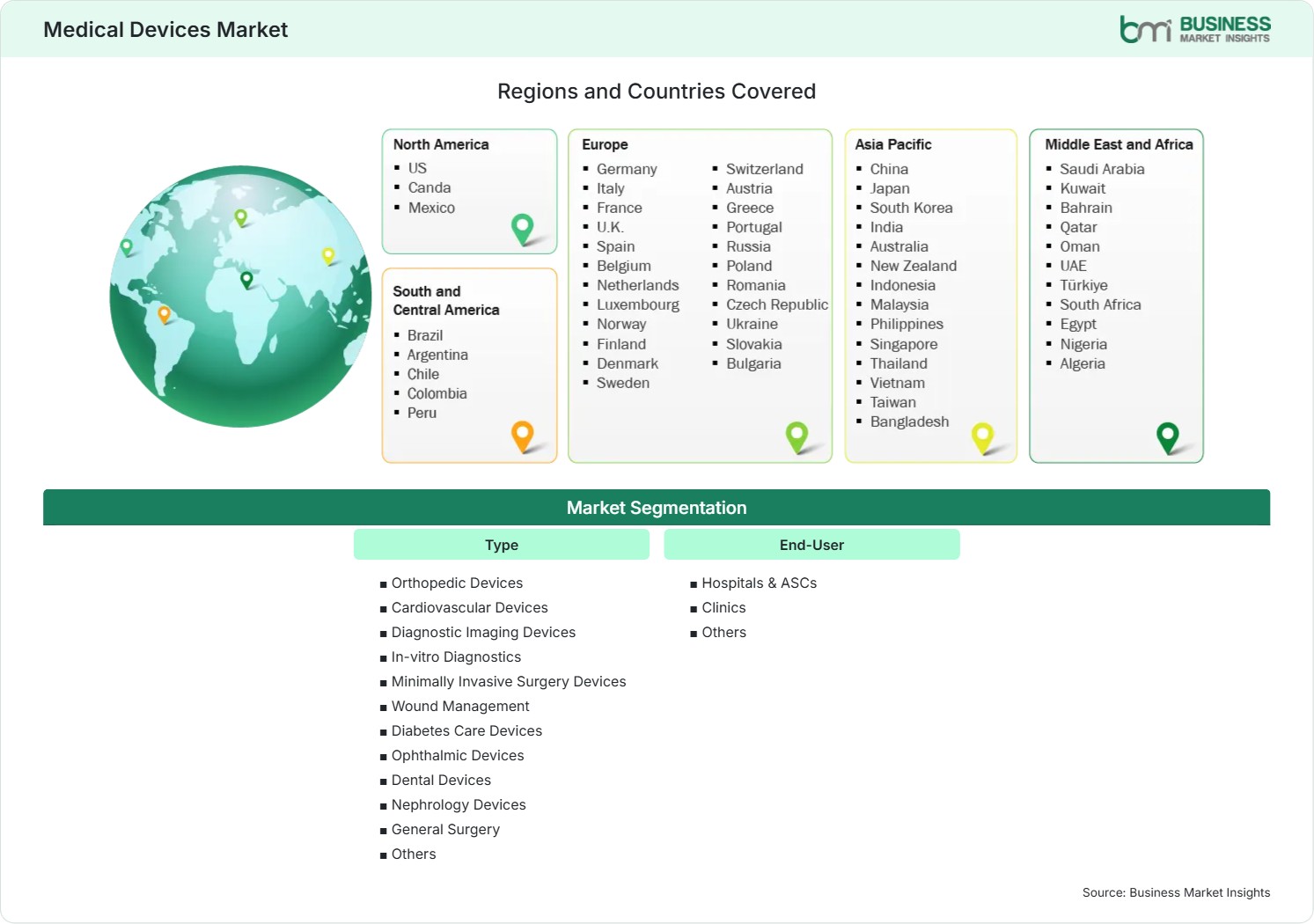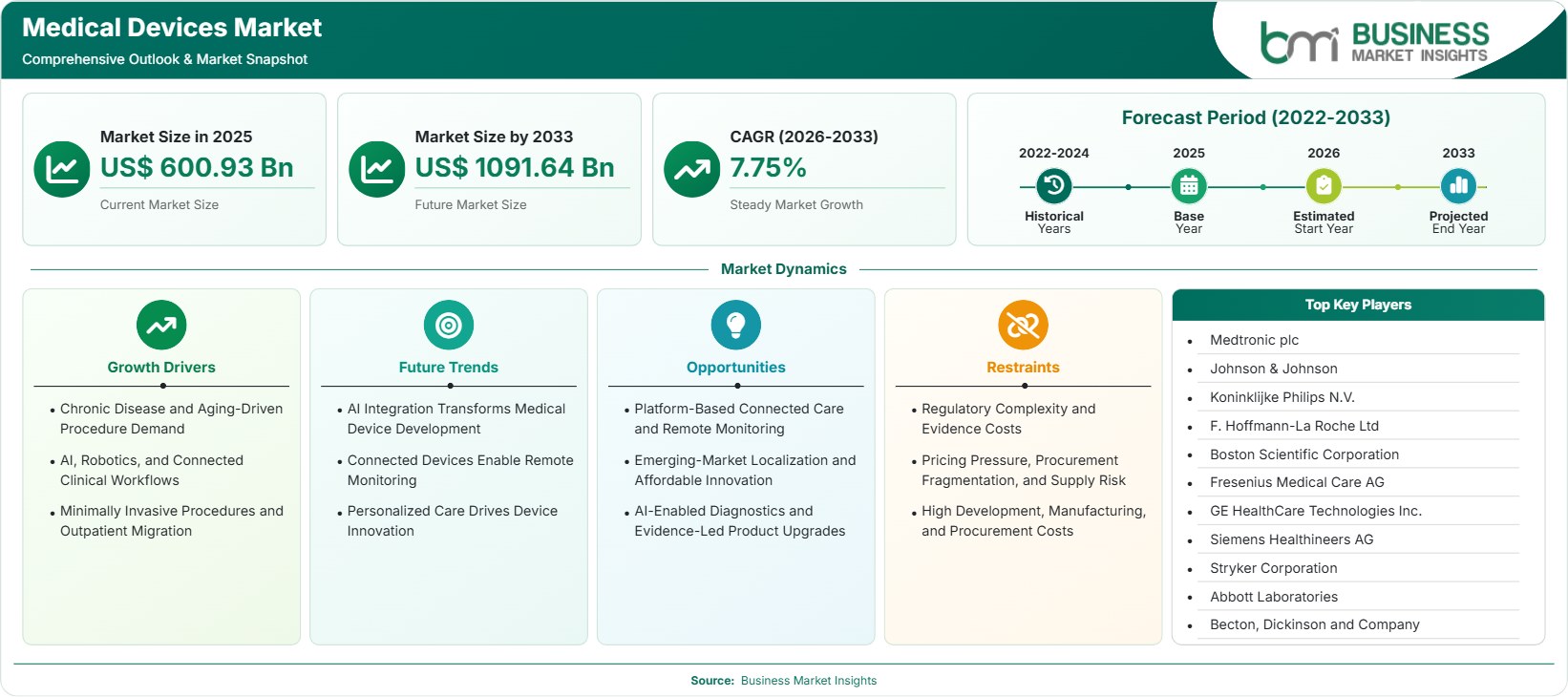
Medical Devices Market Regional Highlights
North America Medical Devices Market
North America held a 38%–41% Medical Devices Market share in 2025 and is modeled to grow at a 6.8%–7.4% CAGR during 2026–2033. The region benefits from high procedure intensity, sophisticated reimbursement, specialist networks, clinical research, and rapid adoption of advanced technologies. The United States accounts for 84%–87% of regional demand, while Canada provides a smaller established base. Recent external industry estimates place North America around the high-30% range globally, supporting the modeled range used here.
- Advanced cardiovascular, orthopedic, imaging, and surgical technologies continue attracting investment because hospitals prioritize clinical precision and operational efficiency.
- Outpatient migration is increasing demand for compact imaging, navigation, monitoring, and minimally invasive systems that can operate efficiently outside tertiary hospitals.
- AI-enabled products are moving toward regulated commercialization, with FDA guidance emphasizing transparency, lifecycle controls, bias assessment, and documentation.
- Diversified sourcing and contract manufacturing are becoming more important as manufacturers manage component availability, tariffs, quality requirements, and regional production resilience.
US Medical Devices Market
The US represented 84%–87% of the North American Medical Devices Market demand in 2025 and is modeled to expand at a 6.8%–7.3% CAGR through 2033. Demand is anchored by advanced clinical capacity, high procedure intensity, established reimbursement mechanisms, and rapid adoption of innovative technologies. Hospitals and ASCs increasingly prioritize equipment that improves utilization and staff productivity. FDA activity surrounding AI-enabled devices is also influencing development strategies by emphasizing lifecycle planning, transparency, safety, effectiveness, and controlled software updates.
- Robotic surgery, cardiovascular intervention, advanced imaging, and connected monitoring benefit from specialist demand and increasingly data-driven clinical workflows.
- Ambulatory surgery expansion creates opportunities for compact, interoperable technologies designed around faster turnover, efficient staffing, and lower facility complexity.
- AI regulation is becoming an important competitive consideration because robust documentation and predetermined change-control strategies can support controlled software improvement.
Europe Medical Devices Market
Europe held a 24%–28% Medical Devices Market share in 2025 and is modeled to grow at a 6.3%–7.1% CAGR through 2033. Germany remains a leading market, supported by engineering capabilities, specialized hospitals, and a strong manufacturing ecosystem. The United Kingdom, France, Italy, and the Netherlands provide substantial demand for diagnostics, imaging, surgery, monitoring, and digital health. Germany is modeled near 6.4%–7.0% CAGR, while the United Kingdom and selected Northern European markets can reach 6.8%–7.5%, supported by outpatient care and digital transformation.
- Germany benefits from advanced manufacturing, specialist hospitals, engineering expertise, and demand for high-value imaging and surgical technologies.
- The United Kingdom provides opportunities in remote monitoring, diagnostics, and workflow technologies as healthcare providers seek capacity and productivity improvements.
- France and Italy remain attractive for hospital modernization, minimally invasive procedures, diagnostic infrastructure, and digital healthcare adoption.
- European suppliers increasingly emphasize traceability, cybersecurity, interoperability, clinical evidence, and lifecycle services to meet purchasing and regulatory requirements.
Asia Pacific Medical Devices Market
Asia Pacific held a 26%–29% share in 2025 and is modeled to grow at an 8.2%–9.1% CAGR, making it the fastest-growing major region. China remains the largest market, while Japan, India, South Korea, and Southeast Asia contribute expanding demand. China is modeled near 8.8%–9.6% CAGR, while India can reach 9.0%–10.0%, reflecting infrastructure expansion, local production, increasing diagnostic volumes, and greater access to specialized treatment. The region combines scale with expanding domestic technology capabilities.
- China’s domestic innovation agenda supports local production while procurement reforms encourage manufacturers to improve cost efficiency, clinical evidence, and supply-chain competitiveness.
- India offers strong opportunities in imaging, diagnostics, cardiovascular care, orthopedics, dialysis, diabetes care, and affordable hospital equipment beyond major metropolitan centers.
- Japan and South Korea support premium adoption through aging demographics, advanced infrastructure, robotics, imaging, and high reliability expectations.
- Southeast Asia is becoming increasingly attractive as private hospitals expand and cross-border healthcare networks stimulate demand for advanced devices.
Rest of World Medical Devices Market
South and Central America represented approximately 4%–6% of global demand in 2025, while Middle East and Africa represented approximately 2%–3%, placing Rest of World at 6%–8%. South America is modeled at a 6.5%–7.5% CAGR, with Brazil and Mexico leading regional scale. Middle East and Africa are modeled at 6.2%–8.0%, supported by Gulf healthcare investment, private hospital development, diagnostic expansion, and healthcare modernization programs. Price sensitivity and distributor dependence remain important commercial considerations.
- Brazil offers the strongest Latin American scale, with demand concentrated in cardiovascular care, diagnostics, orthopedic treatment, hospital equipment, and private healthcare networks.
- Mexico benefits from proximity to North American supply chains and expanding private-sector healthcare capacity, creating opportunities for localized manufacturing and distribution.
- Saudi Arabia and the United Arab Emirates are leading Gulf opportunities as healthcare modernization programs prioritize hospitals, imaging, surgery, and digital care.
- African markets remain procurement-sensitive, making durable devices, service networks, financing models, training, and public-sector partnerships essential for sustainable adoption.