
Skincare Devices Market Outlook: Size, Share, Trends, Growth Analysis, Competitive Landscape & Forecast, 2026-2033

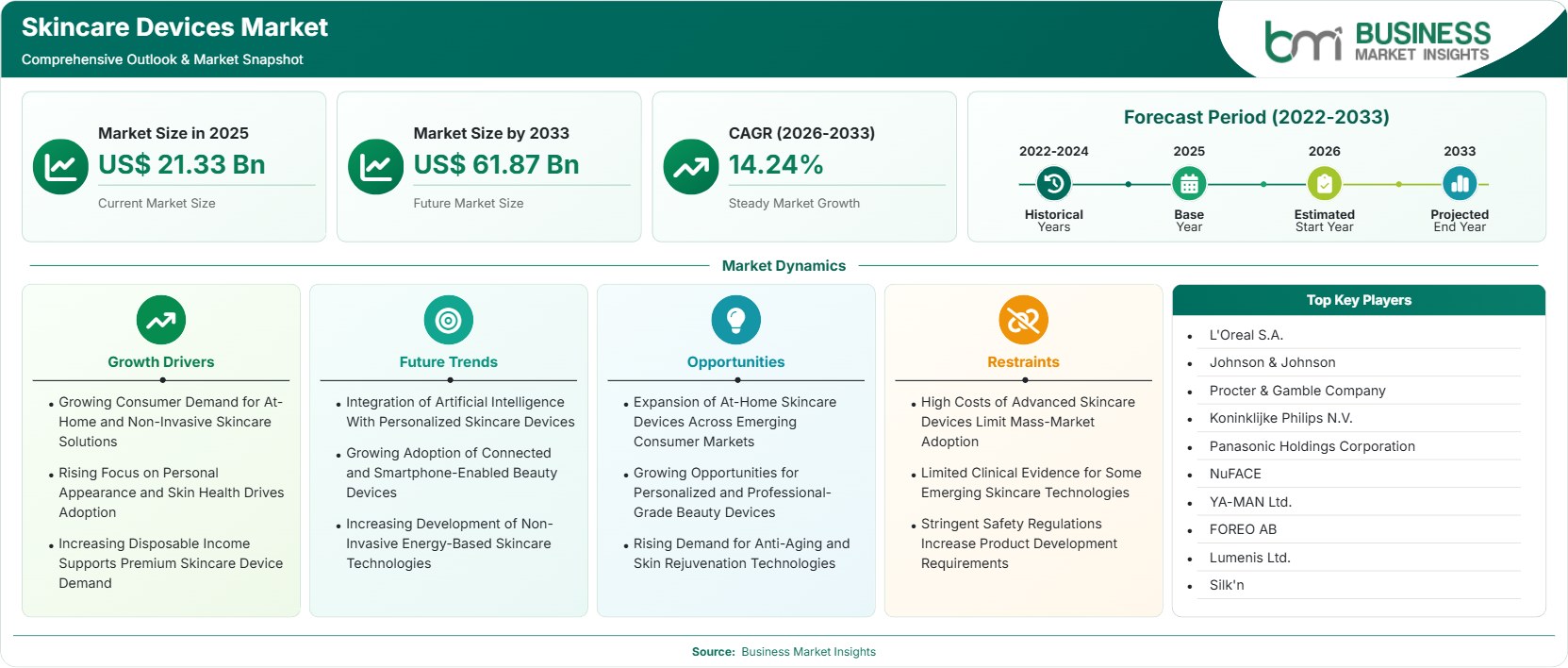
The Skincare Devices Market size was valued at US$ 21.33 Billion in 2025 and is projected to reach US$ 61.87 Billion by 2033, growing at a CAGR of 14.24% during 2026–2033, driven by at-home beauty adoption, non-invasive treatments, personalized skincare, rising disposable incomes, anti-aging demand, and technological innovation.

Report Coverage
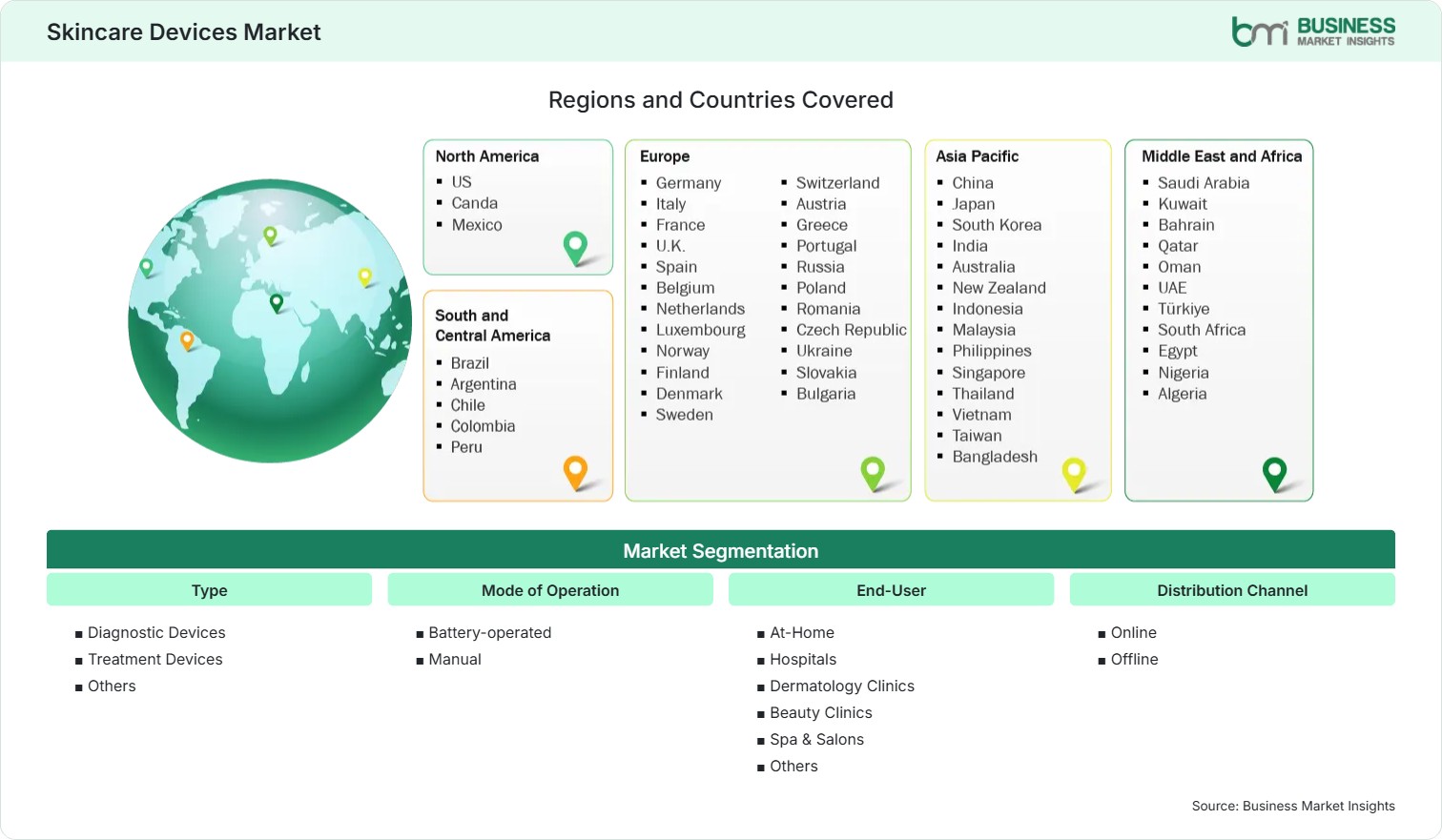
  • Type: Diagnostic Devices, Treatment Devices, Others
  • Mode of Operation: Battery-operated, Manual
  • End-User: At-Home, Hospitals, Dermatology Clinics, Beauty Clinics, Spa & Salons, Others
  • Distribution Channel: Online, Offline
US$ 21.33 Bn Market size in 2025
US$ 61.87 Bn Market Size by 2033
14.24% CAGR, 2026 - 2033
2026-2033 Forecast Period

AI Overview

Skincare Devices Market Summary

  • North America Region: North America holds a share of 32%–36% in 2025, growing with a CAGR of 13.0%–14.0%, supported by high consumer spending on beauty technology, strong dermatology infrastructure, at-home device adoption, and demand for non-invasive aesthetic treatments. The US represents 28%–32% share, with a CAGR of 13.3%–14.3%, supported by premium beauty consumption and expanding home-use technologies.
  • Fastest Growing Region: Asia Pacific holds a share of 24%–28% in 2025, growing with a CAGR of 16.0%–17.0%, driven by rising disposable incomes, expanding beauty markets, social media influence, increasing aesthetic awareness, and growing adoption of technologically advanced skincare devices.
  • Leading Segment: Treatment Devices holds a Skincare Devices Market share of 61%–65% in 2025, growing with a CAGR of 14.5%–15.5%, supported by demand for skin rejuvenation, acne management, pigmentation reduction, hair removal, anti-aging procedures, and non-invasive cosmetic treatments.
  • High Growth Segment: At-Home holds a share of 27%–31% in 2025, growing with a CAGR of 17.0%–18.0%, driven by convenience, privacy, reusable device economics, consumer familiarity with beauty technology, and demand for professional-grade results at home.
  • Key Market Opportunity: The strongest opportunity lies in combining personalized diagnostics, connected devices, AI-assisted recommendations, and professional-grade treatment capabilities to create differentiated at-home skincare ecosystems.
  • Major Market Players: L'Oréal S.A., Johnson & Johnson, Procter & Gamble Company, Koninklijke Philips N.V., Panasonic Holdings Corporation, NuFACE, YA-MAN Ltd., FOREO AB, Lumenis Ltd., and Silk'n.
Strategic Insights

Skincare Devices Market: Strategic Insights

Skincare Devices Market Strategic Framework
FREE PDF
Request your free sample
Request free sample
Stakeholder View

Key Takeaways

  • Value chain integration has become a major trend in the industry and involves device makers, beauty firms, component suppliers, dermatologists, digital networks, retailers and e-commerce sites.
  • At-home treatment devices offer the strongest expansion potential as consumers seek convenient alternatives to frequent clinic visits, particularly for anti-aging, acne, skin tightening, and rejuvenation applications.
  • Personalization is emerging as a key innovation direction, with imaging, artificial intelligence, connected applications, and data-driven recommendations supporting more individualized skincare routines.
  • Asia Pacific provides a compelling investment case because rapidly expanding beauty expenditure, technology adoption, and strong consumer interest in aesthetic products support faster device penetration.
  • Strategic partnerships and acquisitions can strengthen competitive positions by combining device technology, skincare formulations, clinical expertise, digital engagement, and established distribution networks.
  • Manufacturers with clinically supported technologies, strong consumer education, intuitive interfaces, and differentiated product ecosystems are better positioned to command premium pricing and build recurring customer relationships.
Geographic Outlook

Skincare Devices Market Regional Highlights

North America Skincare Devices Market

North America represents a Skincare Devices Market share of 32%–36% in 2025 and records a CAGR of 13.0%–14.0% during 2026–2033. The region benefits from strong consumer purchasing power, advanced dermatology services, established aesthetic clinics, and high awareness of non-invasive procedures. The US accounts for most regional demand, while Canada contributes through growing beauty technology adoption.

  • The US remains the regional demand center as consumers increasingly adopt premium home-use devices offering targeted solutions for aging, acne, pigmentation, and skin rejuvenation.
  • Dermatology and aesthetic clinics continue to support professional device demand, particularly for technologies requiring higher energy intensity, specialized expertise, and controlled treatment protocols.
  • Direct-to-consumer brands are using digital marketing and e-commerce to educate consumers, demonstrate device benefits, and build recurring engagement around personalized skincare routines.
  • Connected skincare ecosystems are expanding as manufacturers combine devices with mobile applications, treatment tracking, personalized recommendations, and digital consultations.

US Skincare Devices Market

The US represents share of 28%–32% in 2025 and records a CAGR of 13.3%–14.3% through 2033. High disposable incomes, strong beauty expenditure, advanced aesthetic services, and widespread e-commerce adoption support demand. Consumers increasingly view skincare devices as complementary to topical products and professional treatments.

  • Premium at-home devices are gaining popularity as consumers seek repeatable treatments that complement professional procedures and established skincare routines.
  • Dermatology clinics and medical spas remain important channels for advanced devices, supporting demand for technologies requiring professional training and controlled treatment environments.
  • Beauty technology brands are increasingly integrating connected applications and personalized treatment guidance to strengthen consumer engagement and differentiate devices in crowded markets.

Europe Skincare Devices Market

Europe accounts for a share of 25%–29% in 2025 and Europe skincare devices Market forecast to grow at CAGR of 12.5%–13.5% through 2033. Germany, the UK, France, and Italy represent leading markets, while Spain and the Netherlands provide attractive growth opportunities. Regulatory requirements and consumer scrutiny are encouraging manufacturers to strengthen product substantiation and transparent communication around device benefits.

  • France remains a leading beauty market, supported by strong cosmetic brand presence, sophisticated consumers, premium skincare routines, and increasing interest in technology-enabled beauty products.
  • Germany benefits from developed healthcare and aesthetic infrastructure, creating opportunities for professional devices and clinically oriented skincare technologies.
  • Spain represents a high-growth market at a CAGR of 14.0%–15.0%, supported by beauty tourism, aesthetic service demand, and expanding consumer interest in non-invasive treatments.
  • The UK offers a CAGR of 13.5%–14.5%, driven by e-commerce penetration, premium beauty consumption, social media influence, and growing awareness of at-home skincare technologies.

Asia Pacific Skincare Devices Market

Asia Pacific represents a share of 24%–28% in 2025 and achieves a CAGR of 16.0%–17.0% through 2033. China, Japan, South Korea, and India are major markets, while Southeast Asia offers significant expansion potential. E-commerce and direct-to-consumer distribution are improving product accessibility across urban and emerging consumer markets.

  • South Korea remains a leading beauty technology market, with strong consumer acceptance of innovative devices, sophisticated skincare routines, and technology-driven personalization.
  • China offers substantial expansion potential due to its large consumer base, growing beauty expenditure, e-commerce penetration, and increasing demand for premium aesthetic technologies.
  • India offers a CAGR of 17.0%–18.0%, supported by rising disposable incomes, expanding beauty awareness, increasing digital commerce, and growing demand for convenient home-use solutions.
  • Southeast Asia provides a CAGR of 17.5%–18.5%, driven by rising middle-class populations, beauty culture expansion, social commerce, and increasing availability of international skincare device brands.

Rest of World Skincare Devices Market

South and Central America represent approximately 6%–9% of regional demand in 2025 and record a CAGR of 13.0%–15.0%. Brazil and Mexico lead adoption, supported by strong beauty cultures, aesthetic services, and growing e-commerce. The Middle East and Africa represent approximately 5%–8% share in 2025 and achieve a CAGR of 14.0%–16.0%. The UAE and Saudi Arabia lead regional demand, supported by premium beauty spending and aesthetic clinics.

  • Brazil remains a leading opportunity because of strong beauty and personal care consumption, established aesthetic services, and growing consumer interest in technology-enabled skincare.
  • Mexico benefits from expanding e-commerce access and increasing consumer awareness of home-use devices, although affordability remains important for broader market penetration.
  • The UAE and Saudi Arabia offer high-growth opportunities through premium beauty consumption, aesthetic tourism, sophisticated clinics, and demand for advanced non-invasive treatments.
  • South Africa provides opportunities for affordable and portable devices as consumers increasingly explore home-based skincare routines and technology-enabled beauty products.
Global Market Geography
FREE PDF
Request your free sample
Request free sample
Segment Analysis

Skincare Devices Market Segmentation

Type

Treatment Devices accounted for a Skincare Devices Market share of 61%–65% in 2025 and are projected to grow at a CAGR of 14.5%–15.5% between 2026–2033. Demand is supported by anti-aging, acne, pigmentation, skin tightening, and rejuvenation applications. Diagnostic devices are gaining traction as consumers and professionals seek more personalized assessments. Device innovation is increasingly focused on combining diagnosis and treatment capabilities, enabling users to identify skin concerns and select targeted interventions.

  • Diagnostic Devices: Diagnostic technologies support skin imaging, condition assessment, and personalized recommendations, helping professionals and consumers better understand skin characteristics and tailor treatment strategies.
  • Treatment Devices: Treatment technologies address aging, acne, pigmentation, and rejuvenation, with adoption supported by non-invasive procedures, home-use convenience, and continued product innovation.

Type

Treatment Devices represented a Skincare Devices Market share of 61%–65% in 2025 and are projected to grow at a CAGR of 14.5%–15.5% between 2026–2033. The repeated classification reflects the supplied segmentation structure, with treatment-focused technologies representing the largest commercial opportunity. Diagnostic capabilities increasingly complement treatment products by enabling personalized recommendations and more targeted skincare routines.

  • Diagnostic Devices: Diagnostic devices support professional and consumer skin analysis, helping identify visible concerns and enabling more targeted product selection and treatment planning.
  • Treatment Devices: Treatment devices provide targeted interventions for common aesthetic concerns, with innovation focused on greater convenience, improved usability, and increasingly personalized treatment experiences.

Mode of Operation

Battery-operated devices accounted for a Skincare Devices Market share of 58%–62% in 2025 and are projected to grow at a CAGR of 15.0%–16.0% between 2026–2033. Portability, cordless operation, and convenience support consumer adoption, particularly for at-home applications. Manufacturers are also exploring longer battery life and lightweight construction to strengthen consumer convenience and product differentiation.

  • Battery-operated: Battery-powered devices offer portability, cordless convenience, and flexible usage, supporting demand among consumers seeking convenient skincare treatments at home or while traveling.
  • Manual: Manual devices provide affordable and accessible skincare options without charging requirements, appealing to cost-conscious consumers and users seeking simple treatment routines.

End-User

At-Home accounted for a Skincare Devices Market share of 27%–31% in 2025 and is projected to grow at a CAGR of 17.0%–18.0% between 2026–2033. Convenience, privacy, affordability relative to repeated professional visits, and growing consumer familiarity with beauty technology support adoption. Hospitals and dermatology clinics remain important for medically oriented and higher-intensity treatments.

  • At-Home: At-home devices benefit from convenience, privacy, repeatable use, and consumer demand for professional-grade skincare experiences without frequent clinic appointments.
  • Hospitals: Hospitals use advanced skincare technologies for selected dermatological and aesthetic applications, particularly where clinical oversight and specialized treatment protocols are required.
  • Dermatology Clinics: Dermatology clinics adopt professional-grade devices for controlled treatments targeting pigmentation, acne, aging, skin tightening, and other dermatological concerns.
  • Beauty Clinics: Beauty clinics provide non-invasive aesthetic procedures and increasingly adopt energy-based technologies to deliver differentiated treatments and premium service experiences.
  • Spa & Salons: Spas and salons use skincare devices to enhance facial treatments, attract customers, and expand premium service offerings beyond conventional topical products.

Distribution Channel

Online channels accounted for a Skincare Devices Market share of 43%–47% in 2025 and are projected to grow at a CAGR of 17.0%–18.0% between 2026–2033. E-commerce enables direct consumer access, product comparison, educational content, reviews, and direct-to-consumer brand strategies. Social commerce and influencer-led marketing are further increasing product discovery and consumer engagement across younger demographics.

  • Online: Online distribution supports direct-to-consumer sales, broader geographic reach, product education, customer reviews, and personalized digital marketing campaigns.
  • Offline: Offline channels remain important for product demonstrations, professional recommendations, retail assistance, and consumers seeking physical evaluation before purchasing premium devices.
Market Forces

Skincare Devices Market Dynamics

Key Market Drivers

Growing Consumer Demand for At-Home and Non-Invasive Skincare Solutions

The current consumer demand for skincare solutions centers on convenient options that do not require regular salon visits or invasive procedures. At-home devices are a way to cater to such consumer demands by providing repeatable treatments within the consumers' usual schedule. Technologies like LED light therapy, microcurrent, cleansing, and others are becoming more widely available to consumers as manufacturers make devices simpler and more user-friendly. In addition, the development of e-commerce and social media education is helping consumers understand device features and applications.

Rising Focus on Personal Appearance and Skin Health Drives Adoption

Rise in the awareness of appearance, skin health, and preventive skincare has driven an interest in consumer that address the devices which help treat problems like wrinkles, pimples, pigmentation, dullness, and loss of firmness. Social media websites are playing a role in raising awareness of technology-driven regimes. Younger people have started adopting preventive techniques, whereas older people have become interested in anti-aging and rejuvenation solutions. Dermatologists and aesthetic specialists can provide more assurance to the consumers regarding the technology.

Increasing Disposable Income Supports Premium Skincare Device Demand

The increase in disposable income in the advanced and developing consumer economies is driving spending on premium beauty products and technology-based skin care treatments. Consumers with higher incomes are becoming more open to investing in products that offer convenience and long-term value compared with multiple visits to professionals for their skin care needs. This skincare devices market trend is especially evident in products that offer advanced technology, elegant design, mobility, and personal treatments.

Key Market Opportunities

Expansion of At-Home Skincare Devices Across Emerging Consumer Markets

The emerging consumer markets provide excellent opportunities for home-use skincare devices due to rising disposable incomes and increased beauty consciousness among consumers. In urban areas, consumers have been found to seek convenient solutions for treating acne, aging, hyperpigmentation, and other skincare problems, while improved availability through e-commerce enables them to access skincare devices from other countries. By manufacturing the device at various price levels, the manufacturers could increase their market penetration.

Growing Opportunities for Personalized and Professional-Grade Beauty Devices

Personalization is key due to the rise in consumer demands for skincare regimens based on their unique needs. Diagnostic imaging, artificial intelligence, connectivity, and treatment monitoring will enable the manufacturers to provide personalized solutions to customers and enhance engagement. Professional technology modified for safe usage at home will increase the size of the target audience, making it possible to introduce advanced technologies into consumer settings. Personalization and professional performance can be the key justifiers of premium pricing and will provide a basis for subscription-based business models.

Rising Demand for Anti-Aging and Skin Rejuvenation Technologies

Increased importance on retaining youthful appearance is giving rise to many devices aimed at reducing wrinkles, lines, tightening, texture, and pigmentation. People are becoming more inclined towards non-invasive technology that can act as an adjunct to clinical therapy or maintenance after clinic visits. LED, radio frequency, microcurrent, ultrasonic, and combination therapy are becoming popular in both professional and home use sectors. Companies offering their products backed by clinical evidence can gain customer confidence and make their product different from less expensive devices.

Market Restraints and Challenges

High Costs of Advanced Skincare Devices Limit Mass-Market Adoption

Factor: Skin care devices equipped with advanced energy-use technology, along with high-quality components and engineering, tend to be priced higher than traditional skin care solutions. Impact: Such costs may hinder the adoption among price-sensitive consumers. The problem may be most significant in emerging economies where income levels remain uneven, and people prefer more affordable topical skin care products.

Limited Clinical Evidence for Some Emerging Skincare Technologies

Factor: There are some new skincare technologies that lack independent clinical evidence or inconsistent data over time to substantiate their claims, especially when these products are introduced into the market very quickly. Impact: Lacking scientific evidence could make it difficult for manufacturers in terms of consumer trust and recommending the technology professionally. It is made harder due to the competition of other products making claims not supported by science. Competitiveness of companies can be enhanced through clinical tests and evidence communication.

Company Analysis

Competitive Landscape

Skincare Devices Market analysis reflects competition between diversified beauty companies, healthcare technology providers, consumer electronics manufacturers, specialist aesthetic device developers, and direct-to-consumer beauty technology brands. Competitive positioning increasingly depends on technological differentiation, clinical evidence, product design, brand credibility, distribution strength, and the ability to combine devices with personalized digital experiences and complementary skincare products.

Company Name

Overview

Products and Services relevant to this market

L'Oréal S.A.

Global beauty company with extensive skincare expertise and increasing focus on beauty technology, personalization, and connected consumer experiences.

Skincare technology, beauty diagnostic solutions, personalized skincare technologies, connected beauty devices, and professional aesthetic solutions.

Johnson & Johnson

Diversified healthcare company with established consumer and medical technology capabilities relevant to dermatology and skin health.

Dermatology-related healthcare technologies, skincare products, professional medical solutions, and technologies supporting skin health applications.

Procter & Gamble Company

Global consumer goods company with major skincare and beauty brands serving mass-market and premium consumer segments worldwide.

Beauty and skincare technologies, consumer skincare products, connected beauty initiatives, and technology-enabled personal care solutions.

Koninklijke Philips N.V.

Healthcare and consumer technology company offering personal health and beauty technologies across home-use categories.

At-home skincare devices, light-based technologies, beauty care products, personal health technologies, and connected consumer solutions.

Panasonic Holdings Corporation

Electronics and technology company developing consumer beauty and personal care technologies with strong presence in Asian markets.

Facial care devices, cleansing technologies, beauty equipment, personal care electronics, and home-use skincare solutions.

NuFACE

Specialist beauty technology brand focused on microcurrent facial toning and at-home skincare devices.

Microcurrent facial devices, skin toning technologies, device accessories, skincare products, and connected beauty routines.

YA-MAN Ltd.

Japanese beauty technology company specializing in advanced home-use beauty and skincare devices.

Facial treatment devices, RF technologies, LED solutions, cleansing devices, and professional-inspired home beauty technologies.

FOREO AB

Beauty technology company known for connected skincare devices combining innovative design with digital consumer experiences.

Facial cleansing devices, LED treatments, microcurrent technologies, smart beauty devices, and connected skincare solutions.

Lumenis Ltd.

Aesthetic and medical technology company specializing in energy-based platforms for dermatology and cosmetic treatments.

Laser systems, light-based technologies, energy-based aesthetic devices, dermatological treatments, and professional skincare solutions.

Silk'n

Beauty technology brand focused on consumer-oriented home-use devices for skincare and personal aesthetics.

At-home light-based devices, hair removal technologies, facial treatment systems, anti-aging devices, and personal beauty solutions.

Trust & Transparency

Research Methodology

The market analysis combines proprietary research with secondary data from government agencies, company disclosures, regulatory filings, industry databases and expert interviews. Market estimates are validated through data triangulation, cross-market benchmarking and analyst review.

View Full Research Methodology

Questions Answered

Frequently Asked Questions

What does the market report cover?

The Skincare Devices Market Report evaluates device type, mode of operation, end-user, and distribution channels, alongside regional demand, technology trends, and competitive dynamics.

Why is Asia Pacific important for skincare device manufacturers?

Asia Pacific combines strong beauty cultures, rising disposable incomes, rapid e-commerce adoption, and high consumer acceptance of technology-enabled products.

How does personalization influence skincare device demand?

Personalization enables consumers to receive recommendations based on individual skin conditions and treatment objectives.

Which technologies are driving innovation in skincare devices?

LED, microcurrent, radiofrequency, ultrasound, imaging, and connected technologies are shaping innovation. Manufacturers are increasingly combining multiple functions to improve treatment experiences and differentiate premium products.

Why are at-home skincare devices gaining popularity?

At-home devices provide convenience, privacy, and repeatable treatments without requiring frequent professional appointments. Improvements in device usability, e-commerce availability are supporting adoption across anti-aging, acne, and rejuvenation applications.

Access the Full Skincare Devices Market Report

Get segment-level forecasts, regional estimates, competitive benchmarking, company profiles and downloadable Excel datasets.

Access the full Skincare Devices Market Report
350 pages PDF & Excel | 2026-08-10
Similar Research

Related Market Reports