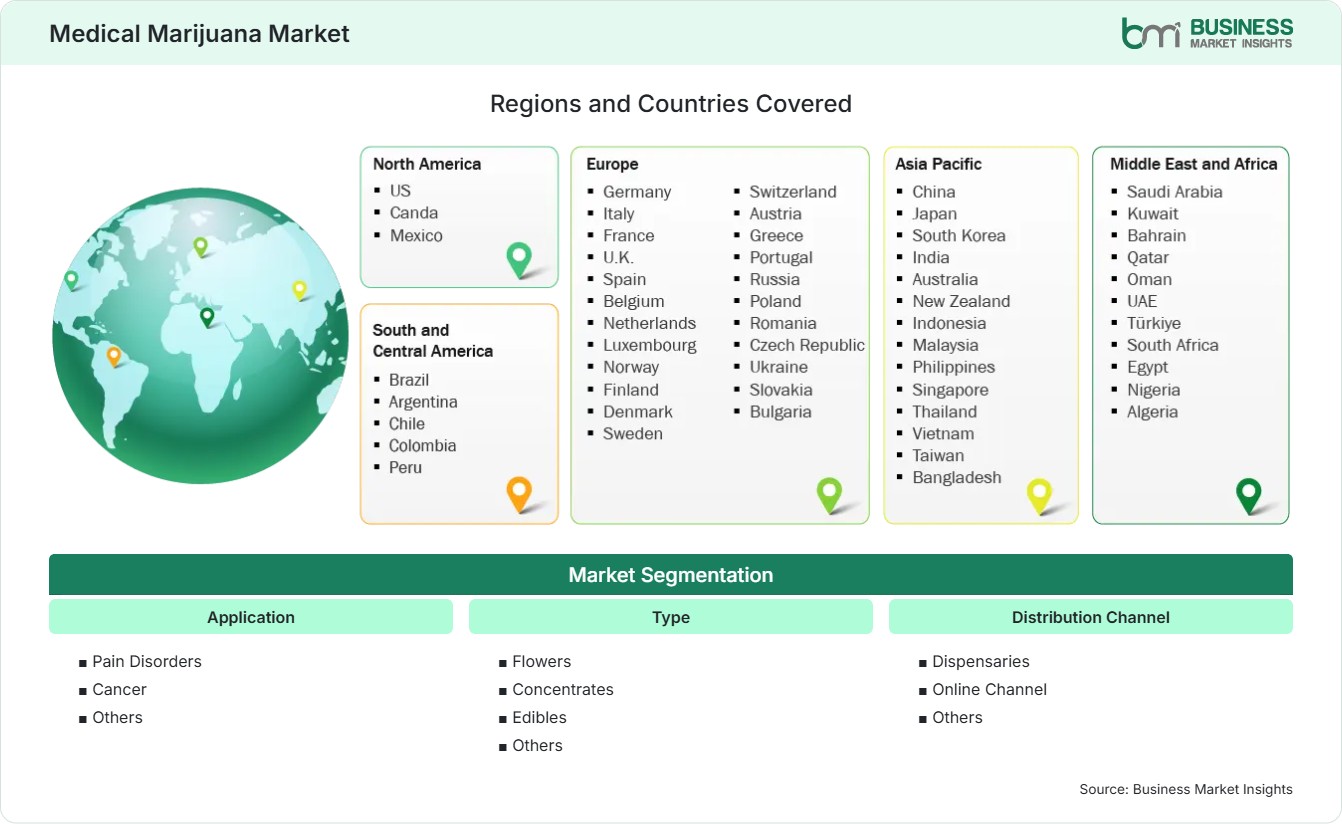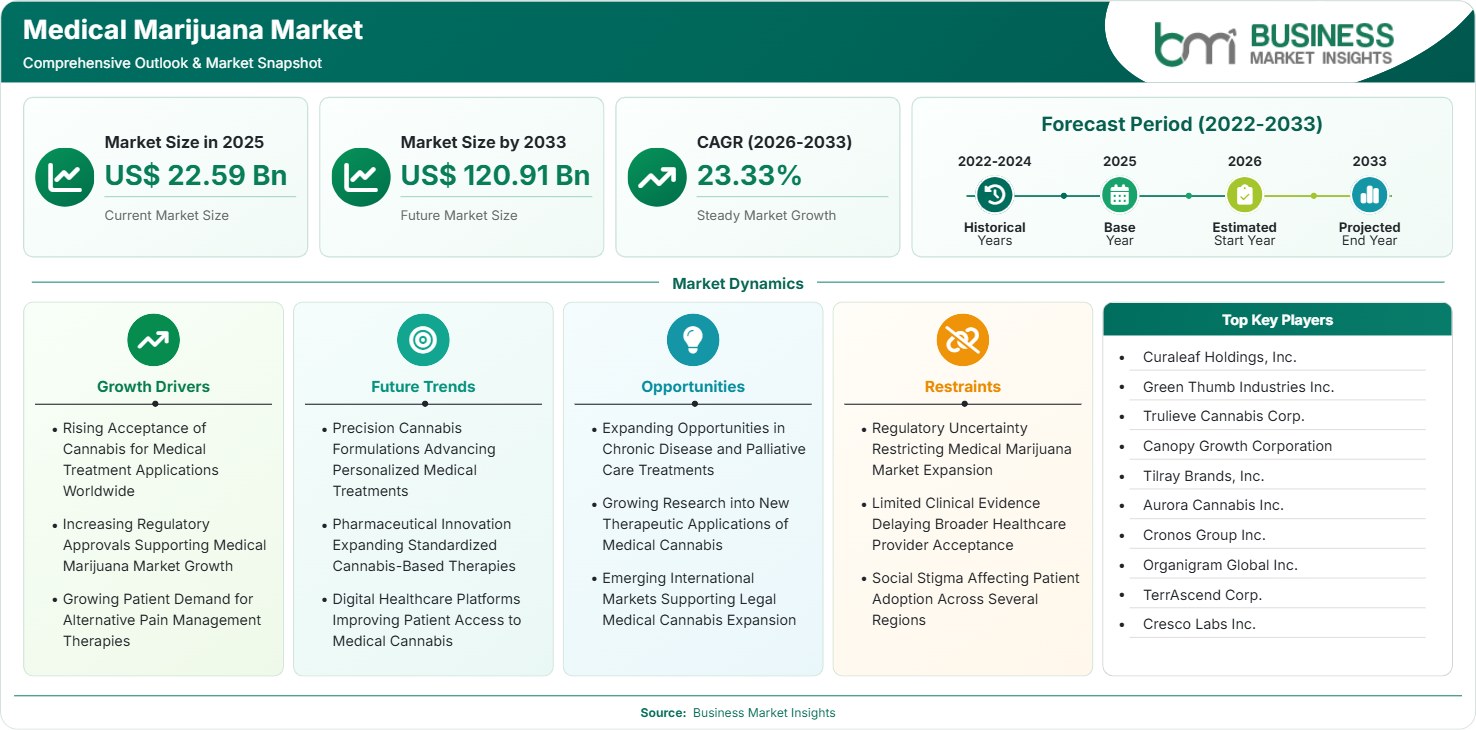
Medical Marijuana Market Regional Highlights
North America Medical Marijuana Market
North America accounted for a 68%–72% share in 2025 and is projected to grow at a 21.0%–23.0% CAGR during 2026–2033. The US dominates regional activity through extensive state-level medical cannabis programs, while Canada provides a nationally regulated framework. Medical Marijuana Market share remains concentrated in North America because of established cultivation infrastructure, dispensary networks, patient awareness, and product availability. Continued research and product standardization are supporting broader healthcare applications.
- Established medical cannabis programs provide a developed patient access infrastructure, supporting demand for flower, concentrates, edibles, oils, and other regulated formulations across multiple therapeutic applications.
- US state-level regulatory differences create operational complexity, but they also provide opportunities for companies with strong compliance systems and localized market strategies.
- Canadian producers benefit from established federal regulation and export capabilities, supporting opportunities in international medical cannabis markets where regulations permit pharmaceutical-grade imports.
- Clinical research and physician education are increasingly important as healthcare stakeholders seek stronger evidence regarding cannabinoid efficacy, safety, dosing, and interactions with conventional therapies.
US Medical Marijuana Market
The US represented a 62%–66% share in 2025 and is expected to expand at a 20.5%–22.5% CAGR through 2033. Medical cannabis access remains governed primarily by state-level frameworks, creating substantial differences in qualifying conditions, product rules, and patient access. The market benefits from established dispensary infrastructure and strong consumer awareness. The market growth is supported by expanding product portfolios, increasing research activity, and broader acceptance of cannabis-based therapeutic options.
- State-level medical cannabis programs continue to create regional demand differences, requiring operators to tailor cultivation, retail, product, and compliance strategies to individual jurisdictions.
- Dispensary networks are expanding product availability while increasingly emphasizing product testing, cannabinoid labeling, dosage information, and consumer education.
- Research institutions and commercial companies are increasing studies examining cannabinoids for pain, neurological disorders, cancer-related symptoms, and other potential therapeutic applications.
- Physician and healthcare-provider education remains a strategic priority because clinical confidence and appropriate patient selection can influence broader medical adoption.
Europe Medical Marijuana Market
Europe held a 13%–17% share in 2025 and is forecast to register a 25.0%–28.0% CAGR through 2033. Germany leads regional demand and program development, while the UK maintains a growing specialist-prescribed market. Germany is projected to grow at a 24.0%–27.0% CAGR, while the UK is expected to expand at a 23.0%–26.0% CAGR. Regulatory modernization, pharmaceutical involvement, and physician awareness are supporting regional expansion.
- Germany's established medical cannabis framework provides a substantial addressable patient base and supports demand for imported and locally distributed regulated products.
- The UK market continues developing through specialist prescribing, creating opportunities for pharmaceutical-grade products supported by clinical evidence and standardized cannabinoid formulations.
- European companies are increasingly focusing on cultivation, extraction, manufacturing, and distribution capabilities that meet strict quality and regulatory requirements.
- Research and clinical evidence remain important for improving physician confidence and potentially expanding prescribing beyond currently established therapeutic indications.
Asia Pacific Medical Marijuana Market
Asia Pacific accounted for a 5%–8% share in 2025 and is expected to grow at a 27.0%–30.0% CAGR through 2033. Australia leads regional medical cannabis development through an established regulatory pathway, while New Zealand is building a regulated industry. Australia is projected to grow at a 24.0%–27.0% CAGR, whereas Thailand is expected to record a 29.0%–32.0% CAGR as its cannabis policy landscape evolves. Regulatory developments remain critical to regional expansion.
- Australia's regulated medical cannabis program supports domestic cultivation, pharmaceutical development, and research, creating a comparatively mature ecosystem within the Asia Pacific region.
- Thailand's evolving cannabis framework creates both opportunities and regulatory uncertainty, requiring companies to closely monitor policy developments affecting medical and therapeutic applications.
- Japan and other markets remain highly restrictive, but pharmaceutical research and international regulatory developments could influence future cannabinoid-based medicine frameworks.
- Regional opportunities are strongest for companies capable of meeting stringent quality standards and navigating country-specific requirements governing cultivation, imports, manufacturing, and prescribing.
Rest of World Medical Marijuana Market
South and Central America represented a 4%–6% share in 2025 and are expected to grow at a 22.0%–25.0% CAGR through 2033, supported by gradual regulatory development. Brazil leads regional medical cannabis activity, while Colombia offers cultivation and export potential. Middle East and Africa accounted for a 2%–4% share and are projected to grow at a 18.0%–21.0% CAGR, with Israel remaining a leading research ecosystem.
- Brazil's expanding regulated access framework is creating opportunities for imported products, domestic distribution, pharmaceutical partnerships, and cannabinoid-based treatment research.
- Colombia's cultivation advantages and evolving export ecosystem provide opportunities for companies seeking cost-efficient production platforms serving international medical cannabis markets.
- Israel's established research environment supports cannabinoid science, clinical development, agricultural innovation, and collaboration between cannabis companies and healthcare institutions.
- Emerging markets require careful regulatory assessment because prescribing rules, import controls, product standards, and legal definitions vary substantially across individual countries.