
Medical Swabs Market Outlook: Size, Share, Trends, Growth Analysis, Competitive Landscape & Forecast, 2026-2033

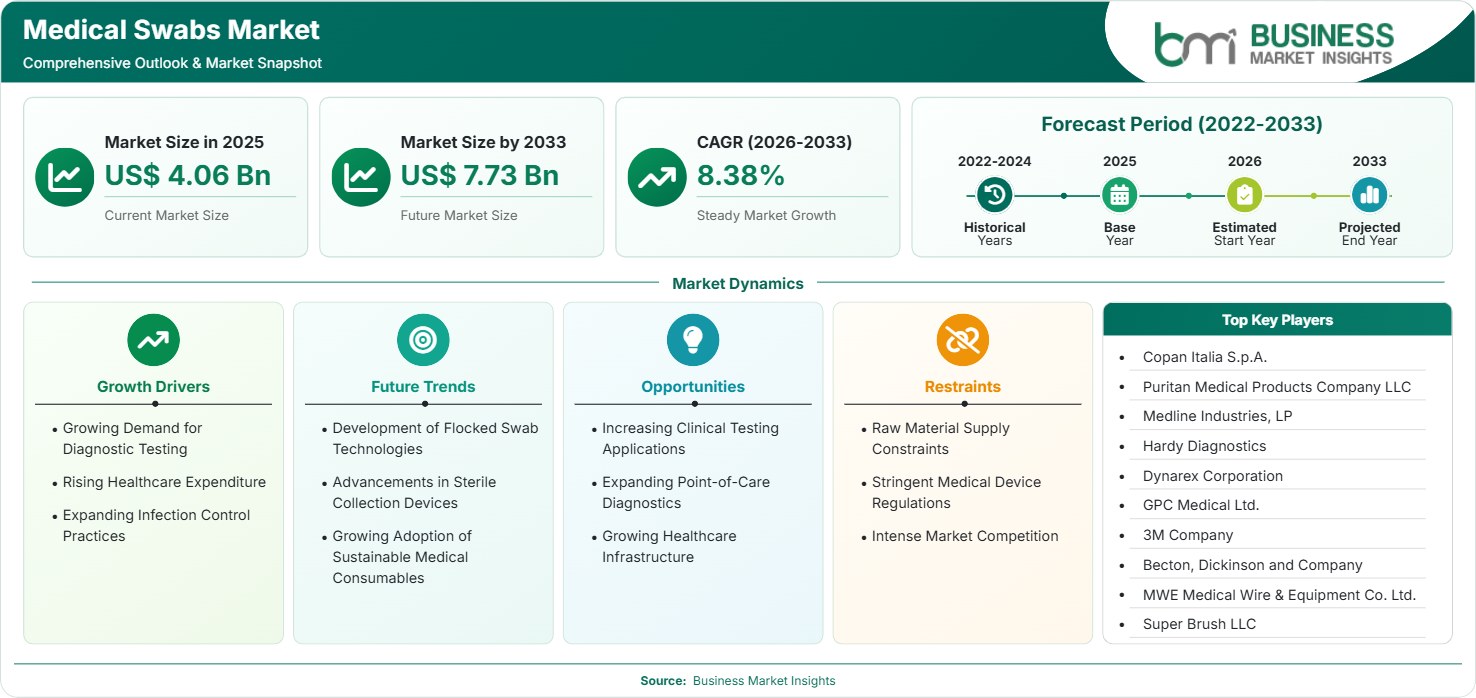
The Medical Swabs Market size was valued at US$ 4.06 Billion in 2025 and is projected to reach US$ 7.73 Billion by 2033, growing at a CAGR of 8.38% during 2026–2033, driven by rising diagnostic testing volumes, expanding infection prevention practices, increasing healthcare infrastructure investments, and opportunities in advanced specimen collection technologies.

Report Coverage
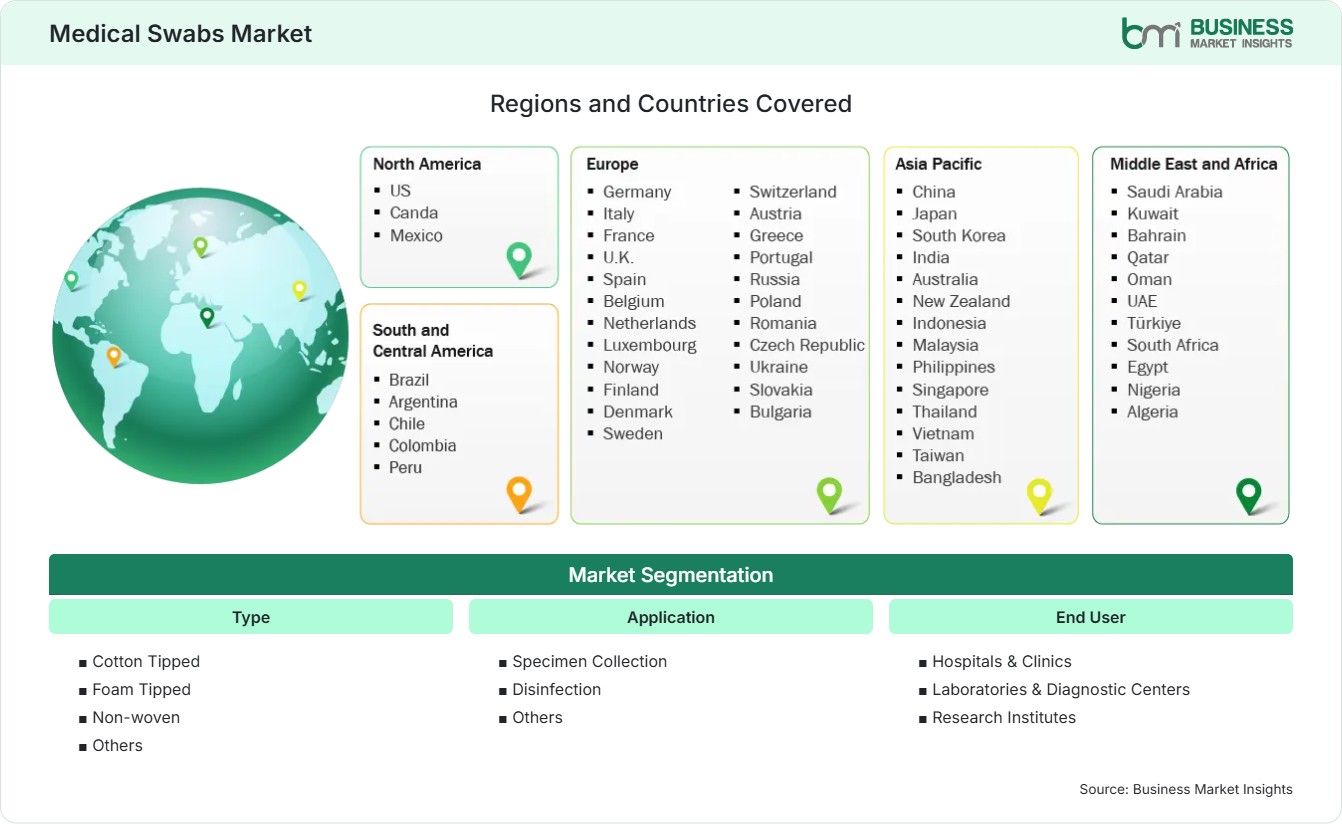
  • Type: Cotton Tipped, Foam Tipped, Non-woven, Others
  • Application: Specimen Collection, Disinfection, Others
  • End User: Hospitals & Clinics, Laboratories & Diagnostic Centers, Research Institutes
US$ 4.06 Bn Market size in 2025
US$ 7.73 Bn Market Size by 2033
8.38% CAGR, 2026 - 2033
2026-2033 Forecast Period

AI Overview

Medical Swabs Market Summary

  • North America Region: North America holds a market share of 34%–37% in 2025, growing with a CAGR of 7.8%–8.2% influenced by advanced diagnostic networks, infection control requirements, and healthcare innovation opportunities. The US market demonstrates strong adoption of medical swabs with a CAGR of 8.0%–8.4% during 2026–2033.
  • Fastest Growing Region: Asia Pacific maintains a market share of 27%–30% in 2025, expanding at a CAGR of 9.2%–9.7% supported by healthcare modernization, rising laboratory capacity, infectious disease surveillance, and increasing diagnostic accessibility across developing economies.
  • Leading Segment: Specimen Collection application accounts for a market share of 42%–45% in 2025, growing at a CAGR of 8.5%–8.9% due to increasing molecular testing demand, laboratory workflow expansion, and clinical screening requirements worldwide.
  • High Growth Segment: Foam Tipped Type represents a market share of 18%–21% in 2025, advancing at a CAGR of 9.0%–9.4% driven by improved sample absorption, patient comfort, and adoption in specialized diagnostic procedures.
  • Key Market Opportunity: Growth opportunities are emerging through point-of-care diagnostics, decentralized testing models, automation-enabled laboratories, and innovative swab designs supporting rapid disease detection, personalized healthcare, and expanding clinical applications globally.
  • Major Market Players: Copan Italia S.p.A., Puritan Medical Products Company LLC, Medline Industries, LP, Hardy Diagnostics, Dynarex Corporation, GPC Medical Ltd., 3M Company, Becton, Dickinson and Company, MWE Medical Wire & Equipment Co. Ltd., and Super Brush LLC.
Strategic Insights

Medical Swabs Market: Strategic Insights

Medical Swabs Market Strategic Framework
FREE PDF
Request your free sample
Request free sample
Stakeholder View

Key Takeaways

  • The market ecosystem is shaped by manufacturers supplying specialized swab materials, sterile packaging solutions, transport systems, and integrated collection platforms.
  • Specimen collection applications provide substantial growth potential as healthcare providers expand molecular diagnostics, infectious disease screening, and routine testing programs.
  • Innovation is shifting toward flocked structures, synthetic fibers, and ergonomic designs that enhance diagnostic accuracy while reducing patient discomfort.
  • Asia Pacific presents a compelling investment opportunity due to expanding healthcare access, increasing laboratory infrastructure, and government-led disease surveillance initiatives.
  • Sustainability is becoming an additional strategic consideration as healthcare suppliers evaluate recyclable materials, efficient manufacturing processes, and environmentally responsible packaging solutions without compromising sterility and performance standards.
Geographic Outlook

Medical Swabs Market Regional Highlights

North America Medical Swabs Market

North America accounted for approximately 34%–37% share in 2025 and is projected to expand at a CAGR of 7.8%–8.2% during 2026–2033. The region benefits from advanced healthcare infrastructure, high diagnostic testing volumes, established laboratory networks, and strong adoption of infection prevention protocols. The Medical Swabs Market share in this region is supported by demand from hospitals, clinical laboratories, and research institutions.

  • Increasing molecular diagnostic testing across the US and Canada is strengthening demand for sterile collection products with improved sample preservation, accuracy, and compatibility with advanced laboratory platforms.
  • Regulatory emphasis from healthcare authorities on infection control standards is encouraging manufacturers to enhance quality systems, sterile production capabilities, and compliance-focused medical swab solutions.
  • Expansion of point-of-care testing infrastructure is creating opportunities for compact, reliable specimen collection products used in decentralized healthcare settings and outpatient diagnostic facilities.
  • Healthcare providers are increasingly adopting specialized swabs for respiratory testing, microbiological analysis, and molecular applications requiring consistent collection performance and reduced contamination risks.

US Medical Swabs Market

The US represented approximately 29%–32% of the global in 2025 and is expected to register a CAGR of 8.0%–8.4% between 2026–2033. Strong laboratory infrastructure, high healthcare expenditure, and extensive diagnostic testing capacity support market expansion. The country remains a major innovation hub where manufacturers develop advanced collection devices aligned with clinical requirements, regulatory standards, and evolving healthcare delivery models.

  • Rising demand for infectious disease diagnostics is increasing utilization of nasal, oral, and specialized specimen collection swabs across hospitals, laboratories, and outpatient healthcare facilities.
  • Investments in biotechnology research and molecular testing platforms are supporting adoption of high-performance swab designs with improved sample recovery and analytical reliability.
  • Domestic manufacturers are strengthening production capabilities to address healthcare preparedness requirements and maintain stable supply availability for critical diagnostic applications.

Europe Medical Swabs Market

Europe accounted for approximately 26%–29% share in 2025 and is forecast to grow at a CAGR of 7.5%–8.0% during 2026–2033. The region benefits from strong healthcare systems, advanced laboratory infrastructure, and strict medical device quality regulations. Germany, the United Kingdom, France, and Italy represent leading markets, while emerging Eastern European countries provide additional growth opportunities through healthcare modernization programs.

  • Germany continues supporting adoption through advanced diagnostic facilities, research institutions, and strong demand for reliable specimen collection technologies across clinical applications.
  • The United Kingdom is experiencing increased utilization of medical swabs due to expanding diagnostic networks and growing emphasis on rapid disease detection capabilities.
  • France is strengthening laboratory capacity through healthcare investments focused on improving testing efficiency, infection prevention, and clinical research capabilities.
  • European manufacturers are prioritizing product safety, regulatory compliance, and sustainable materials to align with evolving healthcare procurement requirements.

Asia Pacific Medical Swabs Market

Asia Pacific accounted for approximately 27%–30% share in 2025 and is expected to achieve the fastest growth with a CAGR of 9.2%–9.7% during 2026–2033. Expanding healthcare infrastructure, increasing diagnostic accessibility, and rising public health investments are supporting regional expansion. China, India, Japan, and South Korea represent major markets, while Southeast Asian countries demonstrate strong future potential.

  • China is expanding diagnostic capabilities through healthcare modernization initiatives, increasing laboratory investments, and rising demand for advanced specimen collection technologies.
  • India is witnessing higher adoption of medical swabs due to expanding healthcare access, growing diagnostic centers, and increased infectious disease testing requirements.
  • Japan and South Korea continue adopting advanced collection solutions through technologically developed healthcare systems and strong research activities.
  • Southeast Asian countries are improving laboratory networks and public health preparedness, creating new opportunities for affordable and reliable medical swab products.

Rest of World Medical Swabs Market

Rest of World accounted for approximately 8%–11% share in 2025 and is projected to expand at a CAGR of 7.0%–7.5% during 2026–2033. South and Central America are witnessing gradual adoption due to improving diagnostic infrastructure and healthcare investments. Brazil and Mexico remain important markets with increasing laboratory capabilities and infectious disease monitoring requirements.

Middle East and Africa markets are developing through healthcare expansion projects, government initiatives, and increased focus on disease surveillance. Countries including Saudi Arabia, the UAE, and South Africa are investing in healthcare facilities and diagnostic accessibility.

  • Brazil is strengthening medical testing capacity through expanded healthcare networks and increased demand for clinical specimen collection products.
  • Mexico is improving diagnostic infrastructure through public healthcare investments and growing laboratory service availability across urban and regional centers.
  • Saudi Arabia and UAE are adopting advanced healthcare technologies through national healthcare transformation programs and expanded medical facility development.
  • South Africa is increasing diagnostic accessibility through laboratory improvements and infectious disease management initiatives.
  • Regional suppliers are focusing on affordable, high-quality products to address diverse healthcare requirements across developing markets.
Global Market Geography
FREE PDF
Request your free sample
Request free sample
Segment Analysis

Medical Swabs Market Segmentation

Type

The Type segment accounted for approximately 38%–41% of total revenue in 2025 and is expected to expand at a CAGR of 8.2%–8.6% during 2026–2033. Product selection is influenced by sample requirements, diagnostic compatibility, and clinical application needs. Manufacturers are developing advanced materials and designs to improve collection efficiency, patient comfort, and laboratory accuracy across healthcare settings.

  • Cotton Tipped: Cotton tipped swabs remain widely used for general specimen collection, wound care, and routine clinical procedures due to affordability, availability, and established healthcare familiarity.
  • Foam Tipped: Foam tipped swabs provide enhanced absorption, gentle patient interaction, and efficient sample collection, supporting specialized diagnostic procedures and sensitive healthcare applications.
  • Non-woven: Non-woven swabs offer consistent performance, improved durability, and broad compatibility with medical procedures requiring sterile and dependable collection materials.

Application

The Application segment represented approximately 42%–45% share in 2025 and is projected to grow at a CAGR of 8.5%–8.9% through 2033. Expanding diagnostic requirements, infection prevention initiatives, and clinical testing programs are strengthening demand. The Medical Swabs Market scope continues widening as healthcare systems integrate advanced testing approaches and decentralized diagnostic models.

  • Specimen Collection: Specimen collection remains the dominant application due to increasing molecular diagnostics, microbiological testing, and routine clinical screening requirements across healthcare facilities.
  • Disinfection: Disinfection applications utilize medical swabs for cleaning, preparation, and infection control procedures supporting safe healthcare environments and improved clinical hygiene practices.

End User

The End User segment accounted for approximately 36%–39% of revenue in 2025 and is anticipated to register a CAGR of 8.0%–8.4% during 2026–2033. Increasing healthcare utilization, laboratory expansion, and diagnostic service demand are supporting adoption across multiple facilities. The Medical Swabs Market analysis highlights growing importance of reliable collection products in clinical workflows and research environments.

  • Hospitals & Clinics: Hospitals and clinics represent major users due to increasing diagnostic procedures, infection control requirements, emergency testing needs, and routine specimen collection activities.
  • Laboratories & Diagnostic Centers: Laboratories and diagnostic centers increasingly adopt advanced swabs supporting molecular testing, microbiological analysis, automated workflows, and high-volume diagnostic operations.
  • Research Institutes: Research institutes utilize specialized medical swabs for biomedical studies, clinical research, validation activities, and development of emerging diagnostic technologies.
Market Forces

Medical Swabs Market Dynamics

Key Market Drivers

Growing Demand for Diagnostic Testing

The increasing use of diagnostic tests in cases of infectious diseases, molecular diagnostics, and screening programs is driving the need for high-quality specimens collecting devices. The Medical Swabs Market growth is driven by increased laboratory testing activities, expansion in the surveillance of respiratory diseases, and growing acceptance of nucleic acid testing techniques. As per the World Health Organization, improving the diagnostic capabilities of countries around the world continues to be an important issue in healthcare, especially in emerging countries. The market developments suggest that there is a growing preference for high-quality swabs with high sample recoveries, contamination resistance, and compatibility with advanced testing devices.

Rising Healthcare Expenditure

Increasing expenditure trends within the global healthcare industry are driving investments into diagnostic infrastructure, diagnostic laboratories, and healthcare delivery systems. Higher investments into healthcare services are allowing for more efficient specimen collection product adoption by diagnostic centers and hospitals. Growth in the budget allocations of the healthcare industry in developing countries is leading to the demand for economic and scalable diagnostic consumables. The market is gaining from growing procurement activity linked to preventive healthcare initiatives, infection disease diagnostics, and lab modernization programs. Healthcare institutions are focusing on adopting quality certified products that not only comply with regulatory requirements but also improve performance.

Expanding Infection Control Practices

The increasing implementation of advanced infection prevention measures within hospitals and other healthcare centers is raising the need for sterile and dependable specimen collecting devices. Infection control policies at hospitals, laboratories, and clinics are being upgraded in order to minimize contamination and enhance the safety of patients in diagnostic processes. Regulatory authorities are constantly stressing the reduction of healthcare-associated infections by setting strict hygiene standards and product quality standards for medical products. The Medical Swabs Market trends are showing the increasing usage of sterilized and contamination-resistant swabs, as well as the swabs optimized for different purposes.

Key Market Opportunities

Increasing Clinical Testing Applications

Expansion of clinical testing applications creates new opportunities for companies that develop specimen collection solutions tailored to different healthcare needs. Increased molecular diagnostics, microbiology testing, and personalized medicine require more swabs for advanced testing equipment. Application specific swabs used by healthcare organizations for increased precision, patient comfort, and faster laboratory processing have been gaining more popularity. As per the Medical Swabs Market Forecasts, there will be plenty of new opportunities due to increased demand for diagnostic tests performed in hospitals, clinics, and outpatient clinics. Companies can capitalize on this chance by investing in innovation in materials, ergonomic design, and others.

Expanding Point-of-Care Diagnostics

Advances in the field of point-of-care diagnostics have created opportunities in terms of smaller, efficient, and user-friendly specimen collection products. The decentralization trend in diagnostics has spread out of the hospital setting into clinics, pharmacies, community care centers, and other remote sites. Specimen collection tools suitable for quick testing can enable faster clinical decisions as well as greater healthcare access. Growing trends in the use of portable diagnostic technologies are prompting manufacturers to design products suitable for new diagnostic platforms. Increased spending on digital health infrastructure and decentralization in healthcare delivery could lead to greater demand for effective collection devices.

Growing Healthcare Infrastructure

The development of infrastructure in the healthcare sector in developing countries is opening up many opportunities for manufacturers of medical swabs. Governments and private healthcare institutions are setting up hospitals, laboratories, and diagnostic centers in order to enhance disease detection capacities. The development of better access to healthcare services is increasing the demand for consumables for the purposes of conducting routine tests and implementing public health programs. The Medical Swabs Market is broadening its scope because of the need for standard specimen collection instruments in new healthcare facilities.

Market Restraints and Challenges

Raw Material Supply Constraints

Factor: Dependence on specific raw materials such as specialized fibers, plastics, and packaging components can create supply chain vulnerabilities. Impact: Fluctuations in the availability and cost of material could lead to higher production costs as well as issues in the manufacturing process by medical swab producers. It is imperative that manufacturers keep a diverse strategy for sourcing their material as well as having a reliable network to avoid any disruption in their supply chain. Additionally, the quality requirements of medical material make substitutions difficult.

Stringent Medical Device Regulations

Factor: Increasing regulatory requirements for medical consumables require manufacturers to complete extensive testing, documentation, and compliance procedures. Impact: Longer approval timelines and higher compliance expenses can delay product launches and increase operational costs. Regulatory authorities require manufacturers to demonstrate safety, sterility, and performance reliability before commercialization. Differences between regional regulatory frameworks create additional complexity for companies operating across international markets. However, compliance-focused companies can strengthen market credibility through high-quality manufacturing practices.

Company Analysis

Competitive Landscape

The Medical Swabs Market analysis highlights a competitive environment driven by product innovation, manufacturing capabilities, regulatory compliance, and global distribution networks. Leading companies are focusing on specialized collection technologies, expanded production capacities, and strategic partnerships to address rising diagnostic requirements.

Company Name

Overview

Products and Services relevant to this market

Copan Italia S.p.A.

Global diagnostics company specializing in specimen collection and laboratory automation solutions for healthcare markets worldwide.

Provides flocked swabs, transport systems, microbiology collection products, and automated laboratory solutions.

Puritan Medical Products Company LLC

US-based manufacturer producing high-quality specimen collection products for healthcare and diagnostic applications.

Offers sterile medical swabs, collection kits, transport systems, and customized sampling solutions.

Medline Industries, LP

Healthcare supply company providing medical products and distribution services across global healthcare networks.

Supplies sterile swabs, diagnostic consumables, infection prevention products, and clinical supplies.

Hardy Diagnostics

Laboratory diagnostics manufacturer focused on microbiology products and specimen processing solutions.

Provides collection swabs, transport systems, microbiology supplies, and laboratory testing products.

Dynarex Corporation

Healthcare products manufacturer offering disposable medical supplies for clinical and diagnostic environments.

Manufactures sterile swabs, wound care products, examination supplies, and healthcare consumables.

GPC Medical Ltd.

Medical device company supplying healthcare products across hospitals and clinical facilities globally.

Offers medical swabs, surgical consumables, diagnostic accessories, and healthcare products.

3M Company

Diversified technology company developing healthcare solutions and advanced medical products.

Provides infection prevention solutions, diagnostic materials, and healthcare consumables.

Becton, Dickinson and Company

Global medical technology company focused on diagnostics and healthcare delivery solutions.

Supplies specimen collection systems, diagnostic products, and laboratory workflow technologies.

MWE Medical Wire & Equipment Co. Ltd.

UK-based manufacturer specializing in specimen collection and transport solutions.

Produces swabs, transport media, collection devices, and microbiology laboratory products.

Super Brush LLC

Healthcare manufacturer developing specialty brush and swab products for clinical applications.

Provides diagnostic swabs, medical applicators, and customized collection solutions.

Trust & Transparency

Research Methodology

The market analysis combines proprietary research with secondary data from government agencies, company disclosures, regulatory filings, industry databases and expert interviews. Market estimates are validated through data triangulation, cross-market benchmarking and analyst review.

View Full Research Methodology

Questions Answered

Frequently Asked Questions

5. How does the Medical Swabs Market Report support industry decision-making?

“The report provides insights into market structure, technology developments, competitive positioning, application trends, and regional opportunities, helping stakeholders evaluate investment priorities and strategic expansion opportunities.

What role does automation play in the medical swabs industry?

“Laboratory automation is increasing demand for standardized collection products compatible with automated processing systems. These solutions improve workflow efficiency, reduce handling errors, and support higher diagnostic throughput.”

Why are point-of-care diagnostics important for medical swab adoption?

Point-of-care testing requires efficient specimen collection solutions that support rapid analysis outside centralized laboratories. Medical swabs enable faster testing workflows in clinics, community centers, and decentralized healthcare environments.

How are manufacturers improving medical swab performance?

Companies are developing improved fiber materials, ergonomic designs, optimized collection tips, and sterile packaging solutions to enhance sample recovery, patient comfort, and compatibility with modern diagnostic platforms.

What factors are increasing demand for advanced medical swabs?

Rising infectious disease monitoring, expanding molecular diagnostics, increasing laboratory testing volumes, and greater focus on contamination control are encouraging healthcare providers to adopt high-quality specimen collection products.

Access the Full Medical Swabs Market Report

Get segment-level forecasts, regional estimates, competitive benchmarking, company profiles and downloadable Excel datasets.

Access the full Medical Swabs Market Report
350 pages PDF & Excel | 2026-08-21
Similar Research

Related Market Reports