
Medical Elastomers Market Outlook: Size, Share, Trends, Growth Analysis, Competitive Landscape & Forecast, 2026–2033

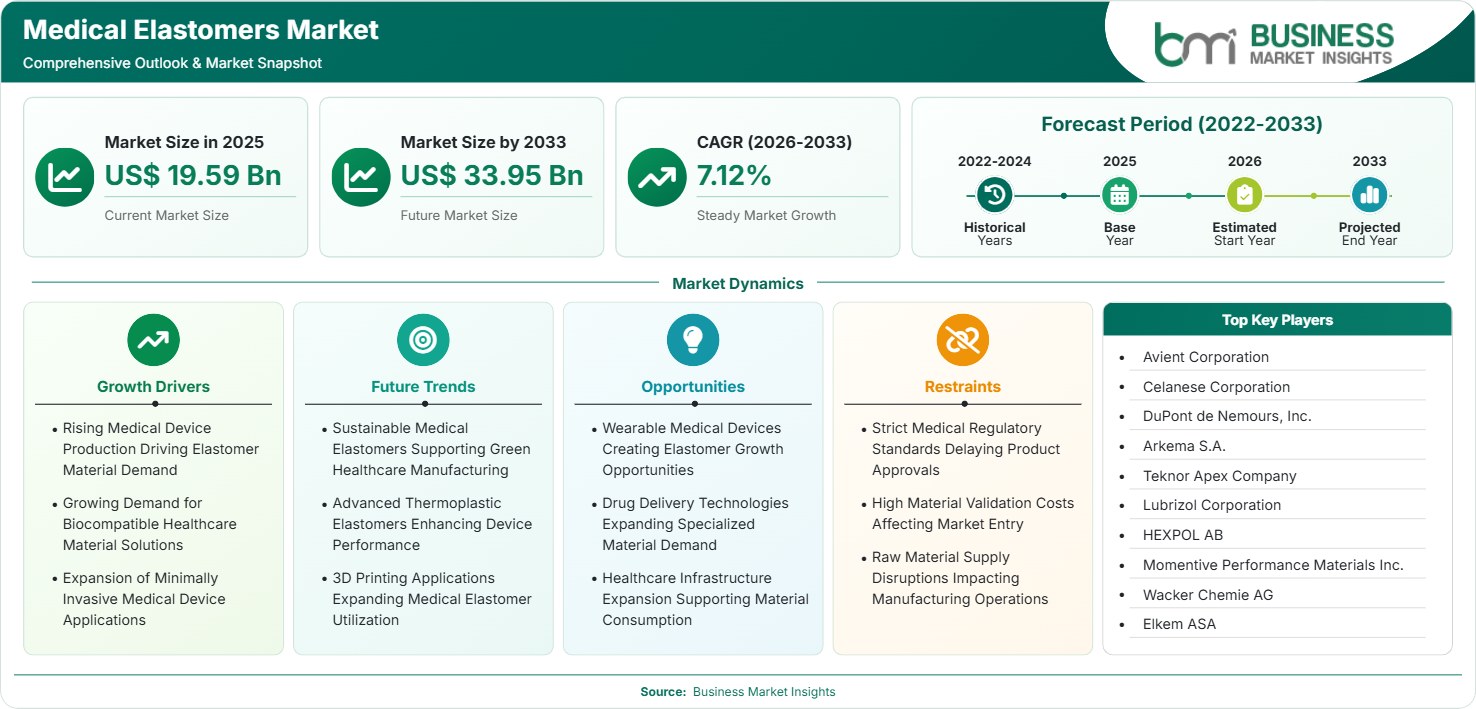
The Medical Elastomers Market size was valued at US$ 19.59 Billion in 2025 and is projected to reach US$ 33.95 Billion by 2033, growing at a CAGR of 7.12% during 2026–2033, driven by increasing medical device production, rising demand for biocompatible materials, and opportunities from wearable devices and advanced drug delivery systems.

Report Coverage
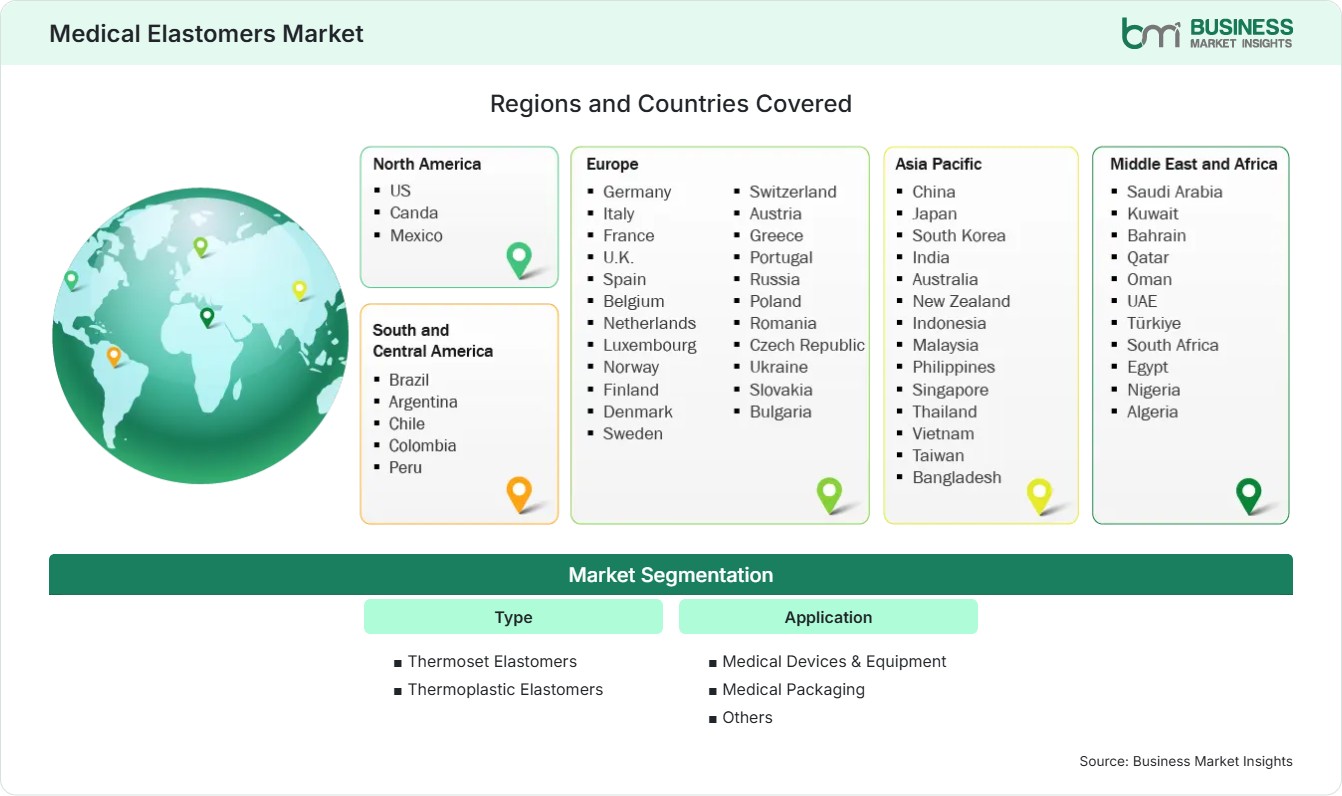
  • Type: Thermoset Elastomers, Thermoplastic Elastomers
  • Application: Medical Devices & Equipment, Medical Packaging, Others
US$ 19.59 Bn Market size in 2025
US$ 33.95 Bn Market Size by 2033
7.12% CAGR, 2026 - 2033
2026-2033 Forecast Period

AI Overview

Medical Elastomers Market Summary

  • North America Region: North America holds a 35%–38% share in 2025, growing at a CAGR of 6.80%–7.30% during 2026–2033, supported by advanced healthcare infrastructure, medical device manufacturing, regulatory compliance, and investments in specialty polymer technologies. The US market demonstrates strong adoption of silicone and thermoplastic elastomers across healthcare applications, supported by medical innovation, device manufacturing expansion, and a CAGR of 6.90%–7.40% during 2026–2033.
  • Fastest Growing Region: Asia Pacific accounts for a 28%–32% share in 2025, expanding at a CAGR of 8.00%–8.60% during 2026–2033, driven by healthcare infrastructure investments, expanding medical manufacturing capabilities, increasing healthcare accessibility, and rising demand for cost-effective medical components.
  • Leading Segment: Medical Devices & Equipment represents a 60%–65% share in 2025, growing at a CAGR of 7.00%–7.50% during 2026–2033, supported by increasing adoption of catheters, surgical equipment, diagnostic devices, respiratory systems, and flexible healthcare components requiring durability and biocompatibility.
  • High Growth Segment: Thermoplastic Elastomers capture a 40%–45% share in 2025 and register a CAGR of 7.50%–8.00% during 2026–2033, driven by processing advantages, lightweight properties, recyclability benefits, and increasing adoption in disposable healthcare products and wearable medical devices.
  • Key Market Opportunity: Growth opportunities exist through advanced drug delivery systems, wearable healthcare technologies, customized elastomer formulations, and sustainable medical materials improving device performance, patient comfort, and manufacturing efficiency.
  • Major Market Players: Avient Corporation, Celanese Corporation, DuPont de Nemours, Inc., Arkema S.A., Teknor Apex Company, The Lubrizol Corporation, HEXPOL AB, Momentive Performance Materials Inc., Wacker Chemie AG, Elkem ASA.
Strategic Insights

Medical Elastomers Market: Strategic Insights

Medical Elastomers Market Strategic Framework
FREE PDF
Request your free sample
Request free sample
Stakeholder View

Key Takeaways

  • The market environment is becoming increasingly integrated owing to cooperation between polymer suppliers, compounds providers, medical devices manufacturers, and the healthcare segment in order to create custom-made elastomer products.
  • Medical devices, healthcare wearables, and drug delivery systems offer promising growth potential since there is growing interest in flexible and resilient healthcare components.
  • Innovations in materials include advanced thermoplastic elastomers, silicones for healthcare applications, and custom-made elastomers that can withstand sterilization procedures.
  • Asia Pacific provides significant investment potential due to expanding medical manufacturing capabilities, rising healthcare expenditure, and government-supported healthcare infrastructure development.
  • Strategic collaborations, portfolio expansion, and technology investments are shaping competitive strategies as companies strengthen their presence in healthcare material applications.
  • Sustainability initiatives are influencing product development as manufacturers explore environmentally improved elastomer solutions while maintaining medical performance standards.
Geographic Outlook

Medical Elastomers Market Regional Highlights

North America Medical Elastomers Market

North America represents a 35%–38% share in 2025 and forecast to expand at a CAGR of 6.80%–7.30% during 2026–2033. The region benefits from advanced healthcare systems, established medical device manufacturers, and strong research capabilities. The Medical Elastomers Market share remains supported by demand from the United States and Canada, where high-quality medical materials are required for advanced healthcare equipment and precision medical components.

  • The United States drives regional demand through strong medical device production, advanced healthcare research, and increasing utilization of specialty elastomer materials.
  • Healthcare manufacturers are adopting medical-grade elastomers for flexible components requiring improved durability, safety, and sterilization performance.
  • Regulatory requirements encourage adoption of validated materials with consistent quality for critical healthcare applications.
  • Wearable medical devices and home healthcare technologies are creating additional demand for advanced elastomer solutions.

US Medical Elastomers Market

The US market accounts for a 28%–31% share of the global market in 2025 and U.S. Medical Elastomers Market forecast to grow at a CAGR of 6.90%–7.40% during 2026–2033. Strong medical technology capabilities, domestic device manufacturing, and healthcare innovation continue supporting market expansion. The country remains a major hub for development and commercialization of advanced medical components.

  • Medical device manufacturers are increasing adoption of silicone and thermoplastic elastomers in catheters, tubing, seals, and surgical equipment.
  • Growing demand for remote monitoring devices and wearable healthcare solutions is supporting material innovation.
  • Research institutions and healthcare companies are investing in advanced polymer technologies for improved medical performance.

Europe Medical Elastomers Market

Europe Medical Elastomers Market holds a 25%–28% share in 2025 and is estimated to register a CAGR of 6.50%–7.10% during 2026–2033. Germany, France, the United Kingdom, and Switzerland represent key markets due to established healthcare systems, medical technology expertise, and strict product quality requirements. The region emphasizes sustainable materials, advanced healthcare manufacturing, and innovation-driven medical solutions.

  • Germany contributes significantly through its advanced medical engineering sector and strong healthcare equipment manufacturing base.
  • France and the United Kingdom are expanding medical technology adoption through healthcare modernization initiatives.
  • European manufacturers are developing sustainable elastomer solutions aligned with environmental objectives.
  • Switzerland supports high-value healthcare innovation through specialized medical technology development.

Asia Pacific Medical Elastomers Market

Asia Pacific Medical Elastomers Market represents a 28%–32% share in 2025 and is projected to record the highest CAGR of 8.00%–8.60% during 2026–2033. The region is supported by expanding healthcare infrastructure, increasing medical device production, rising healthcare accessibility, and growing investments in local manufacturing capabilities. China, India, Japan, and South Korea are major contributors due to their expanding healthcare ecosystems and increasing demand for advanced medical materials.

  • China remains a major regional contributor due to its large medical device manufacturing base, expanding healthcare industry, and increasing domestic demand for advanced elastomer components.
  • India is witnessing growing investment in healthcare manufacturing facilities, supporting local production of medical equipment and specialized polymer-based components.
  • Japan and South Korea continue developing advanced healthcare technologies, increasing demand for high-performance elastomer materials in precision medical applications.
  • Regional manufacturers are strengthening partnerships with global material suppliers to improve availability of medical-grade elastomer solutions.
  • Increasing healthcare expenditure across emerging economies is accelerating adoption of disposable and advanced medical devices requiring flexible materials.

Rest of World Medical Elastomers Market

Rest of World accounts for a 7%–10% share in 2025 and is expected to grow at a CAGR of 6.00%–6.60% during 2026–2033. South and Central America are supported by improving healthcare infrastructure, increasing medical equipment demand, and private healthcare investments. Middle East and Africa markets are progressing through healthcare modernization initiatives and rising adoption of advanced medical technologies.

  • Brazil and Mexico are expanding medical equipment consumption through healthcare improvements, increasing private sector investments, and growing demand for medical consumables.
  • Middle Eastern countries are investing in advanced healthcare facilities, creating demand for reliable medical-grade elastomer materials and components.
  • Healthcare development programs across Africa are supporting gradual adoption of essential medical devices and flexible healthcare products.
  • Regional companies are forming partnerships with international suppliers to strengthen medical material availability and technical capabilities.
  • Infrastructure expansion and healthcare modernization continue creating long-term opportunities for elastomer manufacturers across developing markets.
Global Market Geography
FREE PDF
Request your free sample
Request free sample
Segment Analysis

Medical Elastomers Market Segmentation

Type

The Type segment includes Thermoset Elastomers and Thermoplastic Elastomers, covering materials used across medical devices, healthcare equipment, and specialized applications. The segment is influenced by requirements for flexibility, durability, chemical resistance, and sterilization performance. Thermoplastic Elastomers are gaining adoption due to processing advantages, while thermoset elastomers remain important for high-performance applications. The segment accounted for a 2025 share distribution based on application demand and is expected to achieve a CAGR of 7.00%–7.50% during 2026–2033.

  • Thermoset Elastomers: These materials provide excellent elasticity, thermal stability, and long-term performance. Silicone-based solutions are widely utilized in implants, tubing, seals, and surgical applications requiring biocompatibility.
  • Thermoplastic Elastomers: These materials combine rubber-like flexibility with efficient processing capabilities, supporting disposable medical products, wearable devices, and flexible healthcare components.

Application

The Application segment includes Medical Devices & Equipment and Medical Packaging, representing major consumption areas for specialized elastomer materials. Increasing healthcare technology adoption, rising medical device production, and demand for reliable materials are supporting segment expansion. The Medical Elastomers Market scope continues broadening through advanced healthcare applications requiring improved flexibility, safety, and durability. The segment is expected to register a CAGR of 7.00%–7.50% during 2026–2033.

  • Medical Devices & Equipment: This segment dominates demand due to extensive usage in catheters, respiratory equipment, surgical instruments, seals, and diagnostic devices requiring flexible and reliable material performance.
  • Medical Packaging: Elastomer-based packaging solutions support pharmaceutical containment, protective components, and healthcare packaging systems requiring chemical resistance and contamination protection.
Market Forces

Medical Elastomers Market Dynamics

Key Market Drivers

Rising Medical Device Production Driving Elastomer Material Demand

The rise in the manufacturing of medical devices is increasing the use of elastomer materials in the health sector in areas such as catheters, surgical tools, diagnostic machines, breathing devices, and monitoring devices. The increase in the construction of health infrastructure globally coupled with an increased need for medical devices is driving manufacturers towards more flexible, tough, and biocompatible materials. Manufacturers of medical devices are increasingly opting for elastomers which have resistance to chemicals, sterilization, and mechanical wear.

Growing Demand for Biocompatible Healthcare Material Solutions

The medical elastomers market trend towards patient safety and improved healthcare product performance is fueling demand for biocompatible elastomer materials. The medical industry needs materials that produce low reaction rates but have high flexibility and durability, as well as resistance to sterilization procedures. Silicone elastomers and innovative thermoplastic elastomers have become increasingly popular because of their suitability for applications that require constant contact with living tissue, such as implants, tubes, seals, and wearable healthcare devices.

Expansion of Minimally Invasive Medical Device Applications

With the growing number of minimally invasive procedures, there is an increasing demand for flexible and highly performing elastomer parts that can be incorporated into advanced medical devices. Small and highly precise surgical processes require materials that are able to ensure not only elasticity but also strength and excellent performance during difficult procedures. Elastomers are more frequently used in catheters, surgical instruments, diagnostic equipment, and special delivery systems owing to their capability to enable compact and user-friendly design. The increased popularity of minimally invasive surgeries in hospitals and other healthcare organizations driving the medical elastomers market growth.

Key Market Opportunities

Wearable Medical Devices Creating Elastomer Growth Opportunities

The rapid adoption of wearable medical devices is creating new opportunities for elastomer manufacturers developing flexible, lightweight, and skin-compatible materials. Wearable health monitoring systems, smart patches, portable diagnostic devices, and fitness-oriented healthcare technologies require materials that provide comfort, durability, and resistance to environmental exposure. Elastomers enable manufacturers to develop products with improved flexibility and enhanced user experience. Increasing consumer interest in continuous health monitoring and remote healthcare solutions is expanding application potential.

Drug Delivery Technologies Expanding Specialized Material Demand

Advancements in drug delivery technologies are creating opportunities for specialized elastomer materials used in pumps, seals, reservoirs, and flexible delivery components. Modern drug delivery systems require materials capable of maintaining chemical stability, dimensional accuracy, and safe interaction with pharmaceutical formulations. Increasing development of injectable therapies, automated delivery devices, and patient-focused treatment systems is supporting demand for advanced elastomer solutions. Manufacturers are focusing on customized materials that improve device reliability and ensure consistent performance throughout product lifecycles.

Healthcare Infrastructure Expansion Supporting Material Consumption

Expansion of healthcare infrastructure across emerging economies is creating opportunities for increased consumption of elastomer-based medical products. Rising hospital construction, improved healthcare accessibility, and government healthcare development programs are increasing demand for medical devices, diagnostic equipment, and disposable healthcare products. Countries investing in healthcare modernization require reliable material solutions that support large-scale production of medical equipment. Elastomer suppliers are benefiting from increasing partnerships with regional manufacturers seeking advanced materials for healthcare applications.

Market Restraints and Challenges

Strict Medical Regulatory Standards Delaying Product Approvals

Factor: Strict regulations governing the medical field pose hurdles for elastomer producers who wish to get approval for innovative use cases. The Factor refers to the need to conduct elaborate validation in regard to biocompatibility, sterilization tolerance, chemical resistance, and performance characteristics. Impact: Longer approval times, delays in commercialization of the product, and increased costs of compliance on the part of companies manufacturing innovative medical elastomers. Validation has to be performed prior to the adoption of such materials in healthcare products.

High Material Validation Costs Affecting Market Entry

Factor: High material validation costs represent another challenge affecting participation in specialized medical elastomer applications. This significant investment required for laboratory testing, certification procedures, quality evaluation, and performance validation before healthcare adoption. Impact: higher research and development expenses, longer qualification periods, and increased barriers for new market entrants. Medical device manufacturers often require extensive documentation and reliability testing before approving new elastomer suppliers. These requirements increase financial pressure on companies developing innovative materials.

Company Analysis

Competitive Landscape

The Medical Elastomers Market analysis highlights a competitive environment shaped by global specialty polymer manufacturers, silicone technology providers, and engineered material suppliers. Companies are focusing on healthcare-grade formulations, product innovation, strategic partnerships, and manufacturing expansion to strengthen their position. Competitive strategies include development of biocompatible materials, sustainable elastomer solutions, and customized compounds designed for medical devices, packaging systems, and advanced healthcare applications.

Company Name

Overview

Products and Services relevant to this market

Avient Corporation

Global specialty materials company providing engineered polymer solutions for healthcare and advanced applications.

Medical-grade thermoplastic elastomers, polymer compounds, colorants, additives, and customized healthcare material solutions.

Celanese Corporation

Specialty materials manufacturer developing engineered polymers for demanding healthcare applications.

Medical-grade engineered polymers, thermoplastic elastomers, and advanced material solutions for medical components.

DuPont de Nemours, Inc.

Science-driven materials company offering advanced polymer technologies for healthcare applications.

Medical elastomers, specialty polymers, biomaterial solutions, and healthcare-grade material technologies.

Arkema S.A.

Specialty chemicals producer focused on high-performance polymers and innovative material solutions.

Advanced elastomers, specialty polymers, and healthcare material solutions for medical applications.

Teknor Apex Company

Custom compounder specializing in engineered thermoplastic and elastomer solutions.

Medical-grade thermoplastic elastomers, custom compounds, and healthcare polymer formulations.

The Lubrizol Corporation

Specialty chemical company developing advanced polymer technologies for medical applications.

Medical-grade thermoplastic polyurethane elastomers, coatings, and healthcare material systems.

HEXPOL AB

Global polymer compounder providing customized elastomer solutions across multiple industries.

Medical rubber compounds, silicone materials, and specialty elastomer formulations for healthcare.

Momentive Performance Materials Inc.

Silicone technology provider specializing in high-performance silicone material solutions.

Medical-grade silicone elastomers, silicone compounds, and healthcare device material solutions.

Wacker Chemie AG

Chemical manufacturer offering silicone-based materials for healthcare and industrial applications.

Medical silicone elastomers, silicone rubber compounds, and specialty healthcare materials.

Elkem ASA

Global silicone producer developing advanced materials for healthcare and technology markets.

Medical silicone elastomers, silicone compounds, and customized healthcare material solutions.

Trust & Transparency

Research Methodology

The market analysis combines proprietary research with secondary data from government agencies, company disclosures, regulatory filings, industry databases and expert interviews. Market estimates are validated through data triangulation, cross-market benchmarking and analyst review.

View Full Research Methodology

Questions Answered

Frequently Asked Questions

How does Medical Elastomers Market Report support strategic planning?

The Market Report helps stakeholders evaluate regional opportunities, competitive positioning, application trends, and future material adoption opportunities across healthcare industries.

Which regions offer the strongest expansion opportunities for suppliers?

Asia Pacific provides significant opportunities due to expanding healthcare infrastructure, increasing medical manufacturing capacity, and rising demand for advanced healthcare materials.

How do regulations influence medical elastomer development?

Healthcare regulations require extensive testing for safety, sterilization compatibility, and biocompatibility, influencing material development timelines and approval processes.

What makes thermoplastic elastomers attractive for medical manufacturers?

Thermoplastic elastomers provide processing efficiency, design flexibility, recyclability advantages, and lightweight performance, making them suitable for disposable and advanced healthcare products.

What applications are driving medical elastomer demand worldwide?

Medical elastomers are increasingly used in catheters, surgical equipment, wearable devices, drug delivery systems, and medical packaging due to their flexibility, durability, and biocompatibility.

Access the Full Medical Elastomers Market Report

Get segment-level forecasts, regional estimates, competitive benchmarking, company profiles and downloadable Excel datasets.

Access the full Medical Elastomers Market Report
350 pages PDF & Excel | 2026-08-20