
Medical Lasers Market Outlook: Size, Share, Trends, Growth Analysis, Competitive Landscape & Forecast, 2026-2033

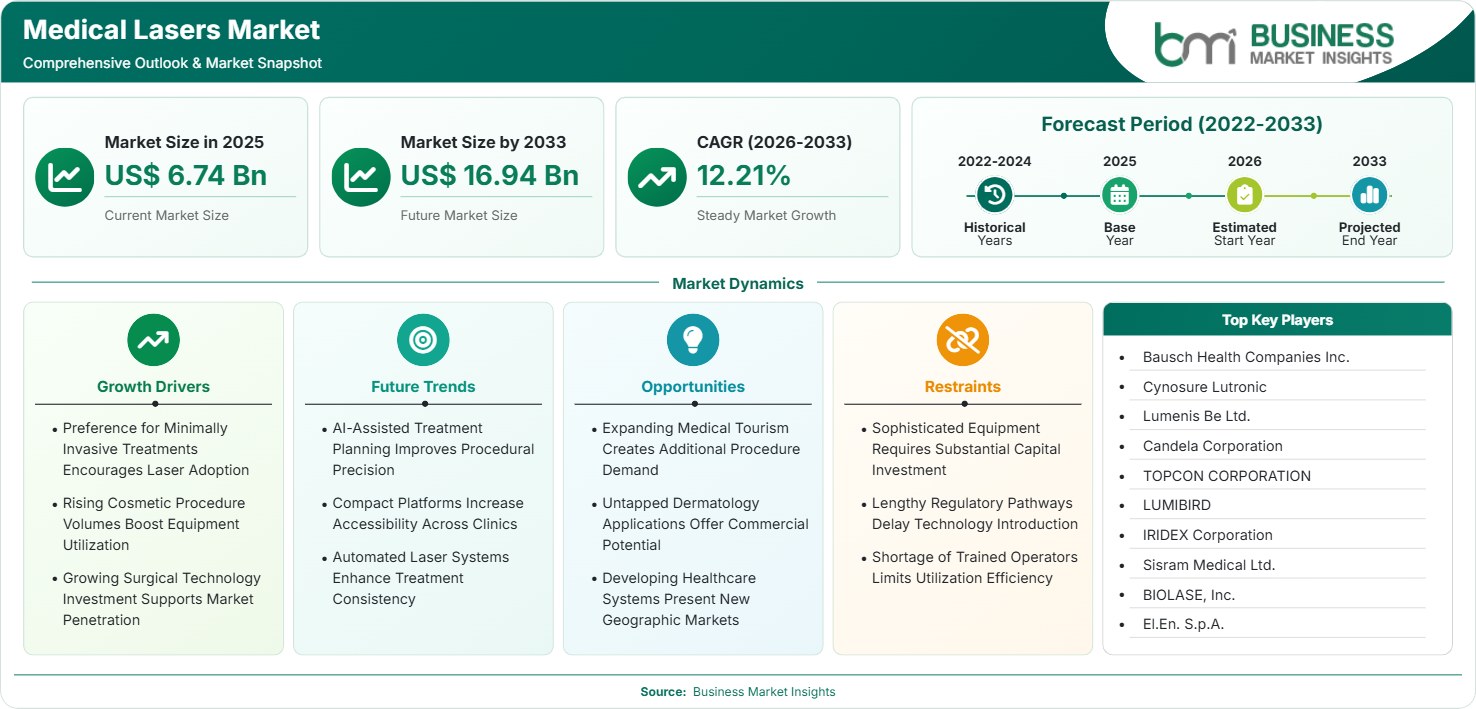
The Medical Lasers Market size was valued at US$ 6.74 billion in 2025 and is projected to reach US$ 16.94 billion by 2033, growing at a CAGR of 12.21% during 2026–2033. Preference for minimally invasive treatments, rising cosmetic procedures, surgical technology investment, medical tourism, and expanding specialty care are creating attractive opportunities.

Report Coverage
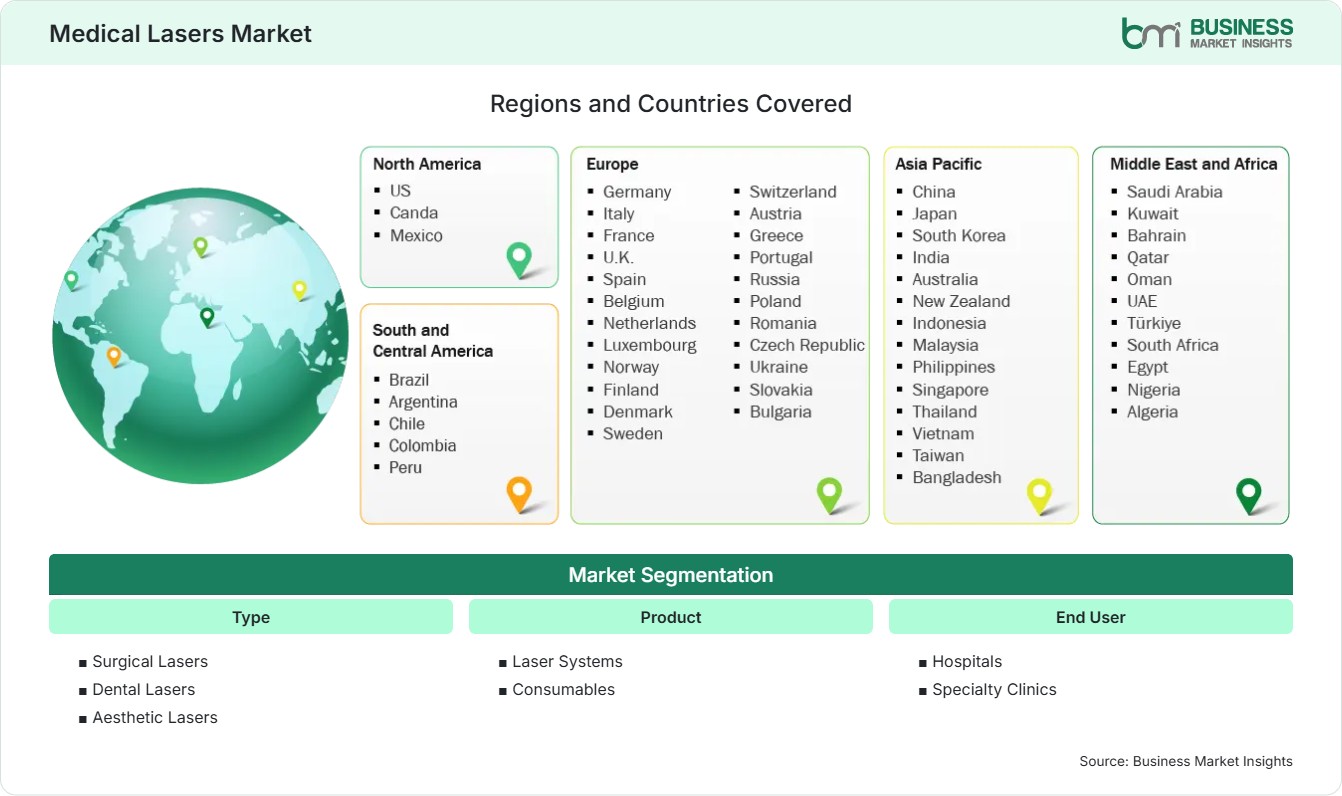
  • Type: Surgical Lasers, Dental Lasers, Aesthetic Lasers
  • Product: Laser Systems, Consumables
  • End User: Hospitals, Specialty Clinics
US$ 6.74 Bn Market size in 2025
US$ 16.94 Bn Market Size by 2033
12.21% CAGR, 2026 - 2033
2026-2033 Forecast Period

AI Overview

Medical Lasers Market Summary

  • North America Region: North America holds 30%–33% Medical Lasers Market share in 2025 and is projected to expand at a CAGR of 11.6%–12.2% during 2026–2033. Advanced hospitals, specialist clinics, physician expertise, aesthetic procedure adoption, technology replacement, and established distribution networks support demand. The U.S. remains the leading market, recording a CAGR of 11.8%–12.4%, supported by specialty healthcare investment, sophisticated clinical infrastructure, and adoption of advanced laser platforms.
  • Fastest Growing Region: Asia Pacific accounts for 31%–34% market share in 2025 and is expected to register a CAGR of 13.2%–13.8% during 2026–2033, supported by healthcare infrastructure expansion, medical tourism, rising aesthetic awareness, specialty clinic development, private healthcare investment, and broader access to advanced surgical, dermatological, dental, and ophthalmic procedures.
  • Leading Segment: Surgical Lasers represent 41%–44% market share in 2025 and are anticipated to grow at a CAGR of 11.9%–12.5% during 2026–2033, supported by minimally invasive procedures, precision treatment requirements, surgical infrastructure upgrades, broader procedural applications, and increasing provider preference for technologically advanced operating-room capabilities.
  • High Growth Segment: Aesthetic Lasers account for 28%–31% market share in 2025 and are projected to record a CAGR of 13.5%–14.1% during 2026–2033, driven by increasing cosmetic procedure volumes, non-invasive treatment preferences, specialty clinic expansion, multifunctional platforms, and broader consumer acceptance of energy-based aesthetic procedures.
  • Key Market Opportunity: Expanding medical tourism, underserved dermatology applications, healthcare modernization, and specialty clinic development create opportunities for multifunctional, compact, cost-efficient laser systems supported by training, financing, distribution, and service capabilities.
  • Major Market Players: Bausch Health Companies Inc., Cynosure Lutronic, Lumenis Be Ltd., Candela Corporation, TOPCON CORPORATION, LUMIBIRD, IRIDEX Corporation, Sisram Medical Ltd., BIOLASE, Inc., and El.En. S.p.A.
Strategic Insights

Medical Lasers Market: Strategic Insights

Medical Lasers Market Strategic Framework
FREE PDF
Request your free sample
Request free sample
Stakeholder View

Key Takeaways

  • The value chain increasingly extends beyond capital equipment toward delivery systems, accessories, consumables, software, maintenance, physician training, and technical support, creating multiple revenue opportunities around installed laser platforms.
  • Surgical and aesthetic applications provide strong upside because providers increasingly seek technologies that improve treatment precision, support minimally invasive procedures, and broaden the number of indications served by individual systems.
  • Innovation is moving toward multifunctional equipment, improved energy delivery, compact designs, simplified interfaces, enhanced safety controls, and application-specific systems that can improve workflow consistency.
  • Asia Pacific offers an attractive investment environment because private healthcare development, medical tourism, specialty clinics, aesthetic awareness, and advanced treatment adoption are expanding the potential customer base.
  • Competitive positioning increasingly depends on clinical usability, physician education, regulatory readiness, distribution capabilities, after-sales service, and the ability to demonstrate economic value alongside technological differentiation.
  • Manufacturers can strengthen recurring revenue by combining equipment sales with consumables, accessories, service contracts, upgrades, software, clinical training, and application-specific support.
Geographic Outlook

Medical Lasers Market Regional Highlights

North America Medical Lasers Market

North America represents 30%–33% Medical Lasers Market share in 2025 and is projected to expand at a CAGR of 11.6%–12.2% during 2026–2033. Advanced hospitals, established specialty clinics, trained physicians, aesthetic treatment adoption, and technology replacement support regional demand. The United States remains the principal contributor, while Canada provides additional opportunities through healthcare modernization. The region benefits from established distribution networks and strong utilization across surgery, dermatology, ophthalmology, dentistry, and aesthetics, supporting continued equipment upgrades and application expansion.

  • Hospitals increasingly prioritize laser platforms offering precise energy delivery, broader procedural capabilities, and compatibility with established surgical workflows.
  • Specialty clinics are expanding aesthetic laser portfolios as providers seek differentiated procedures, broader treatment offerings, and improved utilization of treatment rooms.
  • Physician training infrastructure supports technology adoption by improving operator familiarity, procedural confidence, treatment consistency, and effective utilization of advanced systems.
  • Replacement demand creates opportunities for manufacturers as providers transition from older equipment toward multifunctional platforms with improved interfaces and treatment flexibility.

US Medical Lasers Market

The United States represents 84%–87% of North American revenue and is projected to expand at a CAGR of 11.8%–12.4% during 2026–2033. Sophisticated hospitals, established dermatology practices, advanced specialty clinics, and broad adoption of minimally invasive procedures support demand. The substantial installed equipment base also creates replacement and upgrade opportunities. Manufacturers increasingly emphasize physician education, clinical applications, equipment usability, service support, and technology differentiation to strengthen customer relationships and improve utilization.

  • Aesthetic practices continue upgrading equipment as consumers increasingly seek non-surgical approaches for skin rejuvenation, pigmentation management, and other cosmetic indications.
  • Hospitals favor multifunctional systems capable of supporting multiple specialties because broader utilization can improve the economics of substantial equipment investments.
  • Physician education remains important because effective laser treatment depends on appropriate parameters, procedure selection, clinical expertise, and patient-specific treatment planning.

Europe Medical Lasers Market

Europe accounts for 24%–27% market share in 2025 and is projected to register a CAGR of 10.9%–11.5% during 2026–2033. Germany, the United Kingdom, France, and Italy represent leading markets, while Spain and selected Central European economies provide additional expansion potential. Established clinical infrastructure, sophisticated specialty practices, aesthetic medicine, ophthalmology, and dental care support equipment adoption. Regulatory compliance, clinical documentation, operator training, service capabilities, and technology reliability remain important purchasing criteria for European healthcare providers and specialty practices.

  • Germany represents a leading opportunity because established hospitals and specialist practices support adoption of advanced surgical, ophthalmic, dermatological, and aesthetic laser platforms.
  • France and Italy provide attractive aesthetic opportunities as dermatology and cosmetic clinics broaden treatment portfolios and invest in advanced energy-based technologies.
  • European providers increasingly evaluate technology alongside regulatory documentation, training, service infrastructure, equipment reliability, and long-term ownership economics.
  • Spain and Central European markets provide expansion opportunities as private healthcare investment and specialty treatment capacity continue developing.

Asia Pacific Medical Lasers Market

Asia Pacific holds 31%–34% market share in 2025 and is projected to record the fastest CAGR of 13.2%–13.8% during 2026–2033. China, Japan, South Korea, and India represent major markets, while Southeast Asia offers additional expansion opportunities. Rising healthcare investment, medical tourism, specialty clinic development, aesthetic awareness, and broader access to advanced procedures support regional demand. Medical Lasers Market growth is further supported by expanding private healthcare capacity and increasing availability of technologically advanced treatments in metropolitan areas.

  • China combines a large healthcare base with expanding aesthetic medicine and specialty treatment capacity, supporting opportunities for surgical and aesthetic laser suppliers.
  • South Korea remains strategically important for aesthetic technologies because specialist clinics and consumer interest encourage adoption of innovative energy-based treatment platforms.
  • India offers substantial long-term potential as private hospitals, dental centers, dermatology clinics, and medical tourism facilities expand advanced procedure capabilities.
  • Southeast Asian markets provide opportunities for suppliers offering localized training, financing, distribution, maintenance, and application support alongside equipment.

Rest of World Medical Lasers Market

Rest of World represents 9%–12% market share in 2025 and is projected to expand at a CAGR of 10.1%–10.7% during 2026–2033. Latin American markets benefit from aesthetic medicine and private healthcare investment, while Middle Eastern markets benefit from premium specialty care and medical tourism. Brazil and Gulf economies represent important demand centers. Market development depends on distributor capabilities, physician training, financing availability, regulatory access, reliable technical service, and the availability of procedure-specific technologies.

Latin America provides opportunities across dermatology, dentistry, aesthetics, and selected surgical applications as private healthcare providers expand specialty services. Brazil represents a leading market, while Mexico and other developing economies provide additional opportunities. Middle Eastern healthcare providers increasingly invest in technologically advanced equipment for premium hospitals and specialty clinics. Suppliers can improve penetration through regional partnerships, financing structures, physician education, technical support, and dependable maintenance capabilities that reduce operational concerns surrounding sophisticated laser systems.

  • Brazil offers attractive opportunities in aesthetic and dermatological applications supported by private healthcare investment and established specialty clinic networks.
  • Gulf healthcare markets provide opportunities for premium laser platforms as hospitals and specialty providers expand advanced aesthetic and surgical capabilities.
  • Distributor partnerships remain important because local technical support, regulatory knowledge, physician training, and maintenance influence purchasing decisions.
  • Financing and service models can reduce capital barriers and improve accessibility for smaller specialty practices in developing healthcare markets.
Global Market Geography
FREE PDF
Request your free sample
Request free sample
Segment Analysis

Medical Lasers Market Segmentation

Type

The type segment remains central to product positioning because different laser technologies address distinct clinical procedures, energy requirements, and treatment objectives. Surgical Lasers represented 41%–44% market share in 2025 and are projected to grow at a CAGR of 11.9%–12.5% during 2026–2033. Medical Lasers Market trends increasingly favor multifunctional systems capable of supporting broader procedures, improving utilization, and strengthening clinical workflow efficiency across specialist providers.

  • Surgical Lasers: Lead demand through minimally invasive procedures, precise tissue treatment, surgical technology upgrades, broader clinical applications, and provider preference for controlled energy delivery.
  • Dental Lasers: Gain adoption as dental practices seek efficient soft-tissue and hard-tissue procedures, improved patient comfort, treatment differentiation, and technology-enabled clinical workflows.
  • Aesthetic Lasers: Expand rapidly as dermatology and cosmetic clinics increase non-invasive treatment offerings, adopt multifunctional platforms, and address broader consumer demand for appearance-focused procedures.

Product

The product segment comprises laser systems and consumables, creating complementary capital-equipment and recurring-revenue opportunities. Laser Systems represented 68%–71% Medical Lasers Market in 2025 and are projected to expand at a CAGR of 11.6%–12.2% during 2026–2033. Demand is supported by new installations, replacement cycles, technology upgrades, procedure expansion, and investments in multifunctional platforms that improve equipment utilization.

  • Laser Systems: Generate the principal equipment opportunity through hospital installations, specialty clinic upgrades, replacement programs, multifunctional platforms, and investments in advanced treatment capabilities.
  • Consumables: Create recurring revenue through procedure-specific accessories and replaceable components, with demand linked to treatment volumes, equipment utilization, maintenance requirements, and clinical workflows.

End User

Hospitals and specialty clinics represent the principal purchasing base because advanced laser procedures require specialized infrastructure, trained operators, safety controls, and clinical support. Hospitals accounted for 63%–66% Medical Lasers Market in 2025 and are projected to grow at a CAGR of 11.5%–12.1% during 2026–2033. Specialty clinics provide strong expansion potential as aesthetic, dermatology, dental, and ophthalmic services broaden.

  • Hospitals: Remain major users because multidisciplinary facilities can deploy laser platforms across surgery, dermatology, ophthalmology, dentistry, and other specialized clinical applications.
  • Specialty Clinics: Offer strong growth potential as focused providers expand aesthetic, dermatology, dental, and ophthalmic services while seeking compact, efficient systems.
Market Forces

Medical Lasers Market Dynamics

Key Market Drivers

Preference for Minimally Invasive Treatments Encourages Laser Adoption

Minimally invasive surgery drives increased demand for laser systems that provide precision and control over energy delivery. Increasingly, hospitals and specialty centers assess medical devices based on their accuracy, adaptability, efficiency, and usability. Surgical lasers could supplement traditional methods where selective tissue interaction is needed, whereas aesthetic lasers could capitalize on consumers' preference for non-surgical alternatives. These developments support Medical Lasers Market growth by increasing the relevance of laser technology across established and emerging clinical applications. Manufacturers are responding through compact designs, improved interfaces, adaptable treatment parameters, multifunctional configurations, and specialized delivery systems.

Rising Cosmetic Procedure Volumes Boost Equipment Utilization

Aesthetic medicine is becoming an increasingly important driver of utilization as dermatology and cosmetic clinics expand their treatment portfolios to include skin rejuvenation, pigmentation, resurfacing, hair reduction, and other appearance-focused procedures. Customers are increasingly interested in therapies that do not require traditional surgery, prompting medical practitioners to invest in energy platforms. The multifunctionality of devices will help address different applications while improving room efficiency and making the business case for expensive purchases more compelling. As a result, medical technology companies focus on flexible energy delivery, interchanging treatment heads, ease of use, and procedure-specific configurations.

Growing Surgical Technology Investment Supports Market Penetration

Healthcare professionals have increased interest in advanced surgical facilities as doctors strive to get better accuracy, efficiency, and technology that can work with traditional modes of therapy. Laser equipment can deliver energy selectively to perform certain surgical procedures, and this equipment will become more appealing if it can be used for multiple procedures. Total cost of ownership becomes increasingly important along with other factors like service, training, and flexibility while making the decision on purchasing.

Key Market Opportunities

Expanding Medical Tourism Creates Additional Procedure Demand

Medical tourism creates opportunities for laser manufacturers because internationally oriented hospitals and specialty clinics frequently seek advanced technologies to differentiate their treatment portfolios. Centers targeting international patients may concentrate on more recent facilities and services in aesthetics, dentistry, ophthalmology, dermatology, and surgery. This will enable manufacturers to make partnerships with hospitals, distributors, training institutions, and clinicians in places where there is growing demand for international treatments. The multi-functional equipment becomes even more appealing, as it enables the providers to handle various indications using one single equipment base.

Untapped Dermatology Applications Offer Commercial Potential

Opportunities exist in dermatology due to the applicability of laser technology to meet diverse clinical and cosmetic needs. The manufacturers can explore under-addressed applications by educating physicians, developing clinical data, designing systems and protocols for treatment that will facilitate implementation. Additionally, opportunities exist outside of large metro practices where portable equipment can minimize infrastructure needs and broaden access to specialty care. Equipment capable of addressing several applications through one system might improve economics by being multifunctional. Product development can offer differentiation through enhanced treatment comfort, flexibility of energy delivery, easy parameter settings and usability. Medical Lasers Market Forecasts indicate attractive potential where technology development is combined with application training, distribution partnerships, and localized service. These capabilities can convert specialized dermatology requirements into scalable equipment opportunities and recurring service revenue.

Developing Healthcare Systems Present New Geographic Markets

Healthcare modernization across developing economies is creating opportunities for laser manufacturers to establish positions in expanding specialty care markets. Hospitals, private practices, dental facilities, and dermatology offices need systems that integrate clinical utility and economic viability. This can be done by suppliers through small packages, modular designs, financing, distributors, on-site training, and technical support services. Regulatory knowledge is equally critical as market entry requires proper registration and follow-up after launch. Those manufacturers that create local technical support structures can minimize the risk of down time and enhance customer retention.

Market Restraints and Challenges

Sophisticated Equipment Requires Substantial Capital Investment

Factor: Medical lasers, which are advanced devices, can be associated with significant upfront costs owing to the integration of various components in an advanced platform like energy sources, delivery devices, safety features, software, accessories, and engineering. The small specialist clinics will thus either delay the purchase process or opt for cheaper options in the event of uncertainty about the number of procedures to be undertaken. Impact: Significant upfront cost will affect the replacement cycle, limit usage to top hospitals and specialized centers, and increase the dependency on financial arrangements. The manufacturer will have to prove its ability to cover a wide range of procedures and high utilization and good ownership benefits.

Lengthy Regulatory Pathways Delay Technology Introduction

Factor: Medical lasers are subject to regulatory filings, safety validation, performance validation, quality controls, and market-specific compliance before they are brought to the market, especially where companies are bringing out their new energy sources for clinical use or exploring new clinical applications of their existing technologies. Impact: This may result in product launch delays, higher product development costs, delayed revenue generation, and difficulties with a synchronized international launch. Smaller firms might be affected more because regulatory funding competes with other funding sources.

Company Analysis

Competitive Landscape

The competitive environment includes diversified healthcare companies, specialist laser manufacturers, ophthalmic technology providers, aesthetic device developers, and dental laser specialists. Medical Lasers Market analysis indicates that competitive differentiation increasingly depends on clinical application breadth, regulatory readiness, physician education, product usability, distribution capabilities, technical support, and recurring revenue opportunities associated with accessories and consumables.

Company Name

Overview

Products and Services Relevant to this Market

Bausch Health Companies Inc.

Diversified healthcare company with established specialty healthcare and medical technology capabilities.

Ophthalmic laser technologies, surgical solutions, specialty medical devices, clinical support, and related ophthalmic products.

Cynosure Lutronic

Energy-based medical technology specialist focused strongly on aesthetic and dermatological treatment platforms.

Aesthetic laser systems, skin treatment platforms, body treatments, hair-removal technologies, and clinical application support.

Lumenis Be Ltd.

Global energy-based medical device company serving aesthetic, surgical, and ophthalmic treatment applications.

Surgical and aesthetic laser systems, energy-based platforms, treatment accessories, and physician-focused clinical solutions.

Candela Corporation

Medical aesthetics technology specialist serving dermatology, cosmetic medicine, and specialty clinical practices.

Aesthetic laser platforms, pulsed-light technologies, skin treatment systems, accessories, and clinical education.

TOPCON CORPORATION

Medical technology company with substantial ophthalmic diagnostic and treatment capabilities.

Ophthalmic laser solutions, retinal treatment technologies, ophthalmic systems, accessories, and clinical workflow solutions.

LUMIBIRD

Laser technology company serving medical, ophthalmic, and specialized clinical applications.

Ophthalmic laser systems, diagnostic technologies, treatment accessories, and specialized medical laser solutions.

IRIDEX Corporation

Specialist ophthalmic laser company focused on retinal and glaucoma treatment technologies.

Ophthalmic laser systems, MicroPulse technologies, delivery devices, retinal consumables, and glaucoma treatment solutions.

Sisram Medical Ltd.

Medical aesthetics technology company offering energy-based treatment platforms for clinical and cosmetic applications.

Aesthetic laser and energy systems, body and skin platforms, treatment technologies, consumables, and clinical solutions.

BIOLASE, Inc.

Dental laser technology specialist focused on laser-assisted dental procedures and clinical workflows.

Dental laser systems, Waterlase technologies, dental consumables, accessories, training, and clinical education.

El.En. S.p.A.

Italian laser technology company serving medical, aesthetic, industrial, and scientific applications.

Medical and aesthetic laser systems, dermatology technologies, surgical applications, accessories, and specialized laser solutions.

Trust & Transparency

Research Methodology

The market analysis combines proprietary research with secondary data from government agencies, company disclosures, regulatory filings, industry databases and expert interviews. Market estimates are validated through data triangulation, cross-market benchmarking and analyst review.

View Full Research Methodology

Questions Answered

Frequently Asked Questions

What are the major Medical Lasers Market trends?

Major Market trends include multifunctional platforms, minimally invasive procedures, aesthetic treatment expansion, compact equipment designs, improved energy delivery, specialty clinic adoption, physician training, and increasing emphasis on equipment utilization and recurring service revenue.

What does the Medical Lasers Market Report cover?

The Market Report covers market sizing, regional assessment, segmentation by type, product and end user, growth drivers, opportunities, restraints, competitive positioning, recent development themes, and strategic industry insights.

What factors are supporting Market growth?

Key factors include preference for minimally invasive treatments, increasing cosmetic procedure volumes, surgical technology investment, medical tourism, dermatology application expansion, specialty clinic development, and healthcare modernization.

Which region has the largest Market share?

Asia Pacific holds 31%–34% market share in 2025, making it the largest regional range in this assessment. North America follows at 30%–33%, while Europe represents 24%–27%.

What is the Market size in 2025?

The Market size was US$ 6.74 billion in 2025 and is projected to reach US$ 16.94 billion by 2033, reflecting the supplied forecast CAGR of 12.21% during 2026–2033.

Access the Full Medical Lasers Market Report

Get segment-level forecasts, regional estimates, competitive benchmarking, company profiles and downloadable Excel datasets.

Access the full Medical Lasers Market Report
350 pages PDF & Excel | 2026-08-19
Similar Research

Related Market Reports