
Medical Tourism Market Outlook: Size, Share, Trends, Growth Analysis, Competitive Landscape & Forecast, 2026-2033

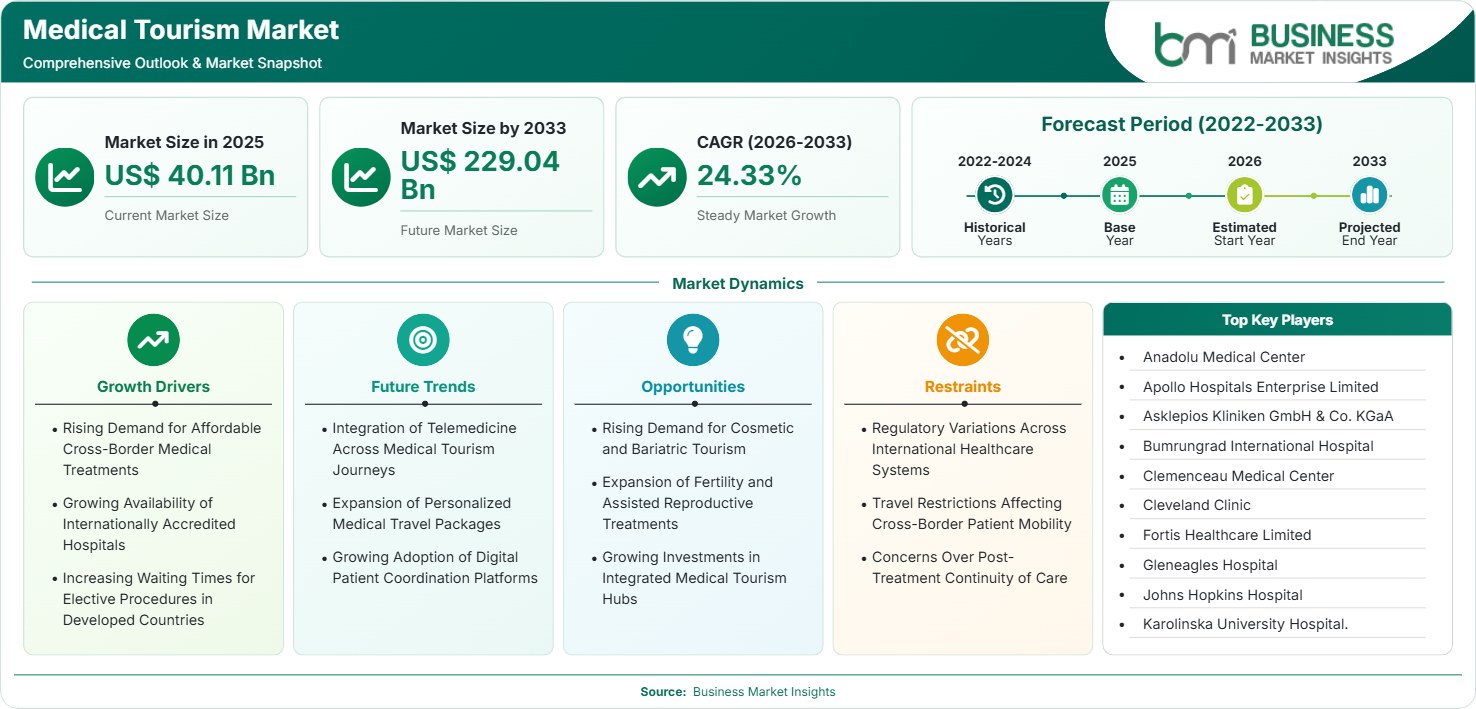
The Medical Tourism Market size was valued at US$ 40.11 Billion in 2025 and is projected to reach US$ 229.04 Billion by 2033, growing at a CAGR of 24.33% during 2026–2033. Healthcare cost escalation in advanced countries, greater availability of hospitals with international accreditations, reduced time for treatment, and increased need for specialized treatments are all speeding up cross-border patient movements, along with creating many opportunities through integration of digital health and medical tourism efforts by governments.

Report Coverage
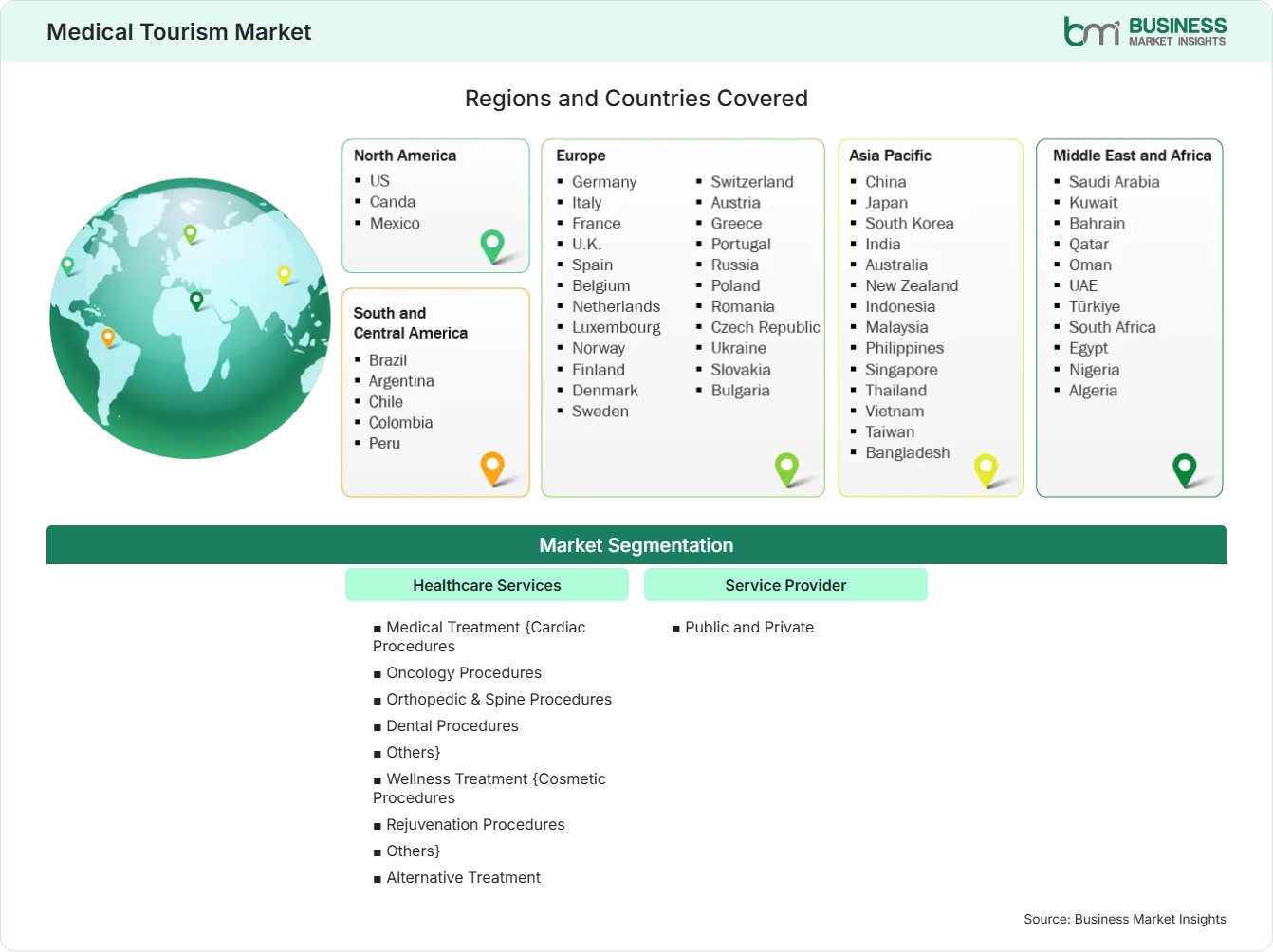
  • Healthcare Services: Medical Treatment {Cardiac Procedures, Oncology Procedures, Orthopedic & Spine Procedures, Dental Procedures, Others}, Wellness Treatment {Cosmetic Procedures, Rejuvenation Procedures, Others}, Alternative Treatment
  • Service Provider: Public and Private
US$ 40.11 Bn Market size in 2025
US$ 229.04 Bn Market Size by 2033
24.33% CAGR, 2026 - 2033
2026-2033 Forecast Period

AI Overview

Medical Tourism Market Summary

  • North America Region: North America holds 33%–36% medical tourism market share in 2025 and is expected to grow at a 22.0%–23.5% CAGR during 2026–2033. Growth is supported by advanced healthcare infrastructure, increasing outbound patients seeking cost-effective treatments, expanding telehealth consultations, and strategic international hospital partnerships. The United States remains the largest contributor within the region, supported by strong demand for specialized treatments and growing collaboration with overseas healthcare providers, advancing at approximately 22.3%–23.8% CAGR through 2033.
  • Fastest Growing Region: Asia Pacific accounts for 34%–37% market share in 2025 and is projected to register the fastest 25.5%–27.2% CAGR through 2033. Competitive treatment costs, internationally accredited hospitals, expanding government promotion, improved air connectivity, and increasing investments in premium healthcare facilities continue attracting international patients.
  • Leading Segment: Healthcare Services account for 66%–69% market share in 2025 and are forecast to expand at a 24.0%–24.8% CAGR during the forecast period. Increasing demand for advanced surgical procedures, specialized diagnostics, multidisciplinary treatment capabilities, and internationally recognized clinical expertise continues driving segment dominance.
  • High Growth Segment: Private service providers hold 61%–64% market share in 2025 and are anticipated to expand at a 25.2%–26.1% CAGR through 2033. Continuous investments in advanced medical technologies, personalized patient services, shorter waiting periods, and international accreditation strengthen their competitive position.
  • Key Market Opportunity: Growing adoption of integrated medical travel platforms combining teleconsultation, treatment planning, visa assistance, accommodation, insurance coordination, and post-treatment follow-up creates significant opportunities for hospitals and healthcare facilitators worldwide.
  • Major Market Players: Anadolu Medical Center, Apollo Hospitals Enterprise Limited, Asklepios Kliniken GmbH & Co. KGaA, Bumrungrad International Hospital, Clemenceau Medical Center, Cleveland Clinic, Fortis Healthcare Limited, Gleneagles Hospital, Johns Hopkins Hospital, and Karolinska University Hospital.
Strategic Insights

Medical Tourism Market: Strategic Insights

Medical Tourism Market Strategic Framework
FREE PDF
Request your free sample
Request free sample
Stakeholder View

Key Takeaways

  • The medical tourism ecosystem is evolving through stronger collaboration among hospitals, insurers, travel facilitators, hospitality providers, and digital health platforms, creating seamless patient experiences and improving care coordination.
  • High-value treatments, including cardiac, oncology, orthopedic, and cosmetic procedures, continue generating the greatest revenue due to rising international demand for affordable specialized healthcare.
  • AI-driven diagnostics, teleconsultations, electronic medical records, multilingual patient portals, and remote monitoring are transforming patient engagement and strengthening provider competitiveness.
  • Asia Pacific remains the leading investment destination, while the Middle East is expanding through premium healthcare infrastructure and government support.
  • Strategic partnerships, hospital expansions, international accreditation, and personalized patient services are enhancing global visibility, patient confidence, and cross-border referrals.
  • The medical tourism market trend suggest that the AI-powered virtual care and personalized patient concierge services are becoming key differentiators in global medical tourism.
Geographic Outlook

Medical Tourism Market Regional Highlights

North America Medical Tourism Market

North America accounts for 33%–36% of the Medical Tourism Market share in 2025 and is expected to expand at a 22.0%–23.5% CAGR through 2033. The region benefits from a highly developed healthcare ecosystem, increasing outbound patients seeking affordable treatments abroad, and growing collaborations between domestic healthcare providers and international hospitals.

  • High healthcare costs and extended waiting periods for selected procedures encourage more patients to seek quality treatment at internationally accredited hospitals offering competitive pricing and shorter treatment timelines.
  • Insurance providers and medical travel facilitators are strengthening partnerships with overseas hospitals to simplify treatment planning, patient referrals, and reimbursement processes for international healthcare services.
  • Hospitals continue investing in multilingual patient services, dedicated international care centers, and digital communication platforms to improve patient satisfaction and strengthen global referral networks.
  • Increasing awareness of internationally accredited healthcare facilities supports continued growth in cross-border treatment for complex medical conditions and elective procedures.

US Medical Tourism Market

The United States represents 84%–87% of North American revenue and is projected to register a 22.3%–23.8% CAGR during the forecast period. While the country remains a destination for advanced complex treatments, rising healthcare expenditure also encourages outbound medical travel for elective surgeries, dental procedures, and cosmetic treatments.

  • Patients increasingly travel abroad for elective procedures where treatment quality remains high while total healthcare expenditure, including travel costs, is substantially lower than domestic alternatives.
  • Academic medical centers continue attracting international patients requiring advanced oncology, organ transplantation, neurology, and rare disease management supported by internationally recognized clinical expertise.
  • Telemedicine integration enables healthcare providers to conduct pre-treatment evaluations and post-discharge monitoring, improving treatment continuity for international patients.
  • Cross-border healthcare partnerships between hospitals and insurance organizations continue expanding referral networks while improving patient confidence and administrative efficiency.

Europe Medical Tourism Market

Europe represents 24%–27% market share in 2025 and is anticipated to grow at a 21.0%–22.4% CAGR through 2033. The region benefits from advanced healthcare infrastructure, internationally recognized medical specialists, and strong regulatory oversight. Germany leads the regional medical tourism market through its high-quality tertiary care hospitals, while Russia is projected to register the fastest growth with a 26.0%–27.5% CAGR, supported by competitive treatment costs, internationally accredited hospitals, and proactive government promotion of medical tourism.

  • Germany continues attracting patients seeking complex cardiovascular, orthopedic, neurological, and oncology treatments supported by advanced clinical infrastructure and internationally respected healthcare professionals.
  • Cross-border healthcare within Europe benefits from improved transportation infrastructure and growing collaboration among healthcare providers across multiple countries.
  • Rising demand for fertility treatment, cosmetic surgery, rehabilitation, and dental care continues expanding opportunities for private healthcare providers throughout the region.
  • Digital patient engagement platforms are improving appointment scheduling, treatment planning, and post-treatment communication for international healthcare travelers.

Asia Pacific Medical Tourism Market

Asia Pacific accounts for 34%–37% market share in 2025 and is projected to register the fastest 25.5%–27.2% CAGR during 2026–2033. The region has established itself as the global hub for medical tourism owing to internationally accredited hospitals, competitive treatment costs, highly qualified medical professionals, and supportive government initiatives. Thailand leads the regional market through its mature medical tourism ecosystem, while India is anticipated to record the fastest growth with a 26.8%–28.3% CAGR during the forecast period, supported by expanding super-specialty hospitals, internationally trained physicians, and increasing investments in digital healthcare infrastructure.

  • Thailand continues attracting international patients for cosmetic surgery, orthopedics, cardiac care, fertility treatment, and wellness services through internationally accredited hospitals and integrated healthcare hospitality offerings.
  • India is strengthening its global competitiveness by expanding advanced tertiary care hospitals, robotic surgery capabilities, organ transplantation programs, and internationally recognized centers of excellence across multiple specialties.
  • Singapore maintains strong demand for complex oncology, neurology, cardiology, and pediatric treatments owing to premium healthcare infrastructure, advanced medical technologies, and stringent quality standards.
  • Government initiatives promoting medical visas, international healthcare accreditation, and healthcare infrastructure investments continue improving patient accessibility and supporting long-term industry expansion.

Rest of World Medical Tourism Market

The Rest of World region accounts for 8%–10% market share in 2025 and is projected to expand at a 22.8%–24.0% CAGR through 2033. South & Central America is experiencing increasing demand for dental care, cosmetic surgery, and bariatric procedures, while the Middle East & Africa continues strengthening its position through investments in premium hospitals and specialized treatment centers. Brazil remains the leading medical tourism market in South & Central America, whereas the United Arab Emirates is expected to witness the fastest growth with a 24.8%–26.0% CAGR, supported by world-class healthcare infrastructure and government-led medical tourism initiatives.

  • Brazil continues attracting international patients for cosmetic surgery, dental procedures, fertility treatment, and reconstructive surgery supported by experienced specialists and competitive healthcare pricing.
  • The United Arab Emirates is expanding its position as a regional healthcare destination through internationally accredited hospitals, premium patient services, and strategic investments in specialized medical centers.
  • Gulf countries continue investing in smart hospitals, precision medicine, and digital healthcare ecosystems to reduce outbound medical travel while attracting international patients.
  • Growing collaborations between healthcare providers, airlines, hospitality companies, and medical tourism facilitators are improving patient travel experiences and strengthening regional competitiveness.
Global Market Geography
FREE PDF
Request your free sample
Request free sample
Segment Analysis

Medical Tourism Market Segmentation

Healthcare Services

The Healthcare Services segment held 66%–69% of the medical tourism market in 2025 and is projected to grow at a 24.0%–24.8% CAGR through 2033. Growth is driven by internationally accredited hospitals, specialized expertise, cost-effective treatments, and expanding digital healthcare services.

  • Medical Treatment: Largest segment supported by demand for specialized surgeries and advanced diagnostics.
    • Cardiac Procedures: Driven by advanced cardiovascular care, competitive costs, and shorter waiting times.
    • Oncology Procedures: Growing demand for precision medicine, radiation therapy, immunotherapy, and multidisciplinary cancer care.
    • Orthopedic & Spine Procedures: High demand for joint replacement, spine surgery, sports injury treatment, and rehabilitation.
    • Dental Procedures: Popular due to affordable implants, cosmetic dentistry, and restorative treatments.
  • Wellness Treatment: Expanding with rising demand for preventive healthcare and wellness services.
    • Cosmetic Procedures: Includes facial aesthetics, body contouring, reconstructive, and minimally invasive treatments.
    • Rejuvenation Procedures: Covers anti-aging therapies, regenerative medicine, detoxification, and wellness programs.
  • Alternative Treatment: Includes Ayurveda, naturopathy, acupuncture, yoga therapy, and other complementary healthcare services.

By Service Provider

The Service Provider segment is projected to grow at a 24.5%–25.2% CAGR through 2033 as patients increasingly prioritize treatment quality, physician expertise, accreditation, and overall patient experience.

  • Public: Attracts international patients through teaching hospitals, research centers, and specialized tertiary care.
  • Private: Largest and fastest-growing segment, supported by shorter waiting times, advanced infrastructure, internationally accredited facilities, personalized care, multilingual support, and continuous technology investments.
Market Forces

Medical Tourism Market Dynamics

Key Market Drivers

Rising Demand for Affordable Cross-Border Medical Treatments

Patients have been seeking international medical care because they can receive quality medical treatment from internationally accredited hospitals while paying significantly less compared to the costs charged back home. Such medical procedures include cardiac surgeries, orthopedic procedures, dental work, fertility treatment, and cosmetic surgery among others. High costs of health care, insurance coverage for overseas medical care in certain jurisdictions, and improved availability of web-based consultation platforms are making the process easier. Increased awareness of treatment affordability on the web is also contributing to the growth of medical tourism market.

Growing Availability of Internationally Accredited Hospitals

The growing number of internationally accredited hospitals is boosting the confidence of the patients and facilitating the growth of the medical tourism sector around the world. The accreditation by internationally renowned bodies proves that the hospitals are following the highest levels of standards in patient safety, quality care delivery, infection control, and healthcare management. Investments in sophisticated diagnostic machinery, robotic surgery systems, personalized medicine techniques, multi-lingual medical personnel, and e-health technology are being made by the hospitals to draw international patients. Many health institutions have set up separate units for international patients to coordinate their medical records, visas, travel plans, accommodation facilities, and interpreters.

Increasing Waiting Times for Elective Procedures in Developed Countries

Prolonged waiting times for elective surgeries and advanced medical procedures in some developed healthcare systems have prompted some patients to obtain fast access to medical treatment abroad. Orthopedic surgeries, cataract surgeries, weight-loss treatments, fertility services, and cosmetic surgeries are among those which are subject to long waiting times owing to capacity issues and increasing demand for health care. Through medical tourism, patients can benefit from quick treatment while minimizing the hassle of long waiting times. Medical centers in destination nations have increased capacity, number of specialists, and coordination for their patients because of the rising demand for such services.

Key Market Opportunities

Rising Demand for Cosmetic and Bariatric Tourism

Cosmetic and bariatric procedures continue creating attractive opportunities for medical tourism providers as patients increasingly seek high-quality treatment at competitive prices. Plastic surgery, body contouring, facial rejuvenation, weight-loss surgery, and reconstructive procedures are witnessing strong international demand, particularly in countries offering experienced specialists and internationally accredited healthcare facilities. Hospitals are expanding dedicated aesthetic and metabolic health centers while investing in advanced surgical technologies and personalized recovery programs. Comprehensive medical travel packages that combine treatment with accommodation, transportation, and wellness services further improve patient convenience. Growing consumer awareness through digital platforms and social media continues supporting international demand for elective cosmetic and bariatric procedures. This together is driving the medical tourism market growth.

Expansion of Fertility and Assisted Reproductive Treatments

Growing instances of infertility, postponed childbearing, and the increasing willingness to adopt assisted reproduction technologies is increasing the international need for fertility treatments. The patients are becoming more frequent in traveling abroad in order to receive in vitro fertilization, intracytoplasmic sperm injection (ICSI), egg freezing, donor treatments, and reproductive genetic screening due to greater availability of these services, highly-qualified clinics, and friendly legislation in certain countries. The hospitals are now developing special fertility units that are provided with modern laboratories of embryology, AI-aided technology of embryo selection, and personalized reproductive medicine programs.

Growing Investments in Integrated Medical Tourism Hubs

Integrated medical tourism hubs, which involve a combination of hospitals, rehab centers, wellness centers, hotels, diagnostic laboratories, and hospitality centers, are being embraced more and more by governments as well as private healthcare institutions. This makes life easier for patients, offering them coordinated health care and hospitality services such as transportation and recovery after treatment. Smart hospitals equipped with artificial intelligence, electronic health records, robot surgeries, and remote patient monitoring help to improve both the quality of care and the efficiency of operations. Strategic partnerships between healthcare providers, tourist organizations, airline companies, and insurance companies make destinations more competitive, while encouraging sustainable inflow of international patients.

Market Restraints and Challenges

Regulatory Variations Across International Healthcare Systems

Factor: The disparity in healthcare laws, licensing laws, confidentiality, insurance coverage policies, malpractice laws, and accreditation standards makes the operations of international healthcare organizations difficult. Inconsistency in regulation may influence treatment eligibility, documentation processes, and patient continuity of care.

Impact: These variations increase administrative costs, extend treatment planning timelines, and create uncertainty for patients seeking overseas medical services. Hospitals must invest in compliance expertise, international patient coordination teams, legal support, and standardized documentation processes to ensure safe and efficient cross-border care. Greater international collaboration and harmonization of healthcare quality standards will remain important for sustaining long-term medical tourism market growth.

Travel Restrictions Affecting Cross-Border Patient Mobility

Factor: Medical tourism depends heavily on uninterrupted international travel, efficient visa processing, airline connectivity, and stable geopolitical conditions. Public health emergencies, border restrictions, regional conflicts, natural disasters, and changes in immigration policies can significantly disrupt international patient movement and treatment schedules.

Impact: Travel disruptions may lead to appointment cancellations, delayed surgeries, reduced hospital utilization, and revenue losses for healthcare providers that depend on international patients. To mitigate these risks, hospitals are expanding virtual consultations, strengthening international referral networks, diversifying target patient markets, and improving pre-travel care coordination to maintain service continuity during periods of travel uncertainty.

Company Analysis

Competitive Landscape

The medical tourism market analysis indicates that leading hospitals are expanding specialty centers, investing in robotic-assisted surgery, precision diagnostics, AI-enabled healthcare solutions, and telemedicine platforms to strengthen their international patient base. Strategic collaborations with insurance companies, travel facilitators, hospitality providers, and government tourism agencies are further enhancing patient accessibility while improving the overall cross-border treatment experience.

Company Name

Overview

Products and Services Relevant to this Market

Anadolu Medical Center

Türkiye-based tertiary care hospital recognized for multidisciplinary clinical expertise and international patient services supported by advanced medical technologies and global healthcare collaborations.

Oncology, cardiology, organ transplantation, orthopedics, neurology, diagnostic imaging, robotic surgery, and comprehensive international patient management services.

Apollo Hospitals Enterprise Limited

One of India's leading integrated healthcare providers with an extensive hospital network serving domestic and international patients across multiple medical specialties.

Cardiac care, oncology, organ transplantation, orthopedics, neurology, fertility treatment, preventive health checkups, telemedicine, and international patient services.

Asklepios Kliniken GmbH & Co. KGaA

Germany-based private hospital group operating numerous specialty hospitals with strong expertise in complex medical treatments and rehabilitation services.

Oncology, cardiology, neurology, orthopedics, rehabilitation, diagnostic services, surgical care, and dedicated international patient coordination programs.

Bumrungrad International Hospital

Thailand-based internationally accredited hospital widely recognized for serving a large international patient population across numerous specialty disciplines.

Cardiology, oncology, orthopedics, fertility treatment, cosmetic surgery, digestive diseases, health screening, and multilingual international patient support services.

Clemenceau Medical Center

Multispecialty academic medical center delivering advanced healthcare services through internationally trained physicians and modern clinical infrastructure.

Cardiology, oncology, orthopedics, neurology, minimally invasive surgery, imaging services, and comprehensive care for international patients.

Cleveland Clinic

Globally recognized academic medical center providing advanced tertiary and quaternary healthcare through extensive clinical research and specialized treatment programs.

Cardiovascular medicine, cancer care, transplantation, neurology, digestive diseases, robotic surgery, precision medicine, and virtual healthcare services.

Fortis Healthcare Limited

Major private healthcare provider offering multispecialty tertiary care through an extensive hospital network supported by advanced clinical capabilities.

Cardiology, oncology, orthopedics, nephrology, organ transplantation, critical care, diagnostics, and international patient assistance services.

Gleneagles Hospital

International hospital network delivering premium healthcare services through multidisciplinary specialists and internationally accredited medical facilities.

Oncology, cardiology, orthopedics, liver transplantation, fertility care, health screening, rehabilitation, and personalized international patient services.

Johns Hopkins Hospital

World-renowned academic medical institution recognized for complex disease management, clinical research, and highly specialized patient care.

Oncology, neurology, pediatrics, cardiovascular medicine, transplantation, rare disease treatment, advanced diagnostics, and telehealth consultations.

Karolinska University Hospital

Leading Swedish university hospital integrating advanced clinical care, medical research, and education while treating complex and rare medical conditions.

Precision medicine, oncology, transplantation, advanced surgery, cardiovascular care, diagnostics, research-based therapies, and specialized international healthcare services.

Trust & Transparency

Research Methodology

The market analysis combines proprietary research with secondary data from government agencies, company disclosures, regulatory filings, industry databases and expert interviews. Market estimates are validated through data triangulation, cross-market benchmarking and analyst review.

View Full Research Methodology

Questions Answered

Frequently Asked Questions

What does the Medical Tourism Market Report cover?

The market report provides detailed insights into market size, share, segmentation, regional trends, competitive landscape, growth drivers, opportunities, restraints, recent developments, and future industry outlook through 2033.

Why are private hospitals dominating medical tourism?

Private hospitals typically offer shorter waiting times, internationally accredited facilities, advanced medical technologies, multilingual patient services, personalized treatment pathways, and dedicated international patient departments, making them attractive to overseas patients.

Which healthcare service attracts the highest number of international patients?

Medical treatments, particularly cardiac procedures, oncology, orthopedic and spine surgeries, and dental procedures, account for the largest share because they combine advanced clinical expertise with significant treatment cost advantages.

Which region leads the market?

Asia Pacific is the largest regional market owing to competitive treatment costs, internationally accredited hospitals, experienced healthcare professionals, supportive government policies, and strong medical tourism infrastructure across countries such as Thailand, India, and Singapore.

What factors are driving the medical tourism market growth?

The market is primarily driven by affordable treatment costs, internationally accredited hospitals, growing demand for specialized procedures, long waiting times in several developed countries, and increasing availability of digital healthcare services that simplify international patient management.

Access the Full Medical Tourism Market Report

Get segment-level forecasts, regional estimates, competitive benchmarking, company profiles and downloadable Excel datasets.

Access the full Medical Tourism Market Report
350 pages PDF & Excel | 2026-08-31
Similar Research

Related Market Reports