
Medical Adhesives Market Outlook: Size, Share, Trends, Growth Analysis, Competitive Landscape & Forecast, 2026-2033

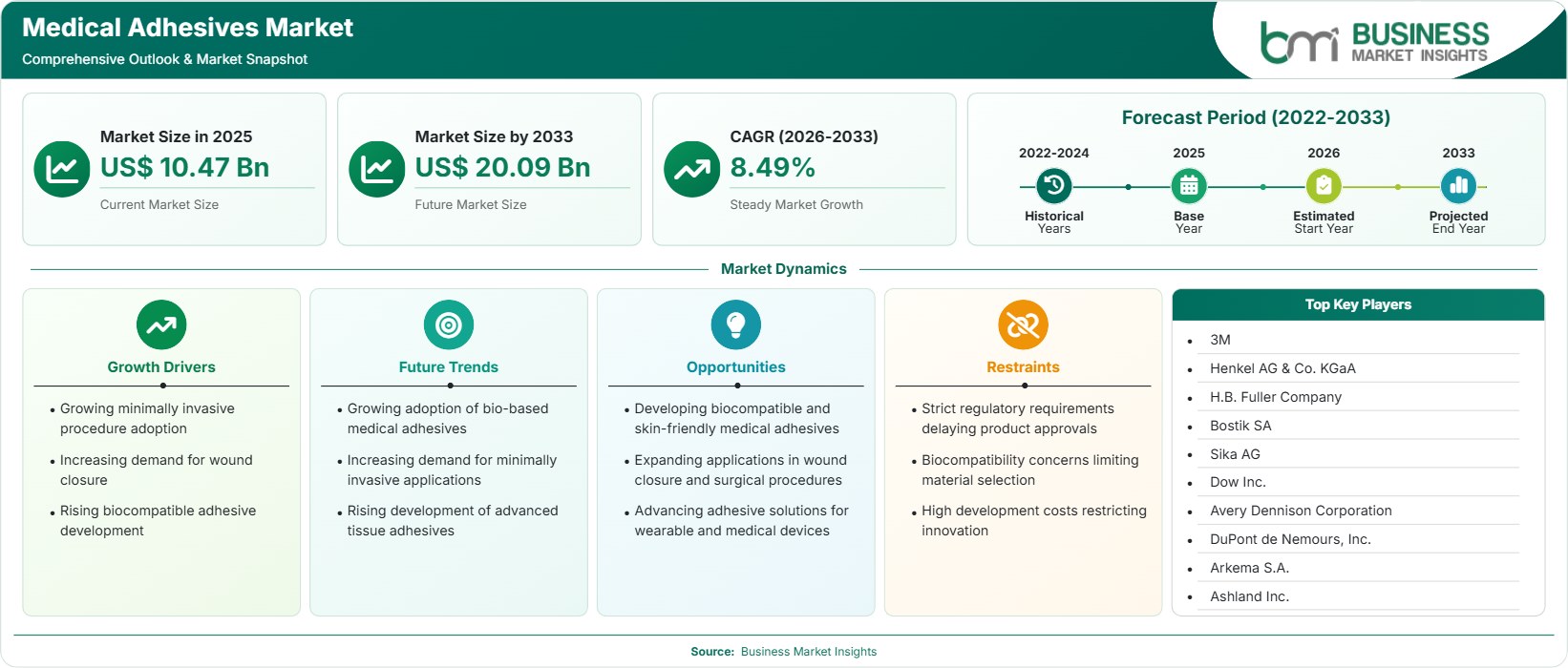
The Medical Adhesives Market size was valued at US$ 10.47 Billion in 2025 and is projected to reach US$ 20.09 Billion by 2033, growing at a CAGR of 8.49% during 2026–2033. Rising adoption of minimally invasive procedures, increasing demand for advanced wound closure solutions, and continuous innovation in biocompatible adhesive technologies are supporting market expansion. Opportunities are emerging through wearable healthcare devices, surgical applications, and next-generation skin-friendly adhesive formulations.

Report Coverage
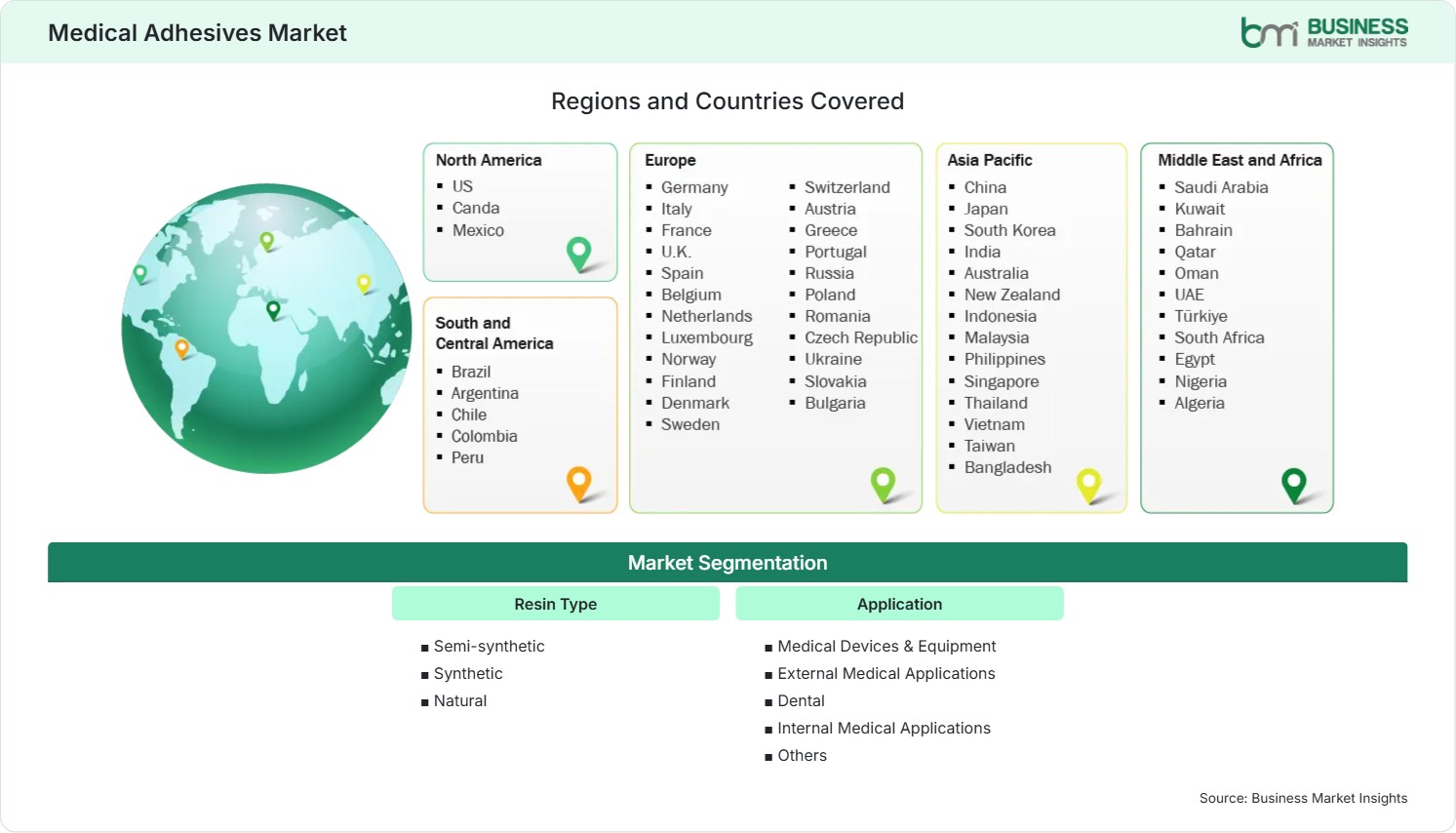
  • Resin Type: Semi-synthetic, Synthetic, Natural
  • Application: Medical Devices & Equipment, External Medical Applications, Dental, Internal Medical Applications, Others
US$ 10.47 Bn Market size in 2025
US$ 20.09 Bn Market Size by 2033
8.49% CAGR, 2026 - 2033
2026-2033 Forecast Period

01 AI Overview

Medical Adhesives Market Summary

  • North America Region: North America holds 36%–39% share in 2025 and is projected to expand at a CAGR of 8.0%–8.5% during 2026–2033. Strong medical device manufacturing, advanced healthcare infrastructure, increasing surgical volumes, and growing adoption of wearable healthcare technologies continue supporting market growth. The U.S. remains the dominant regional market, expanding at a CAGR of 8.1%–8.6%.
  • Fastest Growing Region: Asia Pacific accounts for 24%–27% share in 2025 and is expected to register a CAGR of 9.1%–9.7% during 2026–2033. Expanding healthcare expenditure, rising medical device production, increasing surgical procedures, and growing demand for advanced wound care solutions are accelerating regional adoption.
  • Leading Segment: Semi-synthetic & Synthetic resins account for 72%–76% share in 2025 and are projected to grow at a CAGR of 8.7%–9.2% during 2026–2033. High bonding strength, durability, moisture resistance, and broad medical applicability continue driving segment leadership.
  • High Growth Segment: Internal Medical Applications represent 18%–22% share in 2025 and are expected to grow at a CAGR of 9.0%–9.5% during 2026–2033. Rising minimally invasive procedures, tissue bonding requirements, and surgical innovation are supporting adoption.
  • Key Market Opportunity: Development of highly biocompatible, skin-friendly, and long-wear adhesive technologies for wearable monitoring devices, advanced wound care products, and surgical procedures continues creating substantial commercial opportunities.
  • Major Market Players: 3M, Henkel AG & Co. KGaA, H.B. Fuller Company, Bostik SA, Sika AG, Dow Inc., Avery Dennison Corporation, DuPont de Nemours, Inc., Arkema S.A., and Ashland Inc.
02 Strategic Insights

Medical Adhesives Market: Strategic Insights

Medical Adhesives Market Strategic Framework
FREE PDF
Request your free sample
Request free sample
03 Stakeholder View

Key Takeaways

  • The industry is increasingly driven by collaboration between adhesive manufacturers, medical device companies, and healthcare providers to develop application-specific bonding solutions.
  • Internal medical applications and wearable healthcare devices present the strongest long-term revenue opportunities due to rapid technology adoption and expanding healthcare utilization.
  • Material innovation is shifting toward biocompatible, breathable, and skin-friendly formulations capable of supporting long-duration medical applications.
  • Asia Pacific offers a compelling investment opportunity owing to expanding healthcare infrastructure, rising medical manufacturing capacity, and increasing surgical procedure volumes.
  • Strategic acquisitions and product development initiatives are accelerating innovation in advanced wound care, surgical adhesives, and wearable medical technologies.
  • Regulatory compliance and product performance validation remain key competitive differentiators among leading market participants.
04 Geographic Outlook

Medical Adhesives Market Regional Highlights

North America Medical Adhesives Market

North America accounted for 36%–39% share in 2025 and is projected to grow at a CAGR of 8.0%–8.5% during 2026–2033. The region maintains a leading position due to advanced healthcare infrastructure, strong medical device manufacturing capabilities, and widespread adoption of innovative wound closure technologies. Growing demand for wearable medical devices, increasing surgical procedure volumes, and continuous investment in healthcare innovation continue to support market expansion. The Medical Adhesives Market share remains highest in this region because of extensive product adoption across hospitals, ambulatory surgical centers, and home healthcare settings.

  • The United States remains the primary revenue contributor, supported by strong demand for advanced wound care products, surgical sealants, medical tapes, and adhesive solutions used across diagnostic and therapeutic devices.
  • Rising utilization of wearable healthcare technologies such as glucose monitoring systems, cardiac monitoring devices, and remote patient management solutions is increasing demand for skin-friendly adhesive formulations.
  • Medical device manufacturers are increasingly adopting high-performance adhesive technologies to improve product durability, patient comfort, and regulatory compliance across diverse healthcare applications.
  • The growing number of outpatient procedures is encouraging healthcare providers to utilize adhesive-based wound closure products that reduce procedure times and enhance recovery outcomes.
  • Ongoing research and development activities are supporting innovations in biocompatible materials capable of delivering improved adhesion while minimizing skin irritation and allergic reactions.

US Medical Adhesives Market

The United States represented 76%–80% of North American demand in 2025 and is expected to register a CAGR of 8.1%–8.6% during 2026–2033 in Medical Adhesives Market. Growth is supported by increasing healthcare expenditure, strong medical technology innovation, and rising adoption of minimally invasive surgical procedures. The country remains a major center for medical device manufacturing and healthcare technology development.

  • Growing demand for wearable healthcare systems is creating significant opportunities for adhesive manufacturers focused on long-wear and skin-compatible bonding technologies.
  • Advanced wound care adoption continues increasing across hospitals and home healthcare environments, supporting demand for specialized closure and dressing adhesives.
  • Medical device manufacturers continue investing in compact, lightweight, and flexible products that require highly reliable adhesive bonding solutions.
  • Strong regulatory standards are encouraging continuous innovation in biocompatible, hypoallergenic, and patient-friendly adhesive formulations.

Europe Medical Adhesives Market

Europe held 26%–29% share in 2025 and is projected to expand at a CAGR of 7.8%–8.3% during 2026–2033. Strong healthcare systems, increasing surgical volumes, and growing emphasis on patient safety continue supporting demand. Germany represents the leading regional market, while Central and Eastern European countries are emerging as higher-growth opportunities in Medical Adhesives Market forecasts due to expanding healthcare investments and medical device manufacturing activities.

  • Germany remains the largest market due to its well-established medical technology industry, robust healthcare infrastructure, and continuous investment in advanced wound management solutions.
  • France and the United Kingdom continue generating strong demand through increasing surgical procedures, aging populations, and broader adoption of minimally invasive treatment approaches.
  • Stringent healthcare quality requirements are encouraging adoption of premium adhesive technologies offering enhanced biocompatibility and long-term clinical performance.
  • Demand for advanced skin adhesives is rising as wearable healthcare devices become more widely utilized across chronic disease monitoring applications.
  • Increasing focus on healthcare innovation is supporting partnerships between adhesive manufacturers and medical device companies across the region.

Asia Pacific Medical Adhesives Market

Asia Pacific accounted for 24%–27% share in 2025 and is anticipated to grow at a CAGR of 9.1%–9.7% during 2026–2033, making it the fastest-growing regional Medical Adhesives Market. Expanding healthcare infrastructure, increasing surgical procedures, and rapid growth in medical device production continue supporting demand. Rising healthcare awareness and improving access to advanced treatment solutions are encouraging broader product adoption across developing and developed economies.

  • China remains the largest regional market owing to significant growth in healthcare manufacturing, medical device production, and hospital infrastructure development.
  • India is among the fastest-growing countries due to increasing healthcare investments, expanding medical tourism activities, and rising adoption of advanced wound care products.
  • Japan continues to support demand through a mature healthcare system, growing elderly population, and strong emphasis on innovative medical technologies.
  • South Korea is witnessing increasing adoption of wearable healthcare devices, creating opportunities for advanced adhesive technologies with superior comfort and durability.
  • Regional manufacturers are investing in high-quality biocompatible formulations to meet both domestic healthcare needs and export market requirements.

Rest of World Medical Adhesives Market

The Rest of World region accounted for 8%–11% share in 2025 and is forecast to expand at a CAGR of 8.7%–9.2% during 2026–2033. Growth is supported by improving healthcare infrastructure, increasing surgical volumes, and rising medical device adoption across Latin America, the Middle East, and Africa. Expanding healthcare access and government healthcare investments are creating additional opportunities for Medical Adhesives Market participants.

  • Brazil remains the leading Latin American market due to growing healthcare expenditure, expanding hospital networks, and increasing utilization of advanced wound care technologies.
  • Mexico is experiencing steady growth through increasing medical device manufacturing activities and rising demand for modern surgical treatment solutions.
  • Countries within the Gulf Cooperation Council are expanding healthcare infrastructure investments, generating demand for advanced medical consumables and adhesive technologies.
  • South Africa continues to create opportunities through ongoing healthcare modernization initiatives and increasing demand for high-quality wound management products.
  • Growing awareness of infection prevention, patient safety, and post-surgical care is supporting wider adoption of advanced adhesive products throughout developing healthcare markets.
Global Market Geography
FREE PDF
Request your free sample
Request free sample
05 Segment Analysis

Medical Adhesives Market Segmentation

Resin Type

The resin type segment represents the fundamental material base of medical adhesive manufacturing and significantly influences bonding strength, flexibility, durability, biocompatibility, and clinical performance. Semi-synthetic & Synthetic resins accounted for 72%–76% share in 2025 and are projected to expand at a CAGR of 8.7%–9.2% during 2026–2033. The Medical Adhesives Market scope is widening as manufacturers develop innovative formulations that deliver enhanced adhesion properties while maintaining patient safety, skin compatibility, and regulatory compliance across diverse healthcare environments.

  • Semi-synthetic & Synthetic: Dominates demand due to superior adhesion strength, high durability, moisture resistance, formulation flexibility, and widespread use in medical devices, wound care products, surgical applications, and wearable healthcare technologies.
  • Natural: Witnessing stable growth owing to rising preference for biocompatible materials, improved patient comfort, reduced skin irritation potential, and increasing utilization in specialized healthcare applications requiring enhanced biological compatibility.

Application

Application demand is led by Medical Devices & Equipment, accounting for approximately 34%–38% share in 2025, while Internal Medical Applications are expected to record the strongest growth with a CAGR of 9.0%–9.5% during 2026–2033. The Medical Adhesives Market trends are increasingly shaped by technological advancements in medical devices, growth in minimally invasive procedures, and expanding adoption of wearable monitoring systems. Rising healthcare expenditures and ongoing innovations in treatment methods continue supporting demand across all major application categories globally.

  • Medical Devices & Equipment: Represents the largest application area due to expanding production of diagnostic equipment, monitoring systems, wearable healthcare devices, catheters, and disposable medical products requiring reliable bonding technologies.
  • External Medical Applications: Widely utilized in wound dressings, surgical tapes, transdermal patches, skin closure applications, and advanced wound-care products where comfort, flexibility, and durability are critical requirements.
  • Dental: Growing steadily because of increasing restorative dentistry procedures, orthodontic treatments, prosthetic bonding requirements, and rising demand for aesthetic dental solutions supported by advanced adhesive materials.
  • Internal Medical Applications: Emerging as a high-growth category driven by tissue bonding procedures, implant fixation applications, minimally invasive surgeries, and continuous advancements in biocompatible adhesive technologies.
06 Market Forces

Medical Adhesives Market Dynamics

Key Market Drivers

Growing Minimally Invasive Procedure Adoption

The increasing shift toward minimally invasive procedures is one of the most influential growth drivers for the market. Healthcare providers increasingly prefer techniques that reduce surgical trauma, shorten hospitalization periods, and improve recovery outcomes. Medical adhesives contribute toward achieving this goal through providing effective means for tissue attachment and wound closure other than the existing suturing and stapling options. The increasing popularity of laparoscopic, catheter-based, and robot-assisted operations calls for the development of advanced adhesives that can demonstrate high-quality performance in harsh operating conditions. The prevalence of chronic diseases and the increasing number of surgical procedures worldwide promote the adoption of medical adhesives.

Increasing Demand for Wound Closure

The increased need for effective wound care management solutions has driven significant demand for innovative medical adhesives. There has been a growing interest in products which help in enhancing the healing process while minimizing complications. Medical adhesives have an advantage over conventional wound management methods in terms of quick application, reduced risk of infection, aesthetic appearance, and patient comfort. Increase in prevalence of trauma injuries, surgeries, burns and chronic wounds has been a major factor promoting the use of adhesive technology. Increasing awareness of advanced wound care solutions has been a key driver of the adoption of medical adhesives. Continuous innovations in moisture management, flexibility, and antimicrobial capabilities further strengthen the positioning of adhesive-based wound closure technologies within modern clinical practices in Medical Adhesives Market.

Rising Biocompatible Adhesive Development

The development of adhesive technology that can be considered biocompatible is increasingly important for the industry's success. Patient safety, tissue compatibility, and clinical effectiveness are important criteria that receive considerable consideration from both medical experts and regulatory authorities. The manufacturers are investing heavily in developing new products through research and development processes that would have superior bonding capability and low levels of inflammation and irritation in the tissues. The increasing use of implantable, wearable healthcare, and wound-healing products is driving demand for biocompatible adhesives. The advancements in polymer science and biomaterials are contributing towards the improved performance of the products.

Key Market Opportunities

Developing Biocompatible and Skin-Friendly Medical Adhesives

There is an increasing need for patient comfort and wearing for a longer period, which is paving way for many opportunities for manufacturers that are involved in producing biocompatible and skin-friendly adhesive solutions. There is an increasing need for solutions that provide consistent adhesion while reducing skin irritation and trauma from prolonged use. This need becomes even more essential when considering devices such as wearable monitoring solutions, wound dressings, transdermal drug delivery systems, and chronic care management solutions. Advanced formulations are being developed that are commercially important and offer properties such as breathability and flexibility. There is increasing adoption of remote patient monitoring solutions.

Expanding Applications in Wound Closure and Surgical Procedures

Medical adhesives are gaining importance in surgical operations and advanced wound-closure applications. The search for ways of improving efficiency and patient outcome continues at hospitals and healthcare organizations. New adhesive techniques offer greater efficiency in speed, lower risk of infection, and aesthetic benefits compared with conventional techniques. An increase in number of surgical operations performed, increase in spending on healthcare services, and use of less invasive techniques have created good opportunities in the market. There are companies producing adhesive products tailored to the special environment of surgery and to the difficult bonding of tissues. With growing emphasis on outcomes and efficiency in healthcare systems, demand will grow substantially in the future.

Advancing Adhesive Solutions for Wearable and Medical Devices

The rapid evolution of wearable healthcare technology presents a substantial growth opportunity for adhesive manufacturers. The products that are utilized in biosensors, glucose sensors, heart monitoring equipment, and remote healthcare devices should have adhesives that can offer long-lasting performance even during constant usage. The trend of digitizing healthcare services and the use of connected healthcare devices is driving the need for efficient bonding solutions. Wearable devices require products that provide comfort, breathability, flexibility, and secure attachment without compromising performance. Manufacturers developing specialized solutions tailored for prolonged skin contact and demanding healthcare environments are expected to benefit significantly. The continued expansion of digital healthcare ecosystems is anticipated to support long-term growth opportunities across this application segment in Medical Adhesives Market.

Market Restraints and Challenges

Strict Regulatory Requirements Delaying Product Approvals

Factor: Medical adhesive products must comply with rigorous healthcare regulations governing safety, performance, manufacturing consistency, and biocompatibility. Comprehensive testing, validation protocols, quality assessments, and regulatory documentation requirements can significantly increase development timelines. Impact: Extended approval processes often delay product launches, increase research and development costs, and slow commercialization of innovative solutions. Manufacturers must allocate substantial resources to regulatory compliance activities while navigating differing approval requirements across international markets. Smaller companies may encounter additional challenges related to testing costs and compliance infrastructure. As healthcare standards continue becoming more stringent, regulatory complexity remains a major factor influencing market entry, innovation cycles, and competitive positioning.

Biocompatibility Concerns Limiting Material Selection

Factor: Medical adhesives intended for direct skin contact, tissue bonding, or implanted device applications must demonstrate excellent biological compatibility while minimizing irritation, sensitization, and toxicity risks. Material options become increasingly restricted as clinical and regulatory expectations rise. Impact: Limited material availability can increase development complexity, extend testing requirements, and elevate formulation costs. Manufacturers frequently face challenges balancing adhesive performance with patient safety objectives. The need to achieve durable bonding without compromising biological compatibility can restrict product design flexibility and delay innovation efforts. Ongoing investments in material science and advanced biomaterials remain necessary to overcome these challenges while maintaining the high standards expected across healthcare applications.

07 Company Analysis

Competitive Landscape

The Medical Adhesives Market analysis is characterized by the presence of multinational specialty chemical manufacturers and adhesive technology providers focusing on biocompatibility, product innovation, regulatory compliance, and application-specific solutions for medical devices, wound care products, surgical procedures, and wearable healthcare technologies. Companies are increasingly investing in skin-friendly adhesives, advanced bonding technologies, and sustainable material development to strengthen their market positions.

Company Name

Overview

Products and Services Relevant to the Market

3M Company

Global healthcare and materials science company with a strong portfolio of medical adhesive solutions supporting wound care, wearable devices, and surgical applications.

Medical tapes, wound care adhesives, skin adhesives, device attachment solutions, and healthcare bonding technologies.

Henkel AG & Co. KGaA

Leading adhesive manufacturer offering customized medical-grade solutions for healthcare and medical device applications.

Medical adhesives, pressure-sensitive adhesives, device assembly solutions, and specialty healthcare bonding products.

H.B. Fuller Company

Major provider of specialty adhesives serving medical device manufacturers and healthcare product developers globally.

Medical-grade adhesives, assembly solutions, wound care materials, and specialty bonding formulations.

Bostik SA

Global adhesive specialist delivering innovative products tailored for healthcare, medical devices, and wearable technologies.

Medical adhesives, pressure-sensitive solutions, skin-contact bonding materials, and healthcare assembly technologies.

Sika AG

Advanced materials company providing specialty adhesive technologies for medical and healthcare applications.

Medical bonding systems, specialty polymers, assembly adhesives, and healthcare material solutions.

Dow Inc.

Leading materials science company developing silicone-based and specialty adhesive products for healthcare applications.

Silicone adhesives, medical-grade materials, skin-contact solutions, and healthcare device bonding technologies.

Avery Dennison Corporation

Global supplier of pressure-sensitive materials used across healthcare product manufacturing and medical applications.

Medical tapes, wearable adhesives, pressure-sensitive materials, and healthcare labeling solutions.

DuPont de Nemours, Inc.

Technology-driven manufacturer supplying innovative materials and adhesive solutions for medical markets.

Medical-grade materials, healthcare bonding solutions, protective materials, and specialty adhesive products.

Arkema S.A.

Specialty materials producer supporting healthcare innovation through advanced adhesive chemistries.

Medical adhesives, specialty resins, high-performance materials, and healthcare bonding technologies.

Ashland Inc.

Specialty chemicals company offering functional materials for wound care, medical devices, and pharmaceutical applications.

Bioadhesives, medical polymers, wound care materials, and specialty formulation solutions.

10 Trust & Transparency

Research Methodology

The market analysis combines proprietary research with secondary data from government agencies, company disclosures, regulatory filings, industry databases and expert interviews. Market estimates are validated through data triangulation, cross-market benchmarking and analyst review.

View Full Research Methodology

11 Questions Answered

Frequently Asked Questions

What are the major challenges affecting market participants?

Stringent regulatory approval requirements, biocompatibility concerns, extensive product testing requirements, and the need to balance adhesion performance with patient safety remain key challenges for manufacturers

Which region is expected to witness the fastest growth?

Asia Pacific is projected to experience the fastest growth due to increasing healthcare expenditure, expanding medical device manufacturing capabilities, rising surgical volumes, and improving healthcare infrastructure.

Why are medical adhesives increasingly used in wearable healthcare devices?

Wearable devices require reliable, skin-friendly, breathable, and long-lasting bonding solutions. Medical adhesives help ensure continuous device attachment while maintaining patient comfort during extended monitoring periods.

Which resin type segment leads the Medical Adhesives Market report?

Semi-synthetic & Synthetic resins lead the market due to their superior bonding capabilities, durability, moisture resistance, formulation flexibility, and extensive utilization across medical devices, wound care, and surgical applications.

What is driving the growth of the Medical Adhesives Market?

The market is primarily driven by the growing adoption of minimally invasive procedures, rising demand for advanced wound closure technologies, increasing production of medical devices, and continuous development of biocompatible adhesive formulations.

Access the Full Medical Adhesives Market Report

Get segment-level forecasts, regional estimates, competitive benchmarking, company profiles and downloadable Excel datasets.

Access the full Medical Adhesives Market Report
350 pages PDF & Excel | 2026-08-24