
Medical Mask Market Outlook: Size, Share, Trends, Growth Analysis, Competitive Landscape & Forecast, 2026-2033

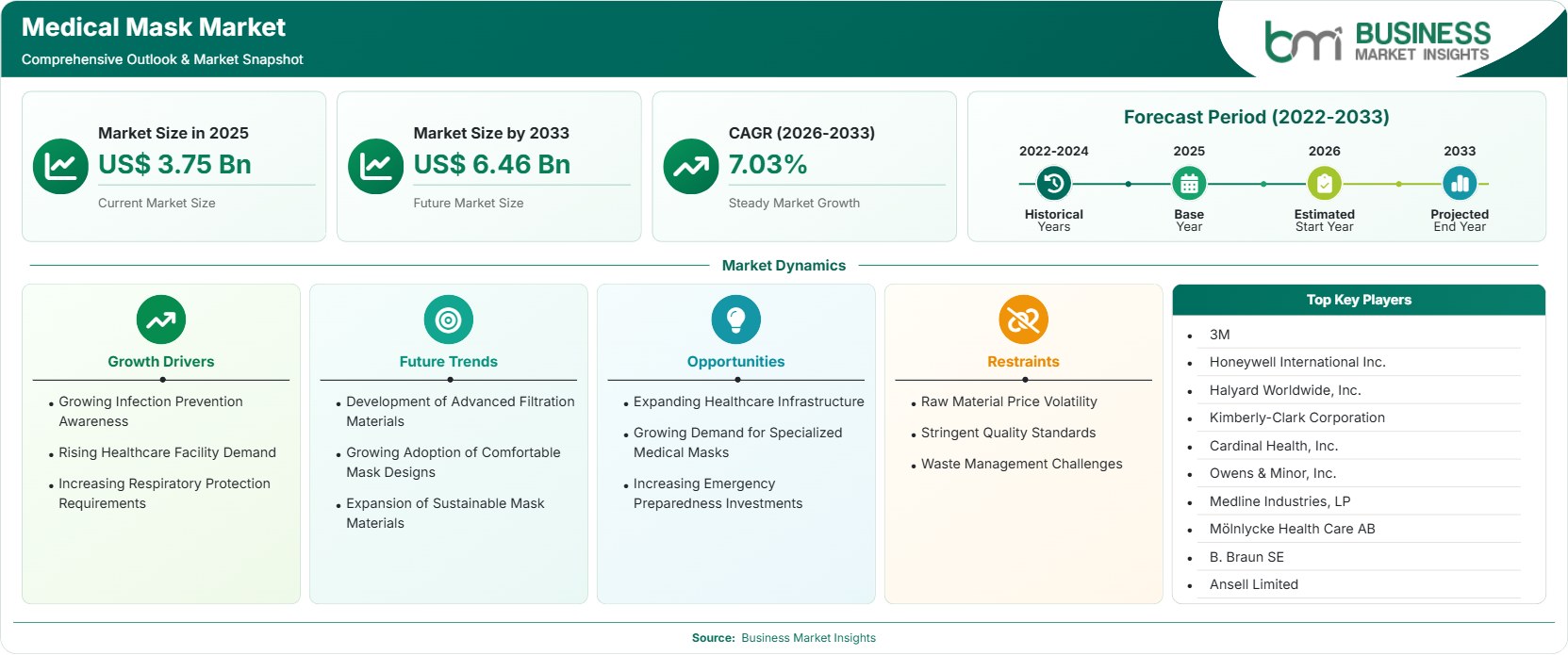
The Medical Mask Market size was valued at US$ 3.75 Billion in 2025 and is projected to reach US$ 6.46 Billion by 2033, growing at a CAGR of 7.03% during 2026–2033, driven by infection prevention, respiratory protection, healthcare expansion, product innovation, and emergency preparedness.

Report Coverage
  • Type: Surgical Mask, Respirators, Others
  • Distribution Channel: Hospital Pharmacies, Retail Pharmacies, Online Pharmacies
US$ 3.75 Bn Market size in 2025
US$ 6.46 Bn Market Size by 2033
7.03% CAGR, 2026 - 2033
2026-2033 Forecast Period

01 AI Overview

Medical Mask Market Summary

  • North America Region: North America holds a Medical Mask Market share of 35%–38% in 2025, growing at a CAGR of 6.70%–7.20%, supported by hospital procurement, respiratory protection programs, replacement demand, domestic manufacturing, and specialized clinical applications. The U.S. market grows at a 6.80%–7.30% CAGR through 2033 as hospitals strengthen respiratory protection, surgical inventory resilience, and infection-control procurement.
  • Fastest Growing Region: Asia Pacific holds a 25%–29% share in 2025 and expands at a CAGR of 8.00%–8.60%, supported by healthcare infrastructure investment, urban respiratory exposure, manufacturing capacity, expanding hospital networks, and rising adoption of certified protective products.
  • Leading Segment: Surgical Mask represents 61%–65% of 2025 demand and expands at a CAGR of 6.40%–6.90%, supported by routine procedures, infection-control protocols, outpatient care, high-volume hospital purchasing, and broad compatibility across clinical environments.
  • High Growth Segment: Respirators account for 27%–31% in 2025 and expand at a CAGR of 8.10%–8.70%, driven by aerosol exposure awareness, fit-tested protection, occupational requirements, respiratory outbreaks, and demand for higher filtration performance.
  • Key Market Opportunity: Product differentiation around fit, filtration, breathability, splash resistance, sustainability, and specialized clinical use creates premiumization opportunities while institutional buyers increasingly evaluate lifecycle value and supply continuity.
  • Major Market Players: 3M, Honeywell International Inc., Halyard Worldwide, Inc., Kimberly-Clark Corporation, Cardinal Health, Inc., Owens & Minor, Inc., Medline Industries, LP, Mölnlycke Health Care AB, B. Braun SE, and Ansell Limited.
02 Strategic Insights

Medical Mask Market: Strategic Insights

Medical Mask Market Strategic Framework
FREE PDF
Request your free sample
Request free sample
03 Stakeholder View

Key Takeaways

  • The value chain increasingly favors manufacturers with integrated nonwoven material sourcing, testing capabilities, regulatory certifications, and large-scale distribution partnerships.
  • Respirators and online pharmacy channels present the strongest upside because demand increasingly prioritizes high-filtration products and digital procurement efficiency.
  • Product innovation is moving toward enhanced fit, skin-friendly materials, reusable components, anti-fog features, and environmentally conscious manufacturing processes.
  • Asia Pacific offers a compelling investment case due to expanding healthcare infrastructure, rising healthcare expenditure, and growing domestic production capabilities.
  • Strategic acquisitions, distributor partnerships, and manufacturing alliances are strengthening supply security and improving market reach across healthcare institutions.
  • Preparedness-driven procurement is evolving into a recurring demand stream rather than a crisis-specific purchasing behavior.
04 Geographic Outlook

Medical Mask Market Regional Highlights

North America Medical Mask Market

North America represented 35%–38% of the Medical Mask Market share in 2025 and is projected to expand at a 6.70%–7.20% CAGR through 2033. Demand is supported by hospital procurement, occupational respiratory programs, surgical procedures, emergency inventories, and domestic supply-chain priorities. The U.S. remains the principal contributor, while Canada provides additional institutional demand through hospitals and long-term care. Product differentiation increasingly centers on certified filtration, fit, fluid resistance, comfort, and dependable replenishment rather than basic disposable-mask availability.

  • Hospital systems are emphasizing validated PPE specifications, recurring replenishment, and supplier reliability, supporting established manufacturers with broad institutional distribution and regulatory expertise.
  • Respirator demand benefits from formal workplace respiratory protection programs, where fit testing, certification, medical evaluation, and training influence purchasing decisions.
  • Surgical masks retain broad procedural applications because they provide barrier protection against splashes and droplets, although they should not be treated as substitutes for respirators.
  • Domestic production and inventory resilience remain strategic procurement considerations following the supply disruptions experienced during the pandemic period.

US Medical Mask Market

The U.S. accounted for 26%–29% of global demand in 2025 and is forecast to grow at a 6.80%–7.30% CAGR. Hospitals, ambulatory facilities, laboratories, occupational-health programs, and emergency-response organizations support recurring purchases. Regulatory differentiation remains central because NIOSH-approved respirators provide defined filtration performance, while surgical masks address barrier and source-control functions. CDC guidance also continues to distinguish masks from respirators according to intended protection and fit.

  • NIOSH approval provides an important purchasing filter for occupational respirators, reinforcing demand for compliant products with documented performance and traceability.
  • Surgical N95 products serve clinical situations requiring both respiratory and fluid-related protection, supporting specialized product categories in operating environments.
  • Hospitals increasingly value comfort and visibility alongside protection, creating opportunities for anti-fog, ergonomic, skin-friendly, and lower-resistance designs.

Europe Medical Mask Market

Europe held 23%–27% share in 2025 and is expected to expand at a 6.50%–7.10% CAGR. Germany, the United Kingdom, France, Italy, and Spain remain important demand centers because of established healthcare infrastructure and surgical activity. Germany and the United Kingdom provide leading institutional markets, while Poland and Spain offer comparatively stronger growth potential at approximately 7.20%–7.80% CAGR as hospital modernization, infection-control procurement, and domestic supply-chain initiatives support demand.

  • European procurement increasingly evaluates product certification, material transparency, packaging efficiency, and environmental attributes alongside filtration and clinical performance.
  • Sustainable-material development is becoming commercially relevant as healthcare organizations examine disposable-product waste without compromising sterility, barrier performance, or usability.
  • Specialist surgical-mask portfolios with anti-fog, splash-resistant, and ergonomic characteristics can achieve stronger differentiation than standardized commodity products.
  • Regional manufacturers benefit from proximity to hospitals, shorter replenishment cycles, and the ability to respond to national procurement requirements.

Asia Pacific Medical Mask Market

Asia Pacific represented 25%–29% of the Medical Mask Market share in 2025 and is projected to register an 8.00%–8.60% CAGR, making it the fastest-growing region. China and Japan remain leading markets, while India, South Korea, and Southeast Asian economies provide expanding opportunities. India and Southeast Asia can achieve approximately 8.70%–9.40% CAGR as healthcare infrastructure, hospital capacity, domestic production, occupational protection, and consumer awareness broaden the addressable demand base.

  • China combines substantial manufacturing capacity with large domestic healthcare demand, supporting integrated production, export activity, and rapid product-scale deployment.
  • India offers an attractive expansion market as hospital networks, diagnostic facilities, surgical volumes, and domestic medical-device manufacturing continue to develop.
  • Japan and South Korea emphasize high-quality healthcare supplies, supporting demand for specialized products with strong comfort, filtration, and ergonomic characteristics.
  • Southeast Asian markets offer opportunities for suppliers able to combine affordable pricing with certified performance and dependable distribution across fragmented healthcare systems.

Rest of World Medical Mask Market

South and Central America represented 6%–9% of 2025 demand and are projected to expand at a 7.00%–7.60% CAGR. Brazil and Mexico are leading markets, while Colombia and Chile offer attractive expansion opportunities as hospital capacity, outpatient care, and infection-control procurement improve. Local distributors remain important because healthcare purchasing is fragmented across public and private institutions.

Middle East and Africa represented 5%–7% share in 2025 and are projected to expand at a 7.20%–7.90% CAGR. Saudi Arabia, the United Arab Emirates, and South Africa lead regional demand, while Gulf healthcare investment supports faster growth.

  • Brazil and Mexico provide scale through large healthcare systems, surgical activity, and distribution networks supporting recurring institutional consumption.
  • Gulf markets increasingly prioritize high-quality imported PPE as hospitals expand specialized services and strengthen clinical safety protocols.
  • South Africa provides a regional distribution base for healthcare products serving both public institutions and private clinical networks.
  • Import dependence creates opportunities for suppliers offering reliable logistics, regulatory documentation, and consolidated PPE portfolios.
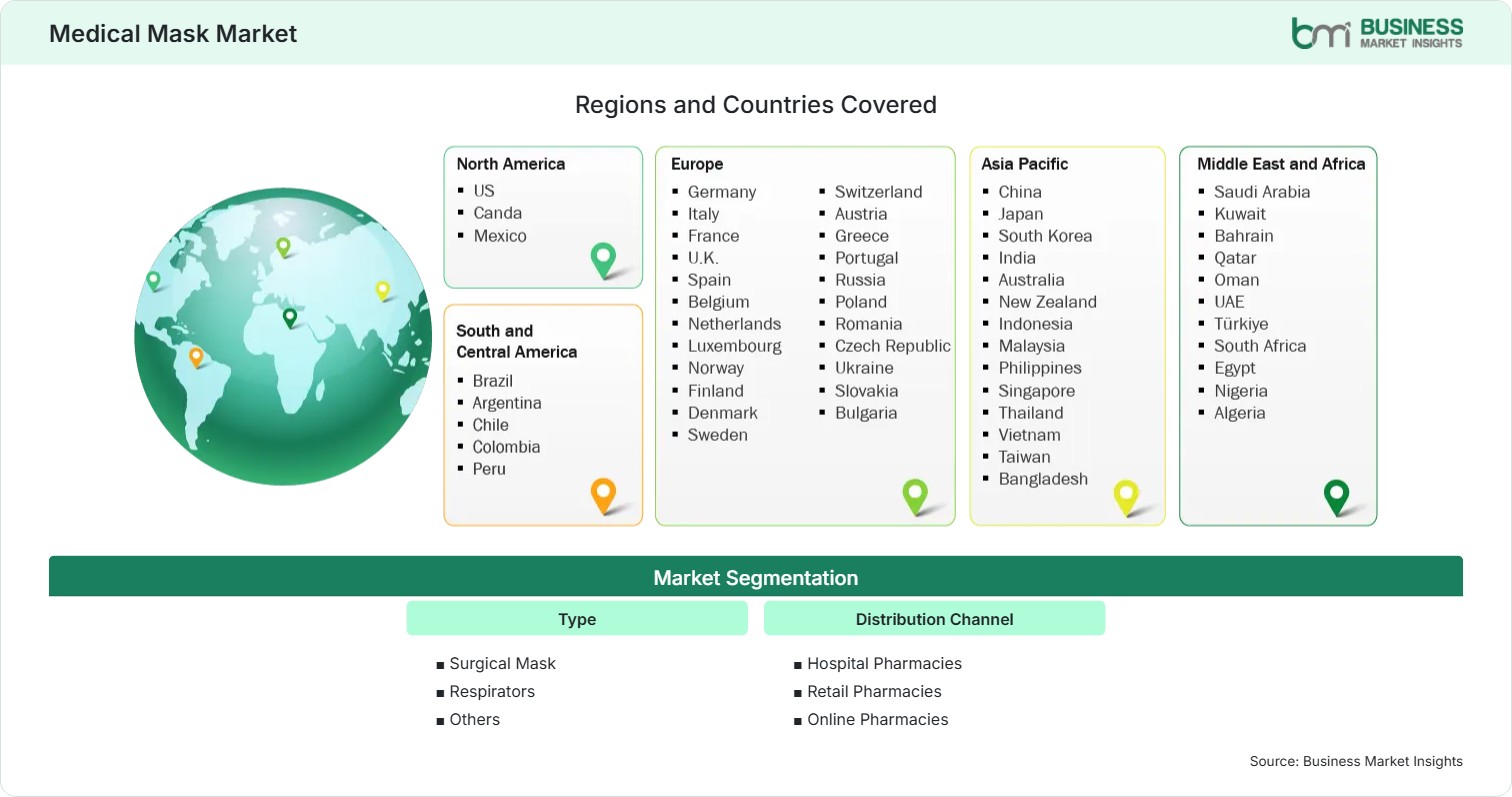
Global Market Geography
FREE PDF
Request your free sample
Request free sample
05 Segment Analysis

Medical Mask Market Segmentation

Type

Type segmentation is led by Surgical Mask, which represented 61%–65% share in 2025 and is projected to grow at a 6.40%–6.90% CAGR through 2033. Surgical demand remains anchored by procedures, infection control, outpatient care, and recurring institutional procurement. Respirators provide the faster expansion opportunity as clinical users seek defined wearer protection and improved fit.

  • Surgical Mask: Routine procedures, infection-control protocols, outpatient services, and barrier requirements sustain high-volume consumption, while anti-fog, splash-resistant, ergonomic, and skin-comfort designs improve differentiation.
  • Respirators: Higher filtration requirements, aerosol-generating procedures, occupational protection, fit-testing practices, and respiratory outbreaks support adoption of N95 and comparable certified respirators.

Distribution Channel

Distribution Channel segmentation is shaped by institutional procurement, pharmacy accessibility, and digital purchasing. Hospital Pharmacies remain the core channel because clinical consumption is recurring and specification-driven. Retail Pharmacies and Online Pharmacies broaden access to individual purchasers and smaller healthcare providers. Digital ordering increasingly supports convenience, availability comparison, replenishment, and decentralized procurement across non-hospital settings.

  • Hospital Pharmacies: Centralized purchasing, recurring clinical consumption, standardized specifications, and inventory management make hospital pharmacies the principal channel for institutional medical-mask demand.
  • Retail Pharmacies: Retail outlets serve patients, caregivers, occupational users, and small clinics requiring convenient access to certified masks and respirators without institutional contracts.
  • Online Pharmacies: Digital channels improve product discovery, availability, price comparison, and repeat ordering, particularly for respirators and specialized products purchased outside hospitals.
06 Market Forces

Medical Mask Market Dynamics

Key Market Drivers

Growing Infection Prevention Awareness

Growing infection prevention awareness remains a fundamental driver of the market. Infection control measures in healthcare professionals, caregivers, and other institutional customers now involve the use of protective equipment not only in public health crises but as part of their infection control processes. Increased attention to patient safety, employee safety, and standards of healthcare quality is driving ongoing investment in protective equipment with high-performance levels. Medical Mask Market trends include increased use of such equipment in hospitals, diagnostic centers, outpatient clinics, and other long-term care centers. The increase in usage patterns is driven by education, infection control, and safety-oriented procurement practices.

Rising Healthcare Facility Demand

The expansion of healthcare infrastructure is generating sustained demand across the Medical Mask Market. New hospital facilities, specialist clinics, ambulatory surgery centers, and community-based healthcare centers need a constant supply of products that provide protection for their routine clinical activities. High volumes of surgeries, increased outpatient treatments, and patient admissions play a direct role in the levels of consumption. Standardization of procurement policies is being implemented in order to ensure a constant supply of products and compliance with regulations. Additional support comes from the implementation of health care upgrades, expansion programs, and infection prevention initiatives.

Increasing Respiratory Protection Requirements

Increasing emphasis on respiratory protection within healthcare environments continues to support Medical Mask Market growth. Healthcare institutions have shown growing concern about effective filtration and higher levels of protection in critical environments. There is growing acceptance of respirators due to their capability to offer increased levels of respiratory protection compared to their traditional counterparts. Innovations within the sector revolve around improving fit, comfort, breathability, and filtration capacity to promote compliance among users. Employers and hospital administrators are budgeting more funds for workplace protection and preparation. Growing emphasis on occupational safety by healthcare institutions will continue to be a driving factor in the growth of the respiratory protection products market.

Key Market Opportunities

Expanding Healthcare Infrastructure

Significant opportunities are emerging from healthcare infrastructure development across developing and emerging economies. Hospitals, laboratories, diagnostic centers, and primary healthcare centers have created greater opportunities for customers who need protective medical products through their investments. The process of urbanization, greater access to healthcare, and increased spending on healthcare are responsible for this. The Medical Mask Market Forecast indicates that companies able to set up manufacturing facilities close to the market and effective distribution channels can secure competitive advantages. There is also government support for companies producing domestically. Those companies that offer assured quality and regulatory compliance are expected to be benefactors.

Growing Demand for Specialized Medical Masks

The growing demand is towards specialty solutions that have been developed for particular clinical purposes. Healthcare institutions are looking for solutions that provide better filtration performance, higher fluid resistance, better ergonomics, and increased comfort for wearers. This development offers opportunities for premium and value-added product categories in the market. Companies that have been focusing on developing new materials, improving designs to make them more comfortable, and differentiating healthcare solutions will gain significant advantages in the market. These specialty solutions can be sold at higher prices and generate increased profits.

Increasing Emergency Preparedness Investments

Emergency preparedness programs remain a significant source of business opportunities. There are efforts by governments, healthcare providers, and public health organizations to build up strategic stockpiles to prepare for future health emergencies. Long-term procurement arrangements, stockpiling initiatives, and diversification of sources of supply are helping stabilize the procurement process. Investments in supply chain robustness and management systems have improved the visibility and efficiency of the procurement process. Companies that can provide reliable supplies, certified goods, and mass production capacities stand to benefit from long-term contracts. Emergency preparedness procurement has become a repeatable demand flow.

Market Restraints and Challenges

Raw Material Price Volatility

Factor: Medical mask manufacturing depends heavily on nonwoven polypropylene and other specialty materials whose costs can fluctuate due to energy prices, transportation expenses, supply disruptions, and broader market conditions.

Impact: Volatile costs create pressure on the profit margins of the manufacturing firms, while making pricing more difficult to handle. It may be difficult for firms to find the right balance between affordability and quality requirements, especially if there is intense competition in the market. Small firms will be more vulnerable since they do not possess strong negotiating power and have few options in terms of suppliers. Volatile costs will make budgeting more difficult for the purchasing departments of distribution companies and healthcare facilities.

Stringent Quality Standards

Factor: Regulatory requirements mandate extensive testing, quality assurance procedures, certification processes, and ongoing compliance monitoring to ensure product performance and user safety.

Impact: The need for compliance adds cost and complexity in the production process. Firms venturing into new geographical regions have to make significant investments in terms of certification, tests, and quality management processes. This may lead to delays in product launches and difficulties for small players in the market. While high standards result in increased consumer confidence and reliable products, they may lack flexibility and add to the cost of commercialization. It is crucial for firms to make investments in quality assurance processes to remain competitive.

07 Company Analysis

Competitive Landscape

The Medical Mask Market analysis indicates a competitive environment combining diversified healthcare conglomerates, PPE specialists, surgical-supply manufacturers, and integrated distributors. Competition increasingly depends on certification, product breadth, supply reliability, ergonomic design, and institutional relationships rather than unit price alone.

Company Name

Overview

Products and Services relevant to this market

3M

Diversified technology company with deep expertise in filtration, personal protective equipment, and healthcare applications.

N95 healthcare respirators, disposable respirators, surgical respiratory protection, fit-testing equipment, and related PPE solutions.

Honeywell International Inc.

Global technology and safety company with established respiratory-protection capabilities serving healthcare and occupational markets.

Surgical N95 respirators, disposable respirators, reusable respiratory protection, filtration products, and PPE solutions.

Halyard Worldwide, Inc.

Healthcare-focused supplier known for infection-prevention products and procedural protective equipment.

Surgical masks, procedure masks, respiratory protection products, protective apparel, and infection-prevention supplies.

Kimberly-Clark Corporation

Consumer and healthcare products company with established professional healthcare and infection-prevention portfolios.

Surgical masks, procedure masks, protective products, respiratory-related PPE, and clinical hygiene solutions.

Cardinal Health, Inc.

Healthcare services and products company with substantial distribution reach and proprietary clinical supplies.

Surgical masks, anti-fog masks, procedural PPE, medical supplies, and hospital distribution services.

Owens & Minor, Inc.

Healthcare logistics and medical-products company supporting providers through manufacturing and distribution capabilities.

Medical masks, surgical PPE, respiratory protection products, medical supplies, and integrated distribution services.

Medline Industries, LP

Large medical-supply manufacturer and distributor with extensive hospital and clinical relationships.

Surgical masks, procedure masks, respirators, PPE, infection-prevention products, and healthcare supply-chain services.

Mölnlycke Health Care AB

MedTech company focused on surgical and wound-care solutions with an established staff-clothing portfolio.

Type 2 and Type 2R medical face masks, protective masks, surgical masks, and related operating-room PPE.

B. Braun SE

Global medical technology company with broad surgical and hospital-care capabilities.

Surgical and procedural protective products, hospital supplies, surgical systems, and complementary clinical PPE offerings.

Ansell Limited

Specialist protection company serving healthcare and industrial users with a broad personal-protection portfolio.

Medical and surgical protective products, respiratory-related PPE, gloves, gowns, and infection-control solutions.

10 Trust & Transparency

Research Methodology

The market analysis combines proprietary research with secondary data from government agencies, company disclosures, regulatory filings, industry databases and expert interviews. Market estimates are validated through data triangulation, cross-market benchmarking and analyst review.

View Full Research Methodology

11 Questions Answered

Frequently Asked Questions

What does a Medical Mask Market Report help procurement teams assess?

A report can help procurement and strategy teams evaluate product segmentation, regional demand, competitive positioning, supply-chain considerations, growth opportunities, regulatory influences, and investment priorities across surgical masks and respirators.

Which innovation areas offer the strongest differentiation?

Anti-fog performance, improved facial fit, lower breathing resistance, ergonomic geometry, splash resistance, skin comfort, and sustainable materials offer practical differentiation because they address clinician experience as well as protective performance.

How are hospitals changing purchasing criteria?

Hospitals increasingly balance price with supply continuity, certification, documented performance, inventory availability, product standardization, and the ability of suppliers to support multiple clinical applications.

Why are respirators gaining importance within healthcare procurement?

Respirators are designed to provide a known level of wearer protection when properly fitted and used within an appropriate respiratory protection program. This makes them distinct from loose-fitting surgical masks.

What is driving demand for higher-performance products?

Demand is shifting toward products that combine filtration with fit, breathability, splash resistance, anti-fog performance, and prolonged-wear comfort. Institutional buyers increasingly evaluate the clinical usability of PPE alongside basic compliance.

Access the Full Medical Mask Market Report

Get segment-level forecasts, regional estimates, competitive benchmarking, company profiles and downloadable Excel datasets.

Access the full Medical Mask Market Report
350 pages PDF & Excel | 2026-08-24