
AI in Medical Diagnostics Market Outlook: Size, Share, Trends, Growth Analysis, Competitive Landscape & Forecast, 2026-2033

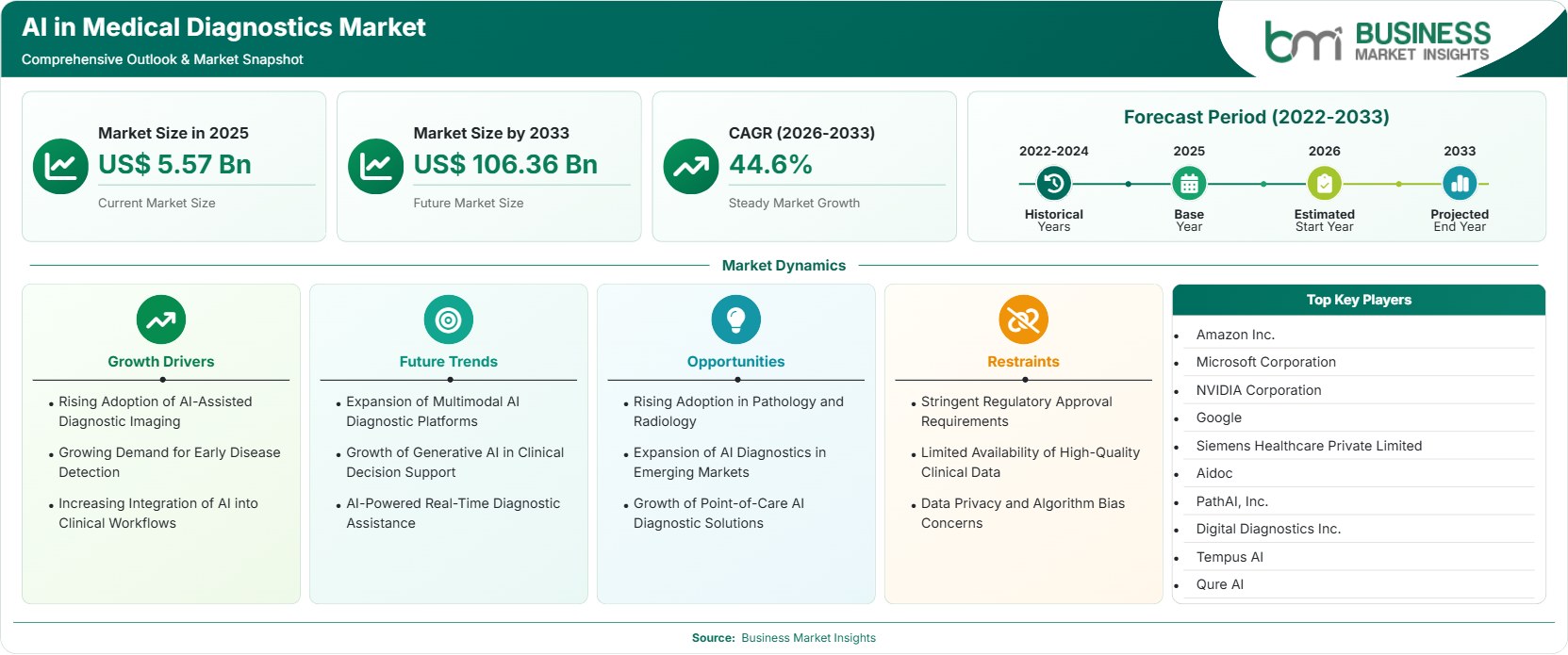
The AI in Medical Diagnostics Market size was valued at USD 5.57 Billion in 2025 and is projected to reach USD 106.36 Billion by 2033, growing at a CAGR of 44.6% during 2026–2033. Growth is driven by increasing adoption of artificial intelligence in healthcare, rising demand for early disease detection, expanding integration of AI-powered imaging analysis tools, growing clinical workload pressures, and advancements in machine learning and deep learning technologies.

Report Coverage
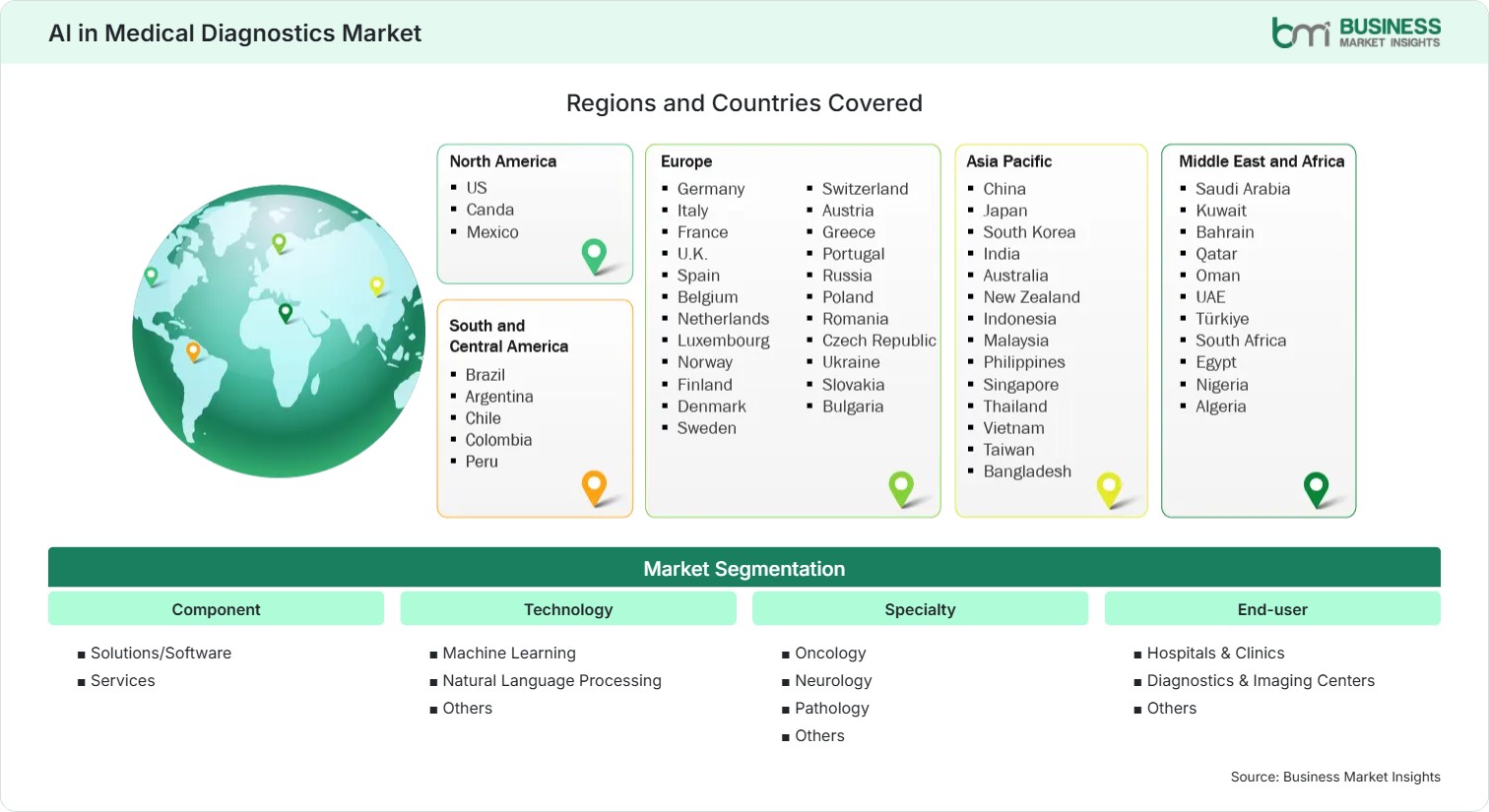
  • Component: Solutions/Software, Services
  • Technology: Machine Learning, Natural Language Processing, Others
  • Specialty: Oncology, Neurology, Pathology, Others
  • End-user: Hospitals & Clinics, Diagnostics & Imaging Centers, Others
US$ 5.57 Bn Market size in 2025
US$ 106.36 Bn Market Size by 2033
44.6% CAGR, 2026 - 2033
2026-2033 Forecast Period

AI Overview

AI in Medical Diagnostics Market Summary

  • North America Region: North America holds a market share of 39%–42% in 2025, growing at a CAGR of 43.0%–43.8% during 2026–2033. Demand is supported by advanced healthcare infrastructure, strong digital health investments, and widespread adoption of AI-enabled diagnostic solutions. The U.S. remains the dominant market, advancing at a CAGR of 43.2%–44.0%.
  • Fastest Growing Region: Asia Pacific accounts for 24%–27% of revenue in 2025 and is projected to register a CAGR of 46.5%–47.4% through 2033. Rising healthcare digitization, growing diagnostic imaging volumes, and increasing AI investments continue supporting market development.
  • Leading Segment: Solutions/Software holds a market share of 72%–76% in 2025 and is expected to grow at a CAGR of 44.8%–45.6%. Demand is driven by growing deployment of AI-powered diagnostic platforms, imaging software, and clinical decision-support systems.
  • High Growth Segment: Oncology accounts for 28%–32% of AI in medical diagnostics market revenue in 2025 and is projected to register a CAGR of 46.2%–47.0% during the forecast period. Increasing demand for early cancer detection and precision medicine solutions continues supporting expansion.
  • Key Market Opportunity: Growing integration of AI in radiology, pathology, and predictive diagnostics is creating significant opportunities for healthcare technology providers and diagnostic solution developers.
  • Major Market Players: Amazon Inc., Microsoft Corporation, NVIDIA Corporation, Google, Siemens Healthcare Private Limited, Aidoc, PathAI, Inc., Digital Diagnostics Inc., Tempus AI, and Qure AI.
Strategic Insights

AI in Medical Diagnostics Market: Strategic Insights

AI in Medical Diagnostics Market Strategic Framework
FREE PDF
Request your free sample
Request free sample
Stakeholder View

Key Takeaways

  • The AI in medical diagnostics market ecosystem includes healthcare providers, AI software developers, medical imaging companies, cloud technology providers, diagnostics laboratories, and research institutions.
  • Solutions and software platforms remain the largest revenue contributors due to growing deployment of AI-enabled diagnostic applications across healthcare settings.
  • Product innovation increasingly focuses on predictive analytics, automated image interpretation, computer-aided diagnosis, and clinical decision-support technologies.
  • Asia Pacific provides the strongest growth potential supported by expanding healthcare digitization, increasing disease burden, and rising investments in AI-enabled healthcare infrastructure.
  • Oncology, radiology, pathology, and neurology continue representing high-value application areas for AI-powered diagnostic solutions.
  • Integration of AI technologies with hospital information systems, imaging workflows, and precision medicine platforms is expected to create substantial opportunities across the healthcare ecosystem.
Geographic Outlook

AI in Medical Diagnostics Market Regional Highlights

North America AI in Medical Diagnostics Market

North America accounted for 39%–42% of global revenue in 2025 and is projected to expand at a CAGR of 43.0%–43.8% through 2033. Growth is supported by advanced healthcare infrastructure, increasing adoption of AI-enabled diagnostic platforms, strong healthcare IT investments, and growing demand for clinical workflow automation. The AI in Medical Diagnostics Market share in the region continues benefiting from pioneering technology adoption and extensive utilization of medical imaging technologies.

  • Healthcare providers are increasingly deploying AI solutions to improve diagnostic accuracy and reduce interpretation times.
  • Hospitals and diagnostic centers continue integrating AI into radiology, pathology, and clinical decision-support workflows.
  • Growing healthcare data volumes are accelerating adoption of machine learning-based diagnostic solutions.
  • Technology companies and healthcare institutions are increasingly collaborating on AI-powered diagnostic innovations.
  • Strong investment in precision medicine and digital health initiatives continues supporting AI in medical diagnostics market trends.

US AI in Medical Diagnostics Market

The United States represented 34%–37% of global revenue in 2025 and is anticipated to register a CAGR of 43.2%–44.0% during the forecast period. Demand is driven by increasing implementation of AI-powered healthcare technologies, growing imaging procedure volumes, and rising pressure to improve healthcare efficiency. Continued innovation in diagnostic algorithms supports AI in Medical Diagnostics Market growth.

  • Major healthcare systems continue investing in artificial intelligence to optimize clinical workflows.
  • Increasing oncology, radiology, and pathology applications are driving software adoption.
  • Cloud-based diagnostic platforms are improving scalability and accessibility of AI solutions.
  • Growing focus on early disease detection continues encouraging healthcare providers to adopt AI-assisted diagnostics.

Europe AI in Medical Diagnostics Market

Europe held 26%–29% of global revenue in 2025 and is projected to grow at a CAGR of 43.5%–44.3% through 2033. Rising healthcare digitization, increasing adoption of AI-assisted imaging technologies, and expanding investments in precision healthcare continue supporting market expansion. Germany remains the leading AI in medical diagnostics market with a CAGR of 43.7%–44.5%, while Poland is the fastest-growing country, expanding at a CAGR of 44.5%–45.3%.

  • Healthcare providers are increasingly utilizing AI to improve diagnostic efficiency and clinical outcomes.
  • Adoption of AI-assisted medical imaging continues rising across hospitals and imaging centers.
  • Germany maintains leadership through strong healthcare infrastructure and technological innovation.
  • Growing research initiatives are accelerating development of advanced diagnostic algorithms.
  • Government support for digital healthcare transformation continues fostering market growth.

Asia Pacific AI in Medical Diagnostics Market

Asia Pacific accounted for 24%–27% of global revenue in 2025 and is expected to remain the fastest-growing region, registering a CAGR of 46.5%–47.4% through 2033. Rapid healthcare digitization, increasing patient populations, rising chronic disease prevalence, and expanding healthcare investments continue driving AI in medical diagnostics market forecasts. China remains the largest regional market with a CAGR of 46.2%–47.0%, while India records the highest growth at 47.1%–48.0%.

  • Healthcare organizations are increasingly adopting AI tools to manage growing diagnostic workloads.
  • China benefits from substantial investments in healthcare AI, imaging technologies, and digital infrastructure.
  • India is witnessing rising adoption of AI-powered diagnostic platforms across hospitals and diagnostic laboratories.
  • Growing shortages of specialized healthcare professionals are accelerating demand for AI-assisted decision-making tools.
  • Expansion of telemedicine and digital healthcare ecosystems continues creating new opportunities across the region.

Rest of World AI in Medical Diagnostics Market

The Rest of World region accounted for 5%–8% of global revenue in 2025 and is expected to register a CAGR of 42.5%–43.3% through 2033. Market growth is supported by increasing healthcare modernization initiatives, rising awareness regarding AI-enabled diagnostics, and growing investment in healthcare technology infrastructure. Demand remains particularly strong within radiology and disease screening applications.

Brazil is the leading market in South & Central America and is forecast to grow at a CAGR of 42.8%–43.6%. In the Middle East & Africa, the United Arab Emirates is expected to be the fastest-growing country with a CAGR of 43.2%–44.0%.

  • Brazil continues benefiting from increasing healthcare digitization and diagnostic technology adoption.
  • The United Arab Emirates is witnessing growing investments in advanced healthcare technologies and AI innovation.
  • Hospitals are increasingly exploring AI-assisted imaging and clinical decision-support solutions.
  • Government-led healthcare modernization programs continue supporting market development.
  • Expanding access to digital healthcare infrastructure is creating long-term growth opportunities.
Global Market Geography
FREE PDF
Request your free sample
Request free sample
Segment Analysis

AI in Medical Diagnostics Market Segmentation

Component

Component-based demand continues to be led by software platforms as healthcare providers increasingly deploy artificial intelligence solutions to improve diagnostic accuracy, workflow efficiency, and clinical decision-making. Solutions/Software hold 72%–76% share in 2025 and are projected to grow at a CAGR of 44.8%–45.6% through 2033. The AI in Medical Diagnostics Market scope continues expanding as hospitals, laboratories, and imaging centers adopt AI-driven platforms capable of analyzing large volumes of clinical and imaging data.

  • Solutions/Software: Dominate market demand due to widespread deployment of AI-powered imaging analysis, clinical decision support, disease detection algorithms, and workflow optimization platforms.
  • Services: Benefit from increasing demand for implementation, integration, training, consulting, maintenance, and AI model customization services.

Technology

Technology advancements continue serving as the foundation for innovation across diagnostic applications. Growing computational capabilities and access to large healthcare datasets are accelerating AI model development and adoption.

  • Machine Learning: Represents the dominant technology segment due to extensive use in pattern recognition, image analysis, disease prediction, and clinical decision support.
  • Natural Language Processing (NLP): Increasingly utilized to extract actionable insights from electronic health records, physician notes, pathology reports, and clinical documentation.
  • Others: Include deep learning, computer vision, neural networks, and advanced predictive analytics technologies.

Specialty

Medical specialties continue increasing utilization of AI technologies to enhance diagnostic precision and improve patient outcomes. Oncology accounts for 28%–32% market share in 2025 and is projected to register the fastest growth at a CAGR of 46.2%–47.0% through 2033.

  • Oncology: Leads growth due to increasing emphasis on early cancer detection, tumor characterization, and precision medicine initiatives.
  • Neurology: Benefits from growing use of AI for stroke detection, neurodegenerative disease assessment, and brain imaging analysis.
  • Pathology: Increasingly adopts AI-assisted image interpretation and digital pathology workflows.
  • Others: Include cardiology, pulmonology, ophthalmology, and additional diagnostic specialties.

End-user

End-user demand continues expanding as healthcare organizations seek technology solutions capable of improving diagnostic efficiency and reducing clinical workload.

  • Hospitals & Clinics: Represent the largest segment due to extensive deployment of AI tools across radiology, pathology, oncology, and patient management workflows.
  • Diagnostics & Imaging Centers: Continue increasing adoption of AI-assisted imaging analysis and reporting platforms.
  • Others: Include research institutions, specialty laboratories, academic healthcare centers, and telemedicine providers.
Market Forces

AI in Medical Diagnostics Market Dynamics

Key Market Drivers

Rising Adoption of AI-Assisted Diagnostic Imaging

Diagnostic imaging remains one of the most important areas for artificial intelligence adoption within healthcare. AI-powered imaging solutions help clinicians interpret radiology scans more quickly while improving diagnostic accuracy and consistency. Healthcare providers increasingly utilize AI technologies to identify abnormalities, prioritize critical cases, and enhance workflow efficiency. Growing imaging volumes and increasing demand for faster reporting continue encouraging adoption across hospitals and imaging centers. As AI algorithms become more advanced and clinically validated, imaging applications are expected to remain a major growth driver for the market.

Growing Demand for Early Disease Detection

Early diagnosis plays a crucial role in improving treatment outcomes and reducing healthcare costs. AI technologies enable healthcare providers to identify disease patterns that may be difficult to detect through traditional methods alone. Rising prevalence of cancer, cardiovascular disorders, neurological diseases, and chronic health conditions is increasing the need for advanced diagnostic tools. Healthcare systems are increasingly investing in AI solutions capable of supporting preventive care and earlier intervention strategies. This growing emphasis on proactive healthcare continues supporting market expansion.

Increasing Integration of AI into Clinical Workflows

Hospitals and healthcare organizations are increasingly integrating AI tools into daily clinical workflows to improve efficiency, reduce administrative burdens, and enhance decision-making processes. AI-powered systems assist clinicians by automating repetitive tasks, analyzing patient data, and generating actionable insights. Integration with electronic health records, imaging systems, and hospital information platforms is further streamlining adoption. As healthcare providers continue focusing on productivity improvements and quality care delivery, AI integration is expected to accelerate significantly over the forecast period.

Key Market Opportunities

Rising Adoption in Pathology and Radiology

Pathology and radiology are emerging as some of the most promising application areas for artificial intelligence in diagnostics. AI solutions can rapidly analyze large volumes of medical images and pathology slides, helping specialists detect abnormalities with greater efficiency and consistency. Healthcare organizations are increasingly utilizing AI technologies to support cancer diagnostics, disease classification, and image interpretation workflows. Growing digitization of pathology and radiology departments is creating favorable conditions for deployment. As healthcare systems seek to improve accuracy while addressing growing diagnostic workloads, adoption across these specialties is expected to expand significantly.

Expansion of AI Diagnostics in Emerging Markets

Emerging economies are investing heavily in healthcare modernization and digital transformation initiatives, creating substantial opportunities for AI-powered diagnostic solutions. Many healthcare systems are seeking technologies that can improve access to quality diagnostics while addressing shortages of specialized clinicians. AI platforms offer the ability to support faster and more scalable healthcare delivery across underserved regions. Increasing internet connectivity, cloud adoption, and healthcare infrastructure development continue supporting market penetration. As awareness regarding AI-assisted diagnostics grows, emerging markets are expected to become important contributors to long-term industry growth.

Growth of Point-of-Care AI Diagnostic Solutions

Point-of-care diagnostic technologies integrated with artificial intelligence are gaining significant attention due to their ability to deliver rapid results closer to patients. These solutions support faster clinical decision-making and improve access to diagnostic services in both urban and remote settings. Healthcare providers are increasingly exploring portable and AI-enabled diagnostic platforms for disease screening, monitoring, and risk assessment applications. Advances in cloud computing, mobile healthcare technologies, and edge AI capabilities are accelerating innovation. This trend is expected to create attractive opportunities for technology developers and healthcare providers alike.

Market Restraints and Challenges

Stringent Regulatory Approval Requirements

Factor: AI-powered medical diagnostic solutions must comply with rigorous regulatory frameworks designed to ensure patient safety, accuracy, transparency, and clinical effectiveness.

Impact: Regulatory approval processes can increase development timelines, validation requirements, and commercialization costs. Companies must invest heavily in clinical evidence generation, quality management systems, and compliance activities before bringing products to market. These requirements may slow product launches and create barriers for new entrants.

Limited Availability of High-Quality Clinical Data

Factor: Effective AI model development requires large volumes of accurate, diverse, and well-annotated clinical datasets that may not always be readily available.

Impact: Data limitations can affect model performance, generalizability, and reliability across different patient populations. Healthcare organizations and technology developers often face challenges related to data accessibility, interoperability, privacy regulations, and standardization. These factors can influence solution development timelines and impact broader adoption of AI-powered diagnostic technologies.

Company Analysis

Competitive Landscape

The market remains highly competitive with the presence of global technology companies, healthcare AI specialists, diagnostic software providers, cloud computing vendors, and medical imaging solution developers. Companies are focusing on advanced machine learning algorithms, medical imaging analytics, digital pathology platforms, predictive diagnostics, and clinical decision-support systems. Increasing investment in precision medicine and healthcare digitization continues shaping AI in Medical Diagnostics Market analysis and competitive strategies across the global healthcare technology ecosystem.

Company Name

Overview

Products and Services Relevant to this Market

Amazon Inc.

Technology company offering cloud computing, artificial intelligence, and healthcare analytics solutions.

Healthcare AI platforms, cloud-based diagnostic solutions, data analytics tools.

Microsoft Corporation

Global technology provider supporting digital health and artificial intelligence applications.

AI diagnostic platforms, healthcare cloud solutions, clinical analytics tools.

NVIDIA Corporation

Computing technology company specializing in AI infrastructure and accelerated computing.

AI processors, medical imaging AI platforms, healthcare computing solutions.

Google

Technology company providing artificial intelligence, cloud computing, and healthcare data solutions.

AI diagnostic software, imaging analysis tools, healthcare AI platforms.

Siemens Healthcare Private Limited

Healthcare technology provider offering imaging, diagnostic, and digital health solutions.

AI-enabled medical imaging, diagnostic software, healthcare analytics systems.

Aidoc

Healthcare AI company specializing in radiology workflow optimization and diagnostic support.

AI imaging analysis solutions, radiology support platforms, clinical workflow tools.

PathAI, Inc.

Artificial intelligence company focused on pathology and diagnostic innovation.

Digital pathology platforms, AI-assisted pathology diagnostics, healthcare analytics.

Digital Diagnostics Inc.

Developer of autonomous AI diagnostic solutions for clinical applications.

AI diagnostic software, disease detection platforms, automated diagnostic tools.

Tempus AI

Precision medicine and healthcare AI company utilizing clinical and molecular data analytics.

AI-powered diagnostics, precision medicine platforms, healthcare data solutions.

Qure AI

Healthcare AI company providing diagnostic imaging and clinical decision support solutions.

AI radiology software, imaging analytics, diagnostic support systems.

Industry Activity

Recent Developments

July 2026

Philips launched the Alturion ultrasound system, featuring AI-powered workflows, advanced imaging, and automated measurement capabilities to improve efficiency, consistency, and clinical decision-making in high-volume healthcare environments.

July 2026

CellCarta launched its Global Digital Pathology and AI Consortium, bringing together leading AI and precision diagnostics companies to accelerate biomarker discovery, patient stratification, and AI-enabled drug development through a platform-agnostic collaborative ecosystem.

May 2026

NVIDIA Corporation announced a partnership with Foxconn and Taiwan's leading medical centers to deploy coordinated agentic and physical AI workforces to scale AI-driven health systems.

March 2026

Roche announced an expansion of its global AI infrastructure by deploying a large-scale AI factory powered by NVIDIA accelerated computing to accelerate the development of new therapeutics and diagnostics solutions.

Trust & Transparency

Research Methodology

The market analysis combines proprietary research with secondary data from government agencies, company disclosures, regulatory filings, industry databases and expert interviews. Market estimates are validated through data triangulation, cross-market benchmarking and analyst review.

View Full Research Methodology

Questions Answered

Frequently Asked Questions

What challenge has the greatest long-term impact on the industry?

Limited availability of high-quality clinical data remains a significant challenge because AI models require large, diverse, and accurately labeled datasets to deliver reliable diagnostic outcomes across different patient populations.

How is artificial intelligence improving medical diagnostics?

AI improves diagnostic accuracy, accelerates image interpretation, assists with early disease detection, reduces clinical workload, and enhances decision-making through advanced data analysis capabilities.

Why is Asia Pacific the fastest-growing region?

The region benefits from increasing healthcare digitization, rising patient volumes, expanding healthcare infrastructure, growing AI investments, and strong demand for efficient diagnostic solutions.

Which component segment leads the market?

Solutions/Software lead the market due to widespread adoption of AI-powered imaging analysis, clinical decision support systems, predictive analytics, and healthcare workflow optimization platforms.

What is driving growth in the AI in Medical Diagnostics Market Report?

Rising adoption of AI-assisted diagnostic imaging, growing demand for early disease detection, increasing integration of AI into clinical workflows, and expanding healthcare digitization initiatives are the primary growth drivers.

Access the Full AI in Medical Diagnostics Market Report

Get segment-level forecasts, regional estimates, competitive benchmarking, company profiles and downloadable Excel datasets.

Access the full AI in Medical Diagnostics Market Report
350 pages PDF & Excel | 2026-07-29