
Cancer Diagnostics Market Outlook: Size, Share, Trends, Growth Analysis, Competitive Landscape & Forecast, 2026–2033

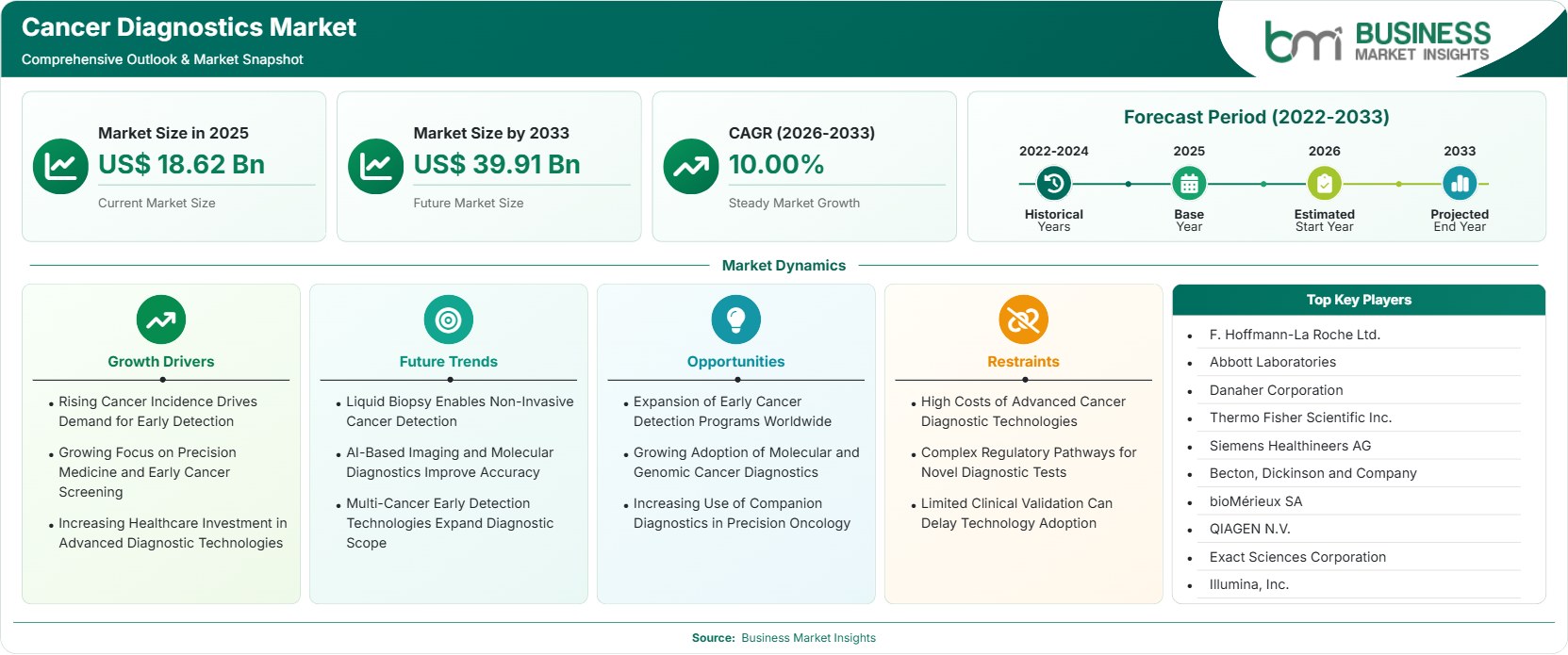
The Cancer Diagnostics Market size was valued at US$ 18.62 Billion in 2025 and is projected to reach US$ 39.91 Billion by 2033, growing at a CAGR of 10.00% during 2026–2033, supported by early detection, molecular testing, precision oncology, and expanding diagnostic capacity.

Report Coverage
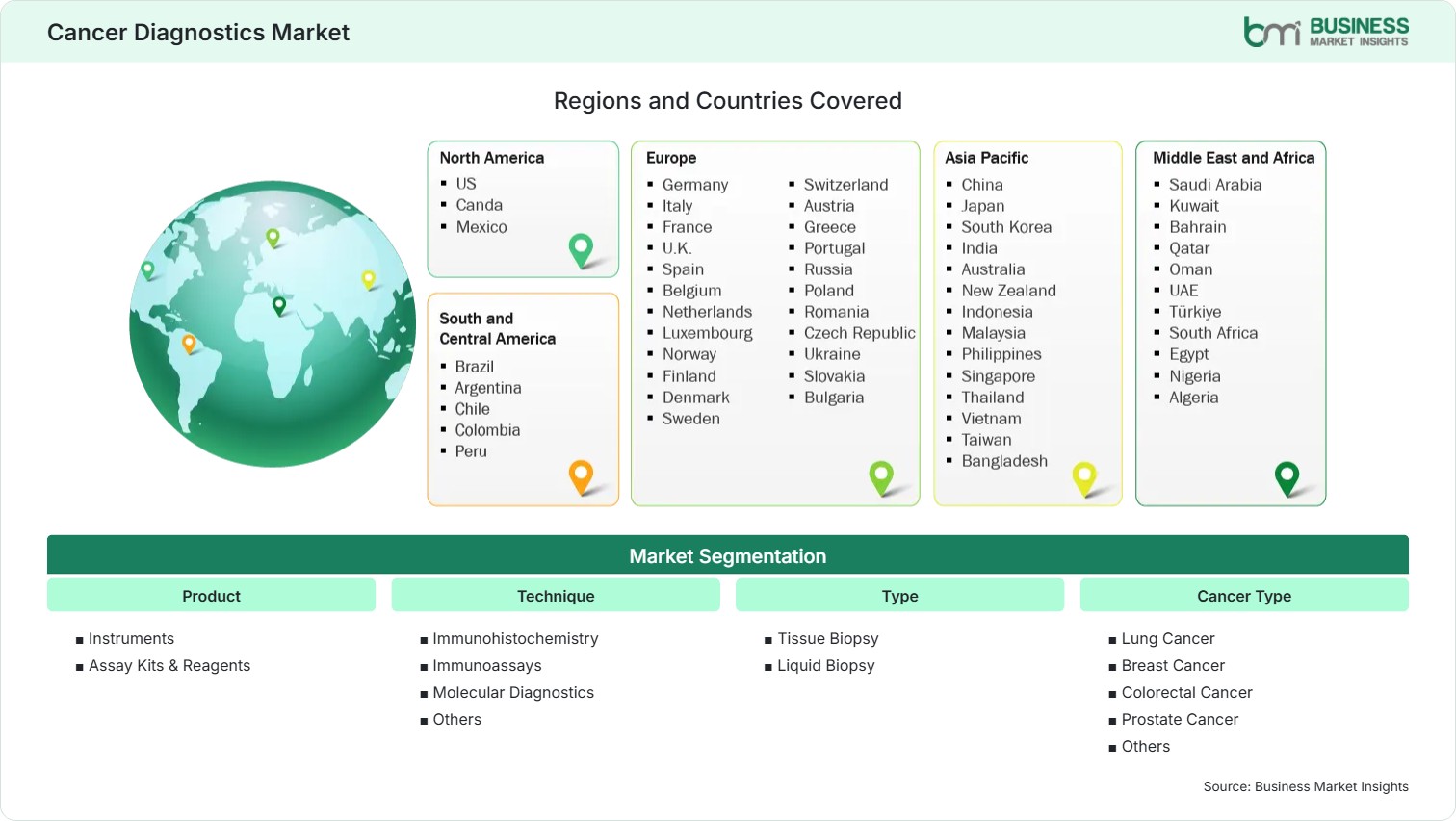
  • Product: Instruments, Assay Kits & Reagents
  • Technique: Immunohistochemistry , Immunoassays, Molecular Diagnostics, Others
  • Type: Tissue Biopsy, Liquid Biopsy
  • Cancer Type: Lung Cancer, Breast Cancer, Colorectal Cancer, Prostate Cancer, Others
  • End-user: Hospitals & Clinics, Clinical Laboratories, Others
US$ 18.62 Bn Market size in 2025
US$ 39.91 Bn Market Size by 2033
10.00% CAGR, 2026 - 2033
2026-2033 Forecast Period

AI Overview

Cancer Diagnostics Market Summary

  • North America Region: holds Cancer Diagnostics Market share of 34%–37% in 2025, growing with a CAGR of 9.20%–9.80%, influenced by advanced pathology infrastructure, precision oncology, reimbursement coverage, and molecular testing adoption. In the US, laboratory automation, genomic testing, and companion diagnostics support a 9.40%–10.00% CAGR during 2026–2033.
  • Fastest Growing Region: Asia Pacific holds market share of 23%–26% in 2025, expanding at a CAGR of 11.20%–12.00%, supported by expanding cancer screening, improving laboratory infrastructure, rising healthcare expenditure, and broader access to molecular diagnostics across major economies.
  • Leading Segment: Assay Kits & Reagents holds market share of 55%–59% in 2025, advancing at a CAGR of 10.20%–10.80%, supported by recurring laboratory consumption, broader biomarker menus, molecular testing, pathology workflows, and increasing demand for standardized diagnostic procedures.
  • High Growth Segment: Liquid Biopsy holds market share of 12%–15% in 2025, advancing at a CAGR of 14.00%–15.20%, supported by minimally invasive sampling, circulating tumor DNA analysis, treatment monitoring, recurrence assessment, and expanding precision oncology applications.
  • Key Market Opportunity: Expansion of molecular diagnostics, liquid biopsy, companion diagnostics, and early screening creates attractive opportunities as laboratories shift toward more precise, minimally invasive, and treatment-linked cancer testing.
  • Major Market Players: F. Hoffmann-La Roche Ltd., Abbott Laboratories, Danaher Corporation, Thermo Fisher Scientific Inc., Siemens Healthineers AG, Becton, Dickinson and Company, bioMerieux SA, QIAGEN N.V., Exact Sciences Corporation, Illumina, Inc.
Strategic Insights

Cancer Diagnostics Market: Strategic Insights

Cancer Diagnostics Market Strategic Framework
FREE PDF
Request your free sample
Request free sample
Stakeholder View

Key Takeaways

  • Suppliers in diagnostics are now competing by offering full workflows, rather than isolated equipment, which includes sample preparation, testing, analysis, informatics, and automation.
  • The upside for molecular diagnostics and liquid biopsy is the most compelling since in oncology, the diagnosis requires biomarker information for treatment, surveillance, recurrence, and efficacy.
  • Product development is moving toward multiplex assays, higher-throughput sequencing, digital pathology, automated interpretation, and tests capable of extracting more clinical information from limited patient samples.
  • The Asia Pacific region presents a great case for expansion of improvements in cancer screening, diagnostics networks, laboratories and oncology infrastructure in key healthcare markets.
  • The focus of investments is becoming increasingly narrow and centered on areas such as precision oncology, artificial intelligence, sequencing, digital pathology and companion diagnostics, making portfolio expansion and acquisitions very appealing.
  • Diagnostic companies with regulatory expertise, scalable laboratory systems, wide assay menus and solid clinical evidence are poised to benefit from increased alignment between diagnostics and treatments.
Geographic Outlook

Cancer Diagnostics Market Regional Highlights

North America Cancer Diagnostics Market

North America Cancer Diagnostics Market holds 34%–37% share in 2025 and is projected to grow at a CAGR of 9.20%–9.80% through 2033. The region benefits from mature pathology networks, advanced molecular testing, high laboratory automation, and established precision oncology pathways. The US accounts for most regional demand, supported by extensive hospital laboratory capacity and specialized diagnostic centers. Cancer screening remains an important demand foundation as providers seek earlier diagnosis and treatment stratification.

  • Molecular testing adoption is expanding as oncology treatment increasingly depends on biomarker identification and genomic characterization across solid tumors.
  • Laboratory automation supports higher testing volumes while reducing manual handling and improving consistency across pathology and molecular workflows.
  • Digital pathology and artificial intelligence are gaining commercial relevance as laboratories seek faster image interpretation and improved workflow management.
  • Companion diagnostics strengthen links between diagnostic developers and pharmaceutical companies, creating demand for validated biomarker testing platforms.

US Cancer Diagnostics Market

The US Cancer Diagnostics Market holds 80%–84% of North American demand in 2025 and is expected to expand at a CAGR of 9.40%–10.00% through 2033. Demand is supported by advanced oncology centers, broad laboratory networks, genomic testing, and established reimbursement mechanisms. Diagnostic development is increasingly connected with targeted therapies and clinical trial requirements.

  • Precision oncology is increasing demand for biomarker testing that supports therapy selection and patient stratification across targeted treatment pathways.
  • Digital pathology is strengthening the role of computational analysis in tissue diagnostics, laboratory workflow optimization, and reproducible interpretation.
  • Companion diagnostic development remains closely linked with oncology drug development, requiring coordinated evidence generation and regulatory planning.

Europe Cancer Diagnostics Market

Europe Cancer Diagnostics Market represents 27%–30% share in 2025 and is forecast to grow at a CAGR of 9.00%–9.60% through 2033. Germany, the UK, France, and Italy remain important markets because of established healthcare infrastructure and oncology services. Germany is projected to grow at 9.20%–9.80%, while the UK is positioned for 9.50%–10.10% growth.

  • Germany benefits from extensive hospital infrastructure and established pathology capabilities, supporting adoption of automated and molecular cancer testing.
  • The UK provides a strong opportunity through screening expansion, genomic medicine integration, and continued investment in diagnostic capacity.
  • France is supported by national cancer-control priorities and growing demand for coordinated diagnostic pathways across oncology services.
  • European regulatory requirements encourage stronger analytical validation, quality systems, and clinical evidence for advanced diagnostic technologies.

Asia Pacific Cancer Diagnostics Market

Asia Pacific accounts for 23%–26% share in 2025 and records the fastest regional growth at 11.20%–12.00% CAGR through 2033. China, Japan, South Korea, and India represent major demand centers, while India is projected to grow at 12.00%–12.80%. Rising cancer incidence, broader screening, expanding private laboratories, and improving molecular testing access support regional expansion.

  • China combines large patient volumes with expanding molecular oncology capacity, supporting demand for sequencing, biomarker assays, and automated pathology systems.
  • Japan maintains advanced diagnostic infrastructure, while aging demographics sustain demand for cancer screening, pathology, and treatment-monitoring technologies.
  • India offers substantial expansion potential as organized diagnostic networks broaden molecular testing and oncology screening beyond major metropolitan centers.
  • South Korea benefits from strong technology infrastructure and increasing integration of advanced diagnostics within specialized cancer-care pathways.

Rest of World Cancer Diagnostics Market

Rest of World represents 11%–14% share in 2025 and is projected to grow at a CAGR of 8.50%–9.30% through 2033. South and Central America benefit from expanding private healthcare networks, cancer screening initiatives, and improved access to pathology services. Brazil and Mexico remain leading markets, while Colombia and Chile provide additional growth opportunities as diagnostic infrastructure develops.

Middle East and Africa show increasing demand for accessible cancer testing, particularly through centralized laboratories and specialized oncology centers. Saudi Arabia and the UAE are leading markets, while South Africa provides a broader regional laboratory base. Investment remains focused on improving diagnostic availability and reducing delays between screening, confirmation, and treatment.

  • Brazil is strengthening oncology diagnostic capacity through private laboratory expansion, hospital modernization, and broader access to molecular testing.
  • Mexico offers opportunities as private healthcare providers expand specialized laboratory services and improve access to advanced diagnostic platforms.
  • Saudi Arabia is investing in healthcare modernization, supporting demand for oncology laboratories, pathology services, and precision diagnostic capabilities.
  • South Africa remains an important regional laboratory hub, with demand linked to specialized oncology services and diagnostic network development.
Global Market Geography
FREE PDF
Request your free sample
Request free sample
Segment Analysis

Cancer Diagnostics Market Segmentation

Product

Assay Kits & Reagents lead with 55%–59% share in 2025 and a 10.20%–10.80% CAGR through 2033. Recurring consumption, expanding biomarker menus, and molecular testing support stronger demand than capital-intensive instruments. The Cancer Diagnostics Market scope increasingly favors integrated product portfolios combining analytes, reagents, workflow software, and automated platforms.

  • Instruments: Automated analyzers, pathology systems, molecular platforms, and sequencing instruments support laboratories handling rising oncology testing volumes and increasingly complex diagnostic workflows.
  • Assay Kits & Reagents: Recurring laboratory consumption and expanding biomarker menus support demand across immunoassays, molecular tests, pathology workflows, and precision oncology applications.

Technique

Molecular Diagnostics leads technique demand with a 30%–34% share in 2025 and a 11.00%–11.70% CAGR through 2033. Growing use of genomic biomarkers and therapy-linked testing supports molecular platforms, while immunohistochemistry remains essential for tissue characterization and treatment decisions.

  • Immunohistochemistry (IHC): IHC remains important for protein expression, tumor classification, and biomarker evaluation, supported by established pathology workflows and companion diagnostic applications.
  • Immunoassays: Immunoassays provide scalable biomarker measurement and remain relevant across routine laboratory testing, tumor markers, and high-volume hospital diagnostic workflows.
  • Molecular Diagnostics: Molecular testing supports mutation detection, genomic profiling, treatment selection, and disease monitoring, making it central to precision oncology development.

Type

Tissue Biopsy remains the larger testing type with 74%–78% share in 2025, while Liquid Biopsy records the strongest growth at 14.00%–15.20% CAGR. Tissue testing retains clinical importance, whereas blood-based approaches gain traction where repeated sampling and minimally invasive monitoring are valuable.

  • Tissue Biopsy: Tissue samples provide cellular architecture and molecular information required for tumor classification, pathology confirmation, biomarker assessment, and treatment planning.
  • Liquid Biopsy: Blood-based testing enables minimally invasive biomarker analysis and repeated monitoring, supporting applications in treatment response, recurrence surveillance, and molecular disease characterization.

Cancer Type

Lung Cancer represents 22%–26% share in 2025 and remains a major diagnostic demand area because molecular characterization increasingly influences treatment decisions. Breast, colorectal, and prostate cancers maintain substantial testing volumes, while broader biomarker coverage supports continued laboratory demand.

  • Lung Cancer: Molecular biomarker testing supports classification and treatment selection, increasing demand for tissue and blood-based assays across advanced diagnostic pathways.
  • Breast Cancer: Pathology and biomarker assessment remain central to diagnosis and treatment planning, supporting sustained demand for IHC, molecular assays, and related testing.
  • Colorectal Cancer: Screening, tissue characterization, and molecular biomarker testing create demand across pathology and precision oncology workflows.
  • Prostate Cancer: Diagnostic demand spans pathology, biomarker assessment, and molecular testing, with increasing attention to treatment stratification and disease monitoring.

End-user

Hospitals & Clinics hold 48%–52% share in 2025 and are expected to expand at a 9.70%–10.30% CAGR through 2033. Hospitals retain a central role because diagnosis, pathology, treatment planning, and oncology follow-up are increasingly integrated. Clinical laboratories provide scalable testing capacity and remain important for specialized molecular and genomic services.

  • Hospitals & Clinics: Integrated oncology services support demand for pathology, molecular testing, companion diagnostics, and rapid diagnostic workflows close to treatment decisions.
  • Clinical Laboratories: High-throughput laboratories support centralized testing, specialized molecular diagnostics, and scalable assay processing for hospitals and outpatient healthcare networks.
Market Forces

Cancer Diagnostics Market Dynamics

Key Market Drivers

Rising Cancer Incidence Drives Demand for Early Detection

Cancer prevalence still results in a large unmet need in terms of cancer screening, diagnosis, and disease monitoring. According to IARC estimates, there will be 20.6 million new cancer cases globally in 2024, which proves the need for scalability in diagnostic capabilities. Increase in cancer cases grows the need for diagnostics such as pathology, molecular diagnostics, and biomarker testing. Therefore, the growth of the market is directly dependent on the disease burden and availability of diagnostics. Labs are meeting this growing need through increased automation and expanded test menu.

Growing Focus on Precision Medicine and Early Cancer Screening

Precision medicine is revolutionizing the requirements for diagnostics through the connection of the disease classification to its molecular/biomarker data. Companion diagnostics may be used to predict which patients will respond to certain drugs or which patients pose certain risks in terms of therapy, thus making the accuracy of diagnostics vital in making decisions regarding therapeutics. This connection makes further investments in genetic testing, IHC, molecular tests, and biomarkers possible. The Cancer Diagnostics Market trend therefore benefits from both increasingly individualized testing and population-level screening pathways.

Increasing Healthcare Investment in Advanced Diagnostic Technologies

The healthcare providers are investing more on modernization and automation in the laboratories, in addition to molecular diagnostics and digital pathology. Such investments help in increasing the test volumes in the laboratories while also managing the complexity in the oncology workflows in a consistent manner. In addition, the advanced platforms enable the providers to streamline testing and minimize manual activities as well as expand their offerings. Such investments become even more significant for the networks involved in providing cancer care. The resulting Market trends favor platforms that combine automation, connectivity, analytical performance, and scalable assay menus.

Key Market Opportunities

Expansion of Early Cancer Detection Programs Worldwide

The expansion of screening and early detection programs will also contribute to the growth in testing procedures in breast, colorectal, cervical, lung cancers, as well as many others. WHO maintains that easily accessible early detection, screening facilities, referral services, and prompt treatment are essential components of cancer control. New healthcare systems may use central laboratories together with an extensive sample collection network. Cancer Diagnostics Market Forecasts will be highly related to public health spending, healthcare access, and the capacity of the diagnostic networks to turn screening into clinical care.

Growing Adoption of Molecular and Genomic Cancer Diagnostics

Molecular and genomic tests offer a roadmap for better characterization of tumors and selection of appropriate treatments. Increased application of personalized treatments has made it necessary to reliably identify mutations, biomarkers, and molecular signatures prior to treatment decisions being made. Sequencing technology and multiplex assays may enable multiple biomarker testing through a smaller number of testing procedures, which enhances the efficiency of the lab testing process. Liquid biopsy represents yet another way of conducting molecular tests.

Increasing Use of Companion Diagnostics in Precision Oncology

Companion diagnostics are becoming more closely connected with precision oncology because treatment selection increasingly depends on biomarker evidence. FDA describes these tests as devices that provide information essential to the safe and effective use of corresponding therapies. Their development creates opportunities for coordinated pharmaceutical and diagnostic partnerships, especially where targeted therapies require defined patient populations. Regulatory pathways also encourage earlier planning between therapeutic and diagnostic developers. FDA guidance supports codevelopment strategies for oncology products and companion tests.

Market Restraints and Challenges

High Costs of Advanced Cancer Diagnostic Technologies

Factor: Advanced sequencing platforms, automated pathology systems, molecular analyzers, and associated software require substantial capital and specialized laboratory infrastructure. Impact: High acquisition and implementation costs can slow adoption among smaller hospitals, regional laboratories, and healthcare systems with constrained budgets. The cost challenge extends beyond instruments because advanced oncology testing requires trained personnel, quality control, maintenance, data infrastructure, and recurring reagents.

Complex Regulatory Pathways for Novel Diagnostic Tests

Factor: Novel molecular tests, companion diagnostics, and diagnostic technologies powered by software need substantial amounts of analytical and clinical data before their commercialization in a regulated market setting. Impact: More time is needed to obtain approval from regulatory authorities, and hence it results in higher cost and risks associated with the development and commercialization process. Expectations of the regulator change with novel technologies.

Company Analysis

Competitive Landscape

The Cancer Diagnostics Market analysis indicates a competitive structure built around diagnostic platforms, assay portfolios, molecular technologies, pathology systems, and precision oncology capabilities. Leading companies increasingly compete through workflow breadth, recurring reagent revenue, clinical evidence, regulatory expertise, and integration across laboratory environments.

Company Name

Overview

Products and Services relevant to this market

F. Hoffmann-La Roche Ltd.

Global healthcare company with a broad diagnostics portfolio spanning pathology, molecular testing, sequencing, and oncology-focused diagnostics.

IHC assays, pathology platforms, molecular diagnostics, companion diagnostics, sequencing, and oncology laboratory solutions.

Abbott Laboratories

Diversified healthcare company serving clinical laboratories through diagnostic instruments, assays, and specialized testing technologies.

Immunoassays, molecular diagnostics, laboratory instruments, biomarker testing, and oncology-related diagnostic solutions.

Danaher Corporation

Life sciences and diagnostics group with businesses covering pathology, molecular diagnostics, laboratory automation, and clinical workflow technologies.

Pathology systems, molecular platforms, reagents, laboratory automation, and diagnostic workflow technologies.

Thermo Fisher Scientific Inc.

Major life sciences supplier supporting clinical laboratories, research organizations, and oncology testing programs.

Sequencing systems, molecular assays, reagents, sample preparation, and genomic analysis technologies.

Siemens Healthineers AG

Medical technology provider with diagnostic imaging and laboratory capabilities supporting integrated cancer-care pathways.

Laboratory diagnostics, automation, molecular testing, imaging technologies, and digital healthcare solutions.

Becton, Dickinson and Company

Medical technology company supplying diagnostic and laboratory systems used across clinical testing environments.

Molecular diagnostic systems, specimen management, laboratory automation, and microbiology-related technologies.

bioMérieux SA

Diagnostics specialist focused on in vitro diagnostics and laboratory technologies across clinical applications.

Molecular biology systems, reagents, immunoassays, sample processing, and laboratory diagnostic platforms.

QIAGEN N.V.

Molecular diagnostics and sample technology company focused on nucleic-acid testing and precision medicine workflows.

Molecular assays, sample preparation, PCR solutions, genomic testing, and oncology biomarker technologies.

Exact Sciences Corporation

Diagnostics company focused on cancer screening, detection, and precision testing with emphasis on non-invasive approaches.

Multi-marker cancer tests, screening solutions, molecular diagnostics, and oncology testing services.

Illumina, Inc.

Genomics technology provider supplying sequencing platforms and consumables for advanced oncology research and clinical testing.

Next-generation sequencing systems, consumables, genomic analysis, and cancer-focused sequencing applications.

Trust & Transparency

Research Methodology

The market analysis combines proprietary research with secondary data from government agencies, company disclosures, regulatory filings, industry databases and expert interviews. Market estimates are validated through data triangulation, cross-market benchmarking and analyst review.

View Full Research Methodology

Questions Answered

Frequently Asked Questions

What is the main challenge for expanding advanced cancer diagnostics in emerging markets?

The main challenge is uneven access to laboratory infrastructure, trained specialists, reimbursement, and advanced equipment. Scalable testing models and centralized laboratory networks can help extend sophisticated diagnostics beyond major healthcare centers.

What is the role of artificial intelligence in Cancer Diagnostics Market report?

Artificial intelligence can support digital pathology, image interpretation, workflow prioritization, biomarker discovery, and data analysis. Its commercial value depends on clinical validation, integration, and regulatory acceptance.

How are companion diagnostics changing cancer treatment pathways?

Companion diagnostics connect biomarker results with treatment decisions, helping identify patients who are more likely to benefit from specific therapies or require alternative treatment strategies.

Why is liquid biopsy gaining importance in oncology diagnostics?

Liquid biopsy can obtain tumor-related biomarkers through blood sampling, allowing less invasive testing and repeated assessments. Its value is particularly relevant when tissue is unavailable, insufficient, or difficult to obtain.

Which technology is likely to have the greatest influence on Cancer Diagnostics Market?

Sequencing, molecular diagnostics, digital pathology, and liquid biopsy are likely to have the strongest influence because they provide more detailed tumor information and support treatment selection, monitoring, and recurrence assessment.

Access the Full Cancer Diagnostics Market Report

Get segment-level forecasts, regional estimates, competitive benchmarking, company profiles and downloadable Excel datasets.

Access the full Cancer Diagnostics Market Report
350 pages PDF & Excel | 2026-08-19