
Medical Scrubs Market Outlook: Size, Share, Trends, Growth Analysis, Competitive Landscape & Forecast, 2026-2033

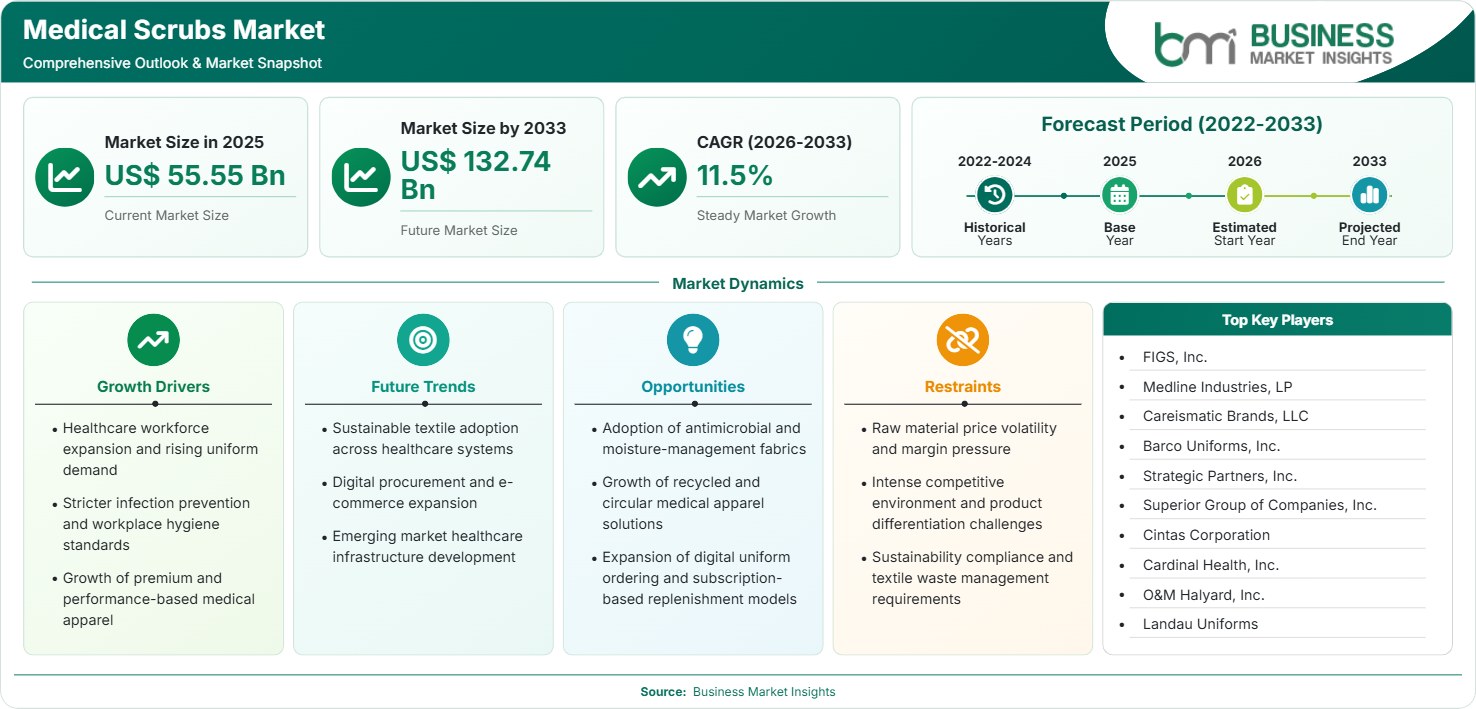
The Medical Scrubs Market size was valued at US$ 55.55 Billion in 2025 and is projected to reach US$ 132.74 Billion by 2033, growing at a CAGR of 11.5% during 2026–2033. Demand is being supported by expanding healthcare workforces, stricter infection-control standards, antimicrobial fabric innovation, e-commerce penetration, and rising institutional procurement across hospitals, clinics, and ambulatory care settings.

Report Coverage
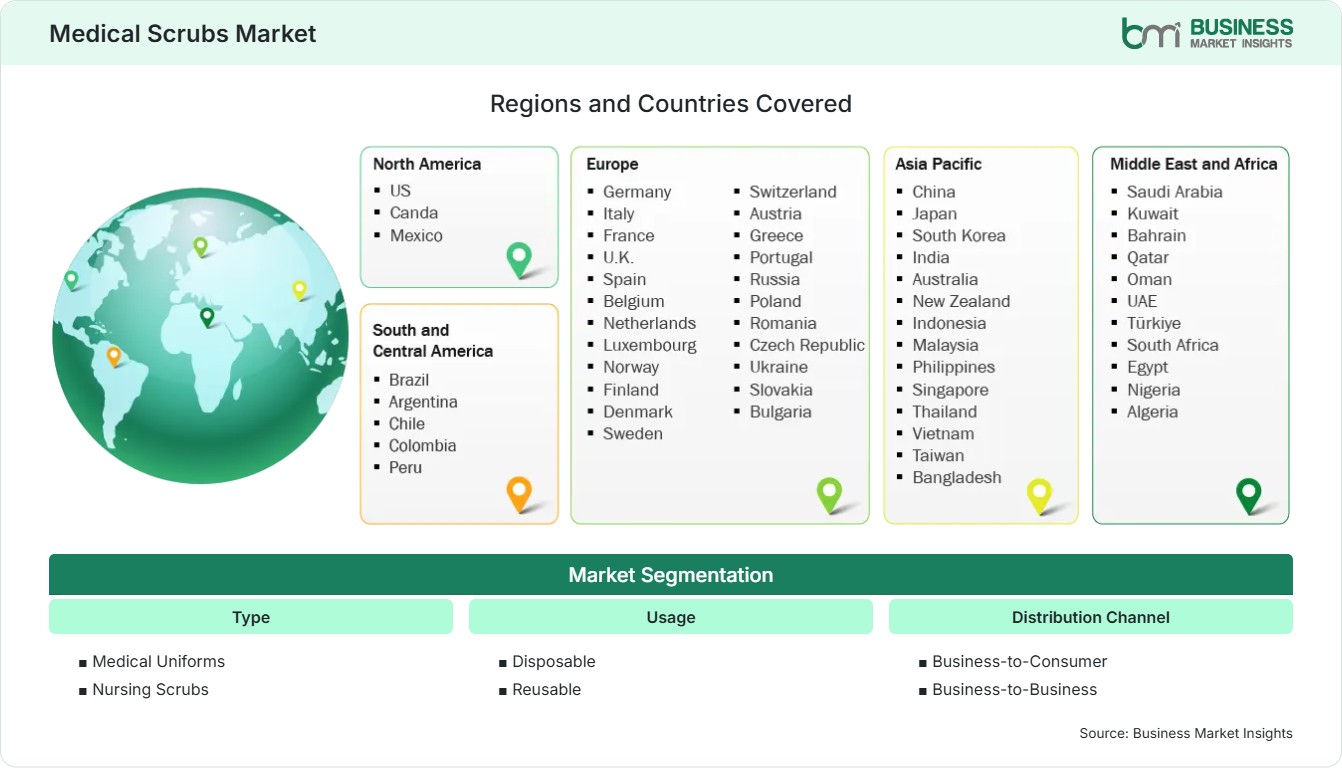
  • Type: Medical Uniforms, Nursing Scrubs
  • Usage: Disposable, Reusable
  • Distribution Channel: Business-to-Consumer, Business-to-Business
US$ 55.55 Bn Market size in 2025
US$ 132.74 Bn Market Size by 2033
11.5% CAGR, 2026 - 2033
2026-2033 Forecast Period

01 AI Overview

Medical Scrubs Market Summary

  • North America Region: North America holds a market share of 34%–37% in 2025 and is expected to grow at a CAGR of 10.2%–11.0% during 2026–2033. Growth is driven by premium apparel adoption, employer-sponsored scrub programs, textile innovation, sustainability initiatives, healthcare workforce expansion, direct-to-consumer sales growth, institutional replacement cycles, branding requirements, and infection-control compliance. The U.S. remains the regional revenue leader, supported by healthcare employment expansion and a CAGR of 10.5%–11.3%.
  • Fastest Growing Region: Asia Pacific accounts for 29%–32% of revenue in 2025 and is forecast to expand at 13.2%–14.0% CAGR. Healthcare infrastructure investment, growing medical tourism, rising nurse populations, domestic manufacturing strength, expanding hospital networks, increasing uniform standardization, digital retail adoption, and affordability-focused product portfolios support regional acceleration.
  • Leading Segment: Medical Uniforms represent 58%–62% share in 2025 and are projected to grow at 10.8%–11.6% CAGR. Large institutional contracts, mandatory workplace dress codes, durable fabric demand, workforce expansion, department-specific branding, advanced textile performance features, centralized procurement practices, replacement demand, and healthcare facility growth support leadership.
  • High Growth Segment: Reusable products hold 63%–67% share in 2025 and are anticipated to advance at 12.0%–12.8% CAGR. Sustainability priorities, lifecycle cost advantages, antimicrobial fabric adoption, durability improvements, healthcare waste reduction targets, institutional laundering infrastructure, procurement efficiency goals, comfort enhancement, and environmental regulations strengthen adoption.
  • Key Market Opportunity: Sustainable, antimicrobial, recycled-fabric apparel integrated with digital ordering platforms offers healthcare organizations stronger cost management, workforce satisfaction, environmental compliance, inventory visibility, and long-term procurement standardization advantages.
  • Major Market Players: FIGS, Inc.; Medline Industries, LP; Careismatic Brands, LLC; Barco Uniforms, Inc.; Strategic Partners, Inc.; Superior Group of Companies, Inc.; Cintas Corporation; Cardinal Health, Inc.; O&M Halyard, Inc.; Landau Uniforms.
02 Strategic Insights

Medical Scrubs Market: Strategic Insights

Medical Scrubs Market Strategic Framework
FREE PDF
Request your free sample
Request free sample
03 Stakeholder View

Key Takeaways

  • The value chain increasingly integrates textile suppliers, performance-fabric developers, healthcare procurement teams, distributors, and digital retail channels, creating opportunities for vertical integration and inventory optimization.
  • Reusable garments and premium medical uniforms offer the strongest adoption potential due to institutional sustainability goals, workforce retention strategies, and recurring replacement demand.
  • Product innovation is shifting toward antimicrobial fabrics, four-way stretch materials, moisture-wicking technologies, recycled fibers, and personalized sizing solutions.
  • Asia Pacific presents the most compelling investment opportunity due to healthcare infrastructure expansion, medical tourism growth, and increasing healthcare workforce numbers.
  • Strategic acquisitions and brand partnerships continue to strengthen distribution capabilities, improve customer reach, and expand premium product portfolios across healthcare apparel suppliers.
  • Digital commerce and subscription-based replenishment models are emerging as competitive differentiators among apparel manufacturers and specialty healthcare retailers.
04 Geographic Outlook

Medical Scrubs Market Regional Highlights

North America Medical Scrubs Market

North America accounted for 34%–37% Medical Scrubs Market share in 2025 and is forecast to grow at a CAGR of 10.2%–11.0% through 2033. The region benefits from large healthcare workforces, premium apparel adoption, and strong institutional purchasing frameworks. Healthcare employers increasingly emphasize comfort, sustainability, and infection-prevention performance. Employer-provided uniforms continue replacing employee-purchased garments in several healthcare systems. Advanced e-commerce penetration and widespread adoption of specialized performance fabrics support stable demand across hospitals, outpatient centers, and long-term care facilities.

  • Large hospital networks increasingly standardize uniforms to strengthen professional identity and operational consistency.
  • Antimicrobial materials and moisture-management textiles are gaining procurement priority among healthcare institutions.
  • Sustainability-focused purchasing policies are encouraging reusable apparel adoption across major healthcare systems.
  • Premium brands continue expanding direct-to-consumer engagement with physicians, nurses, and allied healthcare professionals.

US Medical Scrubs Market

The United States represented approximately 79%–83% of North American revenue in 2025 and is projected to expand at 10.5%–11.3% CAGR through 2033. Healthcare employment growth, outpatient care expansion, and strong premium-product penetration support market demand. Large healthcare providers increasingly emphasize employee experience through enhanced uniform quality. Online purchasing channels continue capturing share as healthcare professionals prioritize convenience, product customization, and wider brand selection.

  • Healthcare workforce growth supports recurring replacement cycles.
  • Premium performance fabrics continue gaining adoption.
  • Online channels accelerate purchasing convenience.
  • Department-specific branding strengthens institutional demand.

Europe Medical Scrubs Market

Europe held 24%–27% share in 2025 and is expected to grow at 10.7%–11.5% CAGR. Demand is supported by strong healthcare systems, sustainability regulations, and institutional uniform programs. Germany remains the largest regional market, while Central and Eastern European countries demonstrate faster adoption rates. Procurement decisions increasingly incorporate environmental considerations and garment lifespan assessments. Healthcare modernization programs contribute additional purchasing activity across public and private healthcare facilities.

  • Germany leads regional demand with widespread healthcare infrastructure.
  • Poland and Romania demonstrate above-regional expansion rates near 12%.
  • Sustainable textile sourcing increasingly influences procurement decisions.
  • Healthcare workforce retention initiatives encourage premium uniform investment.

Asia Pacific Medical Scrubs Market

Asia Pacific accounted for 29%–32% of revenue in 2025 and is projected to achieve 13.2%–14.0% CAGR, making it the fastest-growing regional market. Expanding healthcare facilities, medical tourism, rising healthcare staffing, and manufacturing competitiveness support growth. China remains the largest regional market, while India exhibits the fastest expansion. Rapid digital commerce adoption and increasing private healthcare investments contribute to demand acceleration throughout the forecast period.

  • China leads regional consumption and manufacturing capabilities.
  • India is forecast among the fastest-growing national markets, exceeding 14%.
  • Medical tourism investments support institutional apparel purchases.
  • Expanding hospital construction increases workforce uniform demand.
  • Online retail adoption improves product accessibility across emerging markets.

Rest of World Medical Scrubs Market

Rest of World represented 11%–14% of global revenue in 2025 and is anticipated to grow at 11.8%–12.6% CAGR through 2033. South America benefits from healthcare modernization investments, while Middle East and Africa markets gain support from new healthcare infrastructure projects. Brazil remains the largest South American market. Saudi Arabia and the UAE demonstrate strong growth due to healthcare expansion programs and workforce development initiatives.

  • Brazil remains the principal regional revenue contributor.
  • Saudi Arabia benefits from healthcare transformation projects.
  • UAE healthcare investments stimulate premium apparel demand.
  • Private healthcare expansion supports procurement growth.
  • Infection-control protocols encourage uniform standardization.
Global Market Geography
FREE PDF
Request your free sample
Request free sample
05 Segment Analysis

Medical Scrubs Market Segmentation

Type

Type segmentation is led by Medical Uniforms, accounting for 58%–62% share in 2025 and advancing at 10.8%–11.6% CAGR. Increasing workforce numbers, institutional purchasing agreements, and durable fabric demand support adoption. The Medical Scrubs Market scope continues expanding as healthcare organizations prioritize consistent branding and employee comfort while improving infection-control performance through advanced textile solutions.

  • Medical Uniforms: Widely adopted across hospitals and clinics due to standardization requirements, workforce identification needs, durability expectations, and procurement efficiencies supporting institutional purchasing programs.
  • Nursing Scrubs: Growing adoption reflects expanding nursing populations, ergonomic design preferences, enhanced comfort requirements, and increasing availability of stylish yet functional apparel solutions.

Usage

Reusable products dominate with 63%–67% share in 2025 and are projected to grow at 12.0%–12.8% CAGR. Sustainability initiatives, lifecycle savings, and institutional laundering capabilities continue supporting preference shifts. Medical Scrubs Market trends increasingly favor reusable apparel as healthcare organizations seek waste reduction and environmental compliance benefits.

  • Disposable: Preferred in specific infection-sensitive settings where contamination control and single-use safety requirements remain primary purchasing considerations.
  • Reusable: Supported by cost-effectiveness, sustainability priorities, fabric innovation, and long-term institutional procurement strategies across healthcare facilities.

Distribution Channel

Business-to-Business channels account for 54%–58% share in 2025 and are expected to grow at 10.9%–11.7% CAGR due to institutional contracts and centralized procurement practices. Increasing digital procurement tools improve purchasing visibility and operational efficiency.

  • Business-to-Consumer (B2C): Expanding through personalized shopping experiences, premium branding, broader product selections, and rising healthcare professional preference for direct purchasing.
    • Online: Fast growth supported by convenience, customization options, subscription purchasing models, and extensive product availability.
    • Retail Store: Maintains relevance through physical fitting experiences, immediate product access, and personalized customer assistance.
  • Business-to-Business (B2B): Driven by bulk procurement agreements, standardized workforce outfitting, and long-term supplier relationships.
06 Market Forces

Medical Scrubs Market Dynamics

Key Market Drivers

Healthcare Workforce Expansion and Rising Uniform Demand

Employment in global healthcare will continue to fuel the need for apparel. The workforce development programs by the WHO and capacity building in emerging economies are creating a continuous need for professional wear. The growth of hospitals, outpatient clinics, and other healthcare organizations is causing an increase in the number of staff, which is resulting in ongoing renewal of their apparel. Medical Scrubs Market growth benefits directly from rising nurse and physician populations, while larger healthcare networks seek centralized purchasing approaches that improve quality consistency, operational efficiency, and employee satisfaction across multiple facilities.

Stricter Infection Prevention and Workplace Hygiene Standards

The focus on infection control continues to affect purchasing in healthcare facilities. More healthcare workers are opting for uniforms that help them adhere to hygiene procedures, using fabrics that are easy to clean and sanitize. Uniforms managed by employers have become popular since they improve compliance and ensure the quality of the clothing worn. The purchasing team now considers the fabric's performance, washing, and contamination-management capabilities. Medical Scrubs Market trends are being shaped by heightened awareness surrounding patient safety, healthcare-associated infection prevention, and workforce protection measures.

Growth of Premium and Performance-Based Medical Apparel

Healthcare professionals increasingly prioritize comfort, style, mobility, and functionality. Responses from manufacturers include stretchable fabrics, moisture-management features, ergonomics, and antimicrobial properties. Premiumization is becoming more widespread not only among doctors but also in other areas of the healthcare workforce. Brands targeting consumers directly have raised the bar on performance and customization of clothes. Product differentiation is becoming more dependent on fabric technology and experience than on pricing. Such preferences help set the stage for premium products to flourish.

Key Market Opportunities

Sustainable Textile Adoption Across Healthcare Systems

Healthcare institutions are increasingly incorporating environmental considerations within their procurement systems. Recycling fibers, reduced-impact production methods, and circular textile systems provide clear environmental benefits. The buying institutions are considering lifecycle costs instead of merely considering purchase prices. Investment in green technology production by suppliers can help them gain entry into healthcare tenders. Medical Scrubs Market Forecasts indicate consistent demand for sustainable products as the healthcare sector strives to meet waste-reduction goals. Investment potential is highest in areas where sustainability efforts coincide with cost savings and staff satisfaction.

Digital Procurement and E-Commerce Expansion

Digital commerce platforms are transforming procurement and purchasing experiences. The healthcare industry is looking to integrate inventory management, automate the restocking process, and centralize orders. Healthcare professionals prefer using an e-commerce platform for the increased variety of products and convenience. Businesses adopting data analytics, personalization tools, and subscriptions can build better relationships with customers. E-commerce offers prospects in both developed and emerging countries where there are not many specialty retail stores.

Emerging Market Healthcare Infrastructure Development

Healthcare construction projects across Asia, the Middle East, and select Latin American countries are creating new demand pools. Growth in the workforce due to such investments will need uniform clothing and protective garments. There is an increase in healthcare spending by the government, whereas private firms keep developing specialized facilities. As the procurement process becomes more refined and advanced, firms with the capability to provide quality goods on a larger scale will be in a good position.

Market Restraints and Challenges

Raw Material Price Volatility and Margin Pressure

Factor: Fluctuations in polyester, cotton, transportation, and textile processing costs create procurement uncertainty.

Impact: Manufacturers will find themselves in situations where it will be difficult to remain profitable while maintaining competitive pricing. Budgetary limits and inability to absorb large increases in prices could force healthcare providers not to favor large price rises. This means that manufacturers have to be careful in managing costs as well as investing in product development. Disruptions in the supply chain will also raise procurement costs.

Intense Competitive Environment and Product Differentiation Challenges

Factor: Increasing brand participation across premium, value-oriented, direct-to-consumer, and institutional segments intensifies competition.

Impact: The cost pressures might limit margins and make customer acquisition more difficult. The range of features offered has increasingly become standard practice in the industry, and therefore continuous innovation is necessary to ensure differentiation. The costs of marketing, sustainability measures, and new textile technology are on the rise. Small firms face difficulties competing for visibility against established big brands with broad distribution channels.

07 Company Analysis

Competitive Landscape

The Medical Scrubs Market analysis reflects competition across premium apparel brands, institutional suppliers, healthcare distributors, and diversified uniform manufacturers.

Company Name

Overview

Products and Services relevant to this market

FIGS, Inc.

Direct-to-consumer healthcare apparel brand focused on premium professional wear and digital engagement.

Premium scrubs, performance apparel, outerwear, footwear, and healthcare accessories.

Medline Industries, LP

Major healthcare supplier serving hospitals, clinics, and long-term care facilities globally.

Medical uniforms, scrubs, protective apparel, procurement services, and healthcare supplies.

Careismatic Brands, LLC

Portfolio owner of multiple healthcare apparel brands with broad distribution reach.

Scrubs, uniforms, footwear, lab coats, and healthcare apparel solutions.

Barco Uniforms, Inc.

Established healthcare apparel specialist emphasizing comfort and performance fabrics.

Medical scrubs, uniforms, sustainable apparel collections, and branded programs.

Strategic Partners, Inc.

Healthcare apparel company known for licensed and proprietary scrub brands.

Scrubs, nursing apparel, medical uniforms, and workplace garments.

Superior Group of Companies, Inc.

Uniform manufacturer serving healthcare and professional industries worldwide.

Healthcare uniforms, branded apparel programs, and managed uniform solutions.

Cintas Corporation

Large uniform services provider with nationwide distribution capabilities.

Uniform rental, apparel distribution, facility services, and healthcare garments.

Cardinal Health, Inc.

Healthcare products and services provider supporting medical institutions globally.

Protective apparel, scrubs, surgical garments, and supply-chain services.

O&M Halyard, Inc.

Infection-prevention and protective apparel specialist serving healthcare settings.

Surgical attire, scrubs, protective clothing, and infection-control solutions.

Landau Uniforms

Long-established healthcare apparel manufacturer focused on professional wear.

Nursing scrubs, medical uniforms, lab apparel, and professional healthcare clothing.

10 Trust & Transparency

Research Methodology

The market analysis combines proprietary research with secondary data from government agencies, company disclosures, regulatory filings, industry databases and expert interviews. Market estimates are validated through data triangulation, cross-market benchmarking and analyst review.

View Full Research Methodology

11 Questions Answered

Frequently Asked Questions

What does a Medical Scrubs Market Report typically evaluate?

A comprehensive study assesses demand drivers, regional performance, competitive positioning, product innovation, distribution trends, sustainability initiatives, procurement behavior, and future revenue opportunities across key segments.

What are the most important distribution channels?

Institutional B2B purchasing remains dominant; however, online B2C platforms continue capturing demand from healthcare professionals seeking broader choice, convenience, and personalized product selections.

How does sustainability influence purchasing decisions?

Healthcare organizations are evaluating reusable garments, recycled materials, lifecycle economics, and waste-reduction benefits when selecting apparel suppliers and procurement partners.

What factors are driving premium scrub adoption?

Healthcare professionals increasingly value comfort, durability, stretch fabrics, moisture control, customization, and modern design aesthetics, encouraging migration toward higher-value apparel categories.

Which end-user groups generate the highest demand for medical scrubs?

Hospitals remain the largest purchasers due to workforce size and replacement requirements. Outpatient centers, specialty clinics, diagnostic facilities, and long-term care institutions increasingly contribute demand through standardized apparel procurement programs.

Access the Full Medical Scrubs Market Report

Get segment-level forecasts, regional estimates, competitive benchmarking, company profiles and downloadable Excel datasets.

Access the full Medical Scrubs Market Report
350 pages PDF & Excel | 2026-08-26