Market Summary
Executive Summary and Global Market Analysis
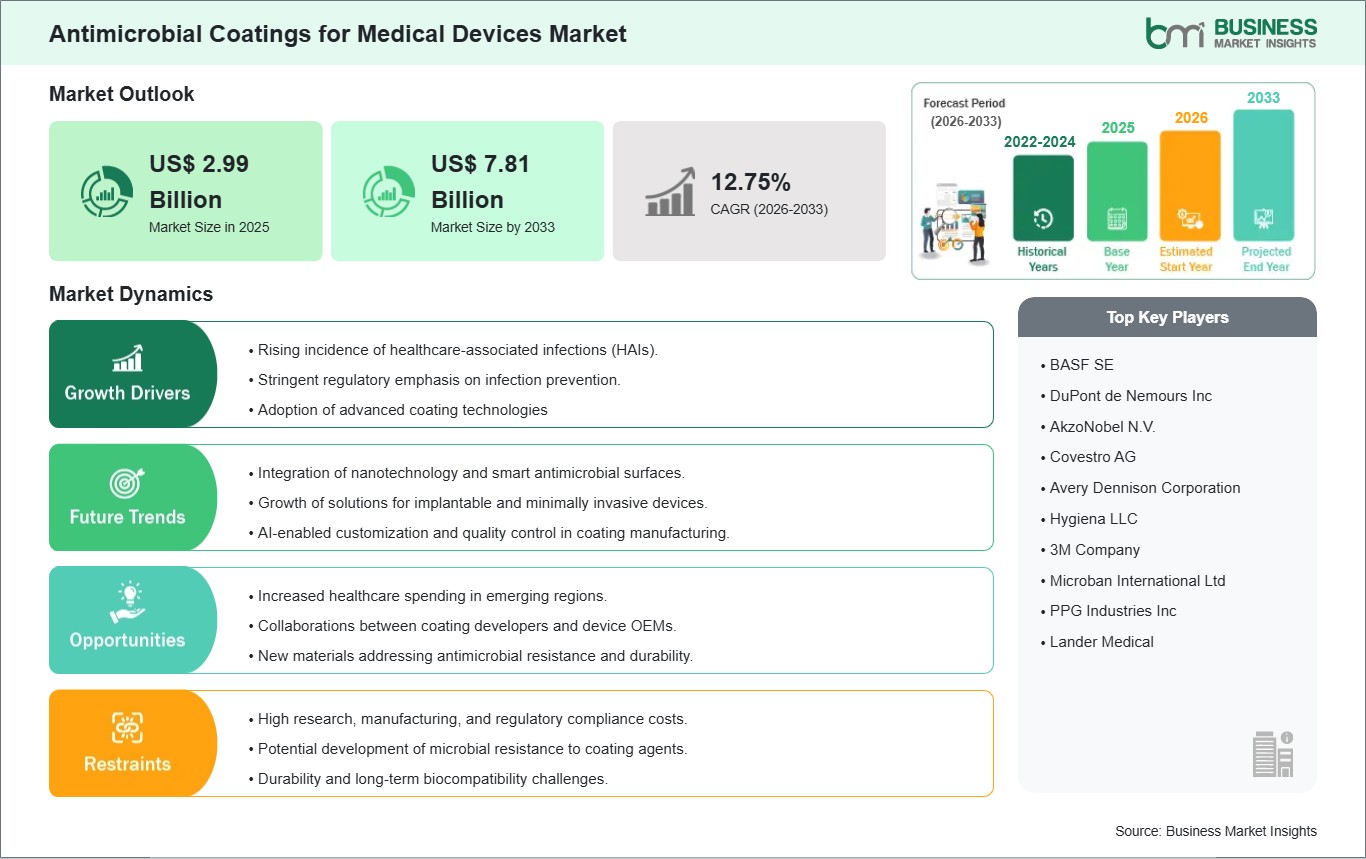
Antimicrobial coatings for medical devices operate as essential components of contemporary medical practice because they improve device security while decreasing the probability of medical procedure-related infections. The coatings function through their design specifications which prevent microbial organisms from developing on the surfaces of medical devices that hospitals use for catheters and implants and surgical tools and diagnostic instruments. Antimicrobial coatings help patients achieve better results because they stop biofilm development and bacterial growth which leads to more successful medical outcomes and longer device usage periods and decreased harm from medical equipment.
The global antimicrobial coatings for medical devices market are experiencing continuous expansion because of two main factors which include the growing rates of healthcare-associated infections and the rising demand for implantable medical devices and the stronger protection measures which healthcare facilities now implement. Hospitals and healthcare providers implement infection control measures to decrease treatment expenses and hospital stays and patient illness rates which creates additional support for the program.
The market encounters obstacles which arise from three main factors because it has strong growth potential: high expenses for product development and manufacturing and complex rules governing operations and the lower market penetration which exists in regions that focus on cost control. The projected period will experience substantial growth opportunities because the healthcare systems in emerging markets continue to build their infrastructures and people become more knowledgeable about infection control methods and researchers study new antimicrobial substances.
Segment Analysis
Antimicrobial Coatings for Medical Devices Market Segmentation
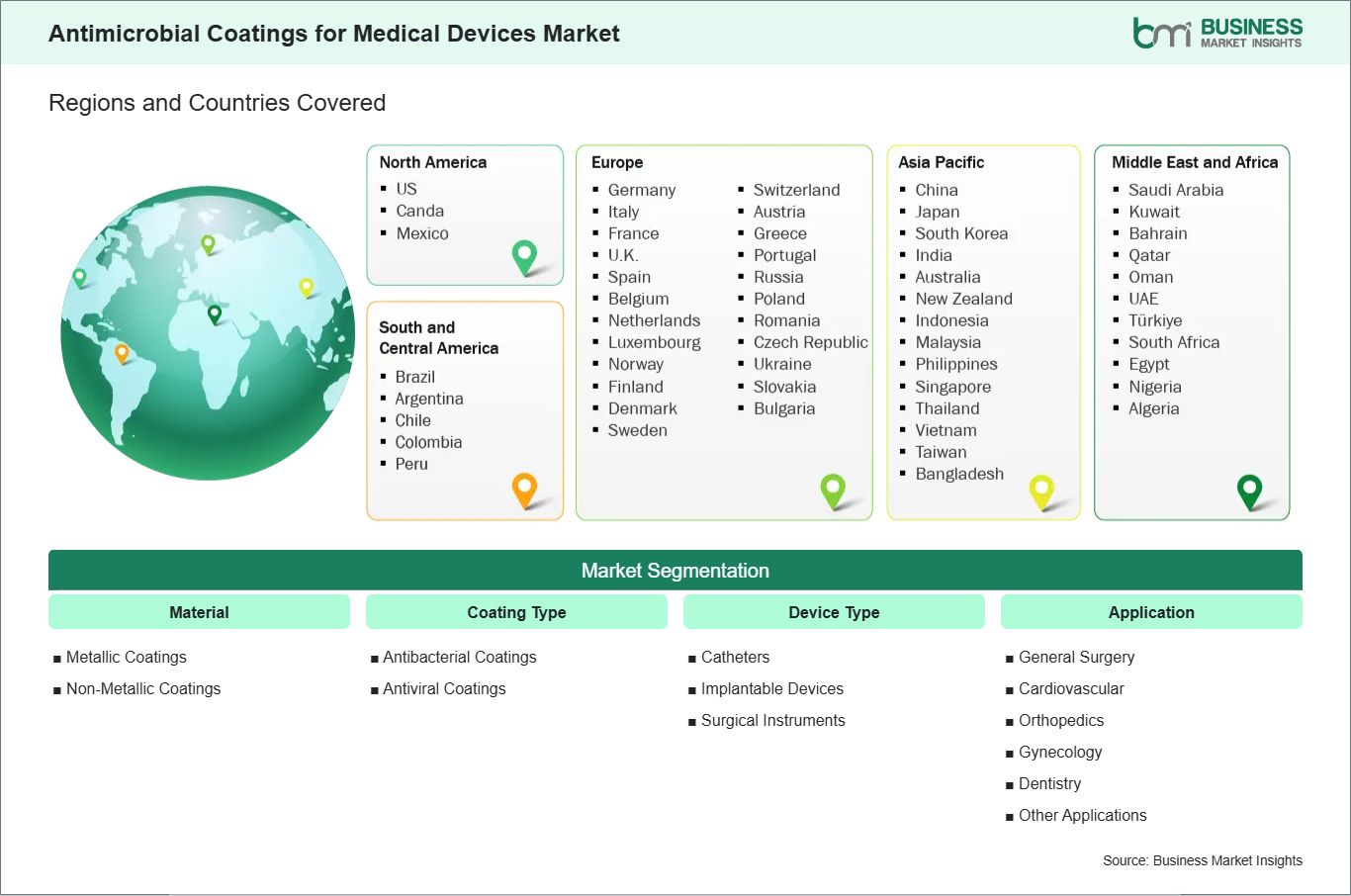
Key segments that contributed to the derivation of the antimicrobial coatings for medical devices market analysis are material, coating type, device type, and application.
- By material, the antimicrobial coatings for medical devices market are segmented into metallic coatings, non-metallic coatings. The metallic coatings segment dominated the market in 2025.
- By coating type, the market is segmented into antibacterial coatings, antiviral coatings. The antibacterial coatings segment held the largest market share in 2025.
- By device type, the antimicrobial coatings for medical devices market are segmented into catheters, implantable devices, surgical instruments. The implantable devices segment dominated the market in 2025.
- By application, the antimicrobial coatings for medical devices market are segmented into general surgery, cardiovascular, orthopedics, gynecology, dentistry, others. The cardiovascular segment dominated the market in 2025.
Market Forces
Antimicrobial Coatings for Medical Devices Market Drivers and Opportunities
Rising Incidence of Healthcare-Associated Infections (HAIs)
The antimicrobial coatings for medical devices market experiences substantial growth because healthcare systems worldwide face rising costs from healthcare-associated infections which create a worldwide medical crisis. HAIs results from medical devices becoming contaminated with harmful microorganisms which affect catheters and orthopedic implants and cardiovascular devices and surgical tools. The infections result in extended hospital admissions which drive up medical expenses and lead to higher antibiotic consumption and in extreme situations result in death.
Hospitals now require better methods to enhance patient safety while meeting new infection control standards which has resulted in more facilities using antimicrobial coatings to protect their patients. The coatings serve as an essential part of contemporary medical device design because they prevent bacterial growth and biofilm development on device surfaces which results in decreased infection rates and better clinical results and lower healthcare system expenses.
Technological Advancements and Expanding Medical Device Applications
The development of new antimicrobial coating materials has created new possibilities for their use in various medical devices. The durability and effectiveness of medical coatings have been improved through the development of silver-based coatings and antibiotic-eluting surfaces and polymer-based antimicrobial layers and nanotechnology solutions. Medical device manufacturers increasingly integrate these coatings to meet regulatory requirements and improve product performance.
The adoption of advanced coating technologies, including nanocoatings and multifunctional antimicrobial surfaces, is increasing as these technologies provide extended device protection which maintains operational efficiency. Manufacturing companies are expanding their product lines to new medical markets because clinical validation improves and research and development funding grow. The global market for antimicrobial coatings in medical devices will experience continuous growth because of rising healthcare costs and new infection prevention regulations.
Technological advancements have brought substantial enhancements to both coating safety and operational efficiency. Advanced antimicrobial coatings now deliver continuous resistance against microbial growth while improving biocompatibility and minimizing toxic effects. Antimicrobial coatings have become wide-ranging hospital and ambulatory surgical center and specialized care facility solutions because of these technological advancements.
Size and Share Analysis
Antimicrobial Coatings for Medical Devices Market Size and Share Analysis
By material, the antimicrobial coatings for medical devices market are segmented into metallic coatings, non-metallic coatings. The metallic coatings segment dominated the market in 2025. The combination of strong antimicrobial properties together with durable nature and extended performance period of metallic coatings results in their ability to drive business expansion. Silver and copper and zinc coatings have gained widespread acceptance because they provide broad-spectrum antimicrobial protection while maintaining thermal stability and enabling safe use with implantable medical devices in high-risk clinical settings.
By coating type, the market is segmented into antibacterial coatings, antiviral coatings. The antibacterial coatings segment held the largest market share in 2025. The antibacterial coatings segment expands because of increasing healthcare-related infections together with strict infection control requirements. Hospitals need these coatings because they stop bacterial growth and biofilm development on medical equipment. Technology has achieved widespread usage because it meets clinical requirements and regulatory standards across different medical devices.
By device type, the antimicrobial coatings for medical devices market are segmented into catheters, implantable devices, and surgical instruments. The implantable devices segment dominated the market in 2025. The increasing number of surgeries together with the growing elderly population and the rising rate of chronic illnesses drive the demand for implantable devices. Antimicrobial coatings help to decrease implant-related infections while producing better patient results and decreasing revision surgery requirements. The regulatory emphasis on device safety requirements drives the adoption of antimicrobial coatings for use in implantable medical devices.
By application, the antimicrobial coatings for medical devices market are segmented into general surgery, cardiovascular, orthopedics, gynecology, dentistry, and others. The cardiovascular segment dominated the market in 2025. The cardiovascular market expands because hospitals use catheters and stents and implants at high rates, which increases the probability of patient infections. The increasing rate of cardiovascular diseases together with more people receiving interventional treatments leads to higher market demand. Antimicrobial coatings improve device protection and decrease bloodstream infections while meeting strict clinical requirements in cardiovascular treatment environments.
Report Coverage
Antimicrobial Coatings for Medical Devices Market Report Coverage and Deliverables
The "Antimicrobial Coatings for Medical Devices Market Size and Forecast (2022&2033)" report provides a detailed analysis of the market covering below areas:
- Antimicrobial coatings for medical devices market size and forecast at global, regional, and country levels for all the key market segments covered under the scope
- Antimicrobial coatings for medical devices market trends, as well as market dynamics such as drivers, restraints, and key opportunities
- Antimicrobial coatings for medical devices market analysis covering key market trends, global and regional framework, major players, regulations, and recent market developments
- Industry landscape and competition analysis covering market concentration, heat map analysis, prominent players, and recent developments for the antimicrobial coatings for medical devices market
- Detailed company profiles, including SWOT analysis
Geographic Insights
Antimicrobial Coatings for Medical Devices Market Geographic Insights
The geographical scope of the Antimicrobial Coatings for Medical Devices market report is divided into five regions: North America, Asia Pacific, Europe, Middle East & Africa, and South & Central America. The antimicrobial coatings for medical devices market in Asia Pacific is expected to grow significantly during the forecast period.
The Asia-Pacific Antimicrobial Coatings for Medical Devices market is segmented into China, Japan, South Korea, India, Australia, New Zealand, Indonesia, Malaysia, the Philippines, Singapore, Thailand, Vietnam, Taiwan, Bangladesh, and the Rest of Asia. The market for Asia-Pacific antimicrobial coatings used in medical devices shows rapid expansion which results from increased healthcare funding and higher surgical activity and improved understanding of infection control methods. The market development receives additional support from better healthcare facilities that various countries in China, Japan, India, South Korea, and Australia are developing to meet rising demand for their cutting-edge medical equipment.
The three countries of China, Japan, and India provide excellent prospects for business expansion because they have large patient populations and their medical device manufacturing base is growing, while hospitals work to decrease infection rates. The region witnesses rising antimicrobial coating adoption because government programs that build healthcare capacity and establish better regulatory standards, and enhance patient protection, create a favorable environment for medical facilities.
The market demand has received a major boost through various technological breakthroughs, which brought forth both nanotechnology-based coatings and antiviral polymers to the market. The market shows continuous growth because of the increasing implementation of implantable devices and minimally invasive procedures which medical facilities use to expand their surgical capacity through new hospitals and surgical centers. The Asia-Pacific region is expected to remain the second-fastest-growing market for antimicrobial coatings for medical devices throughout the forecast period.
Industry Activity
Recent Developments
The Antimicrobial Coatings for Medical Devices market is evaluated by gathering qualitative and quantitative data post primary and secondary research, which includes important corporate publications, association data, and databases. A few of the key developments in the Antimicrobial Coatings for Medical Devices market are:
- In June 2024, Hydromer, Inc., a manufacturer of hydrophilic, thromboresistant, and antimicrobial coating technologies for medical devices, launched HydroThrombX, a next-generation version of the company's current legacy product F200t. F200t is a thromboresistant coating well-known for significantly reducing platelet adhesion and cell mitosis, aiding in the prevention of restenosis.
- In March 2023, AkzoNobel formed a strategic partnership with BioCote to expand the reach of their antimicrobial powder coatings under the brand, enabling application on a variety of internal surfaces including ceiling tiles, window frames, metal doors, metal office partitions, and elevator doors, strengthening the company position in the antimicrobial coatings market.
Trust & Transparency
Research Methodology
The market analysis combines proprietary research with secondary data from government agencies, company disclosures, regulatory filings, industry databases and expert interviews. Market estimates are validated through data triangulation, cross-market benchmarking and analyst
review.
View Full Research Methodology
Key Sources Referred:
World Bank - Global Trade Indicators American Medical Association (AMA) National Center for Biotechnology Information (NCBI) National Library of Medicine (NLM) Centers for Disease Control and Prevention (CDC) Company website National Institutes of Health (NIH) International Hospital Federation (IHF) Company annual reports Company investor presentations