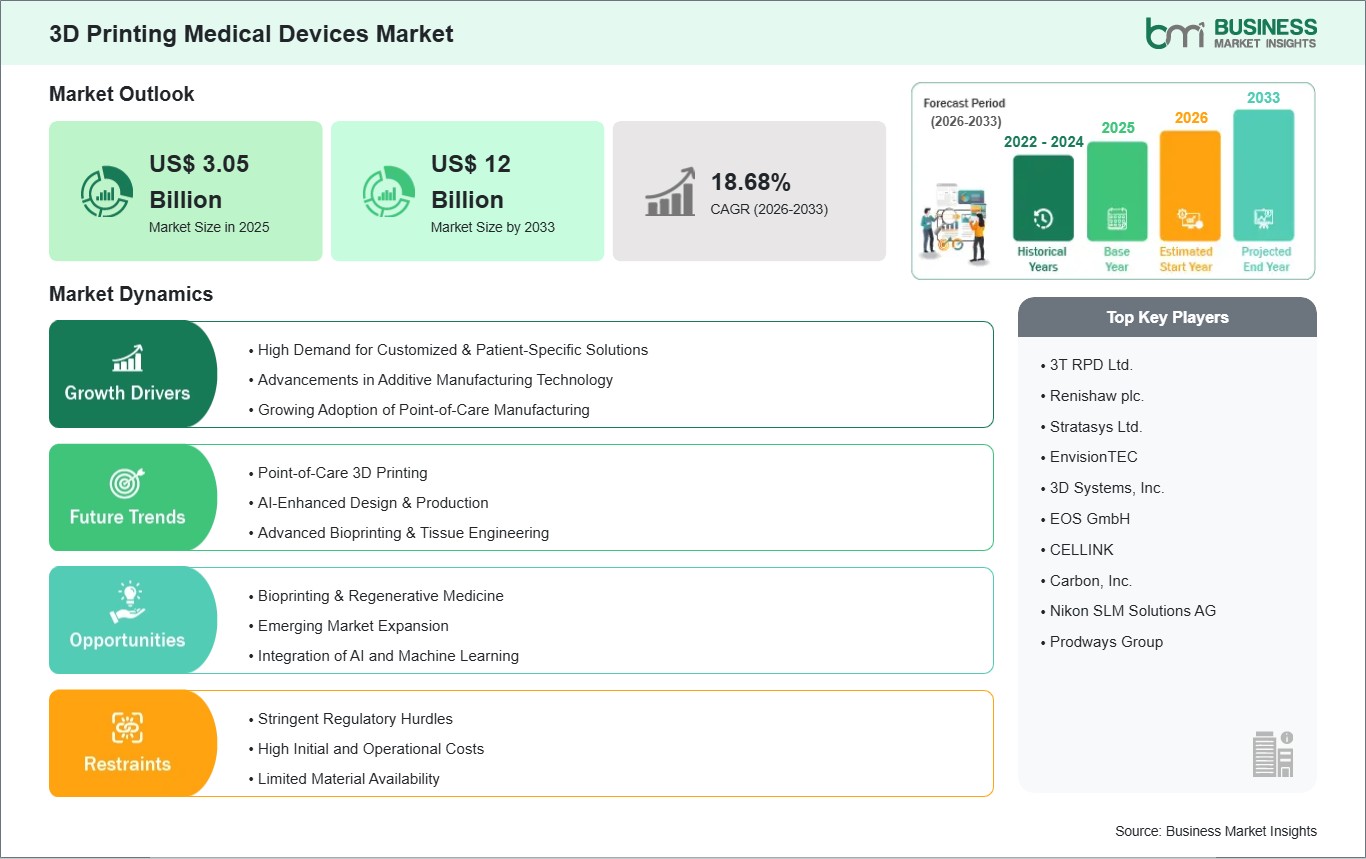
The 3D printing medical devices market size is expected to reach US$ 12.0 billion by 2033 from US$ 3.05 billion in 2025. The market is estimated to record a CAGR of 18.68% from 2026 to 2033.
3D printing of medical devices is the process of manufacturing medical instruments and equipment through 3D printing, also known as additive manufacturing. This method gradually constructs an object from a digital design by adding one layer at a time. The 3D printing medical device market is a part of the healthcare sector that encompasses the manufacturing and consumption of these devices.
The market growth is primarily influenced by the fact that one-off medical devices are designed for every individual patient based on their specific needs, and thus, still supports personalized healthcare, while also improving patient outcomes and satisfaction. 3D printing of medical devices also offers the advantage of being less expensive and faster than traditional methods in production; hence, it becomes a more attractive option for manufacturers. The use of biocompatible materials is a new development that broadens the application of 3D printing for producing medical tools. Along with these, better healthcare services, conducive regulations, and quicker prototyping are some other factors that are increasing the demand for 3D printing medical devices. The 3D printing of medical devices enables rapid prototyping and design changes, which can lead to a reduction in development time by weeks. This quicker method allows new devices to be launched in the market sooner, thus, invigorating the technology and giving patients faster access to state-of-the-art medical treatments.
However, the growth of the market is predicted to be restrained by issues regarding quality assurance and standardization, limitations in materials, and absence of qualified personnel and training. The inconsistency in quality and performance of 3D-printed medical devices is mainly due to the differences in materials used, printing techniques adopted, and types of equipment employed. The medical device sector necessitates that quality control and standardized protocols for 3D printing be established, thereby ensuring that the devices are not only safe for the patients but also reliable for their intended use. The absence of standardized procedures and quality control measures can be a major factor preventing the wide acceptance and use of 3D-printed medical devices.

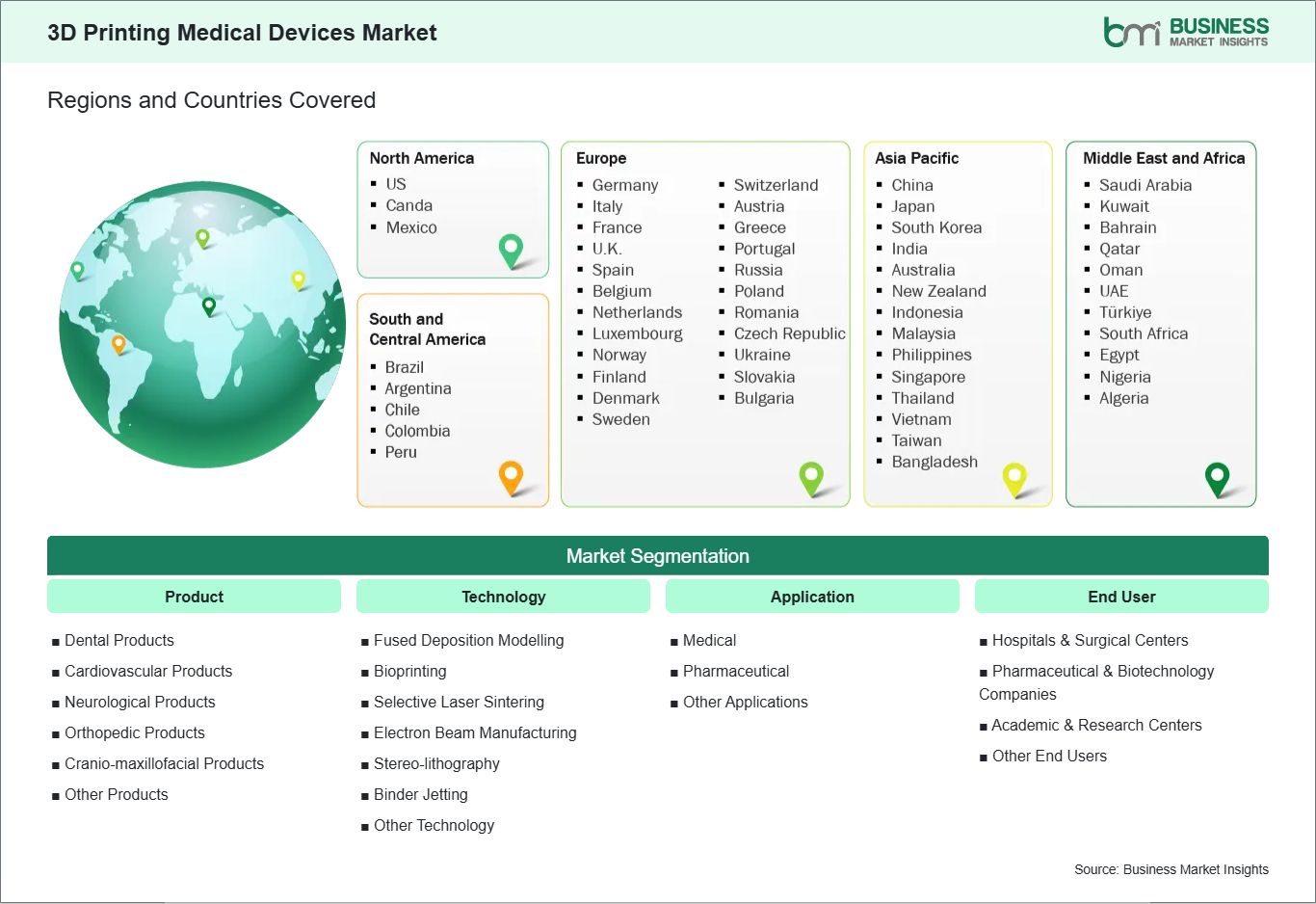
Key segments that contributed to the derivation of the 3D printing medical devices market analysis are product, technology, application, and end user.
The major factor driving the rapid expansion of the 3D printed medical device market is the growing demand for personalized and patient-specific solutions, resulting in a significant shift in how healthcare providers approach treatment and device fabrication. The use of standard medical devices that are not customized to the patient anatomy often results in poor fitting, which in turn leads to longer recovery times and an increased risk of complications. On the other hand, 3D printing technology enables the creation of implants, prostheses, surgical guides, and anatomical models that are perfectly tailored to an individual's unique physiological features by utilizing digital imaging data from CT or MRI scans. This feature yields tangible clinical and economic benefits, including reduced surgery time, improved outcomes, and more satisfied patients — some publications even indicating a 24% decline in complications and a recovery rate approximately 30% faster for personalized implants compared to standard devices.
The use in clinics is a testament to this demand: more than 65% of hospitals and clinics around the globe are utilizing 3D printing for individualized medical purposes, with customized implants and devices accounting for over 40% of all printed healthcare components. Joint replacements and implants in orthopedics, for instance, are made to measure the patient’s bone structure even more accurately thanks to 3D printing, which eventually leads to better surgical results and shorter recovery times. In the same way, 3D printing is applied in dental care to make personalized crowns, bridges, and dentures that offer a better fit than traditional methods, thus resulting in higher patient satisfaction.
Patient comfort is significantly improved by this level of customization, but the risk of complications is also greatly reduced, since the devices are created according to the patient’s medical needs. Besides, individualized medical devices allow the medical professionals to formulate more efficient treatment plans, thereby enhancing the overall healthcare. The progress in 3D printing technology has a significant impact on the healthcare practices through the continued ability to tailor medical devices.
The merging of digital imaging, sophisticated materials, and additive manufacturing not only shortens lead times and lowers inventory costs but also nurtures value-based care models that prioritize precision, effectiveness, and patient experience — thus, reinforcing the importance of customization in the widespread acceptance of 3D printing in orthopedic, dental, and reconstructive surgery.
The potential of bioprinting and regenerative medicine in the 3D printed medical device market is that it can completely transform how tissues and organs are repaired or replaced. Bioprinting, unlike regular 3D printing, enables the construction of living tissues one layer at a time using bio-inks composed of cells, biomaterials, and growth factors. This feature is the main reason for the production of not only patient-customized tissue scaffolds, skin grafts, bone constructs, and cartilage implants, but also of such biologically close structures as naturally occurring ones. The increasing load of chronic diseases, traumatic injuries, and aging-related degenerative conditions has pushed the demand for regenerative solutions that not only manage the symptoms but also restore lost function. Bioprinting addresses the significant drawbacks of traditional transplantation, such as donor shortages, immune rejection, and lengthy waiting periods, by enabling the manufacture of personalized and biologically compatible constructs.
Apart from its medical use, bioprinting also has significant potential in the fields of drug discovery and disease modeling, where printed tissues can mimic human physiology more closely than traditional cell cultures or animal models. This helps to enhance the efficiency of drug screening and, at the same time, to lower the risks of development. The continuous progress in the areas of bio-inks, stem-cell research, and printing precision is contributing to the widening of the clinical relevance of bioprinted products. Bioprinting is viewed as a high-impact opportunity that can lead to innovation, the creation of diverse product portfolios, and a rapid move towards regenerative and personalized medicine in the future, as regulatory standards become more stringent and inter-industry partnerships between medical device manufacturers, biotech companies, and research centers become increasingly stronger.

By product, the 3D printing medical devices market is bifurcated into dental products, cardiovascular products, neurological products, orthopedic products, cranio-maxillofacial products, other products. The orthopedic products segment dominated the market in 2025. The primary advantage of 3D printing is that it enables the design of implants tailored to each patient, which facilitates better bone healing and leads to improved functional outcomes. Orthopedic products made with 3D printing include implants, prostheses, surgical guides, and custom tools for joint replacements, bone fixation, spinal surgeries, and limb prosthetics.
By technology, the market is bifurcated into fused deposition modelling (FDM), bioprinting, selective laser sintering (SLS), electron beam manufacturing (EBM), stereo-lithography, binder jetting, other technology. The electron beam manufacturing (EBM) segment held the largest share of the market in 2025. EBM technology uses an electron beam to melt metal powders and build objects layer by layer. This method is reliable for making orthopedic implants and dental parts because it can create complex and porous structures.
By application, the market is segmented into medical, pharmaceutical, other applications. The medical segment held the largest share of the market in 2025. Medicine is a broad field with numerous applications for 3D printing, particularly in the creation of medical devices and parts. 3D printing is used to produce implants, prosthetics, surgical instruments, anatomical models, patient-specific guides, and orthotics. This technology offers customization, precision, and solutions tailored to each patient.
By end user, the market is segmented into hospitals & surgical centers, pharmaceutical & biotechnology companies, academic & research centers, other end users. The hospitals & surgical centers segment held the largest share of the market in 2025. Hospitals & surgical centers utilize 3D printing to create devices tailored specifically for their patients, including surgical guides, implants, and prosthetics. By creating custom medical devices, hospitals can enhance treatment outcomes and improve patient satisfaction. They also utilize 3D printing to create anatomical models for surgical planning, which aids in preoperative preparation and accuracy during surgery.
| Report Attribute | Details |
|---|---|
| Market size in 2025 | US$ 3.05 Billion |
| Market Size by 2033 | US$ 12 Billion |
| Global CAGR (2026 - 2033) | 18.68% |
| Historical Data | 2022 - 2024 |
| Forecast period | 2026-2033 |
| Segments Covered | By Product
|
| Regions and Countries Covered | North America
|
| Market leaders and key company profiles |
|
The "3D Printing Medical Devices Market Size and Forecast (2022–2033)" report provides a detailed analysis of the market covering below areas:
The geographical scope of the 3D printing medical devices market report is divided into five regions: North America, Asia Pacific, Europe, Middle East & Africa, and South & Central America. The 3D printing medical devices market in Asia Pacific is expected to grow significantly during the forecast period.
The Asia-Pacific 3D printing medical devices market is segmented into China, Japan, South Korea, India, Australia, and the rest of Asia. The Asia-Pacific area is the region that is growing the fastest; China, Japan, and India are examples of countries where 3D printing in healthcare has been facilitated more. The hasty improvement of healthcare infrastructure along with the growing concern over the production of medical devices are the main factors that have contributed to this region. China, more than any other country, is pouring a lot of money into the development of 3D printing techniques for medical use and thus, is taking a lead in the fields of bioprinting and personalized medical solutions.
The Asia-Pacific region is the most notable area in terms of the rapid growth of the healthcare sector, which is driven by an increase in population, rising healthcare spending, and the development of healthcare infrastructure. The aforementioned factors are all propitious for the introduction of 3D printing in medical devices, as healthcare professionals have already begun looking for the best possible ways to care for patients through the use of innovation.

The 3D printing medical devices market is evaluated by gathering qualitative and quantitative data post primary and secondary research, which includes important corporate publications, association data, and databases. A few of the key developments in the 3D printing medical devices market are:
The 3D Printing Medical Devices Market is valued at US$ 3.05 Billion in 2025, it is projected to reach US$ 12 Billion by 2033.
As per our report 3D Printing Medical Devices Market, the market size is valued at US$ 3.05 Billion in 2025, projecting it to reach US$ 12 Billion by 2033. This translates to a CAGR of approximately 18.68% during the forecast period.
The 3D Printing Medical Devices Market report typically cover these key segments-
The historic period, base year, and forecast period can vary slightly depending on the specific market research report. However, for the 3D Printing Medical Devices Market report:
The 3D Printing Medical Devices Market is populated by several key players, each contributing to its growth and innovation. Some of the major players include:
The 3D Printing Medical Devices Market report is valuable for diverse stakeholders, including:
Essentially, anyone involved in or considering involvement in the 3D Printing Medical Devices Market value chain can benefit from the information contained in a comprehensive market report.
Please tell us your area of interest
(Market Segments/ Regions and Countries/ Companies)