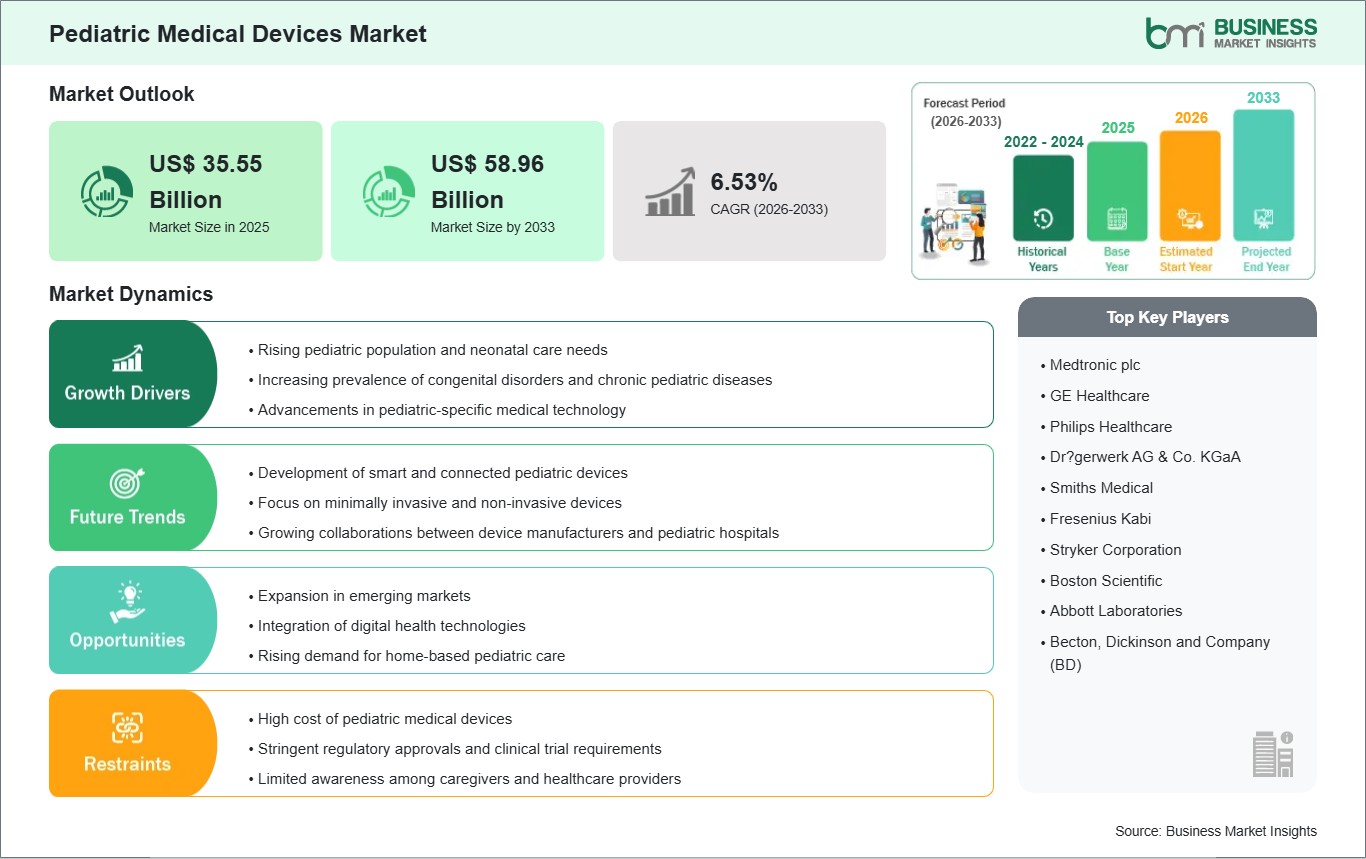
The Pediatric Medical Devices market size is expected to reach US$ 58.96 billion by 2033 from US$ 35.55 billion in 2024. The market is estimated to record a CAGR of 6.5% from 2025 to 2033.
The Global Children's Medical Devices market is growing consistently due to an increase in the focus on child health, the increase in the incidence of childhood disease and an increase in awareness of the need for specially designed medical equipment for children and infants. There are many types of Medical Devices available to be used in children, these include: neonatal oxygen devices; infusion pumps; Patient Monitoring devices as well as diagnostic tools; Surgical Instruments and Feeding Tubes which have been specifically developed for the anatomical and physiological characteristics of a child. Advances made through technological developments and developments such as miniaturised medical devices and non-invasive monitoring systems have increased the ability to provide greater safety; greater accuracy; easier use, therefore leading to wider use of these Medical Devices in hospitals, clinics and homes. The growth of congenital defects, cardiovascular disease, respiratory disease and infectious disease in children increases the demand for these Medical Devices. As well, Government support, Enhanced Health Systems; and increased funding by Private Companies towards Pediatric Health will contribute to rapid market growth in Developed and Emerging Market regions.
North America and Europe continue to be dominant regions due to established healthcare systems, regulatory frameworks, and awareness amongst families about the importance of pediatric medical solutions, while Asia Pacific and Latin America are growing rapidly because of increased investment in pediatric healthcare facilities and an increase in total healthcare expenditures. The outlook for all regions is positive as a result of ongoing technological improvements combined with rising demand for child-specific products and services driving worldwide growth.

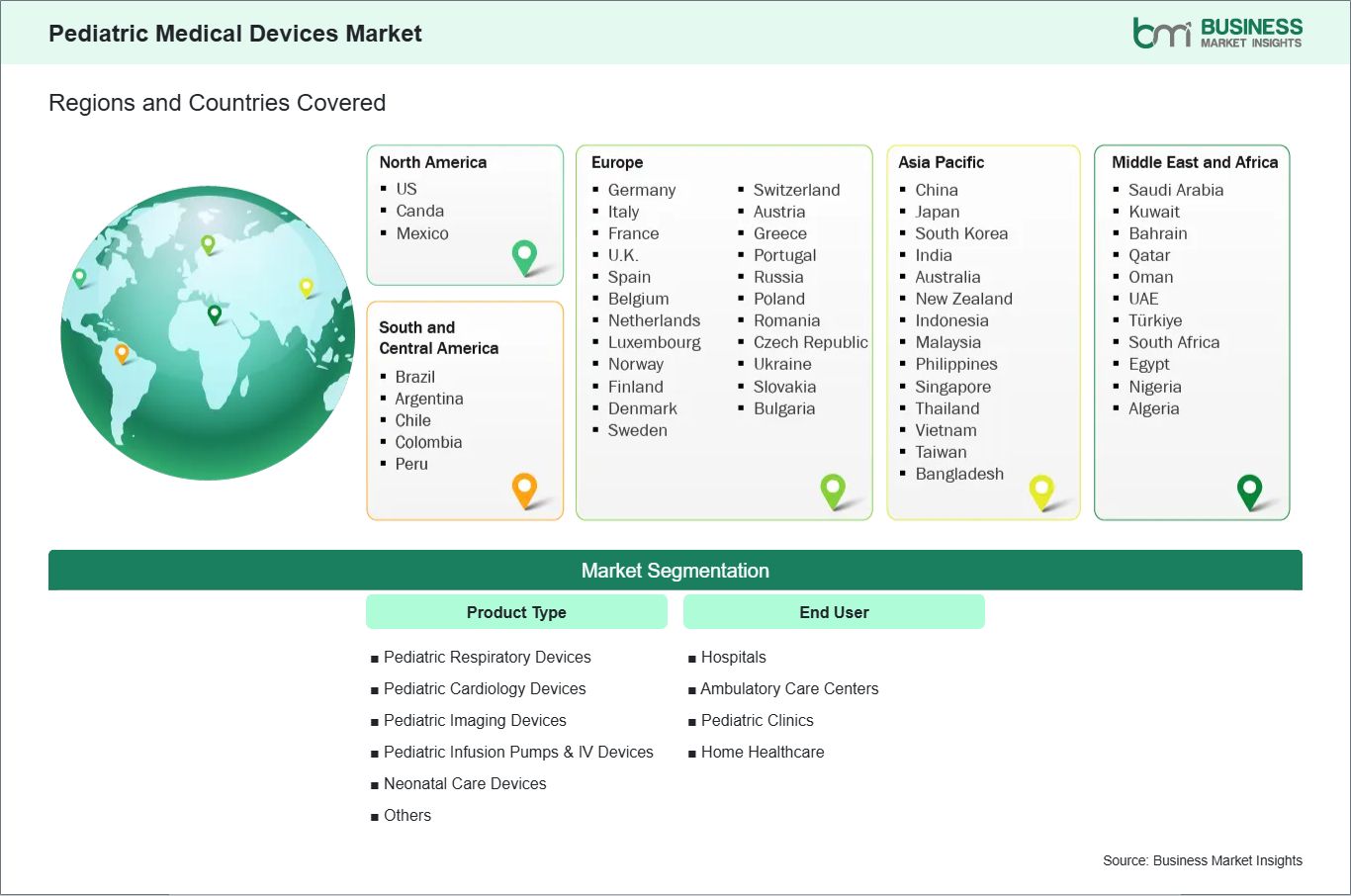
Key segments that contributed to the derivation of the Pediatric Medical Devices market analysis are product type, and end user.
The Pediatric Device Market is driven primarily by the increasing number of pediatric diseases and chronic conditions worldwide. These diseases, such as congenital heart defects, respiratory disease, neonatal problems, infectious diseases, and pediatric cancer, require a specialized approach with medical intervention and ongoing monitoring. Early detection and treatment, as well as continuous monitoring, are key to improving survival rates and long-term health of children, thus fueling a growing need for pediatric-specific products and services. Hospitals and clinics have begun to utilize equipment specifically designed for pediatric populations, such as neonatal ventilators, infusion pumps, patient monitoring systems, diagnostic tools, etc. Since these instruments were developed to address the unique anatomical and physiological needs of infants and children, it is an essential element of their care and treatment plan. Advances in technology, such as miniaturized, non-invasive, and smart monitoring devices, have improved the precision, safety, and efficacy of pediatric care, making these devices an integral part of the care provided to NICU and Pediatric Ward patients. This increased awareness of the need for age-appropriate medical devices continues to promote growth in this market. In addition, as child health outcomes continue to be a strong global focus and as Pediatric Health Infrastructure continues to expand, growth in this sector will remain consistent.
A significant opportunity exists for pediatric medical device manufacturers to capitalize on two key trends shaping the pediatric medical device market: the growth of healthcare service delivery in emerging markets, and the growing adoption of homecare solutions for pediatric patients. Asia-Pacific, Latin America and the Middle East are all experiencing increases in healthcare spending; improvements in infrastructure to support pediatric healthcare; and increased awareness of the need for child-specific medical devices, however, market penetration remains lower than developed markets. This represents a large untapped market for manufacturers who can provide low-cost, high-reliability, and easy-to-use pediatric devices specifically designed to meet the needs of these regions. The increasing adoption of homecare environments for pediatric patients needing long-term care such as children with chronic respiratory illnesses, diabetes or post-surgical care is a further indication of the opportunity that exists in the pediatric medical device market, as the availability of portable, user-friendly devices such as infusion pumps, nebulisers, patient monitors and wearables gives caregivers the ability to provide ongoing care to their patients at home while reducing the need to make repeated hospital visits and decreasing overall healthcare costs associated with the management of these patients. The ability to monitor patients through telehealth and connected healthcare platforms provides an additional benefit to caregivers in homecare environments by enabling them to easily monitor, collect data and intervene when necessary. Manufacturers of cost-effective, technologically advanced and region-specific pediatric medical devices can take advantage of this growing need and expand their footprint globally while simultaneously increasing access to much-needed children’s healthcare services in both clinical and at-home environments.
By product type, the pediatric medical devices market is segmented into pediatric respiratory devices, pediatric cardiology devices, pediatric imaging devices, pediatric infusion pumps & IV devices, neonatal care devices, others. The neonatal care devices segment dominated the market in 2024. The rising prevalence of premature births, low birth weight infants, and neonatal complications has fueled the demand for neonatal care devices.
By end user, the market is segmented hospitals, ambulatory care centers, pediatric clinics, home healthcare. The hospitals segment held the largest share of the market in 2024. The expansion in hospital, based usage is a result of various factors such as a high number of patients, rising incidence of pediatric diseases, availability of skilled healthcare professionals, and improved hospital infrastructure, which have allowed hospitals to seamlessly incorporate specialized pediatric medical devices in their routine care.
| Report Attribute | Details |
|---|---|
| Market size in 2025 | US$ 35.55 Billion |
| Market Size by 2033 | US$ 58.96 Billion |
| Global CAGR (2026 - 2033) | 6.53% |
| Historical Data | 2022 - 2024 |
| Forecast period | 2026-2033 |
| Segments Covered | By Product Type
|
| Regions and Countries Covered | North America
|
| Market leaders and key company profiles |
|
The "Pediatric Medical Devices Market Size and Forecast (2022–2033)" report provides a detailed analysis of the market covering below areas:
The geographical scope of the Pediatric Medical Devices market report is divided into five regions: North America, Asia Pacific, Europe, Middle East and Africa, and South and Central America. The Pediatric Medical Devices market in Asia Pacific is expected to grow significantly during the forecast period.
The Asia-Pacific Pediatric Medical Devices market is segmented into China, Japan, South Korea, India, Australia, New Zealand, Indonesia, Malaysia, the Philippines, Singapore, Thailand, Vietnam, Taiwan, Bangladesh, and the Rest of Asia The Asia Pacific region has seen rapid growth for pediatric medical devices due to an increase in medical spending, an increase in the healthcare for children, and an increase in the number of children. In particular, China, India, Japan, South Korea, and Australia are becoming important players in this industry with improvements in facilities and child healthcare services. An increase in congenital issues, newborn issues, cardiovascular and respiratory diseases, and infectious diseases has created an increased need for neonatal ventilators, infusion pumps, monitoring equipment, and diagnostic instruments that are designed specifically for children. Government initiatives have helped improve child health through increased immunization coverage, providing better access to child health services, and creating awareness of the need for early detection and treatment. As well, increased awareness by caregivers and healthcare providers about the types of medical devices available has led to increased use of them within both hospital and home care systems. Advances in technology have created better quality products, such as smaller, lightweight, and more efficient devices used in pediatrics, thus making it safer to use, more accurate, and easier to use in more places including urban and semi-urban areas. Additionally, with increased disposable income, improved healthcare systems, and an increased awareness on child-centered care has resulted in a significantly rapid expansion of the market for pediatric medical devices in Asia-Pacific.

The Pediatric Medical Devices market is evaluated by gathering qualitative and quantitative data post primary and secondary research, which includes important corporate publications, association data, and databases. A few of the key developments in the pediatric medical devices market are:
The Pediatric Medical Devices Market is valued at US$ 35.55 Billion in 2025, it is projected to reach US$ 58.96 Billion by 2033.
As per our report Pediatric Medical Devices Market, the market size is valued at US$ 35.55 Billion in 2025, projecting it to reach US$ 58.96 Billion by 2033. This translates to a CAGR of approximately 6.53% during the forecast period.
The Pediatric Medical Devices Market report typically cover these key segments-
The historic period, base year, and forecast period can vary slightly depending on the specific market research report. However, for the Pediatric Medical Devices Market report:
The Pediatric Medical Devices Market is populated by several key players, each contributing to its growth and innovation. Some of the major players include:
The Pediatric Medical Devices Market report is valuable for diverse stakeholders, including:
Essentially, anyone involved in or considering involvement in the Pediatric Medical Devices Market value chain can benefit from the information contained in a comprehensive market report.
Please tell us your area of interest
(Market Segments/ Regions and Countries/ Companies)