Market Summary
Executive Summary and Global Market Analysis
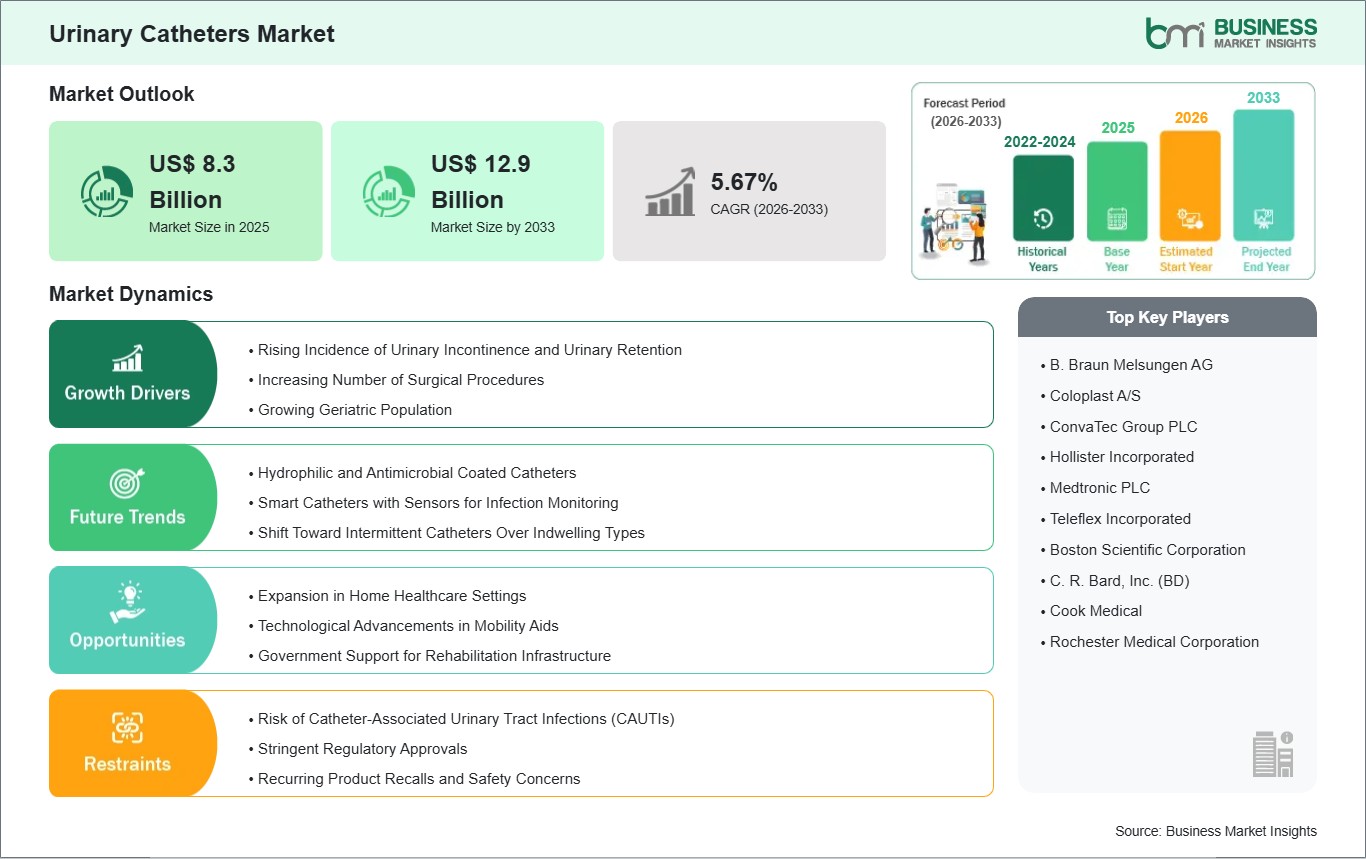
A urinary catheter is a flexible tube inserted through the urethra or a surgical opening into the bladder to drain urine when natural voiding is impaired. These devices are utilized for patients experiencing urinary retention, incontinence, or those undergoing surgical procedures requiring precise fluid monitoring. The urinary catheter market is an essential sector of the urological medical device industry, providing strategic value through the management of bladder dysfunction across hospitals, long-term care facilities, and home healthcare settings. Market expansion is primarily attributed to the global rise in the geriatric population, who are increasingly prone to age-related conditions such as benign prostatic hyperplasia (BPH) and urinary incontinence. Furthermore, the shift toward minimally invasive surgical procedures and the growing adoption of self-catheterization for chronic conditions like spinal cord injuries are significantly increasing the demand for portable, user-friendly intermittent systems.
However, several factors can restrain market growth. The high incidence of catheter-associated urinary tract infections (CAUTIs) remains a major clinical challenge, often leading to increased hospital stays and higher treatment costs. Pain and urethral trauma associated with repeated insertion can also limit patient compliance and lead to the seeking of non-catheter alternatives. Additionally, the industry faces constraints due to stringent regulatory standards for material safety and the pressure to reduce medical waste, which challenges the widespread use of traditional single-use plastic components.
Despite these hurdles, the market holds immense opportunities in the development of smart catheters equipped with sensors for real-time monitoring of urine output and infection markers. The rise of specialized female external catheters and the expansion of reimbursement coverage for advanced coatings in emerging economies are expected to support long-term development within the sector.
Segment Analysis
Urinary Catheters Market Segmentation
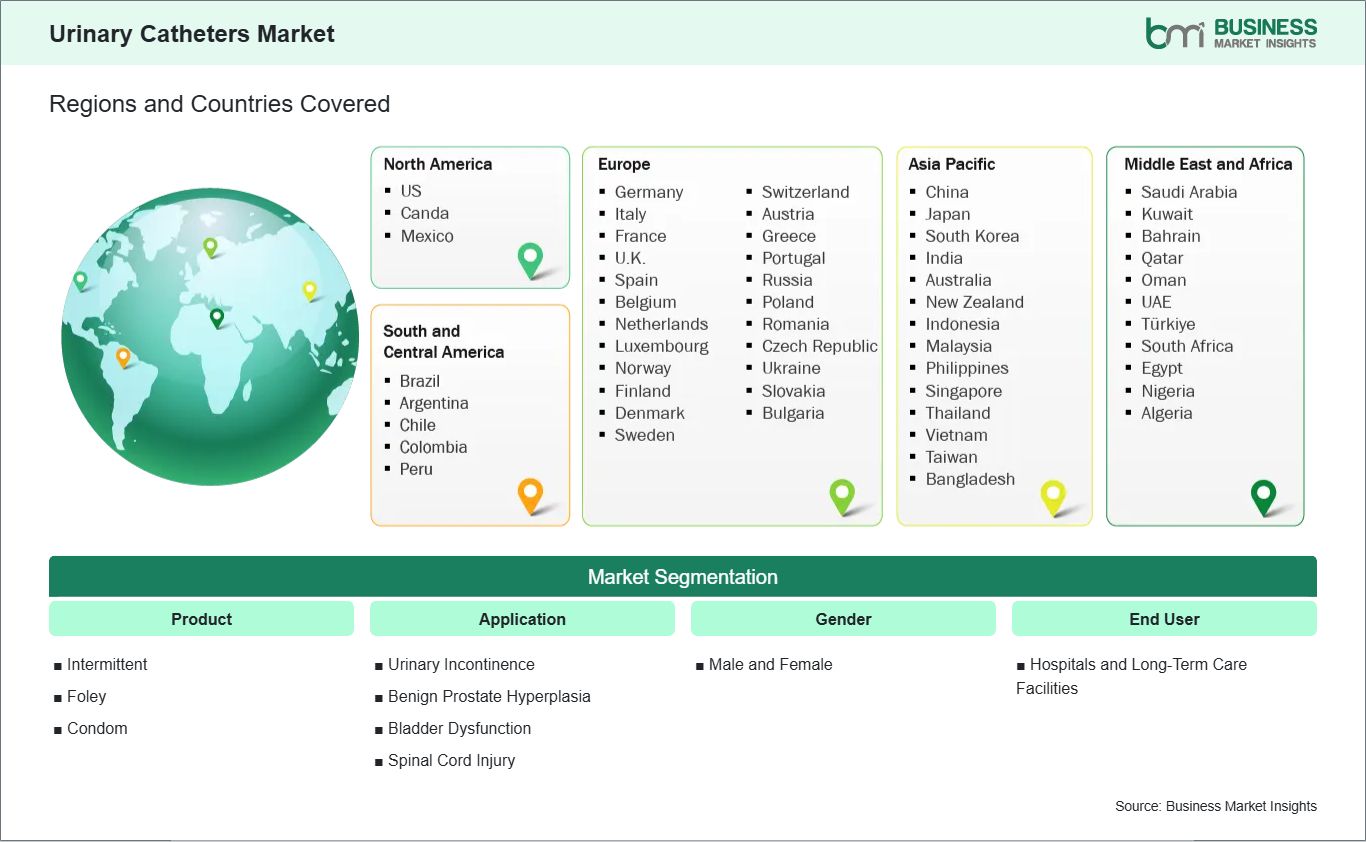
Key segments that contributed to the derivation of the Urinary Catheters market analysis are product, application, gender, and end user.
- By Product, the market is segmented into Intermittent, Foley, and Condom.
- By Application, the market is divided into Urinary Incontinence, Benign Prostate Hyperplasia, Bladder Dysfunction, and Spinal Cord Injury.
- By Gender, the market is segmented into Male and Female.
- By End User, the market is categorized into Hospitals and Long-Term Care Facilities.
Market Forces
Urinary Catheters Market Drivers and Opportunities
Demographic Shifts and the Mainstreaming of Antimicrobial Coatings
The primary driver for the Urinary Catheters Market is the systemic global increase in chronic urological conditions necessitated by an aging population. The Rising Prevalence of Urinary Incontinence and Benign Prostatic Hyperplasia (BPH) acts as a foundational catalyst, as these conditions, along with neurological disorders such as multiple sclerosis and spinal cord injuries, create a sustained, non-discretionary demand for long-term drainage solutions. This momentum is further propelled by the Growing Clinical Mandate for Infection-Resistant Technologies; healthcare facilities are increasingly prioritizing antimicrobial-coated and silver-alloy catheters to reduce the high morbidity and financial burden associated with hospital-acquired infections.
In the technology sphere, the Advancement in Hydrophilic and Lubricious Coatings serves as a critical driver, significantly enhancing patient comfort and reducing the risk of urethral trauma during insertion. Furthermore, Favorable Reimbursement Frameworks and Homecare Support Programs are encouraging the adoption of high-quality, single-use intermittent catheters, which are recognized for their superior safety profile compared to permanent indwelling systems. Together, these factors, demographic aging, infection control priorities, and material innovation, ensure a highly resilient growth path for the global urological supply chain.
AI-Integrated Smart Fixation and Female-Centric Innovation
A significant high-value opportunity lies in the convergence of Urinary Catheters with Smart Monitoring and Securement Systems. Next-generation smart fixation devices are being developed to prevent accidental extractions and monitor for early signs of blockage or infection through integrated sensors, providing real-time alerts to caregivers. There is also a major growth frontier in the development of Advanced External Catheter Solutions for Women; while male external options are well-established, the emerging market for non-invasive, suction-based female external systems offers a lucrative alternative to traditional indwelling devices, significantly improving patient dignity and skin integrity.
Furthermore, the expansion of Sustainable and Biodegradable Catheter Materials presents a unique opportunity, as manufacturers look to align with global environmental goals by developing high-performance, eco-friendly medical polymers that reduce plastic waste. Beyond the device itself, the rise of Digital Self-Care and Tele-Urology Platforms offers a significant frontier, where manufacturers can provide integrated apps that help patients track their catheterization schedules and share diagnostic data with their physicians. Manufacturers who focus on Ultra-Compact Pocket-Sized Intermittent Kits and those pioneering 3D-Printed Anatomically Optimized Tips are positioned to lead the most innovative and high-margin segments of the global urinary catheters market.
Size and Share Analysis
Urinary Catheters Market Size and Share Analysis
The Urinary Catheters market demonstrates steady growth, with size and share analysis revealing evolving trends and competitive positioning among key players. The report examines subsegments categorized within product, application, gender, and end user, offering insights into their contribution to overall market performance.
Based on product, the Intermittent, Foley (Indwelling), and Condom (External) catheters subsegment holds the primary market presence, representing a spectrum of invasiveness and user control. Intermittent Catheters are indispensable for the market, favored for their ability to provide high patient mobility and a significantly lower risk of catheter-associated urinary tract infections compared to permanent models. A notable trend is the surge in the Coated Intermittent and External subsegments, which are registering a higher pace of adoption. Hydrophilic-coated Intermittent Catheters are becoming essential for Neurogenic Bladder Management, as they eliminate the need for manual lubrication and reduce urethral trauma, while External Condom Catheters are being increasingly utilized for male patients with cognitive impairments to avoid the risks associated with internal insertion.
Report Coverage
Urinary Catheters Market Report Coverage and Deliverables
The "Urinary Catheters Market Size and Forecast (2022–2033)" report provides a detailed analysis of the market covering below areas:
- Urinary Catheters market size and forecast at global, regional, and country levels for all market segments covered under the scope
- Urinary Catheters market trends, as well as drivers, restraints, and opportunities
- Urinary Catheters market analysis covering key trends, global and regional framework, major players, regulations, and recent developments
- Industry landscape and competition analysis covering market concentration, heat map analysis, prominent players, and recent developments for the Urinary Catheters market
- Detailed company profiles, including SWOT analysis
Geographic Insights
Urinary Catheters Market Geographic Insights
The geographical scope of the Urinary Catheters market report is divided into five regions: North America, Asia Pacific, Europe, Middle East & Africa, and South & Central America.
North America currently maintains the largest revenue share, supported by a sophisticated healthcare system, favorable reimbursement frameworks, and a high prevalence of urological conditions like Benign Prostatic Hyperplasia (BPH). Europe represents a mature market with a strong emphasis on clinical safety and the early adoption of advanced antimicrobial coatings to reduce the high economic burden of catheter-associated urinary tract infections (CAUTIs). Asia Pacific is identified as the most rapidly growing region, fueled by an expanding geriatric population in China and Japan, alongside massive investments in healthcare infrastructure across emerging economies.
The Asia-Pacific Urinary Catheters Market is segmented into China, Japan, South Korea, India, Australia, and the Rest of Asia Pacific. China is a primary driver of regional volume due to increasing awareness of urinary health and a transition toward modernized surgical care. Japan continues to lead in the integration of high-technology solutions, particularly for elderly-specific urology care, while India is seeing significant growth in the adoption of intermittent and external catheters as home healthcare and self-catheterization become more mainstream.
Industry Activity
Recent Developments
The Urinary Catheters market is evaluated by gathering qualitative and quantitative data post primary and secondary research, which includes important corporate publications, association data, and databases. A few of the key developments in the Urinary Catheters market are:
- In November 2025, BD expanded its PureWick™ portfolio with the first-of-its-kind Portable Collection System for urinary incontinence, offering mobility, comfort, and independence for users. The device builds on the trusted PureWick™ external catheter technology, already adopted by over 4,500 U.S. hospitals, and strengthens the urinary catheters market with a novel, patient-centric solution.
- In April 2024, Medline expanded its catheter portfolio with theQiVi® MEC male external urine management device, designed to reduce CAUTIs and incontinence-associated dermatitis (IAD). The device uses suction to divert urine in real time, keeps skin dry, provides a universal fit with skin-friendly adhesive, and enhances both patient comfort and clinician ease of use. This strengthens Medline`s urology and urinary catheter offerings in acute care settings.
Trust & Transparency
Research Methodology
The market analysis combines proprietary research with secondary data from government agencies, company disclosures, regulatory filings, industry databases and expert interviews. Market estimates are validated through data triangulation, cross-market benchmarking and analyst
review.
View Full Research Methodology
Key Sources Referred:
World Bank – Global Trade Indicators World Trade Organization (WTO) (International Monetary Fund )IMF International Trade Administration (ITA) Company website Company annual reports Company investor presentations