
Cardiac Rhythm Management (CRM) Devices Market Outlook: Size, Share, Trends, Growth Analysis, Competitive Landscape & Forecast, 2026-2033

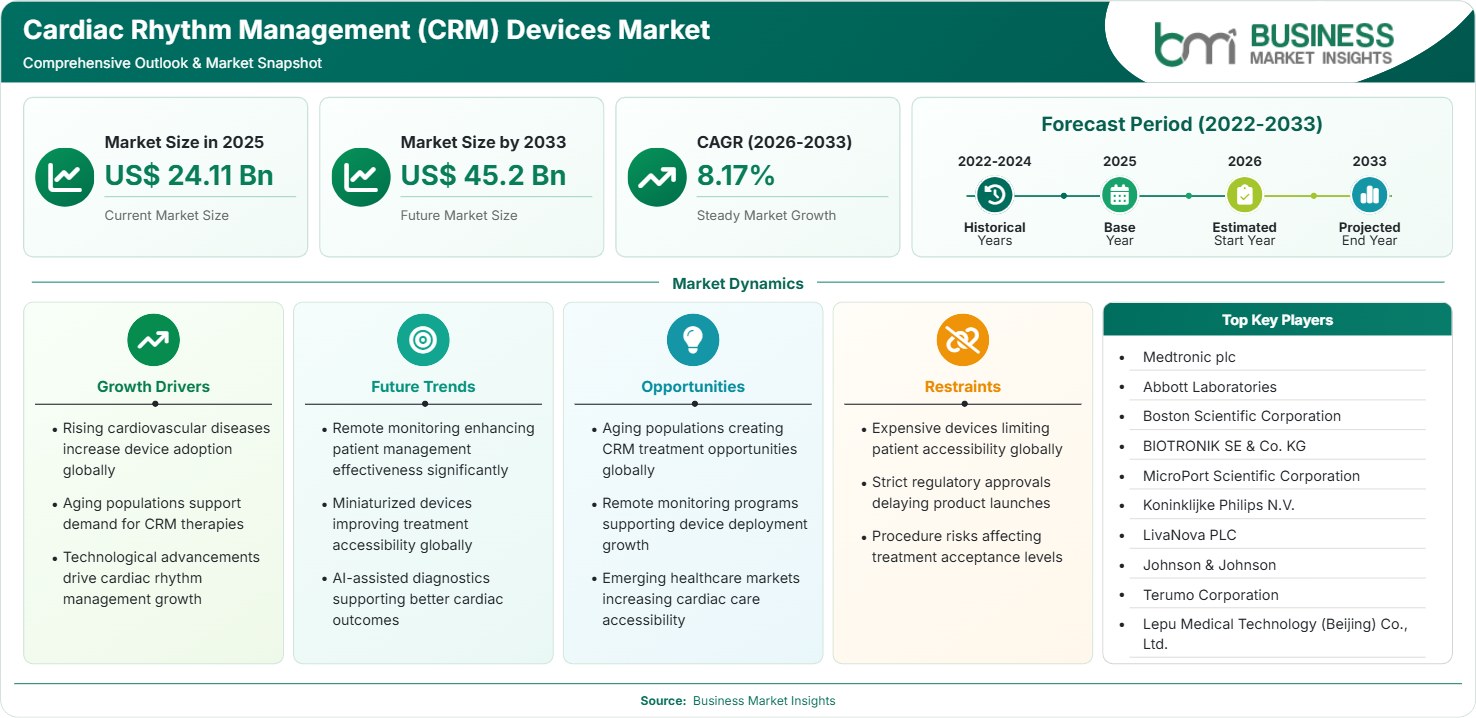
The Cardiac Rhythm Management (CRM) Devices Market size was valued at US$ 24.11 Billion in 2025 and is projected to reach US$ 45.2 Billion by 2033, growing at a CAGR of 8.17% during 2026–2033, driven by cardiovascular disease burden, aging populations, leadless pacing, remote monitoring, and expanding electrophysiology infrastructure.

Report Coverage
  • Product: Cardiac Pacemakers, Defibrillators, Cardiac Resynchronization Therapy Devices
  • End User: Hospitals & Clinics, Ambulatory Surgery Centers
US$ 24.11 Bn Market size in 2025
US$ 45.2 Bn Market Size by 2033
8.17% CAGR, 2026 - 2033
2026-2033 Forecast Period

AI Overview

Cardiac Rhythm Management (CRM) Devices Market Summary

  • North America Region: holds Cardiac Rhythm Management Devices Market share of 40%–43% in 2025, growing with a CAGR of 7%–8%, influenced by replacement demand, sophisticated electrophysiology infrastructure, remote monitoring adoption, and reimbursement-supported device upgrades. The US market advances through established implant volumes, replacement procedures, premium device adoption, and remote follow-up infrastructure, with a 7%–8% CAGR during 2026–2033.
  • Fastest Growing Region: Asia Pacific holds a market share of 21%–24% in 2025, growing with a CAGR of 9%–10%, supported by aging populations, expanding tertiary hospitals, improving specialist availability, rising diagnosis rates, local manufacturing, and wider access to implantable cardiac technologies.
  • Leading Segment: Cardiac Pacemakers hold a market share of 43%–47% in 2025, growing with a CAGR of 7%–8%, supported by bradycardia treatment demand, replacement procedures, longer battery life, MRI-compatible systems, conduction-system pacing, and expanding leadless technology adoption.
  • High Growth Segment: Cardiac Resynchronization Therapy Devices hold Cardiac Rhythm Management Devices Market share of 14%–18% in 2025, growing with a CAGR of 9%–10%, supported by heart-failure management, physiologic pacing, improved patient selection, remote optimization, and technological advances in biventricular and conduction-system approaches.
  • Key Market Opportunity: Leadless pacing, AI-enabled diagnostics, remote patient management, conduction-system pacing, and emerging-market electrophysiology capacity create opportunities for differentiated devices, recurring digital services, clinical partnerships, and localized manufacturing.
  • Major Market Players: Medtronic plc; Abbott Laboratories; Boston Scientific Corporation; BIOTRONIK SE & Co. KG; MicroPort Scientific Corporation; Koninklijke Philips N.V.; LivaNova PLC; Johnson & Johnson; Terumo Corporation; Lepu Medical Technology (Beijing) Co., Ltd.
Strategic Insights

Cardiac Rhythm Management (CRM) Devices Market: Strategic Insights

Cardiac Rhythm Management (CRM) Devices Market Strategic Framework
FREE PDF
Request your free sample
Request free sample
Stakeholder View

Key Takeaways

  • The value chain is moving from standalone implantable hardware toward integrated therapy ecosystems combining generators, leads, programmers, remote monitoring platforms, diagnostics, software, clinical support, and data services. Suppliers with broad portfolios can capture more of the patient-management pathway.
  • Growth opportunities are concentrated in leadless pacemakers, conduction-system pacing, CRT optimization, and connected follow-up solutions. These technologies address procedural efficiency, device longevity, physiological synchronization, and post-implant monitoring rather than relying solely on higher procedure volumes.
  • Product innovation is increasingly focused on miniaturization, battery longevity, lead avoidance, wireless communication, sensing algorithms, and individualized therapy. Abbott’s AVEIR DR launch in India illustrates how dual-chamber leadless pacing is moving toward broader commercial adoption.
  • Asia Pacific provides a distinct expansion pathway because China and India combine large patient pools with expanding cardiac centers, while Japan, South Korea, and Australia provide mature premium-technology markets. Regional investment must therefore balance volume opportunities with reimbursement and procurement conditions.
  • Strategic investment is increasingly directed toward complementary electrophysiology capabilities, digital monitoring, mapping, ablation, and adjacent cardiovascular technologies. Portfolio breadth can improve cross-selling and strengthen hospital relationships, while targeted acquisitions can accelerate entry into specialized technology categories.
Geographic Outlook

Cardiac Rhythm Management (CRM) Devices Market Regional Highlights

North America Cardiac Rhythm Management Devices Market

North America held 40%–43% share in 2025 and is projected to register a 7%–8% CAGR during 2026–2033. Demand benefits from replacement cycles, advanced electrophysiology services, established reimbursement, remote monitoring, and broad physician familiarity with implantable technologies. The US Cardiac Rhythm Management Devices Market represents the principal regional revenue pool because of procedure density and premium technology adoption. Canada contributes through specialized cardiac centers and publicly funded healthcare, although procurement discipline remains important for suppliers seeking wider institutional penetration.

  • Hospitals increasingly evaluate devices through total episode economics, balancing acquisition costs against longevity, follow-up requirements, complications, and readmission implications.
  • Remote monitoring supports earlier identification of rhythm events and device issues, strengthening recurring digital-service opportunities around implanted hardware and physician workflows.
  • Leadless pacing is gaining strategic importance as suppliers emphasize reduced hardware exposure, implantation flexibility, battery longevity, and patient-specific pacing strategies.
  • Replacement demand remains commercially relevant because established installed bases create recurring opportunities for generators, leads, upgrades, programming services, and associated clinical support.

US Cardiac Rhythm Management Devices Market

The US accounted for 82%–85% of the North American share in 2025 and is projected to expand at a 7%–8% CAGR during 2026–2033. The market combines substantial installed-device replacement demand with sophisticated electrophysiology infrastructure and established remote-management pathways. Medicare reimbursement influences hospital economics, while device makers increasingly differentiate through clinical evidence, battery longevity, connectivity, and procedural efficiency. Current reimbursement schedules demonstrate that payment conditions can vary materially by procedure and device replacement category.

  • Major academic centers accelerate adoption of conduction-system pacing, leadless systems, remote monitoring, and advanced CRT approaches through clinical programs and specialist training.
  • Reimbursement changes can alter hospital purchasing priorities, making economic evidence, procedural efficiency, service reliability, and device longevity increasingly important in contracting decisions.
  • Connected monitoring creates opportunities for software-supported care models that extend beyond implantation and generate longitudinal clinical data for physicians.

Europe Cardiac Rhythm Management Devices Market

The Europe market will constitute 27%-30% of the Cardiac Rhythm Management Devices Market in 2025, and is estimated to register 7%-8% CAGR in the period 2026-2033. The markets in Germany, France, the UK, Italy, and Spain remain significant due to the presence of cardiac centers and their expertise. Germany has been considered a dominant market, while Poland and certain Central European markets have been considered as higher-potential markets due to infrastructure development. The procurement process also differs greatly from country to country.

  • Germany combines mature electrophysiology infrastructure with substantial replacement demand, supporting premium pacing, defibrillation, and CRT technologies.
  • France and the United Kingdom emphasize evidence-based purchasing, creating opportunities for technologies demonstrating measurable clinical, workflow, and healthcare-resource benefits.
  • Central and Eastern European markets offer expansion potential as specialist centers modernize equipment and access to implantable rhythm therapies improves.
  • European AF management increasingly supports innovation in connected diagnostics and electrophysiology workflows, broadening the ecosystem surrounding implanted rhythm devices.

Asia Pacific Cardiac Rhythm Management Devices Market

Asia Pacific captured 21%–24% market share in 2025 and is expected to see a 9%–10% CAGR from 2026 - 2033, making it the fastest-growing region. China and Japan dominate the region’s commercialization activities, whereas India is a highly growing region. Australia and South Korea present technologically advanced markets. The demand in the region arises due to an aging population, increased diagnoses, expansion of the tertiary care network, training of doctors, and implantation of devices.

  • China combines high procurement potential with growing domestic device capabilities, while centralized procurement can increase price pressure and reward efficient manufacturers.
  • India offers substantial expansion potential through new cardiac centers, specialist training, private healthcare investment, and wider availability of advanced implantable technologies.
  • Japan provides a mature premium market supported by an aging population, sophisticated hospitals, and established reimbursement pathways for rhythm-management procedures.
  • South Korea and Australia support premium technology adoption through developed healthcare infrastructure, specialist expertise, and increasing use of advanced cardiac diagnostics.

Rest of World Cardiac Rhythm Management Devices Market

Rest of World Cardiac Rhythm Management Devices Market holds a market share of 10%–13% in 2025 and is expected to grow at a CAGR of 8%–9% during 2026–2033. Growth opportunities in South & Central America include private hospital investments, specialist growth, and better diagnosis of cardiovascular conditions. Brazil and Mexico are dominant regions, whereas Colombia and Chile are emerging regions. The Middle East & Africa region includes Saudi Arabia, the UAE, and South Africa as drivers for the market.

  • Brazil combines a large addressable population with concentrated specialist cardiac capacity, creating opportunities for suppliers able to navigate public and private procurement channels.
  • Mexico provides growth potential through private hospital expansion and increasing access to advanced cardiac procedures in metropolitan healthcare networks.
  • Gulf markets prioritize advanced tertiary care, creating opportunities for premium devices, specialized training, remote monitoring, and integrated electrophysiology services.
  • South Africa functions as an important sub-Saharan reference market, although affordability, specialist availability, and geographic access influence adoption.
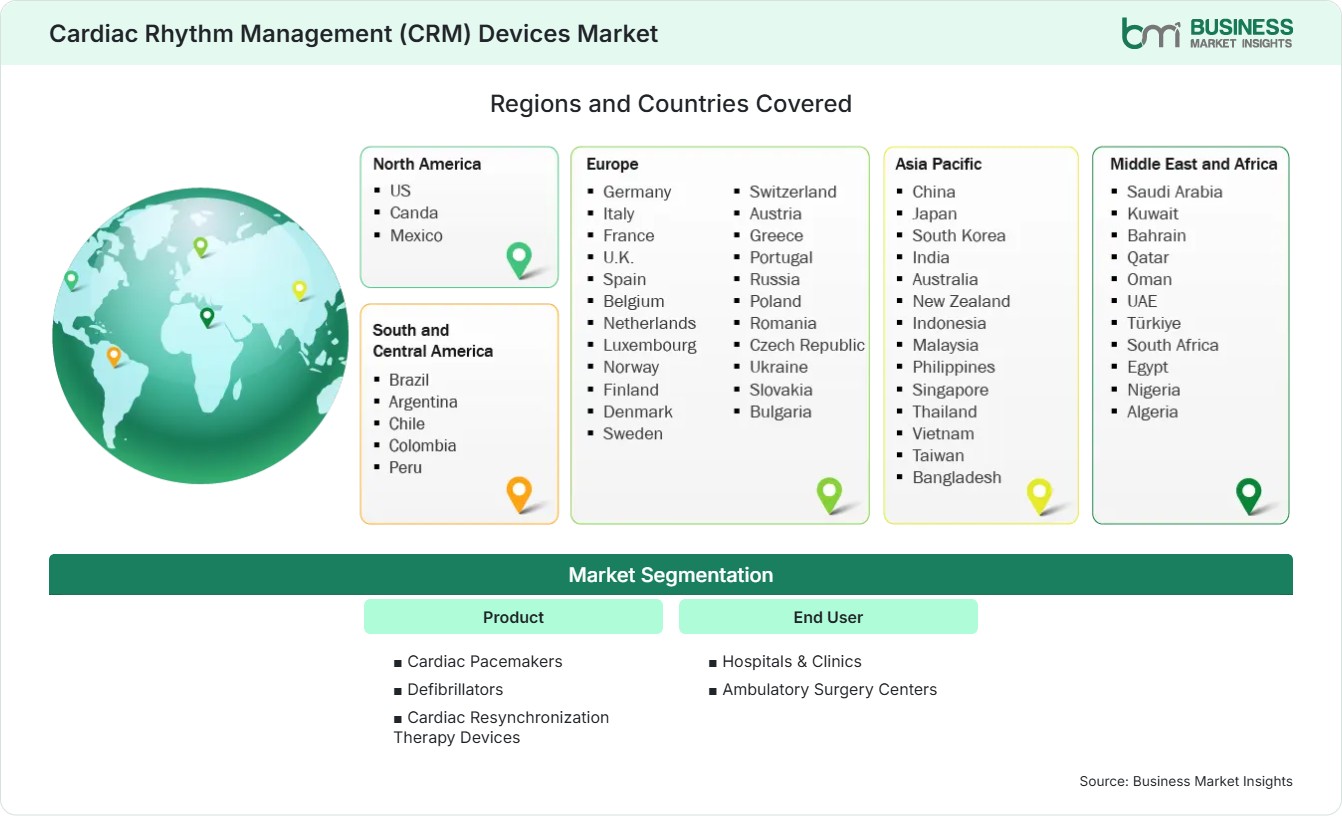
Global Market Geography
FREE PDF
Request your free sample
Request free sample
Segment Analysis

Cardiac Rhythm Management (CRM) Devices Market Segmentation

Product

The Product category continues to be pivotal in market expansion, with technology differentiation being key to creating value. In 2025, Cardiac Pacemakers captured 43%-47% of the Cardiac Rhythm Management Devices Market share and are expected to expand at a 7%-8% CAGR from 2026 to 2033. Defibrillators remain clinically significant, although CRT devices have greater growth potential.

  • Cardiac Pacemakers: Demand is supported by bradycardia treatment, aging populations, replacement procedures, leadless systems, MRI compatibility, improved battery longevity, and expanding use of conduction-system pacing technologies.
  • Defibrillators: Implantable defibrillator demand reflects sudden-cardiac-death prevention, heart-failure management, secondary prevention, improved risk stratification, and continued development of subcutaneous and connected device architectures.
  • Cardiac Resynchronization Therapy Devices: CRT adoption is supported by heart-failure management, improved patient selection, ventricular synchronization requirements, conduction-system innovations, remote optimization, and increasing interest in individualized pacing strategies.

End User

The Hospitals and Clinics setting continues to be the primary end-user setting, as implantation of rhythm devices requires specialized expertise, imaging, surgical infrastructure, device programming, and post-implant monitoring. Ambulatory Surgery Centers have emerged selectively, insofar as regulations, patient selection, anesthetic pathways, and procedural complexities allow. This means that the Cardiac Rhythm Management Devices Market is much more than just the market for devices.

  • Hospitals & Clinics: Hospitals provide the broadest treatment capability, supporting complex implants, replacements, CRT procedures, defibrillator therapy, emergency care, electrophysiology programs, and multidisciplinary follow-up.
  • Ambulatory Surgery Centers: ASCs can capture selected lower-complexity procedures where infrastructure and regulations permit, emphasizing efficient scheduling, shorter stays, predictable workflows, and lower facility utilization.
Market Forces

Cardiac Rhythm Management (CRM) Devices Market Dynamics

Key Market Drivers

Growing Cardiovascular Disease and Aging Patient Populations

Cardiovascular disease remains the leading global cause of death, with the WHO estimating 19.8 million deaths in 2022, equivalent to approximately 32% of global deaths. Age-related increases in CVD mortality lead to an underlying need for rhythm management technology, as the population ages. This means that the Cardiac Rhythm Management Devices Market growth receives positive growth from not only the presence of the disease but also the replacements for existing products. Older patients also require increasingly individualized pacing, defibrillation, and resynchronization strategies because conduction abnormalities, heart failure, and arrhythmias frequently coexist. This demographic base justifies further efforts in the development of long-life batteries, minimally invasive implants, remote monitoring, and technologies that decrease lead-based complications while increasing physiologic cardiac activation.

Shift Toward Leadless and Physiologic Pacing Technologies

Leadless pacing is changing product development priorities by eliminating transvenous leads and surgical pockets in selected patients. Medtronic’s Micra AV2 and VR2 systems demonstrate the direction of innovation, with a projected median longevity of nearly 16–17 years according to company materials. ABBOTT'S AVEIR DR integrates leadless pacing through wireless interplay between two implanted devices. Such innovations are affecting Cardiac Rhythm Management Devices Market trends, as competition is shifting from device size to implantable devices that are easy to retrieve. Performance of battery, synchrony, programming, and proof of efficacy are some other factors that have changed the competition. The conduction system pacing technology is yet another significant innovation which aims at stimulation of natural cardiac conduction pathways rather than right ventricular pacing.

Expansion of Remote Monitoring and Intelligent Device Management

Modern-day connected implants are becoming increasingly data-producing clinical systems, rather than being merely pieces of hardware. Remote monitoring may facilitate the transmission of information about the device's condition, the rhythm itself, warnings, and certain physiological parameters to care providers, thereby enabling early intervention and fewer unnecessary appointments. Medtronic described its experience using clinical data from an implantable cardiac monitor, analyzed with algorithms to detect high-risk AF patients before they are diagnosed with AF, confirming the trend towards AI-driven rhythm management. As a result, Cardiac Rhythm Management Devices Market Trends will need to include greater emphasis on cybersecurity, cloud solutions, data analytics, and integration into clinicians’ workflows.

Key Market Opportunities

Leadless Dual-Chamber Pacing and Next-Generation Device Platforms

Dual-chamber leadless pacing creates an opportunity to address patients who require coordinated atrial and ventricular activity without conventional transvenous leads. AVEIR DR from Abbott was introduced to the Indian market in October 2025 as the world's first leadless pacemaker system with two chambers that communicate wirelessly beat-to-beat. However, the opportunity is not just about hardware, as broader adoption would require physician training, implant programs, recovery capabilities, follow-up mechanisms, and reimbursement support. The Cardiac Rhythm Management Devices Market forecasts are thus required to account for shifts in the technology mix rather than simply extrapolating value growth from procedural growth. Suppliers can earn incremental value through premium devices, training, clinical evidence, and follow-ups.

Emerging-Market Cardiac Infrastructure and Local Manufacturing

Opportunities to expand cardiac implantation facilities exist in India, China, Southeast Asia, Latin America, and select Middle Eastern markets through new cardiac centers, training, distribution, and local manufacturing. It is clear from regional evidence that the Asia-Pacific region has growing volumes of pacemaker procedures and an increasing proportion of premium technologies. Local manufacturing can enhance procurement advantage and minimize supply chain exposure, especially in cases where there is a government drive to localize medical device capability. The tiering of the product portfolio can include conventional devices and premium devices such as leadless, CRT, and connected devices.

Integrated Electrophysiology and Digital Care Ecosystems

Another area of opportunity is not limited to implantable devices; it also encompasses integrated rhythm-care platforms that include diagnostics, mapping, ablation, implantable therapy, remote monitoring, and analytics. An example of such an ecosystem offered by Boston Scientific is the company’s Heart Rhythm 2025 initiative, which encompasses diagnostic heart solutions, implantable heart monitors, heart rhythm therapies, and innovative modular pacemakers and defibrillators. Firms that provide complementary services can leverage their connections with the hospital, the available data, and platform infrastructure to enhance customer retention. The integration can help achieve predictive analytics, automated notifications, optimized treatment, and longitudinal patient care.

Market Restraints and Challenges

High Device Costs and Uneven Reimbursement

Factor: The implantable rhythm device consists of costly materials that need a specialized manufacturing process, regulatory documentation, physician training, surgical procedure, and post-implant monitoring. Public procurement policies may be rather tough, while reimbursement policies may differ significantly from one country to another and even within health care facilities themselves. Effect: High prices may hinder the introduction of premium products in the market, such as leadless pacemakers or advanced CRT, if there is insufficient economic justification on the hospital's part. The reimbursement rates for pacemaker implantation and replacement in FY2026 Medicare in the US vary by condition.

Clinical Complexity, Regulatory Requirements, and Procedure Capacity

Factor: Implantable rhythm devices have specific demands regarding clinical staff, regulated manufacturing processes, validation, post-market monitoring, cybersecurity, and implant pathway management. Device problems, lead complications, infections, inappropriate treatment, and training can all affect clinical uptake. Impact: Poor electrophysiological capabilities may limit the ability to capture market share despite meeting major patient requirements. There are other issues that may increase costs and the development period, such as regulatory requirements arising from expanding operations across several regions. Effective marketing strategies will need to incorporate physicians' education, clinical data, service network, quality assurance, and logistics. There must be a balance between innovation and validation, since any failure can erode hospitals' trust.

Company Analysis

Competitive Landscape

Competitive positioning is shaped by device breadth, clinical evidence, implantation support, manufacturing scale, remote monitoring capabilities, and electrophysiology relationships. The Cardiac Rhythm Management Devices Market analysis indicates that leading suppliers are increasingly competing through integrated portfolios rather than isolated generators.

Company Name

Overview

Products and Services relevant to this market

Medtronic plc

Global medical-technology company with a broad cardiovascular portfolio and long-standing pacing expertise.

Pacemakers, leadless pacing systems, ICDs, CRT systems, cardiac monitoring, programming, remote monitoring, and rhythm-management technologies.

Abbott Laboratories

Diversified healthcare company with a strong structural-heart and electrophysiology presence and growing leadless-pacing portfolio.

AVEIR leadless pacemakers, implantable rhythm devices, diagnostics, monitoring solutions, and related cardiac technologies.

Boston Scientific Corporation

Medical-device manufacturer with established cardiac rhythm and electrophysiology capabilities across implantable and diagnostic technologies.

ICDs, CRT devices, implantable monitors, S-ICD technology, rhythm diagnostics, remote monitoring, and electrophysiology solutions.

BIOTRONIK SE & Co. KG

Specialist cardiovascular technology company focused on cardiac rhythm management and vascular intervention.

Pacemakers, ICDs, CRT devices, implantable monitors, remote monitoring, leads, programmers, and connected cardiac-care technologies.

MicroPort Scientific Corporation

China-based medical-device group with expanding cardiovascular and cardiac rhythm capabilities.

Pacemakers, ICDs, CRT devices, electrophysiology technologies, and related cardiovascular device platforms.

Koninklijke Philips N.V.

Global health-technology company supporting cardiovascular diagnosis, monitoring, imaging, and connected clinical workflows.

Cardiac monitoring, diagnostic technologies, informatics, image-guided intervention, and connected cardiovascular-care solutions.

LivaNova PLC

Medical-technology company with established cardiac-surgery and neuromodulation capabilities and a cardiac rhythm heritage.

Cardiac rhythm technologies, cardiac-surgery solutions, perfusion products, and selected implantable cardiovascular technologies.

Johnson & Johnson

Global healthcare company with advanced electrophysiology capabilities through its MedTech operations.

Cardiac mapping, ablation, electrophysiology catheters, diagnostics, procedural navigation, and rhythm-treatment technologies.

Terumo Corporation

Japanese medical-device company with cardiovascular, interventional, and hospital-focused technologies.

Interventional cardiovascular devices, electrophysiology-related technologies, catheters, access products, and procedural support systems.

Lepu Medical Technology (Beijing) Co., Ltd.

Chinese medical-device manufacturer with broad cardiovascular and interventional product capabilities.

Pacemakers, cardiovascular intervention products, electrophysiology devices, diagnostic technologies, and related cardiac-care equipment.

Trust & Transparency

Research Methodology

The market analysis combines proprietary research with secondary data from government agencies, company disclosures, regulatory filings, industry databases and expert interviews. Market estimates are validated through data triangulation, cross-market benchmarking and analyst review.

View Full Research Methodology

Questions Answered

Frequently Asked Questions

What factors influence the adoption of advanced rhythm-management devices?

Adoption depends on clinical evidence, physician expertise, reimbursement, hospital budgets, regulatory requirements, procedure capacity, device longevity, complication profiles, training availability, and the ability of manufacturers to demonstrate economic value alongside technical performance.

Which technology areas are attracting the strongest innovation focus?

Key innovation areas include leadless pacing, conduction-system pacing, longer-life batteries, AI-supported diagnostics, connected monitoring, improved CRT optimization, and integrated electrophysiology platforms combining diagnostics with procedural technologies.

What role does remote monitoring play in implanted rhythm-device care?

Remote monitoring allows clinicians to review device status and selected rhythm information without requiring every assessment to occur in person. It can support earlier intervention, improve follow-up efficiency, and create opportunities for software-enabled care models.

Why is the Asia Pacific growing faster than mature regions?

Asia Pacific combines large aging populations with expanding tertiary cardiac infrastructure, increasing diagnosis, specialist training, local manufacturing, and rising access to implantable technologies. China and India provide substantial incremental procedure opportunities.

How does leadless technology affect the Cardiac Rhythm Management Devices Market Report?

Leadless systems shift competition toward implant size, battery longevity, synchronization, retrieval, procedural technique, and clinical evidence. Dual-chamber leadless systems broaden the addressable patient population while creating new requirements for physician training and follow-up infrastructure.

Access the Full Cardiac Rhythm Management (CRM) Devices Market Report

Get segment-level forecasts, regional estimates, competitive benchmarking, company profiles and downloadable Excel datasets.

Access the full Cardiac Rhythm Management (CRM) Devices Market Report
350 pages PDF & Excel | 2026-10-22
Similar Research

Related Market Reports