Market Summary
Executive Summary and Global Market Analysis
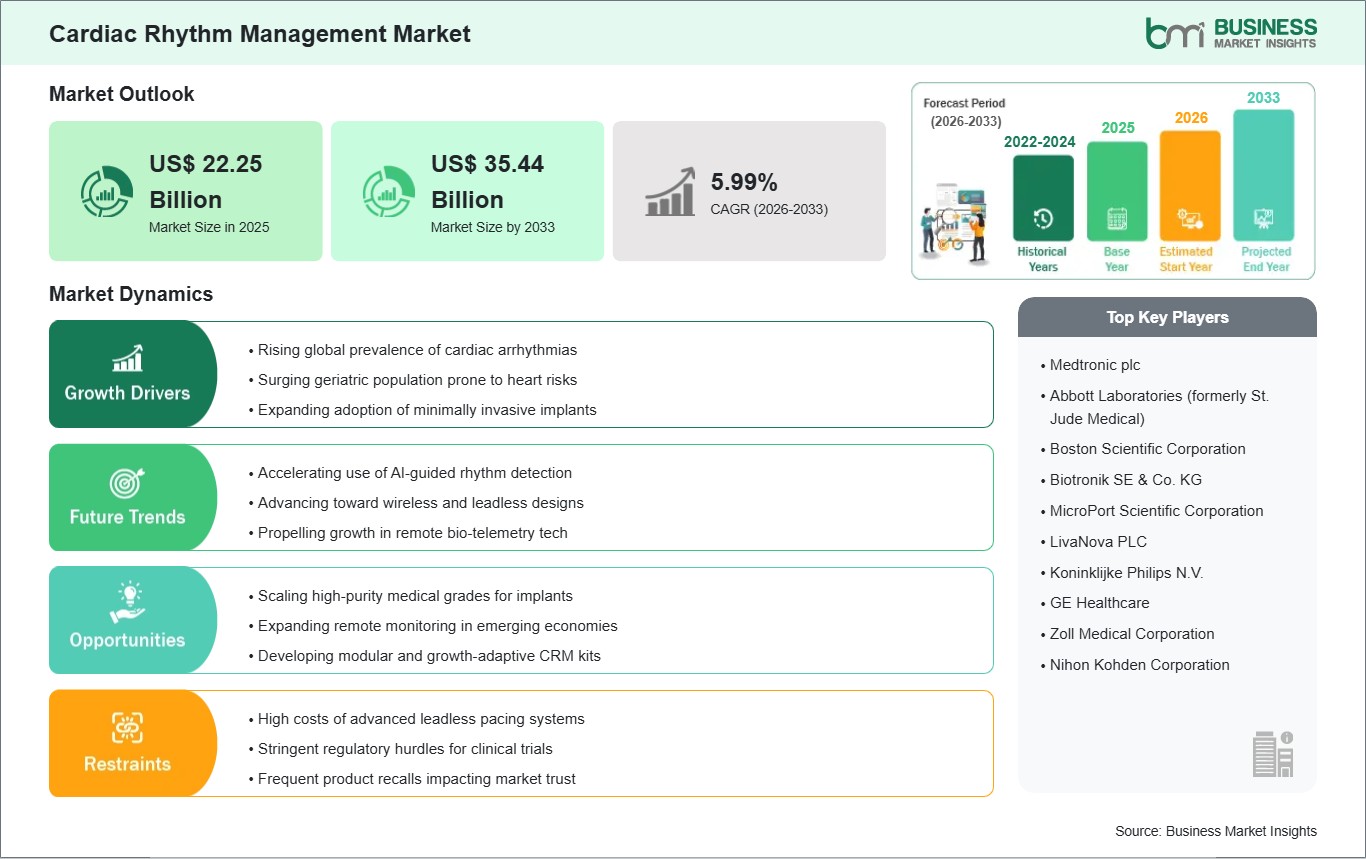
The Cardiac Rhythm Management (CRM) Market is crucial for diagnosing, treating, and monitoring abnormal heart rhythms (arrhythmias) and heart failure. These life-saving devices are essential across core healthcare settings: hospitals, cardiac centers, and home care environments. CRM devices offer advantages, including reducing the risk of sudden cardiac arrest, optimizing the heart's pumping efficiency, and enabling continuous, remote patient monitoring. The market is fueled by the increasing prevalence of CVDs and cardiac arrhythmias worldwide, as well as an enormous increase in the elderly demographic, who are highly vulnerable to CVDs. Advances in microtechnology and leadless pacemakers are additional drivers. The remote monitoring option driven by telehealth also contributes.
However, several challenges restrain market growth: These include strict approval procedures and the high cost associated with clinical trials, which might have an impact on the availability of new products. The cost associated with sophisticated implantable devices, such as ICDs and CRT-D, might become an obstacle, especially for developing nations. Moreover, there are challenges associated with constraints related to device complications and a shortage of cardiologists and technicians for implanting and following up on these devices. Yet opportunities have emerged based on advancements associated with the shift towards MIS procedures, enhancements with AI diagnosis capabilities for arrhythmias, and an enormous market presence within the Asia-Pacific region. Focus on enhanced battery longevity and MRI-compatible devices is expected to open new avenues for market expansion.
Segment Analysis
Cardiac Rhythm Management Market Segmentation
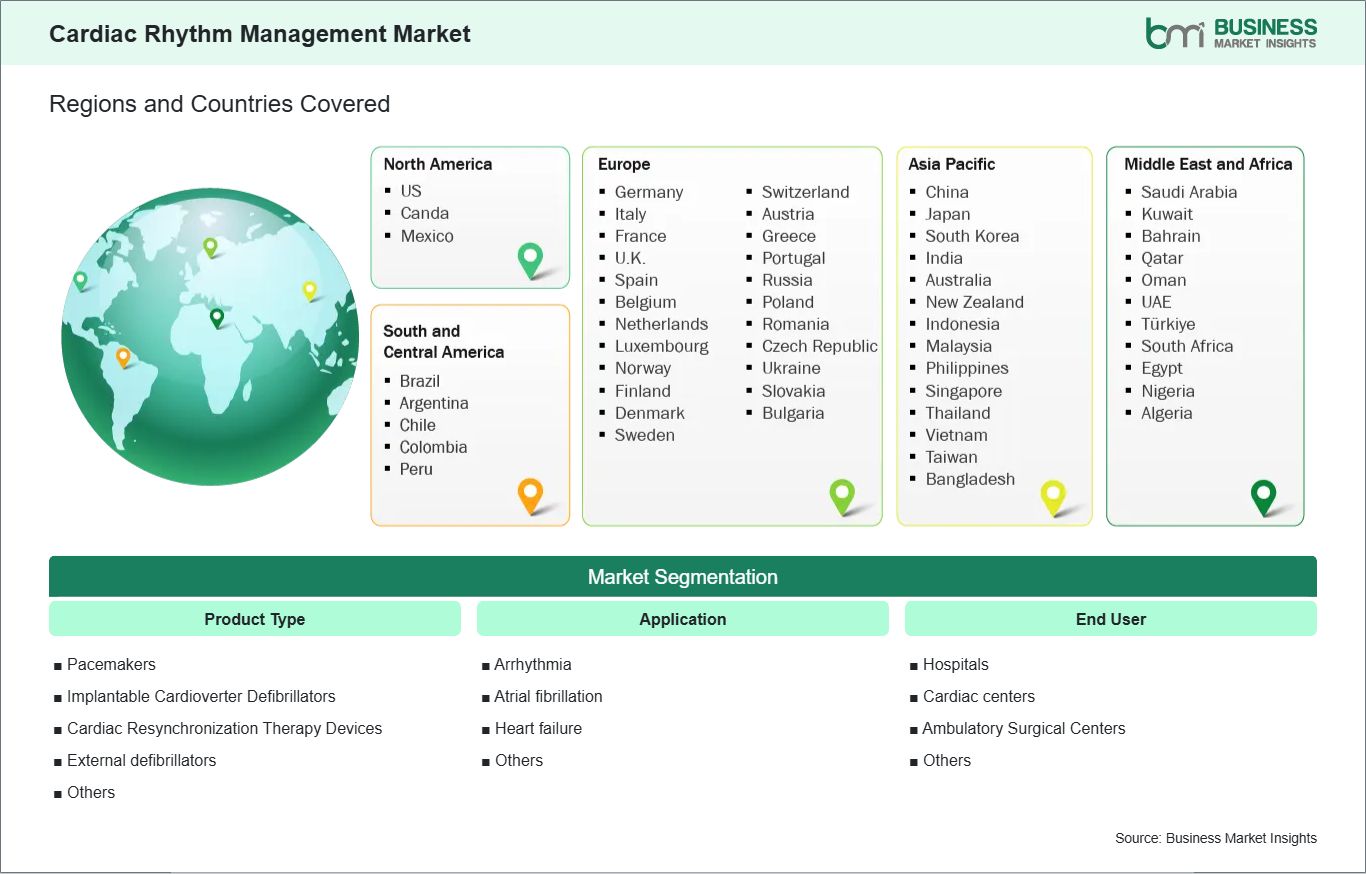
Key segments that contributed to the derivation of the Cardiac Rhythm Management Market analysis are product type, application, and end user.
- By Product Type, the market is segmented into Pacemakers, Implantable Cardioverter Defibrillators, Cardiac Resynchronization Therapy Devices, External Defibrillators, and Others.
- By Application, the market is segmented into Arrhythmia, Atrial fibrillation, Heart Failure, and Others.
- By End User, the market is segmented into Hospitals, Cardiac Centers, Ambulatory Surgical Centers, and Others.
Market Forces
Cardiac Rhythm Management Market Drivers and Opportunities
Rising Incidence of Cardiovascular Diseases
The escalating global prevalence of cardiovascular diseases (CVDs), particularly cardiac arrhythmias, including atrial fibrillation (AF) and bradycardia is the primary driver of the Cardiac Rhythm Management market. CVDs necessitate the use of implantable devices such as pacemakers and implantable cardioverter-defibrillators (ICDs). The incidence of CVDs is significantly increasing due to key demographic and lifestyle factors, including the expanding global geriatric population (as the risk of arrhythmias rises sharply with age) and the growing prevalence of chronic conditions such as obesity, diabetes, and hypertension. These underlying health issues directly contribute to electrical irregularities in the heart, creating a massive and constantly expanding patient pool requiring immediate and long-term device-based therapy to sustain normal heart function and prevent sudden cardiac death. This demographic and epidemiological trend ensures sustained demand for CRM devices.
Leadless Pacing and Remote Monitoring
The most significant growth opportunities involve developments and adoptions in leadless cardiac pacing technology and the widespread implementation of remote patient monitoring systems. Leadless pacemakers, which are significantly smaller and implanted directly into the heart via minimally invasive procedures, eliminate the traditional leads that are prone to fracture, infection, and malfunction. This innovation offers superior patient comfort and reduces procedural risks, representing a high-value technological leap. Furthermore, the integration of CRM devices with sophisticated RPM systems allows healthcare providers to monitor device performance and patient cardiac data continuously from a distance. This reduces the need for frequent in-person clinic visits, enables timely intervention based on predictive data, and improves overall patient outcomes and resource efficiency for healthcare systems, driving market adoption.
Size and Share Analysis
Cardiac Rhythm Management Market Size and Share Analysis
The Cardiac Rhythm Management Market demonstrates steady growth, with size and share analysis revealing evolving trends and competitive positioning among key players. The report further examines subsegments categorized within product type, application, and end user, offering insights into their contribution to overall market performance.
For instance, pacemakers are typically used for bradycardia, delivering electrical impulses to regulate and stabilize the heart rhythm. Their widespread use in elderly populations, especially the adoption of leadless and MRI-compatible versions, drives this segment.
The Congestive Heart Failure application utilizes devices such as Cardiac Resynchronization Therapy (CRT-D/CRT-P) to improve the heart's pumping efficiency and synchronization. This application benefits significantly from advancements in heart failure management and increasing device effectiveness. Hospitals and Cardiac Care Centers utilize CRM devices for complex implant procedures and acute patient monitoring, requiring advanced electrophysiology suites and skilled specialists. They demand high-quality, reliable, and technologically advanced systems for critical care.
Report Coverage
Cardiac Rhythm Management Market Report Coverage and Deliverables
The "Cardiac Rhythm Management Market Size and Forecast (2022 - 2033)" report provides a detailed analysis of the market covering below areas:
- Cardiac Rhythm Management Market size and forecast at global, regional, and country levels for all the key market segments covered under the scope
- Cardiac Rhythm Management Market trends, as well as market dynamics such as drivers, restraints, and key opportunities
- Cardiac Rhythm Management Market analysis covering key market trends, global and regional framework, major players, regulations, and recent market developments
- Industry landscape and competition analysis covering market concentration, heat map analysis, prominent players, and recent developments for the Cardiac Rhythm Management Market
- Detailed company profiles, including SWOT analysis
Geographic Insights
Cardiac Rhythm Management Market Geographic Insights
The geographical scope of the Cardiac Rhythm Management Market report is divided into five regions: North America, Asia Pacific, Europe, the Middle East & Africa, and South & Central America.
The Asia-Pacific Cardiac Rhythm Management Market is segmented into Australia, China, India, Japan, South Korea, Indonesia, Malaysia, Philippines, Singapore, Thailand, Vietnam, Bangladesh, New Zealand, Taiwan, and the Rest of Asia. The Asia-Pacific CRM market is experiencing robust growth, driven by the rapidly ageing population and the soaring prevalence of cardiovascular diseases such as arrhythmia and heart failure.
The region is also witnessing increased adoption of technologically advanced devices, including leadless pacemakers, Subcutaneous Implantable Cardioverter Defibrillators (S-ICDs), and AI-enabled remote patient monitoring (RPM) systems. Additionally, government initiatives aimed at telehealth and giving better reimbursement policies related to cardiovascular devices in countries such as Japan and South Korea are fast-tracking market penetration. The drive toward early diagnosis and intervention, along with increasing public awareness of cardiac conditions, is making the Asia-Pacific a key enabler in the global CRM device ecosystem.
Industry Activity
Recent Developments
The Cardiac Rhythm Management Market is evaluated by gathering qualitative and quantitative data post-primary and secondary research, which includes important corporate publications, association data, and databases. A few of the key developments in the Cardiac Rhythm Management Market are:
- In April 2025, MicroPort® CRM, a pioneering company in the field of Cardiac Rhythm Management headquartered in France, proudly announced CE mark approval under the EU Medical Device Regulation (MDR 2017/745) for its MR-Conditional Mixed Pacing System, the first of its kind in the world. This approval marks a significant advancement in patient care, enabling safe MRI scans for pacemaker patients implanted with both ALIZEA™ pacemaker range from MicroPort® CRM and selected MR-conditional third-party leads. The ALIZEA™, BOREA™, and CELEA™ pacemakers, when combined with these compatible leads constitute a MR-conditional pacing system.
- In September 2024, Boston Scientific received FDA approval to expand the use of its INGEVITY+ Pacing Leads for Conduction System Pacing (CSP) in the left bundle branch area. The company also saw significant growth in 2025 with the ongoing adoption of its FARAPULSE Pulsed Field Ablation (PFA) system, a non-thermal method for treating atrial fibrillation.
Trust & Transparency
Research Methodology
The market analysis combines proprietary research with secondary data from government agencies, company disclosures, regulatory filings, industry databases and expert interviews. Market estimates are validated through data triangulation, cross-market benchmarking and analyst
review.
View Full Research Methodology
Key Sources Referred:
World Bank - Global Trade IndicatorsWorld Trade Organization (WTO)International Monetary Fund (IMF)International Trade Administration (ITA)Company WebsiteCompany Annual ReportsCompany Investor Presentations