
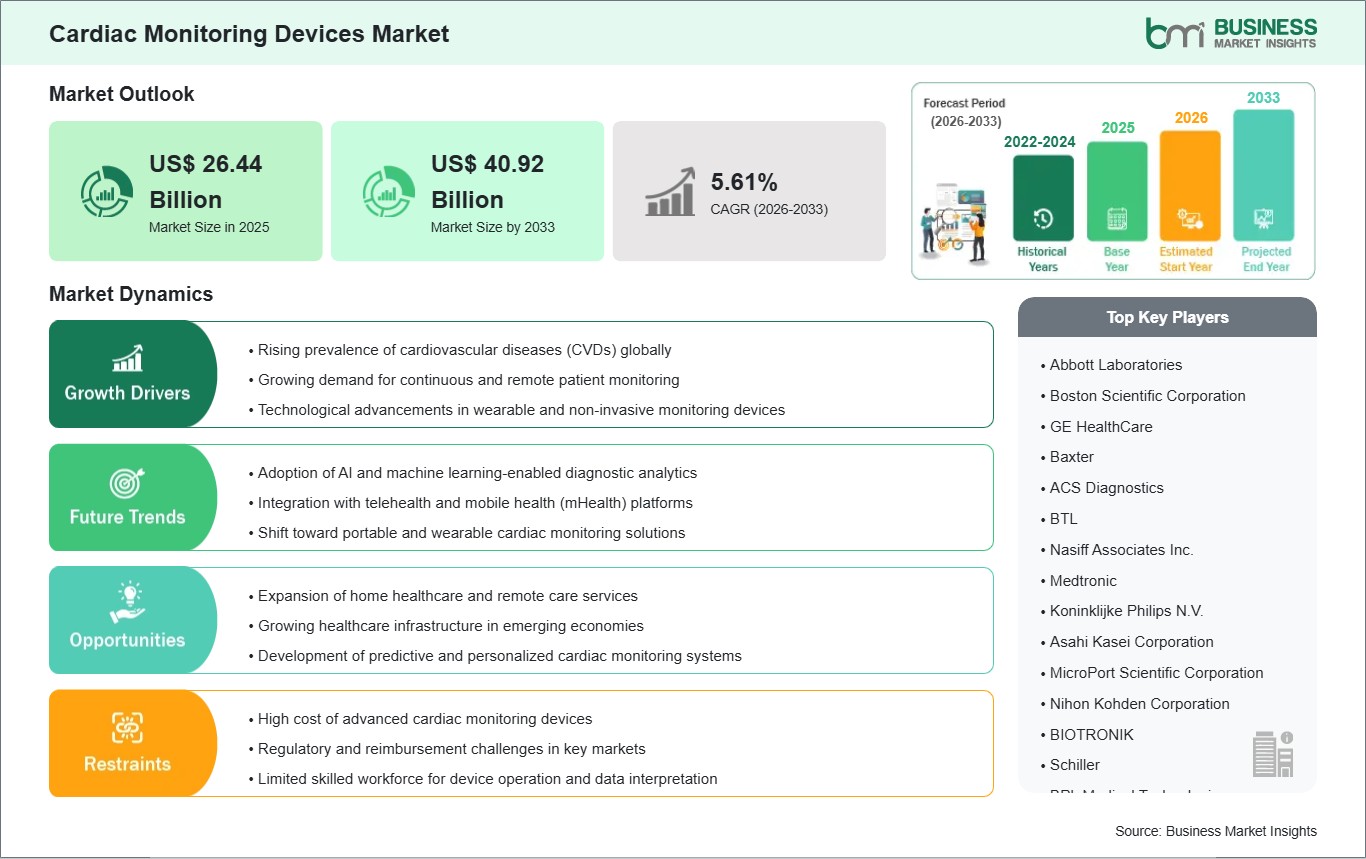
The Cardiac Monitoring Devices market size is expected to reach US$ 40.92 million by 2033 from US$ 26.44 million in 2025. The market is estimated to record a CAGR of 5.61% from 2026 to 2033.
Cardiac Monitoring Devices serve an essential function for diagnosing and treating cardiovascular diseases throughout the world because they provide quick and accurate assessments of heart performance during both brief and extended time periods. The medical field requires these monitoring systems to treat patients who experience arrhythmias and myocardial infarction and heart failure and other cardiac conditions. The advantages of cardiac monitoring devices include their capacity to obtain data in real time and their ability to identify irregularities at an early stage and their function to enable hospitals and clinics and remote care locations to monitor patients continuously. The market experiences growth because of three factors: the rising number of cardiovascular disease cases and the increase in elderly people and the need for ongoing patient monitoring through remote methods. Monitoring practices now achieve higher effectiveness because of fresh developments in wearable monitoring systems and implantable devices and AI diagnostic technologies.
The market experiences multiple growth obstacles that derive from three factors which include expensive device prices and restricted reimbursement processes in specific areas and the intricate regulatory framework which exists throughout worldwide medical systems. The industry remains vulnerable to both budget restrictions which affect healthcare systems and operational interruptions which emerge from medical emergencies or technological challenges. The market presents substantial growth opportunities because of three factors: increasing interest in remote non-invasive monitoring solutions and the development of cardiovascular facilities in emerging markets and the rising usage of digital health technologies and telehealth services. The market is expected to expand through investments which support AI-based diagnostic systems and wearable heart monitoring devices and implantable medical equipment.

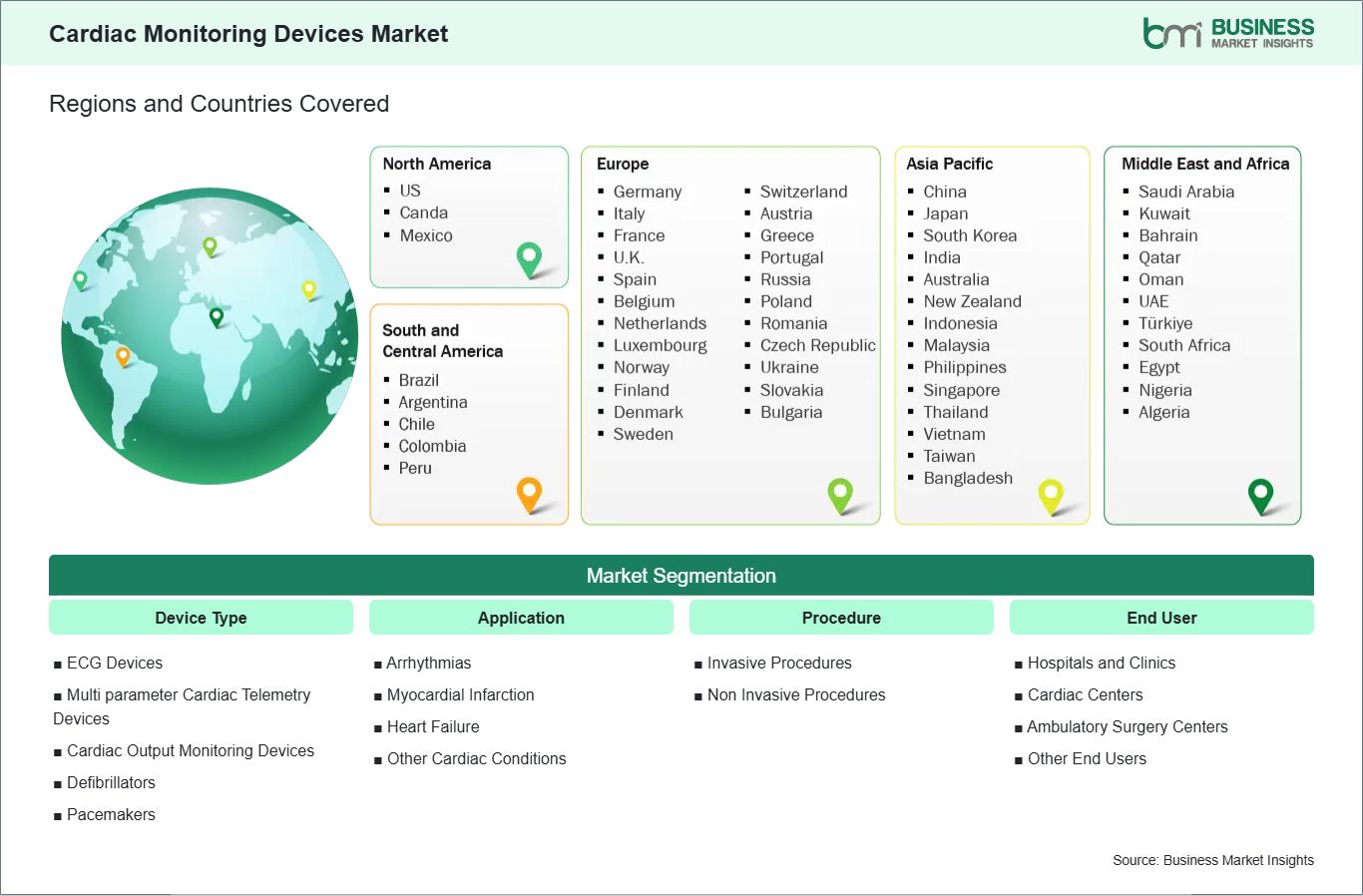
Key segments that contributed to the derivation of the Cardiac Monitoring Devices market analysis are Device Type, Application, Procedure, End User.
The market for cardiac monitoring devices has expanded because of two factors which include the increasing adoption of digital healthcare systems and the growing demand for ongoing patient monitoring that doctors and patients need to achieve instant diagnosis and continuous health assessment and precise medical tracking which has become essential in contemporary medical practice.
The World Health Organization (WHO) together with Global Cardiovascular Health data shows that cardiovascular disorders which include arrhythmias and heart failure and myocardial infarction will affect more people worldwide by 2030. The growth corresponds to rising rates of people who develop age-related conditions together with lifestyle diseases and hypertension and diabetes and obesity. The rising number of cardiovascular cases establishes a direct relationship with market expansion for cardiac monitoring devices because healthcare facilities require monitoring equipment which delivers rapid yet dependable results to meet patient expectations and growing global healthcare requirements.
Major healthcare providers and diagnostic centers such as leading hospitals, cardiac clinics, and neurology centers have not only expanded their reach globally but have also significantly influenced clinical practices by demanding high-speed, accurate cardiac monitoring capabilities. The diagnostic abilities of cardiac monitoring devices enable hospitals to identify heart conditions because these devices possess high detection accuracy. The monitoring devices used today enable medical professionals to track patients' heart conditions throughout the day which helps them identify heart issues before hospitals can begin treatment.
The continuous development of medical facilities creates a strong market expansion for cardiac monitoring equipment. The growth of hospitals and cardiac care centers and telemedicine services worldwide requires clinicians to use advanced cardiac monitoring technologies which provide quick and dependable results for patient management. The development of advanced patient care systems depends on cardiac monitoring devices which deliver real-time data and help with early diagnosis.
The current healthcare sector invests in new hospital facilities while establishing dedicated cardiac treatment centers which create additional market opportunities for cardiac monitoring equipment throughout developed and developing nations. High-risk and critical patients often require these devices due to their superior diagnostic capabilities and continuous monitoring benefits. Cardiac monitoring equipment needs to assess patients who move between distinct care environments because these systems provide reliable six-monitoring capabilities which deliver precise results during their active monitoring period.
The rise in patient numbers and the increasing complexity of cardiovascular diseases have prompted hospitals and clinics to expand their cardiac care services. Medical professionals use cardiac monitoring devices to perform quick diagnoses while maintaining patient observation throughout their treatment process which leads to better patient results. The healthcare sector will experience a continuous increase in demand for advanced cardiac monitoring systems which combine reliability with innovative technology as it shifts toward patient-centered approaches and evidence-based treatment methods
By Device Type, the Cardiac Monitoring Devices market is bifurcated into ECG Devices, Multi parameter Cardiac Telemetry Devices, Cardiac Output Monitoring Devices, Defibrillators, Pacemakers. The ECG Devices segment dominated the market in 2025. ECG devices dominate due to their widespread adoption for routine cardiac monitoring, early arrhythmia detection, ease of use, affordability, and applicability across hospitals, clinics, and outpatient settings.
By Application, the market is bifurcated into Arrhythmias, Myocardial Infarction, Heart Failure, Other Cardiac Conditions. The Arrhythmias segment held the largest share of the market in 2025. Arrhythmias segment leads because of high prevalence, need for continuous monitoring, early diagnosis, frequent hospital visits, and critical role of devices in preventing severe cardiac complications.
By Procedure, the market is bifurcated into Invasive Procedures, Non Invasive Procedures. The Non Invasive Procedures segment held the largest share of the market in 2025. Non-invasive procedures dominate as they offer patient safety, reduced risk, lower cost, ease of repeat monitoring, and suitability for both outpatient and home-based cardiac care.
By end user, the market is segmented into Hospitals and Clinics, Cardiac Centers, and Ambulatory Surgery Centers (ASCs), Other End Users. The Hospitals and Clinics segment held the largest share of the market in 2025. Hospitals and clinics dominate due to high patient volumes, advanced infrastructure, availability of specialized cardiology departments, and consistent demand for monitoring and diagnostic cardiac devices.
| Report Attribute | Details |
|---|---|
| Market size in 2025 | US$ 26.44 Billion |
| Market Size by 2033 | US$ 40.92 Billion |
| Global CAGR (2026 - 2033) | 5.61% |
| Historical Data | 2022-2024 |
| Forecast period | 2026-2033 |
| Segments Covered | By Device Type
|
|
Regions and Countries Covered
| |
| North America | US, Canada, Mexico |
| Europe | Belgium, Austria, Finland, Denmark, Greece, Poland, Romania, Russia, Ukraine, Czech Republic, Slovakia, Bulgaria, Italy, Luxembourg, Germany, Switzerland, France, Netherlands, Norway, Portugal, Spain, Sweden, United Kingdom |
| Asia-Pacific | Australia, China, India, Japan, South Korea, Indonesia, Malaysia, Philippines, Singapore, Thailand, Vietnam, Bangladesh, New Zealand, Taiwan |
| South and Central America | Brazil, Argentina, Peru, Chile, Colombia |
| Middle East and Africa | Bahrain, Kuwait, Oman, Qatar, Saudi Arabia, United Arab Emirates, Turkiye, South Africa, Egypt, Algeria, Nigeria |
| Market leaders and key company profiles |
|
The "Cardiac Monitoring Devices Market Size and Forecast (2022-2033)" report provides a detailed analysis of the market covering below areas:
The geographical scope of the Cardiac Monitoring Devices market report is divided into five regions: North America, Asia Pacific, Europe, Middle East & Africa, and South & Central America. The Cardiac Monitoring Devices market in Asia Pacific is expected to grow significantly during the forecast period.
The Asia-Pacific Cardiac Monitoring Devices market is segmented into China, Japan, South Korea, India, Australia, New Zealand, Indonesia, Malaysia, the Philippines, Singapore, Thailand, Vietnam, Taiwan, Bangladesh, and the Rest of Asia. The Asia-Pacific cardiac monitoring market is experiencing robust growth, driven by the rapid expansion of cardiovascular disease prevalence, growing healthcare infrastructure, and the rising demand for advanced and time-sensitive cardiac diagnostic and monitoring services. Major economies like China and India are leading the way, fueled by increasing hospital capacities, strategic healthcare investments, and the development of specialized cardiac care centers.
The region is also witnessing increased adoption of advanced cardiac monitoring technologies, including wearable devices, implantable monitors, AI-based diagnostics, and remote patient monitoring systems—particularly relevant for conditions like arrhythmias, myocardial infarction, and heart failure. Expansion of hospital and clinic capacities, alongside adoption of modern monitoring devices by healthcare providers, is enhancing operational efficiency and reducing patient diagnosis and treatment times. Additionally, the surge in healthcare infrastructure development and specialized cardiac care centers, coupled with the growth of telemedicine networks, is positioning Asia-Pacific as a key hub in the global cardiac monitoring ecosystem. The rise of regional healthcare initiatives and strong infrastructure development across major medical corridors further solidifies the region's dominant market position.

The Cardiac Monitoring Devices market is evaluated by gathering qualitative and quantitative data post primary and secondary research, which includes important corporate publications, association data, and databases. A few of the key developments in the Cardiac Monitoring Devices market are:
The Cardiac Monitoring Devices Market is valued at US$ 26.44 Billion in 2025, it is projected to reach US$ 40.92 Billion by 2033.
As per our report Cardiac Monitoring Devices Market, the market size is valued at US$ 26.44 Billion in 2025, projecting it to reach US$ 40.92 Billion by 2033. This translates to a CAGR of approximately 5.61% during the forecast period.
The Cardiac Monitoring Devices Market report typically cover these key segments-
The historic period, base year, and forecast period can vary slightly depending on the specific market research report. However, for the Cardiac Monitoring Devices Market report:
The Cardiac Monitoring Devices Market is populated by several key players, each contributing to its growth and innovation. Some of the major players include:
The Cardiac Monitoring Devices Market report is valuable for diverse stakeholders, including:
Essentially, anyone involved in or considering involvement in the Cardiac Monitoring Devices Market value chain can benefit from the information contained in a comprehensive market report.
Please tell us your area of interest
(Market Segments/ Regions and Countries/ Companies)