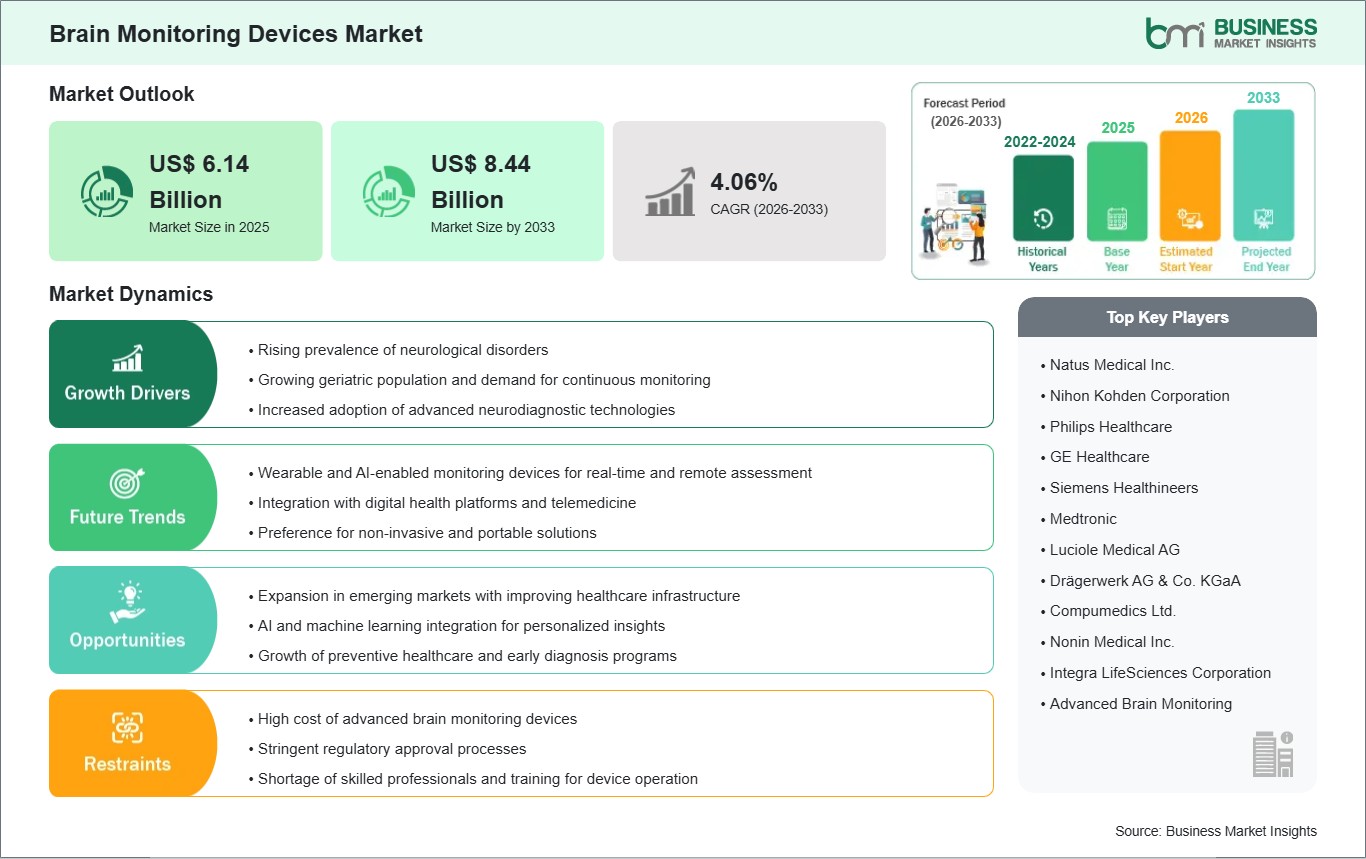
The Brain Monitoring Devices Market size is expected to reach US$ 8.44 Billion by 2033 from US$ 6.14 Billion in 2025. The market is estimated to record a CAGR of 4.06% from 2026 to 2033.
The use of brain monitoring devices has become essential in diagnosing and managing neurological illnesses worldwide by providing instant and accurate evaluations of how the brain functions/operates. They are necessary for diagnosing conditions such as strokes, brain traumas, epilepsy, sleep disorders, Parkinson's, and dementia, and have several benefits, including acquiring market data in real-time, lowering the incidence of incorrect diagnoses, and enabling ongoing patient assessments regardless of location or degree of illness (critical care vs remote). The increase in the number of people diagnosed with neurological diseases, the rise in neurodegenerative disorders, and a growing preference for continuous monitoring of patients is driving demand for these devices. Innovations with wearable and wireless devices, as well as artificial intelligence (AI) used to assess data collected from diagnostic procedures and provide more accurate tests, will also improve diagnostic reliability and operational efficiency.
However, several barriers to growth within the marketplace include excessive costs associated with the devices, complicated approval processes for regulations, and insufficiently trained healthcare workers in certain parts of the world. The industry also has to deal with healthcare agencies looking to cut or modify their periodical budgets as well as disruptions caused by national emergencies (i.e., pandemics) or technological difficulties (i.e., out-of-date tech). Despite the above challenges, there continues to be tremendous opportunities for this industry due to growing needs for non-invasive testing devices, increased development and expansion of neurological support systems in developing nations, and increased utilization of telemedicine and remote monitoring solutions. Investments in AI-enhanced assessments and portable monitoring solutions will continue to grow

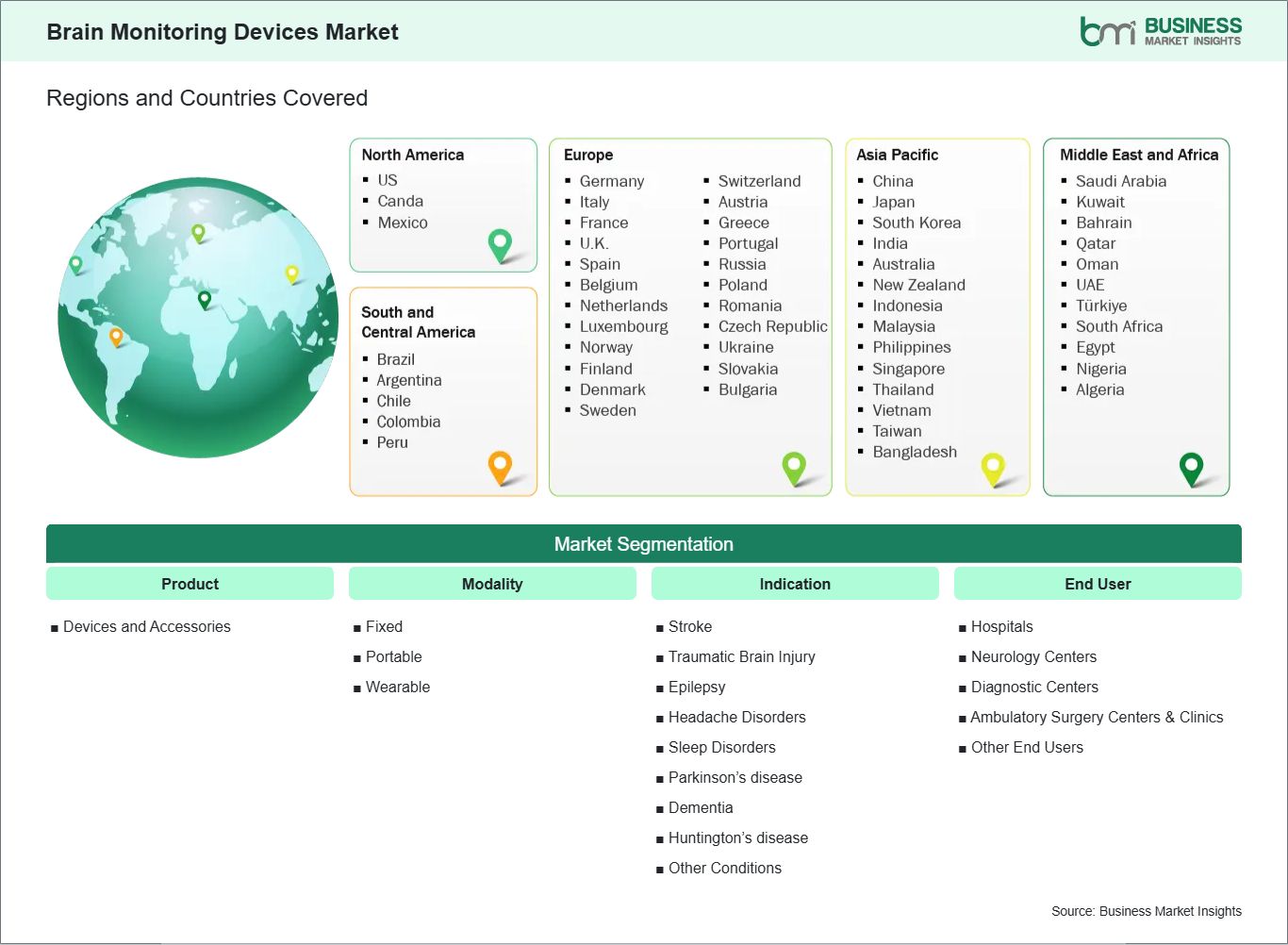
Key segments that contributed to the derivation of the Brain Monitoring Devices market analysis are Product, Modality, Indication, End User.
As the number of people diagnosed with neurological disorders has rapidly increased over the past few years, this growth is now one of the key drivers of future demand for brain monitoring devices. Digitalization of healthcare, along with an emphasis on early detection, has led both patients and clinicians to expect prompt, accurate evaluations and ongoing monitoring of a patient's brain function; this makes brain monitoring devices essential to modern healthcare.
According to data from the World Health Organization (WHO) and the International Neurology Alliance (INA) projected in 2024, the total number of people worldwide who will have received a diagnosis of stroke; TBI (traumatic brain injury); a diagnosis of epilepsy; or a diagnosis of some form of degenerative neurological disease will increase significantly by 2030. Contributing to this prognosis of growth in the prevalence of neurological disorders will be an accelerated rate of newly diagnosed patients with dementia, Parkinson's disease; sleep disorders; TBI; and epilepsy. In addition to supporting the demand for brain monitoring devices, the expected increased prevalence of neurological disorders will result in a pressing need for timely, high-quality diagnostic, and continuous monitoring of these disorders across the globe to meet the expectations of patients and the required demands of the healthcare system.
The leading hospital systems, neurology centers, and specialist clinics that make up the major health system providers and diagnostic centers have expanded their services around the world, but they have also dramatically influenced the establishment of clinical protocols by insisting on the need for high accuracy and real-time ability to monitor brain function. Brain monitoring devices have long been known for their speed in detecting abnormalities in brain function and their reliability as a method of detection, therefore brain monitoring devices fit well with this new era of healthcare where there is ever-changing demand from the world to have accurate and real-time access to brain function. In contrast to previous diagnostic methods, brain monitoring devices provide the opportunity for a rapid and on-going assessment of brain activity for the purpose of providing timely intervention, which is critical for successful neurological treatment and care.
The brain monitoring devices market experiences its strongest growth through ongoing healthcare infrastructure expansion which creates a powerful market driver. Clinicians need high-speed brain monitoring systems which provide accurate results to track patient progress during international hospital and neurology center and home healthcare service expansion. Hospitals need brain monitoring devices because these systems provide immediate medical information which enables them to make critical health assessments about patients.
The combination of healthcare investment increases and specialized neurological service access and new neurology center establishment creates new possibilities which lead to increased brain monitoring device use in developed and emerging markets. The diagnostic accuracy of these devices combined with their ability to monitor patients continuously makes them essential for treating patients with critical and high-risk neurological conditions. Brain monitoring systems need reliable performance because patients require assessments through various care environments.
Hospitals and clinics expand their neurological treatment options to handle increasing patient needs and complex medical cases. Medical facilities use brain monitoring systems to enable doctors to quickly identify patient conditions while maintaining ongoing patient observation which leads to better treatment results. The demand for brain monitoring systems which provide dependable performance and advanced technological solutions will increase as healthcare organizations implement patient-focused and evidence-supported treatment methods
By product, the Brain Monitoring Devices market is bifurcated into devices and accessories. The Devices segment dominated the market in 2025. Devices segment is further segmented as Electroencephalography (EEG) Devices, Magnetoencephalography (MEG) Devices, Transcranial Doppler (TCD) Devices, Intracranial Pressure (ICP) Monitors, Cerebral Oximeters, Magnetic Resonance Imaging (MRI) Devices, Computerized Tomography (CT) Devices, Positron Emission Tomography (PET) Devices, Sleep Monitoring Devices, Electromyography (EMG) Devices. The devices segment dominates due to technological advancement, wide clinical applications, high demand for accurate brain monitoring, and hospital adoption.
By modality, the market is divided into fixed, portable, wearable. The fixed devices segment held the largest share of the market in 2025. Fixed devices dominate because of superior accuracy, continuous monitoring, use in critical care, and integration in hospital infrastructure.
By indication, the market is bifurcated into Stroke, Traumatic Brain Injury (TBI), Epilepsy, Headache Disorders, Sleep Disorders, Parkinson's disease, Dementia, Huntington's disease, and other conditions. The Traumatic Brain Injury (TBI) segment held the largest share of the market in 2025. TBI dominates due to high incidence, critical need for monitoring, rapid diagnosis requirements, and improved patient outcomes.
By end user, the market is segmented into hospitals, neurology centers, diagnostic centers, ambulatory surgery centers (ASCs) & clinics, other end users. The hospitals segment held the largest share of the market in 2025. Hospitals dominate because of large patient volumes, advanced neurological facilities, skilled staff, and frequent use of sophisticated monitoring devices
| Report Attribute | Details |
|---|---|
| Market size in 2025 | US$ 6.14 Billion |
| Market Size by 2033 | US$ 8.44 Billion |
| Global CAGR (2026 - 2033) | 4.06% |
| Historical Data | 2022-2024 |
| Forecast period | 2026-2033 |
| Segments Covered | By Product
|
|
Regions and Countries Covered
| |
| North America | US, Canada, Mexico |
| Europe | Belgium, Austria, Finland, Denmark, Greece, Poland, Romania, Russia, Ukraine, Czech Republic, Slovakia, Bulgaria, Italy, Luxembourg, Germany, Switzerland, France, Netherlands, Norway, Portugal, Spain, Sweden, United Kingdom |
| Asia-Pacific | Australia, China, India, Japan, South Korea, Indonesia, Malaysia, Philippines, Singapore, Thailand, Vietnam, Bangladesh, New Zealand, Taiwan |
| South and Central America | Brazil, Argentina, Peru, Chile, Colombia |
| Middle East and Africa | Bahrain, Kuwait, Oman, Qatar, Saudi Arabia, United Arab Emirates, Turkiye, South Africa, Egypt, Algeria, Nigeria |
| Market leaders and key company profiles |
|
The "Brain Monitoring Devices Market Size and Forecast (2022-2033)" report provides a detailed analysis of the market covering below areas:
The geographical scope of the Brain Monitoring Devices market report is divided into five regions: North America, Asia Pacific, Europe, Middle East & Africa, and South & Central America. The Brain Monitoring Devices market in Asia Pacific is expected to grow significantly during the forecast period.
The Asia-Pacific Brain Monitoring Devices market is segmented into China, Japan, South Korea, India, Australia, New Zealand, Indonesia, Malaysia, the Philippines, Singapore, Thailand, Vietnam, Taiwan, Bangladesh, and the Rest of Asia. The Asia-Pacific brain monitoring devices market is experiencing robust growth, driven by the rapid increase in neurological disorders, growing geriatric population, and rising demand for continuous patient monitoring. Major economies like China and India are leading the way, fueled by increasing healthcare expenditure, strategic investments in medical infrastructure, and the development of specialized neurological care centers.
The region is also witnessing increased adoption of advanced brain monitoring technologies, including EEG, MEG, ICP monitors, wearable devices, and AI-based diagnostic systems—particularly relevant for conditions like stroke, traumatic brain injury, epilepsy, and sleep disorders. Expansion of hospital networks, alongside modernization efforts in healthcare facilities, is enhancing diagnostic efficiency and improving patient outcomes. Additionally, the surge in surgical procedures and neurological patient care requirements, coupled with the growth of telemedicine and remote monitoring solutions, is positioning Asia-Pacific as a key hub in the global brain monitoring devices ecosystem. The rise of regional healthcare initiatives and strong infrastructure development across major urban and semi-urban areas further solidifies the region's dominant market position

The Brain Monitoring Devices market is evaluated by gathering qualitative and quantitative data post primary and secondary research, which includes important corporate publications, association data, and databases. A few of the key developments in the Brain Monitoring Devices market are:
The Brain Monitoring Devices Market is valued at US$ 6.14 Billion in 2025, it is projected to reach US$ 8.44 Billion by 2033.
As per our report Brain Monitoring Devices Market, the market size is valued at US$ 6.14 Billion in 2025, projecting it to reach US$ 8.44 Billion by 2033. This translates to a CAGR of approximately 4.06% during the forecast period.
The Brain Monitoring Devices Market report typically cover these key segments-
The historic period, base year, and forecast period can vary slightly depending on the specific market research report. However, for the Brain Monitoring Devices Market report:
The Brain Monitoring Devices Market is populated by several key players, each contributing to its growth and innovation. Some of the major players include:
The Brain Monitoring Devices Market report is valuable for diverse stakeholders, including:
Essentially, anyone involved in or considering involvement in the Brain Monitoring Devices Market value chain can benefit from the information contained in a comprehensive market report.
Please tell us your area of interest
(Market Segments/ Regions and Countries/ Companies)