Market Summary
Executive Summary and Global Market Analysis
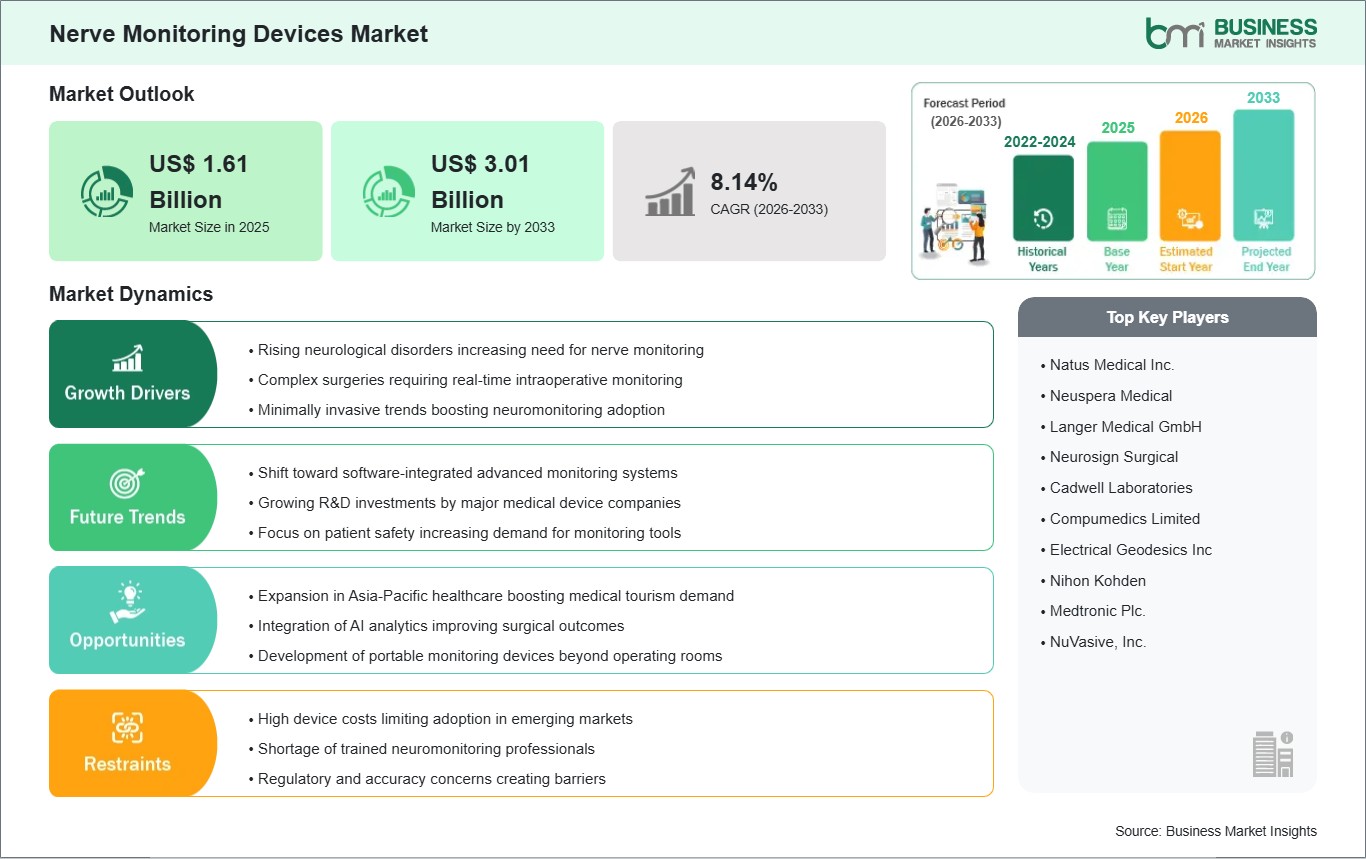
Nerve monitoring devices refer to a specialized category of intraoperative neurophysiological monitoring (IONM) systems used to identify, map, and assess the functional integrity of motor and sensory nerves during high-risk surgical procedures. Market expansion is fundamentally driven by the rising prevalence of neurological and spinal disorders, alongside the global aging population who are increasingly undergoing complex musculoskeletal and neurosurgical interventions. Furthermore, the shift toward minimally invasive surgery (MIS) and the integration of digital signal processing are enhancing the accuracy of real-time monitoring, allowing surgeons to navigate delicate anatomical structures with greater confidence and reduced risk of permanent injury.
However, several factors can restrain market growth. The high initial capital expenditure required for advanced monitoring consoles and the ongoing costs of specialized consumables can be a significant barrier for smaller healthcare facilities. Stringent regulatory approval processes for innovative neurophysiological monitoring technologies often delay product commercialization and increase research and development costs. Additionally, the industry faces constraints due to a global shortage of certified neurophysiologists and trained technical personnel required to interpret complex neural signals accurately during active surgical procedures, potentially limiting the adoption of these systems in underserved or rural regions.
Despite these hurdles, the market holds significant opportunities in the development of artificial intelligence-driven analytics for automated artifact rejection and predictive signal analysis. The rise of portable and wireless monitoring systems for outpatient settings and the expansion of outsourced monitoring services, where specialized firms provide both the equipment and the technical expertise, are expected to support long-term development within the sector. Manufacturers are also finding growth potential in the integration of robotic-assisted surgical platforms with real-time nerve feedback mechanisms.
Segment Analysis
Nerve Monitoring Devices Market Segmentation
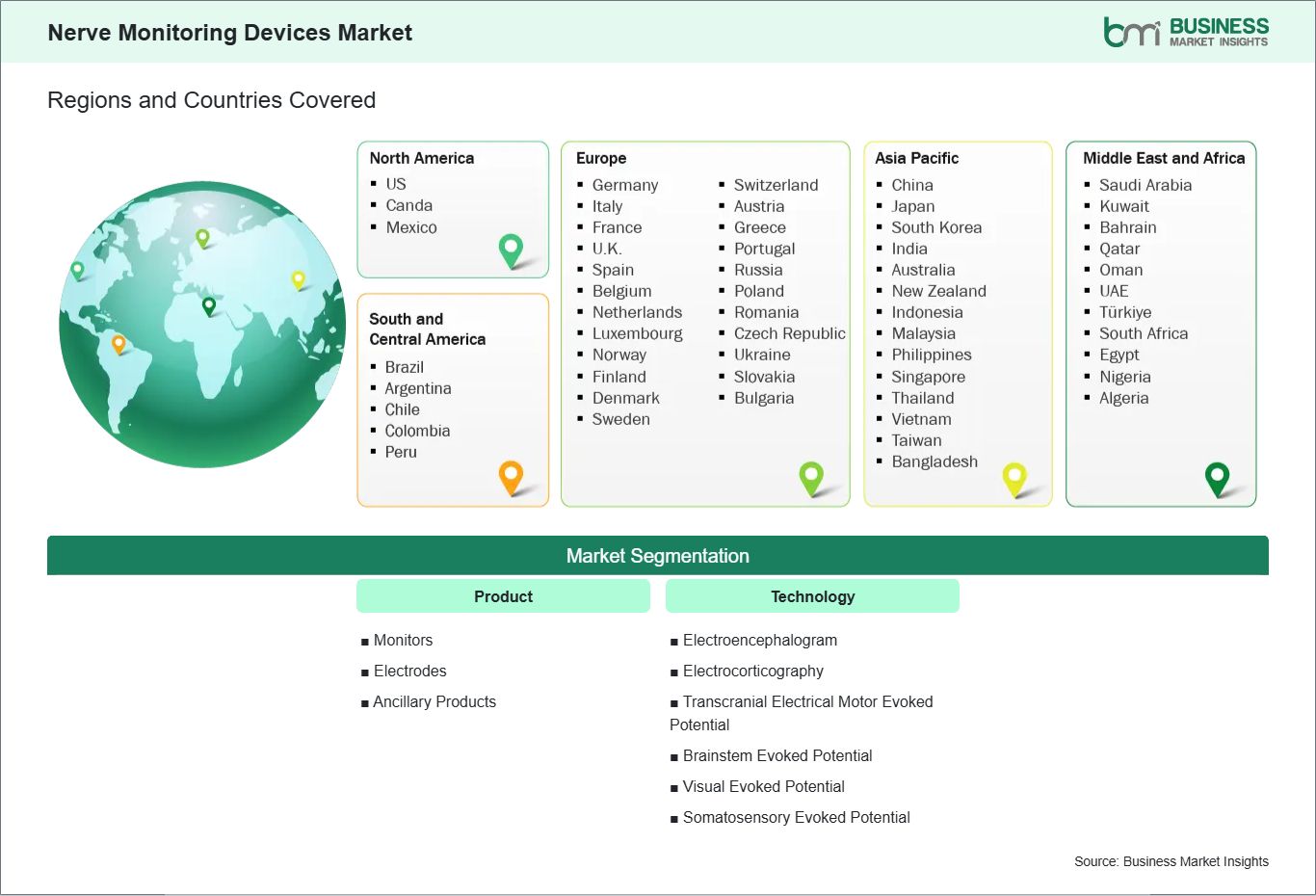
Key segments that contributed to the derivation of the Nerve Monitoring Devices market analysis are product and technology.
- By Product, the market is segmented into Monitors, Electrodes, and Ancillary Products.
- By Technology, the market is divided into Electroencephalogram, Electrocorticography, Transcranial Electrical Motor Evoked Potential, Brainstem Evoked Potential, Visual Evoked Potential, and Somatosensory Evoked Potential.
Market Forces
Nerve Monitoring Devices Market Drivers and Opportunities
Expanding Geriatric Fragility and the Professionalization of Intraoperative Safety
The primary driver for the Nerve Monitoring Devices Market is the accelerating global prevalence of age-related neurological and musculoskeletal disorders. The Rising Incidence of Complex Spinal Deformities and Brain Tumors acts as a foundational catalyst, as these conditions, coupled with an aging population`s demand for functional longevity, necessitate a higher volume of delicate surgical interventions. This momentum is further propelled by the Global Mainstreaming of Patient Safety Regulations and Mandatory Risk-Mitigation Protocols; surgical centers are increasingly adopting intraoperative neuromonitoring (IONM) to comply with clinical guidelines and minimize the significant economic burden of postoperative nerve damage. In the technological sphere, the Rapid Adoption of Minimally Invasive Surgery (MIS) serves as a critical driver, as reduced visualization in endoscopic and robotic procedures makes electronic nerve identification an essential substitute for direct anatomical observation. Furthermore, the Expansion of Specialized Ambulatory Surgical Centers (ASCs) is decentralizing procedural access, creating a robust demand for modular, portable monitoring platforms that do not require the extensive infrastructure of traditional hospitals. Together, these factors, demographic vulnerability, regulatory mandates, and the MIS revolution, ensure a resilient and technologically advancing growth path for the global Nerve Monitoring Devices Market.
AI-Native Signal Analytics and the Integration of Robotic Co-Surgeons
A significant high-value opportunity lies in the convergence of Nerve Monitoring Systems with Artificial Intelligence (AI) and Machine Learning Algorithms. Next-generation smart monitors are being developed to utilize AI for real-time signal quality analytics, which can automatically filter out electrical noise and reduce the rate of false positives, thereby providing surgeons with more actionable and reliable intraoperative data. There is also a major growth frontier in the development of Closed-Loop Robotic Integration; as surgical robots become more autonomous, the ability to feed real-time neural feedback directly into the robotic control system allows for automatic stops if a surgical tool approaches a critical nerve, elevating safety to an unprecedented level. Furthermore, the expansion of Cloud-Based Remote Neuromonitoring Services presents a lucrative opportunity for facilities in emerging markets that lack full-time, onsite neurophysiologists, allowing for expert remote oversight via high-speed digital networks. Beyond traditional equipment, the rise of Single-Use, High-Precision Consumables, such as concentric EMG needles and specialized laryngeal nerve electrodes, offers a stable and high-margin revenue stream driven by recurring procedural volume. Manufacturers who focus on Wireless, Ultra-Low Latency Monitoring Kits and those pioneering AR-Overlay Systems for Nerve Mapping are positioned to lead the global Nerve Monitoring Devices Market
Size and Share Analysis
Nerve Monitoring Devices Market Size and Share Analysis
The Nerve Monitoring Devices market demonstrates steady growth, with size and share analysis revealing evolving trends and competitive positioning among key players. The report examines subsegments categorized within product and technology, offering insights into their contribution to overall market performance.
Based on the product, the Monitors subsegment holds the primary market presence, acting as the essential high-value hub for all neurophysiological data acquisition. These systems are indispensable for the market, maintaining a significant position as the central processing unit required to interpret complex electrical signals during delicate cranial and spinal procedures. However, a notable trend is the surge in the Electrodes subsegment, which is registering the highest pace of adoption. These items are becoming essential for Single-Use Clinical Optimization, as the transition toward disposable, high-sensitivity subdermal and surface electrodes creates a consistent, high-frequency revenue stream while ensuring adherence to rigorous infection control mandates. Furthermore, the growth in Ancillary Products remains substantial, driven by the recurring demand for specialized probes and cables required to maintain system integrity across high-volume surgical schedules.
Report Coverage
Nerve Monitoring Devices Market Report Coverage and Deliverables
The "Nerve Monitoring Devices Market Size and Forecast (2022–2033)" report provides a detailed analysis of the market covering below areas:
- Nerve Monitoring Devices market size and forecast at global, regional, and country levels for all market segments covered under the scope
- Nerve Monitoring Devices market trends, as well as drivers, restraints, and opportunities
- Nerve Monitoring Devices market analysis covering key trends, global and regional framework, major players, regulations, and recent developments
- Industry landscape and competition analysis covering market concentration, heat map analysis, prominent players, and recent developments for the Nerve Monitoring Devices market
- Detailed company profiles, including SWOT analysis
Geographic Insights
Nerve Monitoring Devices Market Geographic Insights
The geographical scope of the Nerve Monitoring Devices market report is divided into five regions: North America, Asia Pacific, Europe, Middle East & Africa, and South & Central America.
North America maintains a dominant market share, supported by a significant volume of complex neurosurgical and spinal procedures, high healthcare expenditure, and the presence of major industry innovators. Europe represents a mature and technologically advanced market where growth is sustained by rigorous surgical safety standards and the widespread institutional adoption of intraoperative neuromonitoring (IONM) in specialized ear, nose, and throat (ENT) and orthopedic centers. Asia Pacific is identified as the most rapidly advancing region, propelled by accelerating healthcare modernization, an expanding geriatric population susceptible to neurological disorders, and a rising demand for minimally invasive surgical interventions in emerging economies.
The Asia-Pacific Nerve Monitoring Devices Market is segmented into China, Japan, South Korea, India, Australia, and the Rest of Asia Pacific. China serves as a primary engine for regional growth, driven by extensive government investments in hospital infrastructure and the increasing prevalence of age-related spinal conditions. India is experiencing a notable surge in demand as private tertiary care networks expand their neuro-diagnostic capabilities to address a high volume of trauma and oncology cases. Japan and South Korea continue to lead in the integration of high-specification monitors and AI-assisted signal processing to enhance procedural precision and patient safety in complex surgical environments.
Industry Activity
Recent Developments
The Nerve Monitoring Devices market is evaluated by gathering qualitative and quantitative data post primary and secondary research, which includes important corporate publications, association data, and databases. A few of the key developments in the Nerve Monitoring Devices market are:
- In November 2025, Neuraxpharm and mjn-neuro announced plans to launch EPISERAS®, an AI-powered wearable device for early detection of epileptic seizures. The collaboration strengthens the Nerve Monitoring Devices Market by introducing a non-invasive, real-time monitoring solution that enhances patient safety and quality of life.
- In August 2025, Nalu Medical launched its next-generation Therapy Disc, a 39% smaller wearable powering the Nalu micro-IPG system for peripheral nerve stimulation. The device enhances patient comfort and expands therapy access, reinforcing innovation and adoption in the nerve monitoring and neurostimulation market.
Trust & Transparency
Research Methodology
The market analysis combines proprietary research with secondary data from government agencies, company disclosures, regulatory filings, industry databases and expert interviews. Market estimates are validated through data triangulation, cross-market benchmarking and analyst
review.
View Full Research Methodology
Key Sources Referred:
World Bank – Global Trade IndicatorsWorld Trade Organization (WTO)(International Monetary Fund )IMFInternational Trade Administration (ITA)Company websiteCompany annual reportsCompany investor presentations