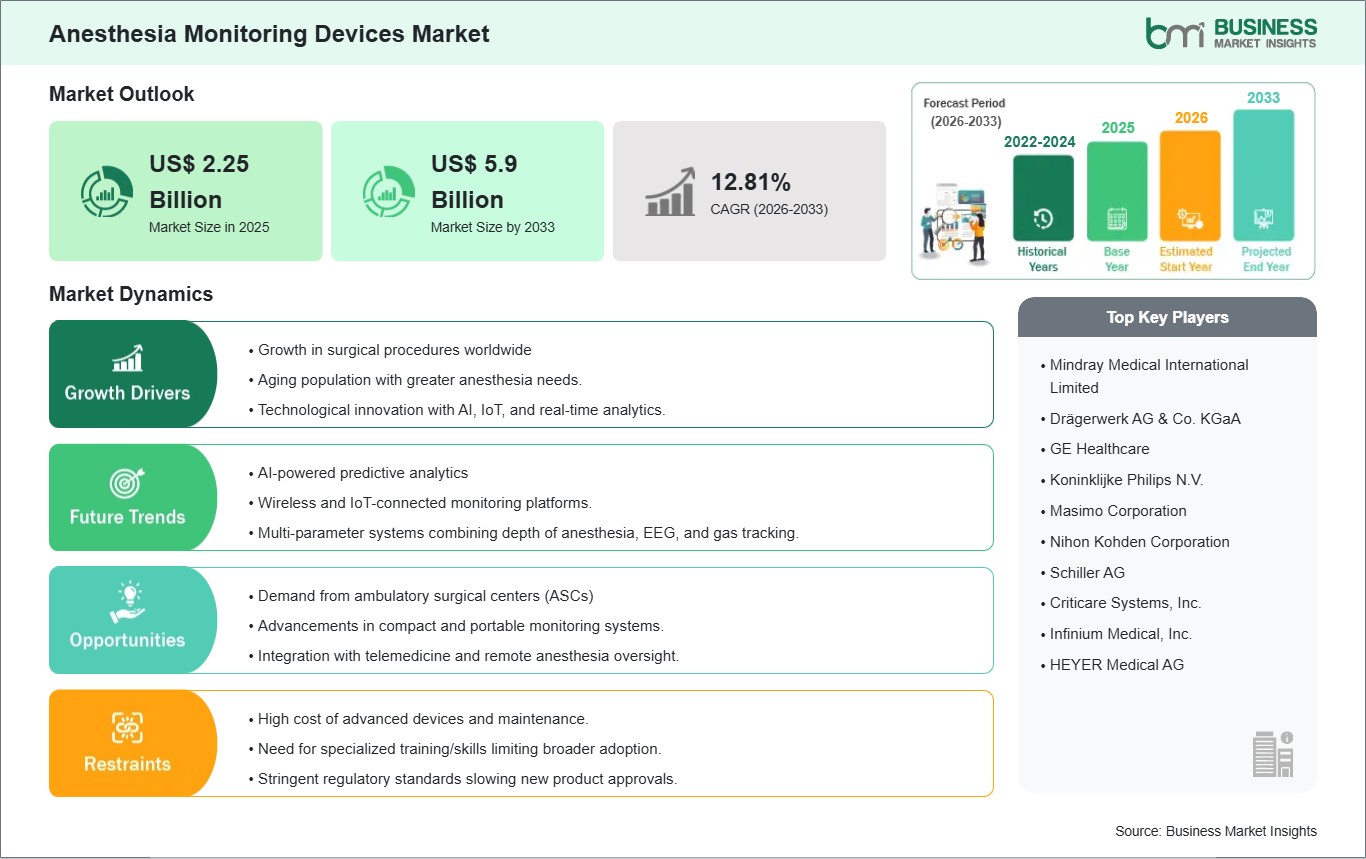
The anesthesia monitoring devices market size is expected to reach US$ 5.9 billion by 2033 from US$ 2.25 billion in 2025. The market is estimated to record a CAGR of 12.81% from 2026 to 2033.
Medical practitioners use anesthesia monitoring devices to continuously track patients' physiological state throughout their surgical procedure and recovery. The devices function as standard equipment in hospitals, ambulatory surgical centers, and specialty clinics to track essential medical data, including heart rate, blood pressure, and oxygen saturation, respiratory rate, and anesthetic gas levels. The system's advanced features enhance patient security, reduce anesthesia-related medical issues, and enable doctors to make better clinical decisions.
The global Anesthesia Monitoring Devices market is experiencing continuous expansion as surgical procedures become more frequent, chronic diseases requiring surgical treatment increase, and people choose less invasive surgical methods. The market expansion receives additional support from hospitals, which focuses on protecting patients and meeting anesthesia monitoring requirements, and enhancing their operating room systems.
The market shows strong growth potential but faces multiple obstacles, including the high cost of advanced monitoring solutions, the need for trained anesthesiology staff, and financial constraints in low- and middle-income countries. The market will likely experience significant growth opportunities due to ongoing technological advancements, expanding healthcare facilities in emerging nations, and a growing understanding of anesthesia safety standards, which will persist through the end of the projected period.

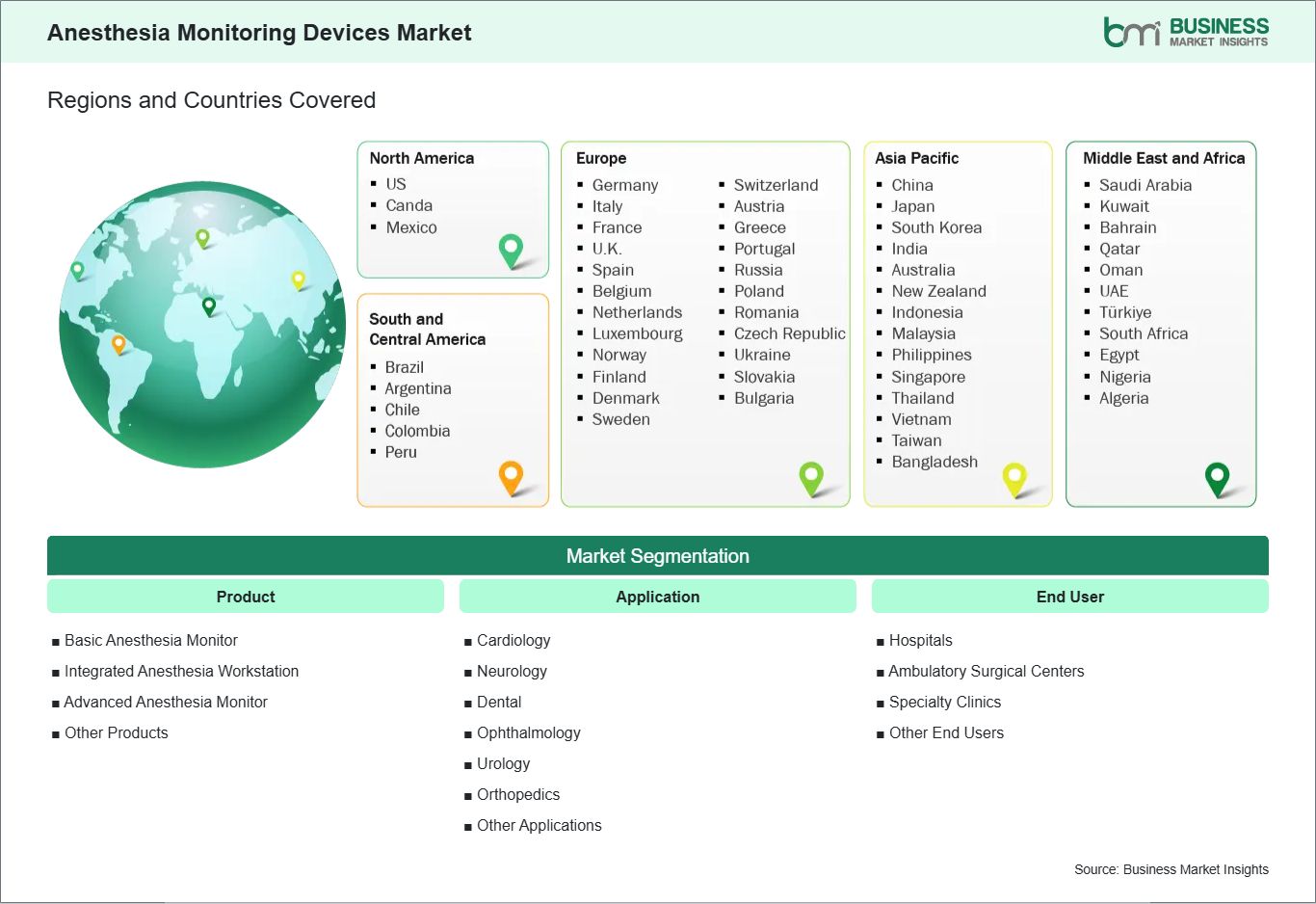
Key segments that contributed to the derivation of the anesthesia monitoring devices market analysis are product, application, and end user.
The Anesthesia Monitoring Devices market primarily grows as more surgical procedures occur worldwide. The rising number of chronic disease cases, which include cardiovascular disorders, neurological conditions, obesity, and cancer, creates an increased requirement for both planned medical procedures and urgent medical treatments, leading to a greater demand for dependable anesthesia monitoring systems. The growing number of elderly people who need multiple surgical procedures that require continuous vital sign monitoring drives this demand.
Healthcare providers now consider patient safety their main priority during perioperative procedures, as they must follow anesthesia monitoring regulations exactly, which helps reduce negative patient outcomes. Medical authorities and healthcare organizations now recommend that healthcare facilities continuously monitor essential signs during anesthesia, which has led to greater use of these monitoring devices. The healthcare industry requires precise, real-time patient tracking due to evolving surgical methods and increasing operational challenges.
The growing number of ambulatory surgical centers, along with the rising popularity of minimally invasive treatments, has created a greater need for lightweight, effective anesthesia-monitoring equipment. The combination of these factors drives sustained market expansion for anesthesia monitoring devices worldwide.
The Anesthesia Monitoring Devices market presents significant growth opportunities driven by technological advancements and expanding global surgical infrastructure. Manufacturers are developing advanced monitoring systems that use multiple-parameter monitoring, wireless connectivity, and AI-powered analytics to improve clinical accuracy and workflow efficiency. New technologies enable faster detection of physiological changes, allowing medical staff to respond more quickly to patient needs.
Emerging economies in Asia-Pacific, Latin America, and the Middle East offer substantial opportunities driven by rising healthcare investments, expanding hospital networks, and expanding access to surgical care. Government initiatives to enhance surgical outcomes while building better healthcare systems have driven a rising demand for advanced anesthesia monitoring technologies in these regions.
The market for portable, affordable monitoring devices offers new business opportunities driven by increasing demand in ambulatory surgical centers and outpatient settings. The growing number of anesthesiologist training programs, together with the development of better perioperative care standards, creates new possibilities for adoption. The market will continue to expand during the forecast period because healthcare providers focus on maintaining patient safety while improving surgical productivity.

By product, the anesthesia monitoring devices market is segmented into basic anesthesia monitor, integrated anesthesia workstation, advanced anesthesia monitor, and other products. The advanced anesthesia monitor segment dominated the market in 2025. Advanced monitors are widely adopted due to their ability to track multiple physiological parameters simultaneously, including oxygen saturation, end-tidal CO₂, anesthetic gas concentrations, and depth of anesthesia, improving patient safety during complex surgical procedures.
By application, the market is segmented into cardiology, neurology, dental, ophthalmology, urology, orthopedics, others. The cardiology segment held the largest market share in 2025. Cardiac procedures require continuous and precise monitoring of vital parameters due to the high risk associated with cardiovascular interventions, driving strong demand for advanced anesthesia monitoring solutions in this application area.
By end user, the anesthesia monitoring devices market is segmented into hospitals, ambulatory surgical centers (ASCs), specialty clinics, and others. The hospitals segment dominated the market in 2025. Hospitals perform a high volume of surgical procedures and are equipped with advanced operating rooms, skilled anesthesiology staff, and comprehensive critical care infrastructure, making them the primary end users of anesthesia monitoring devices.
| Report Attribute | Details |
|---|---|
| Market size in 2025 | US$ 2.25 Billion |
| Market Size by 2033 | US$ 5.9 Billion |
| Global CAGR (2026 - 2033) | 12.81% |
| Historical Data | 2022-2024 |
| Forecast period | 2026-2033 |
| Segments Covered | By Product
|
|
Regions and Countries Covered
| |
| North America | US, Canada, Mexico |
| Europe | Belgium, Austria, Finland, Denmark, Greece, Poland, Romania, Russia, Ukraine, Czech Republic, Slovakia, Bulgaria, Italy, Luxembourg, Germany, Switzerland, France, Netherlands, Norway, Portugal, Spain, Sweden, United Kingdom |
| Asia-Pacific | Australia, China, India, Japan, South Korea, Indonesia, Malaysia, Philippines, Singapore, Thailand, Vietnam, Bangladesh, New Zealand, Taiwan |
| South and Central America | Brazil, Argentina, Peru, Chile, Colombia |
| Middle East and Africa | Bahrain, Kuwait, Oman, Qatar, Saudi Arabia, United Arab Emirates, Turkiye, South Africa, Egypt, Algeria, Nigeria |
| Market leaders and key company profiles |
|
The "Anesthesia Monitoring Devices Market Size and Forecast (2022&2033)" report provides a detailed analysis of the market covering below areas:
The geographical scope of the Anesthesia Monitoring Devices market report is divided into five regions: North America, Asia Pacific, Europe, Middle East & Africa, and South & Central America. The Anesthesia Monitoring Devices market in Asia Pacific is expected to grow significantly during the forecast period.
The Asia-Pacific Anesthesia Monitoring Devices market is segmented into China, Japan, South Korea, India, Australia, New Zealand, Indonesia, Malaysia, the Philippines, Singapore, Thailand, Vietnam, Taiwan, Bangladesh, and the Rest of Asia. The Asia-Pacific Anesthesia Monitoring Devices market is experiencing rapid growth as surgical procedures increase, healthcare facilities expand, and people better understand anesthesia safety standards. Market growth depends on China, Japan, India, South Korea, and Australia because these countries invest in hospital improvements and the development of advanced medical systems.
The markets in China, Japan, and India show strong potential because these countries have large patient bases, increasing surgical volume, and are adopting modern operating room equipment at higher rates. The region is experiencing rising demand because governments implement initiatives that enhance healthcare accessibility and expand insurance coverage and develop surgical care standards.
The use of multi-parameter monitoring together with portable anesthesia systems creates better conditions for adoption. The healthcare industry experiences higher demand because people choose less invasive surgical techniques, together with outpatient treatment, which ambulatory surgical centers and specialty clinics deliver. The Asia-Pacific region will remain one of the fastest-growing markets for anesthesia monitoring devices over the forecast period.

The Anesthesia Monitoring Devices market is evaluated by gathering qualitative and quantitative data post primary and secondary research, which includes important corporate publications, association data, and databases. A few of the key developments in the Anesthesia Monitoring Devices market are:
The Anesthesia Monitoring Devices Market is valued at US$ 2.25 Billion in 2025, it is projected to reach US$ 5.9 Billion by 2033.
As per our report Anesthesia Monitoring Devices Market, the market size is valued at US$ 2.25 Billion in 2025, projecting it to reach US$ 5.9 Billion by 2033. This translates to a CAGR of approximately 12.81% during the forecast period.
The Anesthesia Monitoring Devices Market report typically cover these key segments-
The historic period, base year, and forecast period can vary slightly depending on the specific market research report. However, for the Anesthesia Monitoring Devices Market report:
The Anesthesia Monitoring Devices Market is populated by several key players, each contributing to its growth and innovation. Some of the major players include:
The Anesthesia Monitoring Devices Market report is valuable for diverse stakeholders, including:
Essentially, anyone involved in or considering involvement in the Anesthesia Monitoring Devices Market value chain can benefit from the information contained in a comprehensive market report.
Please tell us your area of interest
(Market Segments/ Regions and Countries/ Companies)