
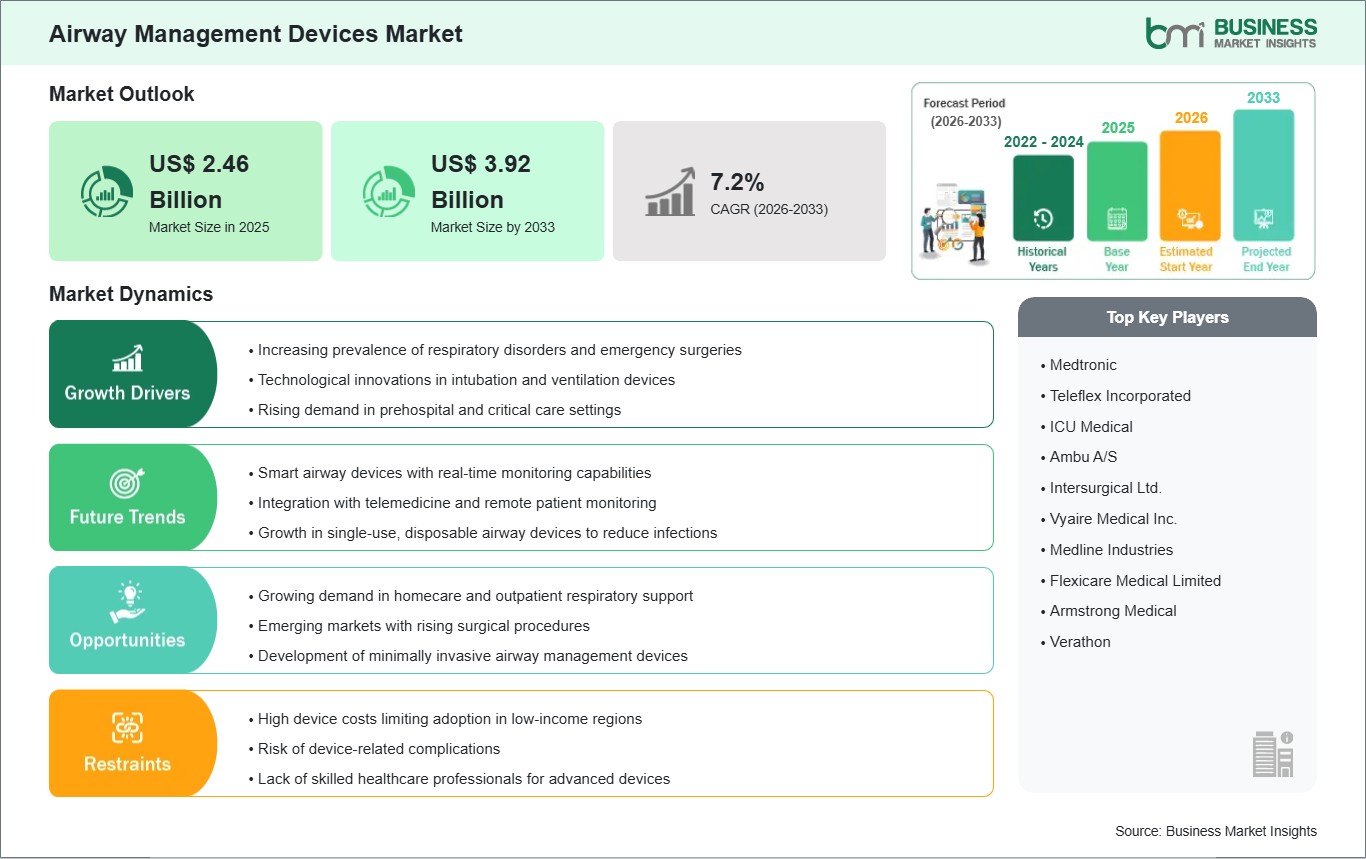
The Airway Management Devices Market size is expected to reach US$ 3.92 billion by 2033 from US$ 2.46 billion in 2025. The market is estimated to record a CAGR of 7.20% from 2026 to 2033.
Airway management devices are critical medical tools used to maintain or secure a patient’s airway to ensure effective ventilation and oxygenation in clinical settings such as anesthesia, emergency care, intensive care, and surgery. These medical devices include endotracheal tubes, supraglottic airway, laryngoscopes, resuscitators, and other adjuncts. All these devices aim to prevent or relieve airway obstruction and support breathing during medical procedures or in patients with respiratory distress. Their proper usage ranges from daily surgeries to trauma and respiratory emergencies, and they always enhance the patients' outcomes, and also, the incidences of complications are lessened.
The global airway management devices market is constantly growing at a slow but steady rate due to the aforementioned factors. The main market driver is the growing number of patients with chronic respiratory diseases (such as COPD, asthma, and sleep apnea), in it, there is an increasing number of surgical procedures, and the parallel development of emergency and critical care services. Among these factors, technological advancements like video laryngoscopy and AI/IoT-enhanced devices are making it easier and more precise, which is why the industry is leaning towards single-use devices to cope with the infection control measures. The market growth is also being contributed to by the upgrading of healthcare infrastructure in the developing regions and the increasing elderly population, which tends to require more respiratory and surgical interventions. At the moment, North America is the leading market because there is a strong demand for advanced airway technologies; meanwhile, the Asia-Pacific and other emerging markets are increasing their market share because of the larger patient base who can now afford treatment, thanks to the expansion of access to care. The situation has its challenges, such as healthcare providers needing training and the high costs of devices; however, the market trends show a lot of opportunities for innovation and acceptance in the different settings of care.

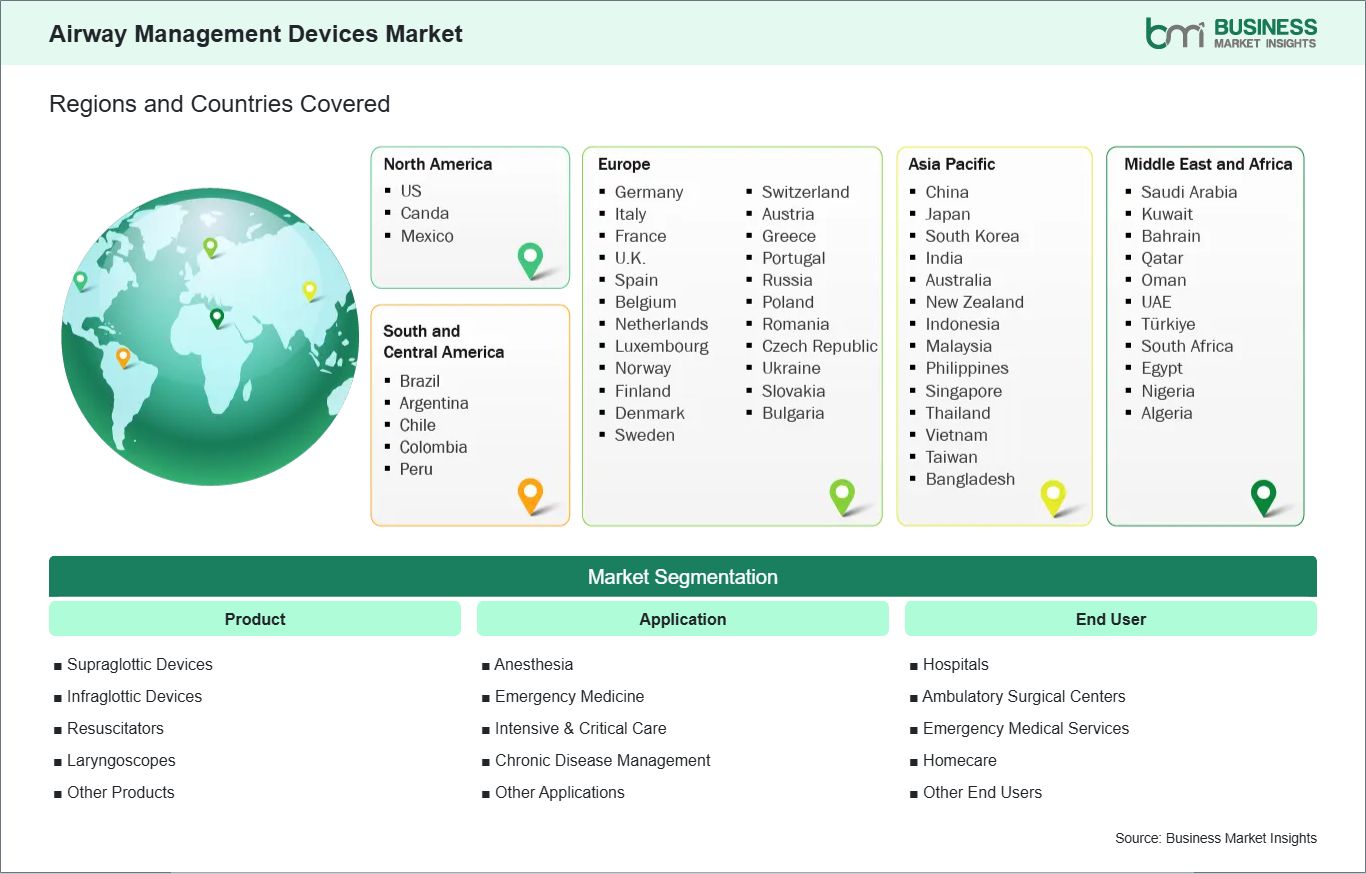
Key segments that contributed to the derivation of the airway management devices market analysis are product, application, and end user.
Chronic ailments like chronic obstructive pulmonary disease (COPD), asthma, and obstructive sleep apnea are a global problem that affects hundreds of millions of people, and thus, there is a continuous need for airway support devices to be used in both acute and chronic care units. Recent estimates show that respiratory diseases are affecting over 544 million people globally, thus making the use of effective airway stabilization tools more widespread in emergency, perioperative, and critical patients' lives. With more than 320 million surgical procedures carried out every year, the majority requiring safe airway management for anesthesia and ventilation, healthcare centers are now investing more in advanced equipment like video laryngoscopes, supraglottic airways, and endotracheal systems to ensure patient safety and minimize complications. This twofold issue of respiratory diseases and increasing surgical volume will keep the market growing and innovative.
The airway management devices market possesses a big growth opportunity due to technological advancements and product innovations, especially the use of artificial intelligence (AI) and better visualization systems in airway devices. One of the recent developments is the launch of AI-assisted video laryngoscopes, which provide better real-time guidance and intubation accuracy, thus solving the difficult airway situations with high first-pass success rates and reducing the number of complications caused by the procedures. In 2025, companies like KARL STORZ and Verathon presented next-generation video laryngoscopy systems with advanced imaging and usability, indicating a wider trend in the med-tech industry toward smarter and more user-friendly airway management tools. Besides that, disposable single-use devices, pre-hospital care portable kits, and ergonomically designed devices are among the innovations that are moving the applications of airway management beyond traditional hospital settings and thus are attracting the adoption of emergency medical services and outpatient clinics. These advancements not only result in better clinical outcomes but also pave the way for the entry of the market in the world's developing healthcare systems.
By product, the airway management devices market is categorized into supraglottic devices, infraglottic devices, resuscitators, laryngoscopes, other products. The supraglottic devices segment held the largest share of the market in 2025. Supraglottic airway devices (e.g., laryngeal masks, oropharyngeal airways) lead the segment, capturing the largest share because they are easy to insert, minimally invasive, and versatile across both elective surgeries and emergency scenarios. Their widespread adoption by anesthesiologists and emergency responders enhances patient comfort and safety by reducing trauma and complication risks compared to deeper airway techniques, supporting consistent demand globally.
By application, the market is segmented into anesthesia, emergency medicine, intensive & critical care, chronic disease management, other applications. The anesthesia segment held the largest share of the market in 2025. The anesthesia segment dominates due to the high volume of surgical procedures worldwide that require controlled airway management to maintain ventilation and oxygenation during general anesthesia. Airway devices are fundamental to anesthetic practice, ensuring secure airways and optimal patient outcomes throughout surgeries, which sustains the largest share in the market.
By end user, the airway management devices market is segmented into hospitals, ambulatory surgical centers, emergency medical services, homecare, other end users. The hospitals segment dominated the market in 2025. Hospitals are the leading end-user segment as they handle the majority of surgical, emergency, and critical-care cases requiring airway management. Equipped with advanced infrastructure and trained staff, hospitals consistently procure a broad range of airway devices to support high procedural volumes, emergency interventions, and critical ventilation needs, driving their dominant market position.
| Report Attribute | Details |
|---|---|
| Market size in 2025 | US$ 2.46 Billion |
| Market Size by 2033 | US$ 3.92 Billion |
| Global CAGR (2026 - 2033) | 7.2% |
| Historical Data | 2022 - 2024 |
| Forecast period | 2026-2033 |
| Segments Covered | By Product
|
|
Regions and Countries Covered
| |
| North America | US, Canada, Mexico |
| Europe | Belgium, Austria, Finland, Denmark, Greece, Poland, Romania, Russia, Ukraine, Czech Republic, Slovakia, Bulgaria, Italy, Luxembourg, Germany, Switzerland, France, Netherlands, Norway, Portugal, Spain, Sweden, United Kingdom |
| Asia-Pacific | Australia, China, India, Japan, South Korea, Indonesia, Malaysia, Philippines, Singapore, Thailand, Vietnam, Bangladesh, New Zealand, Taiwan |
| South and Central America | Brazil, Argentina, Peru, Chile, Colombia |
| Middle East and Africa | Bahrain, Kuwait, Oman, Qatar, Saudi Arabia, United Arab Emirates, Turkiye, South Africa, Egypt, Algeria, Nigeria |
| Market leaders and key company profiles |
|
The " Airway Management Devices Market Size and Forecast (2022–2033)" report provides a detailed analysis of the market covering below areas:
The geographical scope of the airway management devices market report is divided into five regions: North America, Asia Pacific, Europe, Middle East & Africa, and South & Central America. The airway management devices market in Asia Pacific is expected to grow significantly during the forecast period.
The Asia-Pacific airway management devices market is segmented into China, Japan, South Korea, India, Australia, New Zealand, Indonesia, Malaysia, the Philippines, Singapore, Thailand, Vietnam, Taiwan, Bangladesh, and the Rest of Asia. The Asia-Pacific airway management devices market is experiencing robust growth, due to the result of several interconnected factors, indicating the wider healthcare expansion over emerging and developed economies. The increasing number of respiratory diseases, such as chronic obstructive pulmonary disease (COPD), asthma, and sleep apnea, among the general population, particularly in large countries like China and India, has raised the demand for airway support devices in emergency, intensive care, and chronic disease treatment to a large extent. China itself has around 100 million people suffering from COPD, which is a clear indication of the big demand for airway management solutions. In addition, the aging population in certain countries like Japan, which has about 29% of its population aged 65 or older, causes more respiratory complications and surgical procedures that require management of the airway.
Not only this, but the better healthcare, government initiatives (like India’s National Health Mission and China’s Healthy China 2030), and infrastructure are making it easier for hospitals to have access to advanced medical devices, which subsequently leads to hospitals upgrading their critical care capabilities. Additionally, the medical tourism sector can be counted as one of the factors that help to increase the demand for airway management devices, as it is one of the reasons why international patients come to India, Thailand, and Malaysia, which are considered as regional centers for surgical care. All of these trends together add to the strong market momentum in the Asia-Pacific and support each other.

The airway management devices market is evaluated by gathering qualitative and quantitative data post primary and secondary research, which includes important corporate publications, association data, and databases. A few of the key developments in the airway management devices market are:
The Airway Management Devices Market is valued at US$ 2.46 Billion in 2025, it is projected to reach US$ 3.92 Billion by 2033.
As per our report Airway Management Devices Market, the market size is valued at US$ 2.46 Billion in 2025, projecting it to reach US$ 3.92 Billion by 2033. This translates to a CAGR of approximately 7.2% during the forecast period.
The Airway Management Devices Market report typically cover these key segments-
The historic period, base year, and forecast period can vary slightly depending on the specific market research report. However, for the Airway Management Devices Market report:
The Airway Management Devices Market is populated by several key players, each contributing to its growth and innovation. Some of the major players include:
The Airway Management Devices Market report is valuable for diverse stakeholders, including:
Essentially, anyone involved in or considering involvement in the Airway Management Devices Market value chain can benefit from the information contained in a comprehensive market report.
Please tell us your area of interest
(Market Segments/ Regions and Countries/ Companies)