
Life Science Analytics Market Outlook: Size, Share, Trends, Growth Analysis, Competitive Landscape & Forecast, 2026-2033

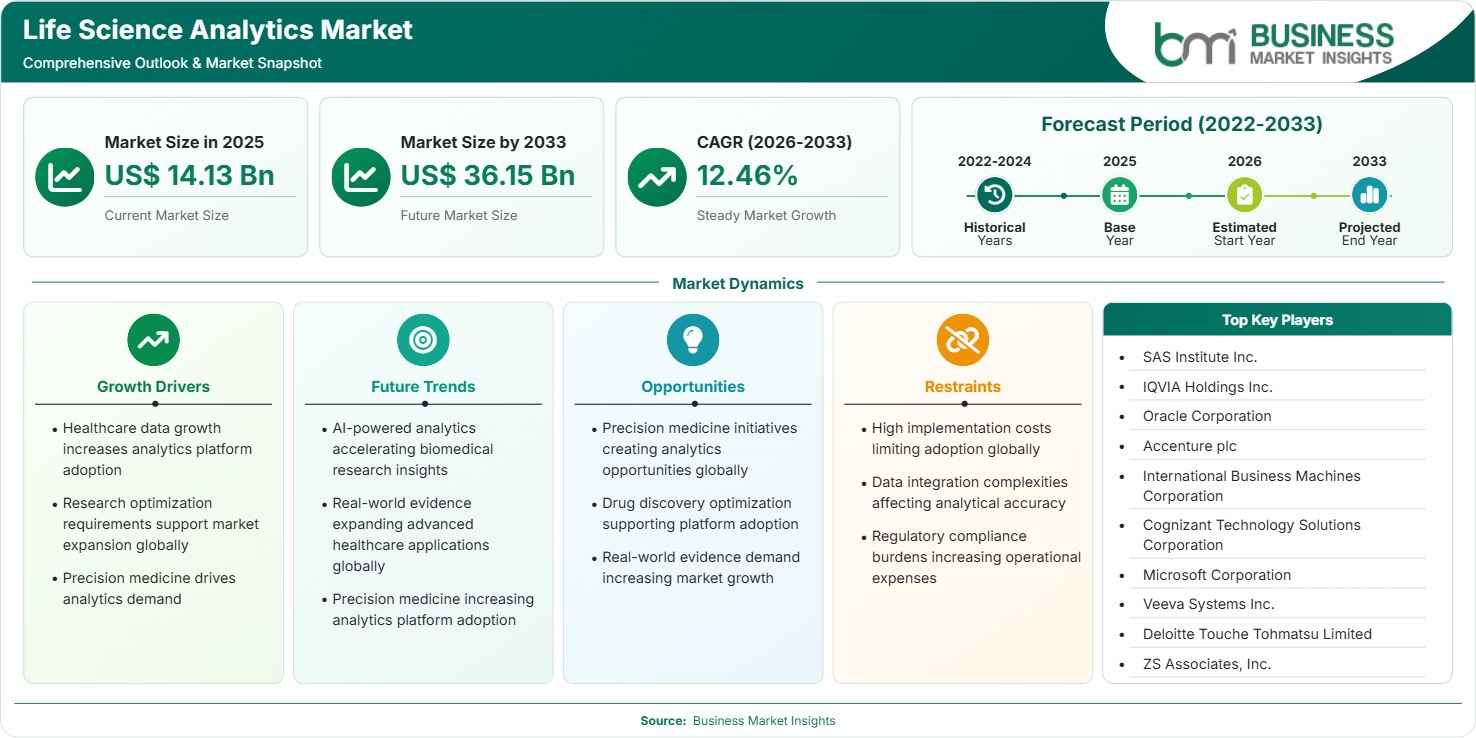
The Life Science Analytics Market size was valued at US$ 14.13 Billion in 2025 and is projected to reach US$ 36.15 Billion by 2033, growing at a CAGR of 12.46% during 2026–2033, driven by AI adoption, real-world evidence, personalized medicine, clinical trial digitization, cloud migration, and supply chain optimization.

Report Coverage
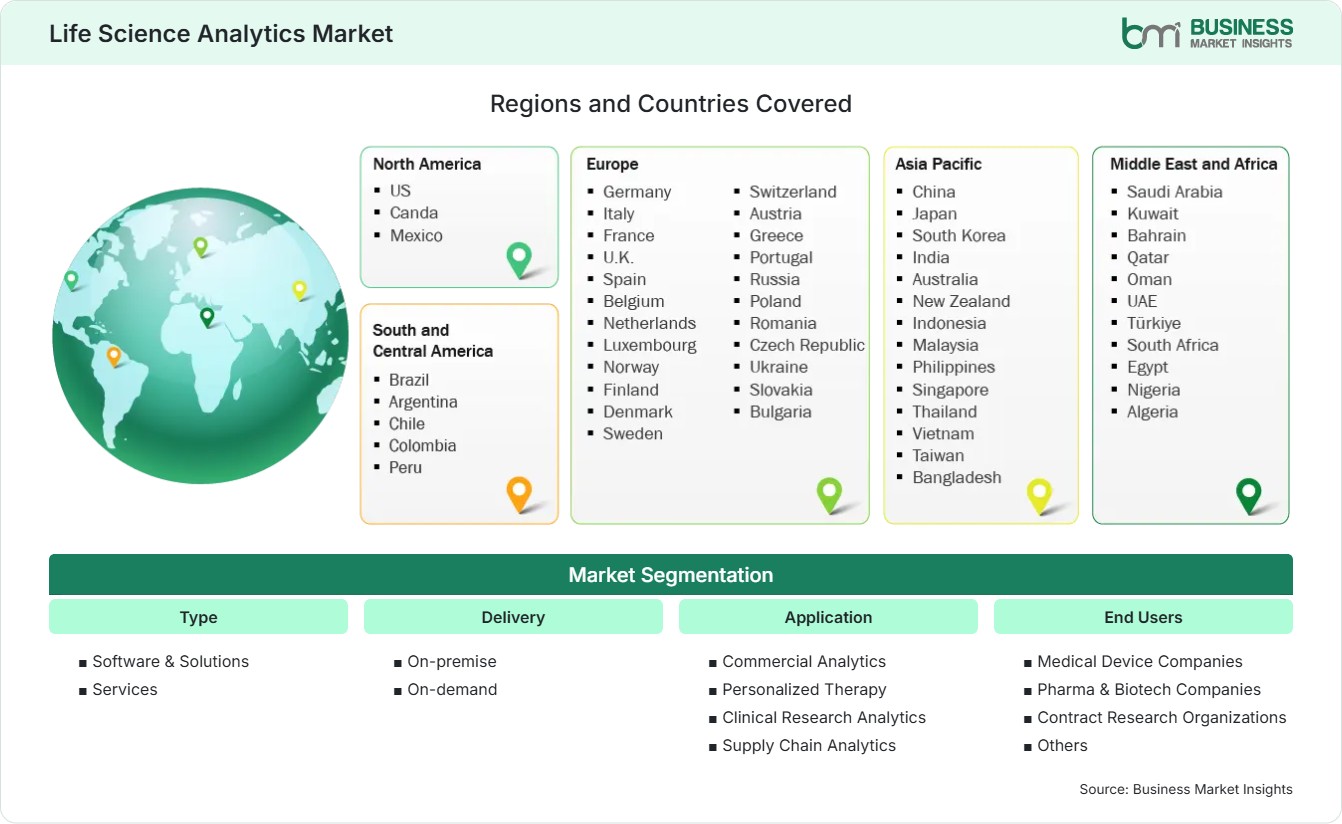
  • Type: Software & Solutions, Services
  • Delivery: On-premise, On-demand
  • Application: Commercial Analytics, Personalized Therapy, Clinical Research Analytics, Supply Chain Analytics
  • End Users: Medical Device Companies, Pharma & Biotech Companies, Contract Research Organizations, Others
US$ 14.13 Bn Market size in 2025
US$ 36.15 Bn Market Size by 2033
12.46% CAGR, 2026 - 2033
2026-2033 Forecast Period

AI Overview

Life Science Analytics Market Summary

  • North America: North America holds 49%–52% share in 2025, with a 10.0%–11.2% CAGR through 2033, supported by mature biopharma ecosystems, clinical research, strong data infrastructure, and sustained AI investment. The US market accounts for 40%–44% globally and is expanding at a 9.5%–10.5% CAGR through 2033 as pharmaceutical R&D, real-world evidence, and cloud analytics adoption deepen.
  • Fastest Growing Region: Asia Pacific captures 17%–20% Life Science Analytics Market share in 2025 and records a 12.8%–14.0% CAGR through 2033, driven by expanding R&D hubs, clinical trial activity, digital regulation, and analytics adoption.
  • Leading Segment: Services holds 54%–59% share in 2025, expanding at a 12.8%–13.6% CAGR through 2033 as organizations seek implementation, integration, validation, managed analytics, and specialized life science expertise.
  • High Growth Segment: On-demand delivery accounts for 50%–54% share in 2025 and advances at a 13.3%–14.4% CAGR through 2033 as cloud scalability, faster deployment, interoperability, and consumption-based economics gain preference.
  • Key Market Opportunity: The strongest opportunity lies in interoperable AI analytics that combine clinical, commercial, genomic, and supply-chain data, enabling faster evidence generation, personalized decisions, and scalable automation across fragmented workflows.
  • Major Market Players: SAS Institute Inc.; IQVIA Holdings Inc.; Oracle Corporation; Accenture plc; International Business Machines Corporation; Cognizant Technology Solutions Corporation; Microsoft Corporation; Veeva Systems Inc.; Deloitte Touche Tohmatsu Limited; ZS Associates, Inc.
Strategic Insights

Life Science Analytics Market: Strategic Insights

Life Science Analytics Market Strategic Framework
FREE PDF
Request your free sample
Request free sample
Stakeholder View

Key Takeaways

  • The value chain is shifting from using individual reporting tools to adopting integrated data platforms that link together the research, clinical, commercial, manufacturing, and supply-chain workflows, which in turn is leading to greater demand for vendors who have the ability to ensure interoperability and governance.
  • The potential for gain in clinical research analytics and in the area of personalized therapy is considerable since ever more advanced analytical facilities are needed to handle biomarker data, real-world evidence, patient stratification, and information from decentralized trials.
  • The kind of AI known as agentic is causing product development to shift its priorities from simply providing passive visualizations to using systems that can retrieve evidence, produce analyses, spot anomalies, recommend actions, and, at the same time, maintain traceable human supervision.
  • The Asia Pacific region presents a significant opportunity for expansion since pharmaceutical R&D, CRO activities, the clinical research infrastructure, and investment in digital healthcare are all continuing to develop in China, India, Japan, South Korea, and Singapore.
  • Money is now being directed more towards platforms that integrate proprietary data, cloud infrastructure, domain models, analytics, and workflow automation rather than towards separate AI applications, thereby promoting partnerships and leading to selective technology acquisitions.
Geographic Outlook

Life Science Analytics Market Regional Highlights

North America Life Science Analytics Market

North America represents 49%–52% Life Science Analytics Market share in 2025 and is projected to advance at a 10.0%–11.2% CAGR through 2033. The region benefits from dense pharmaceutical, biotechnology, medical device, CRO, and technology ecosystems. Strong clinical research activity supports analytics demand across trial design, patient recruitment, safety, and evidence generation.

  • In clinical research, analytics are supported by the large volumes of trials and by complex, multi-site studies, with integrated platforms helping to reduce fragmentation in the various research workflows relating to recruitment, protocol performance, patient retention, data quality, and statistical analysis.
  • Pharmaceutical and biotechnology companies are increasing their investment in generative and agentic AI, but the focus is now turning to governed implementations that produce measurable results in the areas of productivity, quality, compliance, and evidence generation.
  • Enterprise cloud ecosystems that are well developed allow organizations to consolidate their clinical, commercial, and operational data and, at the same time, provide scalable computing capacity for use in machine learning, predictive analytics, and real-world evidence programs.
  • In the area of commercial analytics, advanced segmentation, forecasting, field-force optimization, and customer engagement analytics are growing as life science companies aim to increase the precision of their resource allocation and product commercialization.

US Life Science Analytics Market

The United States accounts for approximately 40%–44% of global Life Science Analytics Market revenue and about 80%–85% of North American demand in 2025, with a 9.5%–10.5% CAGR through 2033. Its scale reflects extensive pharmaceutical R&D, sophisticated healthcare data infrastructure, high clinical trial intensity, and established analytics providers.

  • The amount of data: Because of the huge volume of clinical, claims, genomic, and commercial data, there is a need for analytics systems that are able to combine heterogeneous information while at the same time keeping patient privacy and complying with regulatory requirements.
  • In the area of research and development, drug developers are becoming more reliant on predictive models to identify risks associated with trials, to optimize the groups of patients involved, to prioritize the evidence, and to enhance the operational decisions made at all stages of the development process.
  • Pharmaceutical companies are applying advanced analytics more widely to tasks such as forecasting, territory planning, customer segmentation, omnichannel engagement, and the measurement of post-launch performance as their product portfolios become more complex.

Europe Life Science Analytics Market

Europe represents 19%–22% Life Science Analytics Market share in 2025 and is expected to expand at a 9.0%–10.5% CAGR through 2033. Germany, the United Kingdom, France, and Switzerland remain important markets because of their pharmaceutical manufacturing, research, biotechnology, and medical technology ecosystems.

  • In Germany, investment in pharmaceutical manufacturing, biotechnology research, and industrial analytics is promoting adoption, with the demand being focused on clinical development, production optimization, quality management, and evidence generation.
  • In the United Kingdom, there are strong capabilities in academic research, experience in conducting clinical trials, and a well-developed digital health infrastructure, all of which offer opportunities for the analysis of real-world evidence, the development of personalized therapy models, and the integration of research data.
  • In France and Switzerland, the existing pharmaceutical and medical technology sectors are promoting the use of advanced analytics throughout all areas of research and development, commercialization, pharmacovigilance, and supply-chain planning, with a growing focus on secure data environments.
  • The impact of regulations: the data protection and AI governance requirements in Europe prompt vendors to create transparent models, provide controlled access, ensure that their workflows are auditable, and maintain a documented data lineage in their analytics applications.

Asia Pacific Life Science Analytics Market

Asia Pacific accounts for 17%–20% Life Science Analytics Market share in 2025 and is projected to achieve a 12.8%–14.0% CAGR through 2033, making it the fastest-growing major region. China, Japan, India, South Korea, and Singapore form important demand centers.

  • China is creating a demand for analytics relating to clinical development, patient stratification, manufacturing, and commercial planning as a result of its expanding pharmaceutical innovation, biotechnology research, and digital clinical infrastructure.
  • In India, the demand for analytics in both clinical trials and commercial operations is being supported by pharmaceutical services, the expansion of contract research organizations, advances in technology capabilities, and greater adoption of digital research systems.
  • In Japan and South Korea, the presence of well-developed healthcare systems and advanced technology ecosystems provides opportunities for the use of predictive analytics, personalized therapy, medical device intelligence, and connected clinical research environments.
  • Singapore is important as a regional location for the deployment of advanced analytics and for cross-border life science data initiatives because of the concentration of biomedical research, its multinational pharmaceutical operations, and its digital infrastructure.

Rest of World Life Science Analytics Market

South and Central America together represent approximately 5%–7% Life Science Analytics Market share in 2025 and are projected to grow at a 10.0%–11.8% CAGR through 2033. Brazil remains the principal regional market, supported by pharmaceutical manufacturing, clinical research, healthcare digitization, and a large patient population.

  • In Brazil, the existing healthcare and pharmaceutical sectors generate a demand for commercial analytics, clinical research intelligence, patient segmentation, and supply-chain forecasting as companies modernize their data environments.
  • In Mexico, analytics applications aimed at operational planning, demand forecasting, and commercial performance are supported by pharmaceutical manufacturing, healthcare modernization, and its close link to the North American supply chains.
  • In the Gulf region, programs aimed at digitizing healthcare are speeding up the adoption of cloud analytics, AI-powered decision support, predictive planning, and integrated data platforms among both public and private healthcare systems.
  • In South Africa, the presence of well-established clinical research facilities and pharmaceutical activities has led to a demand for analytics, especially in the areas of evidence generation, patient insights, pharmacovigilance, and research operations.
Global Market Geography
FREE PDF
Request your free sample
Request free sample
Segment Analysis

Life Science Analytics Market Segmentation

Type

Services represent 54%–59% Life Science Analytics Market share in 2025 and are projected to grow at a 12.8%–13.6% CAGR through 2034, supported by integration, validation, consulting, managed analytics, and implementation requirements. Software remains strategically important as organizations seek reusable platforms for AI, reporting, predictive modeling, and data management.

  • Software & Solutions: Platforms combine dashboards, predictive models, AI, data management, and visualization to support research, commercial, clinical, and operational decisions across complex life science workflows.
  • Services: Consulting, implementation, integration, validation, managed analytics, and technical support address fragmented systems and specialist skill shortages, enabling organizations to operationalize advanced analytics faster.

Delivery

On-demand delivery represents 50%–54% Life Science Analytics Market share in 2025 and is expected to record a 13.3%–14.4% CAGR through 2034. Cloud scalability, lower infrastructure requirements, rapid deployment, and easier collaboration are strengthening adoption. On-premise systems remain relevant for organizations with strict control, legacy architecture, or specialized security requirements.

  • On-premise: Locally deployed environments provide direct infrastructure control and can suit regulated workloads, legacy architectures, sensitive datasets, and organizations requiring tightly managed access.
  • On-demand: Cloud-based deployment supports flexible capacity, faster implementation, remote collaboration, automated updates, and scalable analytics, making it increasingly attractive for distributed life science operations.

Application

Commercial Analytics represents a substantial application area, while Personalized Therapy and Clinical Research Analytics provide strong growth potential as evidence becomes more patient-specific. Supply Chain Analytics is gaining strategic importance as manufacturers seek better forecasting, inventory control, production visibility, and resilience.

  • Commercial Analytics: Forecasting, segmentation, market intelligence, customer analytics, and field-force optimization help pharmaceutical and medtech companies improve resource allocation and commercial execution.
  • Personalized Therapy: Analytics integrate biomarkers, patient characteristics, clinical outcomes, and real-world evidence to support treatment stratification, precision medicine, and more targeted therapeutic decisions.
  • Clinical Research Analytics: Trial analytics improve patient recruitment, protocol monitoring, data quality, safety assessment, site performance, and study forecasting while reducing manual analytical workload.
  • Supply Chain Analytics: Predictive demand planning, inventory optimization, supplier monitoring, manufacturing analytics, and logistics visibility help organizations reduce disruption and improve product availability.

End Users

Pharma and biotech companies remain the dominant end-user group, while medical device companies, CROs, and other organizations expand adoption as data complexity increases. The Life Science Analytics Market scope is broadening as analytics moves from departmental reporting toward enterprise decision infrastructure across research and commercialization.

  • Medical Device Companies: Analytics support product development, post-market surveillance, demand forecasting, customer insights, quality monitoring, and evidence generation for increasingly data-intensive device portfolios.
  • Pharma & Biotech Companies: These organizations use analytics throughout discovery, clinical development, regulatory processes, market access, commercialization, pharmacovigilance, and supply-chain planning.
  • Contract Research Organizations: CROs deploy analytics to manage trial operations, recruitment, data quality, study timelines, site performance, and evidence generation across multiple sponsors and therapeutic areas.
Market Forces

Life Science Analytics Market Dynamics

Key Market Drivers

AI-Enabled Clinical and Commercial Decision Automation

Artificial intelligence is moving analytics from descriptive reporting toward predictive and action-oriented workflows. Deloitte's 2026 life sciences outlook found that 48% of surveyed leaders identified accelerated digital transformation as a major organizational influence, while 30% identified agentic AI as an emerging factor. The Life Science Analytics Market growth, therefore, increasingly depends on AI systems that operate within governed workflows rather than standalone experimentation. Pharmaceutical companies are applying machine learning to patient recruitment, trial risk, evidence generation, commercial segmentation, and supply planning. Generative AI is also reducing manual effort in information retrieval and document-intensive processes. However, scalable adoption requires validated models, data lineage, human oversight, and measurable business outcomes. These requirements favor vendors combining analytics software with implementation, governance, domain expertise, and managed services.

Expansion of Real-World Evidence and Integrated Data Ecosystems

Real-world evidence is becoming a core analytical input for research, regulatory strategy, market access, and post-market evaluation. The increasing availability of longitudinal electronic health records, claims information, clinical datasets, registries, and patient-generated information creates demand for platforms that normalize and connect heterogeneous sources. This expansion strengthens Life Science Analytics Market trends around interoperability, common data models, evidence traceability, and secure data exchange.

Growing Analytics Requirements Across Clinical Development

Clinical development generates increasingly complex datasets from electronic systems, decentralized studies, wearables, laboratory platforms, patient-reported outcomes, and real-world sources. This complexity increases the need for analytical capabilities that identify operational risks earlier and improve study execution. AI and automation are being applied to database preparation, data quality, trial monitoring, patient recruitment, and statistical programming. IQVIA's 2026 initiatives demonstrate the direction toward integrated agentic capabilities spanning clinical, commercial, and real-world workflows. The Life Science Analytics Market opportunity extends beyond faster reporting because analytics can connect operational signals with downstream study outcomes.

Key Market Opportunities

Agentic Analytics for End-to-End Life Science Workflows

Agentic analytics offers the chance to turn multi-step analytical tasks into regulated workflows. Rather than asking users to obtain the data sets, build queries, perform calculations, interpret the results, and prepare the outputs one at a time, agentic systems can coordinate all these stages while maintaining approval controls. This approach is being demonstrated by Veeva with the launch of Falcon in 2026, where agents support clinical, regulatory, and safety processes. Likewise, such methods can be applied to areas such as commercial analytics, supply planning, evidence generation, and pharmacovigilance. Companies can distinguish themselves by using agents that are trained specifically for particular domains and based on proven workflows, rather than offering generic conversational interfaces.

Interoperable Analytics for Personalized Medicine

Since personalized medicine involves the integration of clinical, molecular, genomic, imaging, demographic, and outcome data, it offers analytics providers the chance to create interoperable environments that can connect patient characteristics with their therapeutic response and real-world outcomes. Pharmaceutical and biotechnology companies could then use these capabilities to identify different patient subgroups, improve the recruitment of participants for trials, assess the effectiveness of treatments, and help generate evidence. The same opportunity is available to medical device companies that are developing connected products and diagnostic technologies. As the datasets become more diverse, standardized data models and semantic layers become commercially valuable since they cut down on the need for repeated data transformation.

Analytics for Resilient Pharmaceutical Supply Chains

Supply-chain analytics offers an expanding opportunity as pharmaceutical companies balance demand uncertainty, manufacturing complexity, inventory requirements, supplier concentration, and regulatory obligations. Predictive models can combine historical demand, production capacity, logistics information, inventory positions, supplier performance, and external signals to improve planning. Advanced analytics can also identify potential shortages and prioritize mitigation actions before disruptions become operationally severe. The Life Science Analytics Market opportunity extends from manufacturing sites to wholesalers, distributors, and commercial teams.

Market Restraints and Challenges

Data Quality, Interoperability, and Legacy-System Fragmentation

Factor: Life science organizations frequently operate fragmented technology estates containing legacy databases, inconsistent identifiers, incompatible formats, incomplete metadata, and departmental data silos.

Impact: Implementation timelines can lengthen because vendors must normalize information, establish interfaces, reconcile definitions, and validate transformations before analytics can be deployed at scale.

Privacy, Validation, and Responsible AI Requirements

Factor: Life science analytics processes sensitive health information and supports decisions that may affect clinical research, product safety, regulatory submissions, and commercial strategy.

Impact: Organizations may delay deployment while legal, compliance, quality, security, and scientific teams evaluate model behavior and data usage. Responsible AI requirements can also increase development costs because organizations need monitoring, explainability, access controls, audit trails, and human oversight.

Company Analysis

Competitive Landscape

The Life Science Analytics Market analysis indicates a fragmented competitive environment spanning enterprise technology companies, specialized analytics providers, clinical research organizations, cloud platforms, and consulting firms.

Company Name

Overview

Products and Services relevant to this market

SAS Institute Inc.

Analytics specialist providing enterprise data science, AI, statistical analysis, and industry-focused decision-support capabilities for complex regulated environments.

Advanced analytics, AI, predictive modeling, statistical computing, data management, clinical analytics, commercial intelligence, and decision-support solutions.

IQVIA Holdings Inc.

Global life sciences intelligence and research provider combining healthcare data, technology, analytics, and clinical research expertise.

Clinical analytics, real-world evidence, commercial analytics, healthcare intelligence, AI, data services, and research technology platforms.

Oracle Corporation

Enterprise technology provider extending cloud infrastructure, data platforms, AI, and healthcare capabilities into life sciences workflows.

Life sciences data intelligence, real-world data analytics, AI platforms, cloud infrastructure, clinical technology, supply-chain analytics, and enterprise applications.

Accenture plc

Global professional services company supporting digital transformation, cloud modernization, AI implementation, and data-driven operating models across life sciences.

AI, analytics, cloud transformation, data engineering, digital strategy, commercial analytics, supply-chain optimization, and life sciences consulting.

International Business Machines Corporation

Technology company providing enterprise AI, hybrid cloud, data management, automation, and analytical capabilities for regulated industries.

AI, data platforms, predictive analytics, automation, hybrid cloud, consulting, clinical data solutions, and enterprise decision support.

Cognizant Technology Solutions Corporation

Technology services provider focused on digital transformation, AI, data modernization, and operational technology for healthcare and life sciences organizations.

Life sciences analytics, AI, cloud services, data engineering, clinical technology, commercial transformation, and supply-chain solutions.

Microsoft Corporation

Global cloud and software provider supporting enterprise analytics, AI, data integration, collaboration, and scalable computing for life sciences.

Cloud analytics, AI services, data platforms, machine learning, visualization, workflow automation, and research computing infrastructure.

Veeva Systems Inc.

Industry cloud provider focused exclusively on life sciences applications spanning clinical, regulatory, quality, safety, commercial, and data workflows.

Vault applications, AI agents, clinical analytics, commercial analytics, regulatory data, safety solutions, customer data, and workflow automation.

Deloitte Touche Tohmatsu Limited

Professional services network providing strategy, technology, analytics, AI, risk, and transformation capabilities across the life sciences value chain.

AI strategy, analytics transformation, data governance, commercial analytics, supply-chain optimization, clinical transformation, and digital consulting.

ZS Associates, Inc.

Specialized consulting and technology provider serving pharmaceutical, biotechnology, and healthcare organizations with data-driven commercial and operational solutions.

Commercial analytics, AI, data science, customer intelligence, forecasting, field-force optimization, digital transformation, and life sciences consulting.

Trust & Transparency

Research Methodology

The market analysis combines proprietary research with secondary data from government agencies, company disclosures, regulatory filings, industry databases and expert interviews. Market estimates are validated through data triangulation, cross-market benchmarking and analyst review.

View Full Research Methodology

Questions Answered

Frequently Asked Questions

What should buyers evaluate before deploying analytics platforms?

The Life Science Analytics Market Report highlights that Buyers should evaluate data interoperability, security, validation, model transparency, scalability, integration effort, workflow compatibility, regulatory controls, vendor expertise, total cost of ownership, and the ability to demonstrate measurable operational or scientific outcomes.

What is the role of CROs in analytics adoption?

CROs manage complex clinical research programs across multiple sponsors and study environments. Analytics helps them improve recruitment, site performance, data quality, study forecasting, monitoring, and reporting while creating reusable capabilities across therapeutic areas.

How does agentic AI differ from conventional analytics?

Conventional analytics generally presents information or predictions for users to interpret. Agentic AI can coordinate multiple analytical steps, retrieve information, generate analyses, recommend actions, and execute approved workflow tasks while operating within defined controls.

Why are real-world data platforms becoming strategically important?

Real-world data can connect clinical experiences, patient outcomes, healthcare utilization, and treatment patterns outside controlled trials. Analytics platforms increasingly use these datasets for evidence generation, cohort analysis, safety monitoring, market access, and post-market evaluation.

What technologies are reshaping life science analytics adoption?

Cloud analytics, artificial intelligence, machine learning, real-world data platforms, agentic AI, common data models, application programming interfaces, and automated data-quality technologies are reshaping deployment priorities across research, clinical, commercial, and operational workflows.

Access the Full Life Science Analytics Market Report

Get segment-level forecasts, regional estimates, competitive benchmarking, company profiles and downloadable Excel datasets.

Access the full Life Science Analytics Market Report
350 pages PDF & Excel | 2026-10-22
Similar Research

Related Market Reports