
AI In Mental Health Market Outlook: Size, Share, Trends, Growth Analysis, Competitive Landscape & Forecast, 2026–2033

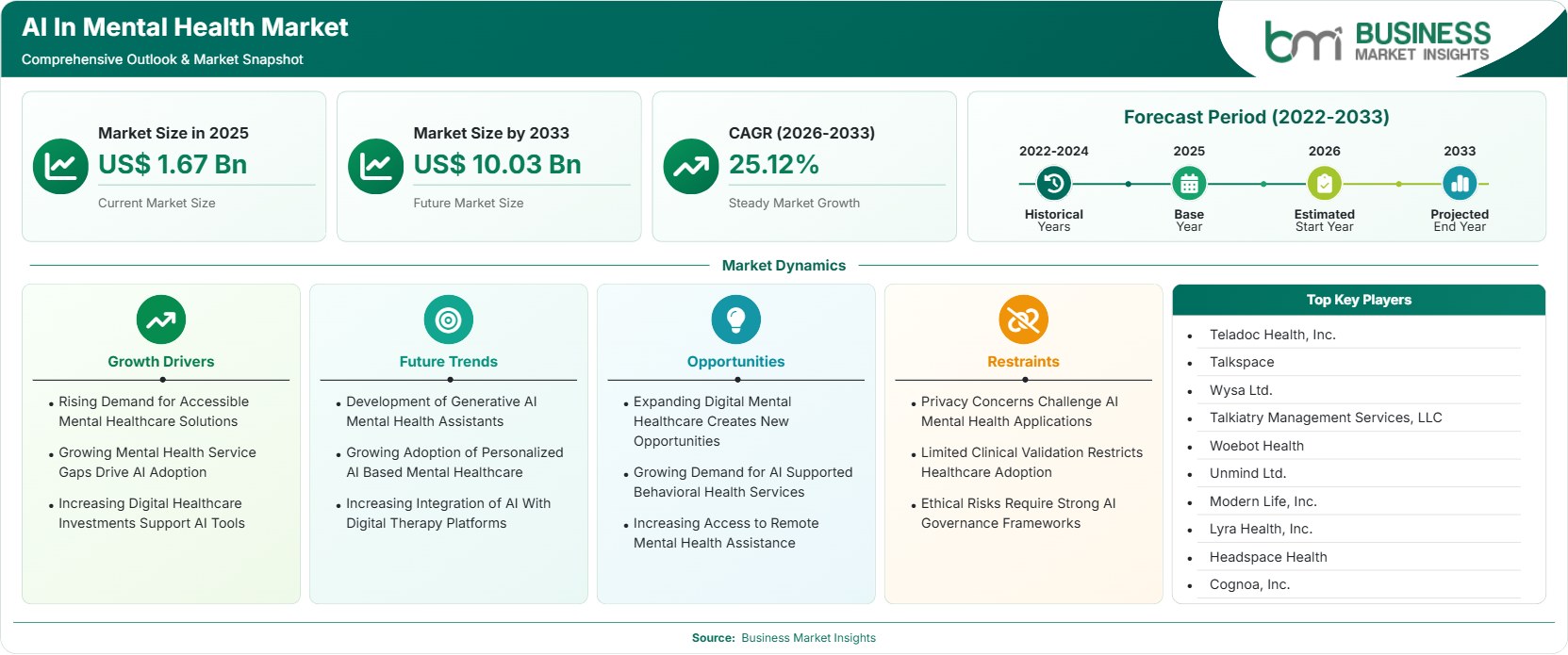
The AI In Mental Health Market size was valued at US$ 1.67 Billion in 2025 and is projected to reach US$ 10.03 Billion by 2033, growing at a CAGR of 25.12% during 2026–2033, driven by healthcare access gaps, digital care expansion, AI investment, remote assistance, and behavioral health demand.

Report Coverage
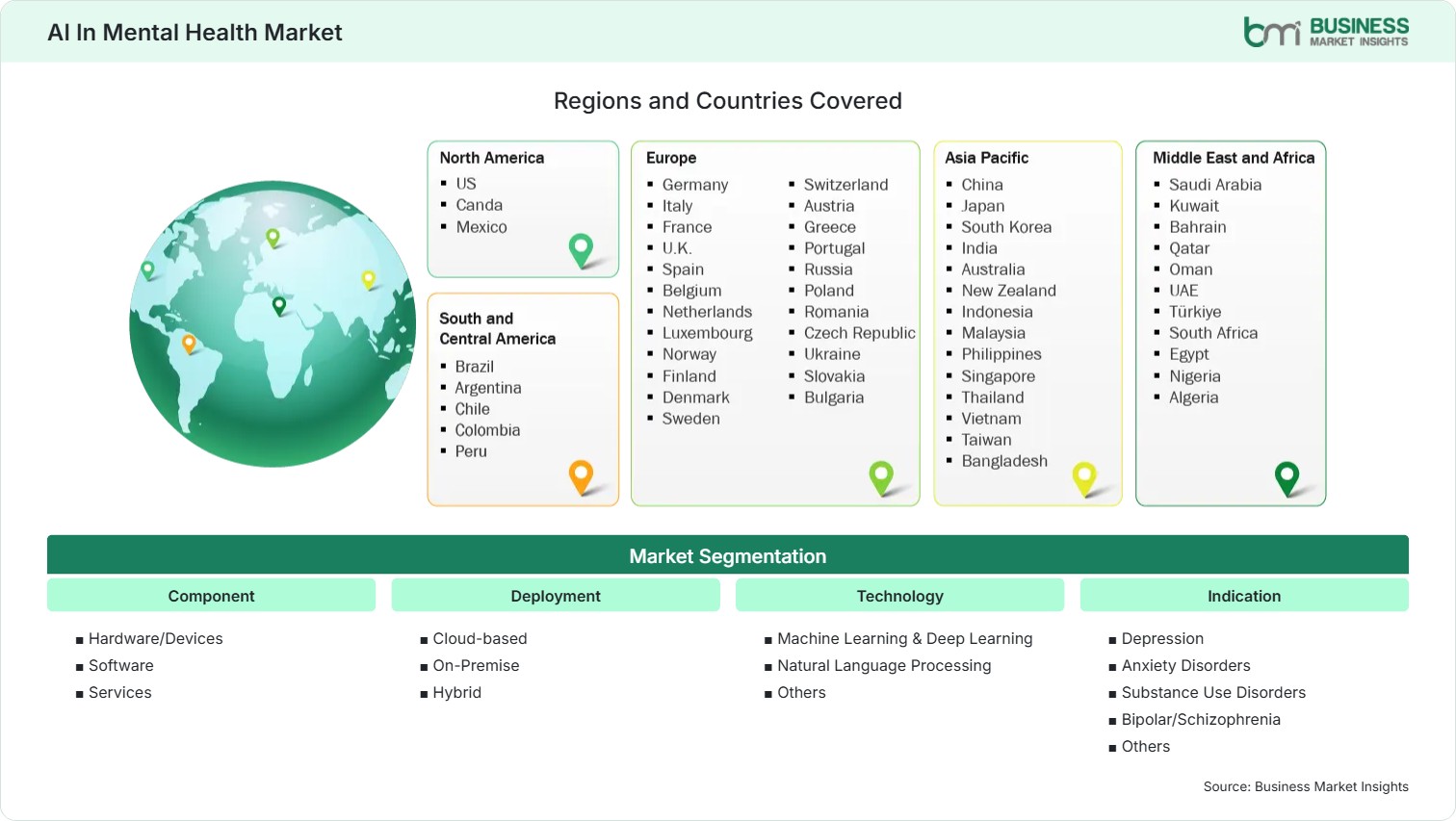
  • Component: Hardware/Devices, Software, Services
  • Deployment: Cloud-based, On-Premise, Hybrid
  • Technology: Machine Learning & Deep Learning, Natural Language Processing, Others
  • Indication: Depression, Anxiety Disorders, Substance Use Disorders, Bipolar/Schizophrenia, Others
  • Application: Screening & Assessment, Therapy Support/Digital Therapeutics, Care Navigation & Triage, Clinical Documentation, Remote Monitoring & Relapse Prediction, Others
US$ 1.67 Bn Market size in 2025
US$ 10.03 Bn Market Size by 2033
25.12% CAGR, 2026 - 2033
2026-2033 Forecast Period

AI Overview

AI In Mental Health Market Summary

  • North America: North America holds a 39%–43% share in 2025 and is advancing at a 24.0%–25.8% CAGR through 2033, supported by digital behavioral healthcare infrastructure, telehealth adoption, provider shortages, employer-sponsored mental health programs, and investment in AI-enabled clinical workflows. The US represents a 35%–39% global share and is advancing at a 24.4%–26.2% CAGR, supported by established digital health ecosystems and demand for scalable behavioral healthcare.
  • Fastest Growing Region: Asia Pacific holds a 22%–26% share in 2025 and records the fastest expansion at a 27.0%–29.0% CAGR through 2033, supported by expanding smartphone access, uneven availability of mental health professionals, digital health investment, teleconsultation growth, and increasing acceptance of technology-assisted behavioral support.
  • Leading Segment: Software & Services accounts for a 69%–73% share in 2025 and is advancing at a 25.0%–26.5% CAGR through 2033, supported by scalable digital platforms, conversational interfaces, clinical decision support, remote monitoring, care navigation, and integration with behavioral health workflows.
  • High Growth Segment: Cloud-based deployment represents a 51%–55% share in 2025 and is expanding at a 27.0%–28.8% CAGR through 2033, supported by scalable infrastructure, remote accessibility, lower deployment complexity, continuous software updates, and growing demand for interoperable digital care platforms.
  • Key Market Opportunity: Expanding digital behavioral healthcare creates opportunities for AI-assisted screening, personalized interventions, care navigation, remote monitoring, multilingual support, and clinician workflow automation across underserved populations and distributed care settings.
  • Major Market Players: Teladoc Health, Inc., Talkspace, Wysa Ltd., Talkiatry Management Services, LLC, Woebot Health, Unmind Ltd., Modern Life, Inc., Lyra Health, Inc., Headspace Health, Cognoa, Inc.
Strategic Insights

AI In Mental Health Market: Strategic Insights

AI In Mental Health Market Strategic Framework
FREE PDF
Request your free sample
Request free sample
Stakeholder View

Key Takeaways

  • Mental healthcare providers are increasingly evaluating AI according to its ability to extend clinician capacity without replacing clinical judgment, making workflow integration a critical adoption criterion.
  • Conversational systems have commercial potential when they complement professional care through structured engagement, screening assistance, education, monitoring, and timely escalation to human providers.
  • Product development is shifting toward multimodal systems that can combine language, behavioral signals, patient-reported information, and longitudinal records to support more personalized interventions.
  • Asia Pacific offers a compelling expansion environment because digital health adoption can help address uneven provider availability and geographic disparities in behavioral healthcare access.
  • Investment priorities are moving toward platforms that combine clinical utility with privacy engineering, interoperability, regulatory readiness, and measurable patient or provider outcomes.
  • Sustainable competitive positioning will depend on evidence quality, responsible AI governance, clinician acceptance, user trust, integration capabilities, and the ability to demonstrate meaningful healthcare value.
Geographic Outlook

AI In Mental Health Market Regional Highlights

North America AI In Mental Health Market

North America holds a 39%–43% AI In Mental Health Market share in 2025 and is projected to grow at a 24.0%–25.8% CAGR through 2033. Strong digital health infrastructure, telebehavioral care adoption, and investment in healthcare technology support regional leadership.

  • Behavioral health services professionals have been embedding technologies in screening, patient engagement, care coordination, and remote monitoring processes.
  • Employee mental health programs will increase the need for scalable technologies that can support geographically dispersed people.
  • Privacy, interoperability, evidence of efficacy, and EHR integration are becoming more important to healthcare organizations.
  • The United States is the leading regional AI In Mental Health Market because of telehealth infrastructure, digital health investments, and continuous demand for behavioral health capabilities.

US AI In Mental Health Market

The US represents a 35%–39% global share in 2025 and is advancing at a 24.4%–26.2% CAGR through 2033. Demand reflects provider capacity constraints, digital behavioral health infrastructure, and growing technology adoption.

  • AI technology is being considered in health care and behavioral health institutions in relation to documentation, screening, triage, consumer engagement, and monitoring.
  • Behavioral health services supported by employers give more ways of distributing digital mental health solutions.
  • Regulatory considerations and clinical evidence play an important role in making purchase decisions, along with functional features and usability.

Europe AI In Mental Health Market

Europe accounts for a 25%–29% share in 2025 and is expanding at a 23.0%–24.8% CAGR through 2033. Germany, the UK, France, Italy, and Spain represent important markets, while the UK and Germany offer strong growth potential.

  • The UK has potential via the existing digital health initiatives, tele-behavioral services, and technology-enabled care pathways.
  • The German market needs safe digital health services capable of operating within the framework of structured healthcare provision and payment models.
  • France and Spain offer opportunities as digital mental healthcare becomes increasingly relevant to access, continuity, and remote patient support.
  • European buyers increasingly emphasize data governance, clinical evidence, transparency, and compatibility with national healthcare systems.

Asia Pacific AI In Mental Health Market

Asia Pacific represents a 22%–26% share in 2025 and records the fastest growth at a 27.0%–29.0% CAGR through 2033. China, Japan, South Korea, India, and Australia provide diverse expansion opportunities.

  • India provides great scope for the use of digital multilingual assistance, tele-screening, care navigation, and other technology-based solutions dealing with specialist shortages.
  • China is set for growth by leveraging digital health platforms, AI applications, mobile applications, and behavioral health services.
  • Japan and South Korea provide opportunities for technology-assisted monitoring and digital interventions supported by advanced healthcare and technology ecosystems.
  • Australia offers demand for remote behavioral healthcare tools serving dispersed populations and complementing established telehealth infrastructure.

Rest of World AI In Mental Health Market

Rest of World holds a 12%–16% share in 2025 and is projected to advance at a 24.0%–26.0% CAGR through 2033. Latin America, the Middle East, and Africa provide opportunities linked to digital access and provider shortages.

Adoption of Latin American markets is driven by mobile health care service delivery, growing telemedicine, and the need for cost-effective behavioral services. Digital health infrastructure is being explored in Middle Eastern markets, while in Africa, a mobile-first approach can help provide mental health assistance outside the traditional institutional framework.

  • Brazil and Mexico provide opportunities for mobile behavioral support, remote engagement, and digitally enabled screening across expanding healthcare technology ecosystems.
  • Gulf AI In Mental Health Market offer opportunities through technology investment, integrated healthcare infrastructure, and growing interest in digitally supported behavioral services.
  • South Africa offers a possible region for using technology to provide mental health services in urban and non-urban settings.
  • Developing countries will gain by using multilingual interface options, low bandwidth services, and a hybrid system that combines automation and professional services.
Global Market Geography
FREE PDF
Request your free sample
Request free sample
Segment Analysis

AI In Mental Health Market Segmentation

Component

Software & Services leads the component structure with a 69%–73% share in 2025 and a 25.0%–26.5% CAGR through 2033. Scalable platforms and recurring digital services support wider adoption.

  • Hardware/Devices: Supports monitoring and data collection through connected devices, sensors, and digital interfaces that can complement behavioral assessment and remote patient management.
  • Software & Services: Enables screening, conversational support, documentation, care navigation, analytics, and monitoring while supporting scalable deployment across healthcare environments.

Deployment

Cloud-based deployment accounts for a 51%–55% share in 2025 and a 27.0%–28.8% CAGR through 2033. Scalability, accessibility, centralized updates, and distributed care requirements support adoption.

  • Cloud-based: Provides scalable access to AI applications, supports distributed healthcare teams, and simplifies software updates, analytics, and remote service delivery.
  • On-Premise: Provides organizations with greater infrastructure control and can appeal to institutions requiring localized data management and tightly controlled technology environments.
  • Hybrid: Combines cloud scalability with localized infrastructure, supporting organizations balancing accessibility, interoperability, security requirements, and control over sensitive behavioral health information.

Technology

Machine Learning & Deep Learning represents a leading technology category with a 47%–51% share in 2025 and a 24.5%–26.0% CAGR through 2033. Predictive analytics and personalization support adoption.

  • Machine Learning & Deep Learning: Supports pattern recognition, risk prediction, personalization, and analysis of complex behavioral information across longitudinal patient interactions.
  • Natural Language Processing: Enables conversational interfaces, sentiment analysis, clinical text processing, and automated extraction of relevant information from patient-provider interactions.

Indication

Depression holds a 30%–34% share in 2025 and is advancing at a 24.5%–26.0% CAGR through 2033. High prevalence and digital intervention suitability support continued application.

  • Depression: Supports screening, symptom monitoring, behavioral interventions, patient engagement, and escalation pathways that can complement professional mental healthcare.
  • Anxiety Disorders: Enables conversational support, screening assistance, symptom tracking, and personalized digital interventions for patients requiring continuous behavioral engagement.
  • Substance Use Disorders: Offers opportunities for monitoring, behavioral support, relapse-risk identification, and connection with professional services across continuing-care pathways.
  • Bipolar/Schizophrenia: Can support monitoring, documentation, engagement, and early identification of behavioral changes when used alongside appropriate clinical oversight.

Application

Therapy Support/Digital Therapeutics leads applications with a 31%–35% share in 2025 and a 26.0%–27.5% CAGR through 2033. Personalized digital engagement supports expansion.

  • Screening & Assessment: Helps structure patient information, identify potential concerns, and prioritize individuals requiring further professional evaluation.
  • Therapy Support/Digital Therapeutics: Provides guided digital interventions, behavioral exercises, engagement tools, and personalized support that complement clinician-led treatment.
  • Care Navigation & Triage: Helps direct users toward appropriate resources, services, clinicians, or escalation pathways according to identified needs.
  • Clinical Documentation: Automates selected documentation activities, reducing administrative workload and allowing clinicians to dedicate more time to patient-facing responsibilities.
  • Remote Monitoring & Relapse Prediction: Supports longitudinal observation and identification of behavioral changes that may warrant additional assessment or clinical intervention.
Market Forces

AI In Mental Health Market Dynamics

Key Market Drivers

Rising Demand for Accessible Mental Healthcare Solutions

The limitations that people have to contend with have driven healthcare providers to find ways for the technology to deliver more behavioral health solutions outside the traditional visit model. AI-enabled software would allow them to structure engagement, conduct screening, educate the patient, and monitor the individual between sessions. This approach is especially useful in those instances where there is a shortage of specialists or the distance to the facility prevents people from getting the help. Digital platforms also enable a consistent interaction without involving clinicians at each interaction. The ecosystem of Artificial Intelligence in the mental healthcare environment thus builds up along the lines of a combination of automated and professional services. Healthcare providers may derive more value from creating escalation paths, roles, and workflow design to make sure that the automated support is placed at an appropriate position within the entire process.

Growing Mental Health Service Gaps Drive AI Adoption

The ever-growing gap between the need for behavioral health care and professional capacity is leading to innovation through technology. AI will help automate tasks like organizing intake, documentation, monitoring symptoms, preparing for appointments, and engaging with the patients. Such capabilities can enable clinicians to balance their workload while still keeping human professionals in charge of diagnostics and treatment decisions. There is an increasing focus on evaluating how automation can help ensure consistency and not only save money. The success of this process will depend on the identification of applications that provide clear value through quantifiable benefits and governance systems that determine where humans need to intervene. With increasing experience, usage could evolve from administrative support to more complex monitoring and decision-making capabilities.

Increasing Digital Healthcare Investments Support AI Tools

The investment in digital health infrastructure has created a favorable climate for AI-supported behavioral solutions by making organizations more familiar with cloud-based services, telemedicine, connectivity, and interoperable platforms. AI can leverage these existing resources and does not need separate channels for its delivery. Technology investments are focused on those innovations that have the potential to fit seamlessly into existing processes and deliver valuable insights for doctors. Companies can create value propositions by showcasing improvements in engagement rates, efficiency, and care coordination. The development path for AI in mental healthcare will largely be determined by the ability of vendors to produce clinically meaningful solutions with good governance and performance.

Key Market Opportunities

Expanding Digital Mental Healthcare Creates New Opportunities

Mental healthcare delivery platforms powered by AI technology are generating new business possibilities through the expansion of the scope of screening, behavior therapy, care coordination, and monitoring outside the traditional clinical settings. Healthcare organizations may leverage the potential of AI tools to increase access and assist clinicians through digital workflow management. The AI In Mental Health Market forecast indicates that there is potential for the development of applications that will offer intelligent screening, personalized engagement, monitoring, and workflow automation. Providers can boost their chances to succeed by creating platforms that will be interoperable, secure in terms of data privacy, provide clear outputs, and facilitate the involvement of clinicians. These abilities will enhance the utility of AI applications in addition to solving the problem of scalability of mental health programs within healthcare organizations.

Growing Demand for AI Supported Behavioral Health Services

Personalized behavioral healthcare would be facilitated through AI by virtue of the differences in patients’ needs, symptoms, engagement patterns, and treatment reactions. Algorithms would allow recognizing patterns throughout repeated interactions and presenting necessary data to clinicians or care teams. Thus, there would be room for personalized solutions that could facilitate treatment adherence, symptom management, behavioral activities, and relapse risk assessment. Additionally, developers would be able to reach niche audiences and tailor interfaces and languages accordingly. The growth of a commercial market would depend on evidence proving that technology is beneficial in improving engagement and processes of care without raising too much concern. Collaborations with providers, academics, and digital health companies will help speed up validation and also assist developers in developing their product around clinical requirements.

Increasing Access to Remote Mental Health Assistance

Remote mental healthcare is expanding the addressable user base for AI-enabled tools by connecting individuals with screening, guidance, monitoring, and care-navigation capabilities outside traditional facilities. Platforms that operate through smartphones and web-based interfaces can support users who face geographic, scheduling, or availability barriers. The AI In Mental Health Market trend is also encouraging developers to design solutions around continuous engagement, personalized recommendations, and integration with telehealth workflows. Commercial opportunities are particularly relevant where digital infrastructure supports remote service delivery and healthcare organizations seek technologies that can extend existing mental health resources without requiring proportional increases in physical capacity.

Market Restraints and Challenges

Privacy Concerns Challenge AI Mental Health Applications

Factor: Mental health applications may process highly sensitive information, including personal disclosures, behavioral patterns, clinical histories, and interaction data. Impact: Privacy concerns can slow adoption among patients, providers, and institutions that require strong safeguards before integrating AI into care pathways. Developers must implement appropriate security controls, access management, data governance, and transparent information practices. Organizations may also require clear policies governing data retention, third-party processing, and secondary use. These requirements can increase development and implementation complexity while extending procurement cycles. Vendors that demonstrate strong privacy architecture and transparent governance can reduce institutional resistance and improve trust among users who may be particularly cautious about sharing sensitive behavioral information through automated systems.

Limited Clinical Validation Restricts Healthcare Adoption

Factor: Some AI mental health applications may lack sufficient evidence demonstrating consistent performance across diverse populations, clinical settings, and real-world care conditions. Impact: Limited validation can make healthcare organizations reluctant to rely on automated outputs for screening, monitoring, or treatment-related decisions. Developers need structured evaluation programs that assess accuracy, safety, usability, bias, and clinical relevance before broad deployment. Evidence requirements can increase development timelines and costs, particularly when products operate in regulated healthcare environments. Providers may also demand ongoing monitoring after deployment to identify performance changes. Strong clinical partnerships and transparent validation methodologies can therefore become important commercial assets for vendors seeking institutional adoption and long-term healthcare relationships.

Company Analysis

Competitive Landscape

The AI In Mental Health Market analysis indicates competition among digital behavioral health providers, telehealth companies, AI specialists, and technology-enabled healthcare platforms. Differentiation centers on clinical evidence, privacy, AI capabilities, workflow integration, user experience, provider partnerships, scalability, and the ability to connect automated assistance with professional care.

Company Name

Overview

Products and Services relevant to this market

Teladoc Health, Inc.

Digital healthcare company providing virtual care and technology-enabled healthcare services across multiple clinical areas.

Behavioral health services, virtual mental healthcare, digital engagement, remote care delivery, and technology-enabled patient support.

Talkspace

Digital behavioral healthcare provider focused on expanding access to therapy and psychiatric services through online platforms.

Online therapy, psychiatry, behavioral health support, digital patient engagement, and technology-enabled mental healthcare delivery.

Wysa Ltd.

Digital mental health company focused on AI-enabled conversational support and accessible behavioral health engagement.

AI conversational support, mental health coaching, behavioral exercises, wellness engagement, and digital mental health services.

Talkiatry Management Services, LLC

Technology-enabled behavioral healthcare organization connecting patients with psychiatric professionals through virtual care models.

Virtual psychiatry, behavioral health services, digital patient engagement, psychiatric assessment, and remote treatment support.

Woebot Health

Digital mental health company developing conversational technology designed to support behavioral health engagement.

AI-enabled conversational mental health support, behavioral interventions, digital therapeutic approaches, and patient engagement technologies.

Unmind Ltd.

Digital mental health platform focused on workplace behavioral health and employee wellbeing.

Digital mental health programs, behavioral health resources, employee wellbeing tools, and technology-supported mental health engagement.

Modern Life, Inc.

Mental healthcare technology company focused on improving access and coordination across behavioral health services.

Digital mental health support, care coordination, behavioral health services, and technology-enabled patient engagement.

Lyra Health, Inc.

Behavioral healthcare company combining technology with provider networks and employer-focused mental health services.

Digital behavioral health support, therapy access, care navigation, provider matching, and technology-enabled mental healthcare.

Headspace Health

Digital mental health and wellness company providing technology-supported behavioral health and wellbeing resources.

Digital mental health programs, mindfulness content, behavioral health support, meditation services, and technology-enabled wellbeing solutions.

Cognoa, Inc.

Healthcare technology company developing AI-enabled tools for earlier identification and support of developmental and behavioral conditions.

AI-enabled assessment technologies, developmental screening, behavioral health-related tools, and clinical decision-support solutions.

Trust & Transparency

Research Methodology

The market analysis combines proprietary research with secondary data from government agencies, company disclosures, regulatory filings, industry databases and expert interviews. Market estimates are validated through data triangulation, cross-market benchmarking and analyst review.

View Full Research Methodology

Questions Answered

Frequently Asked Questions

What does the AI In Mental Health Market Report indicate about future competition?

Future competition will emphasize clinical validation, privacy, responsible AI governance, interoperability, personalization, workflow integration, and measurable outcomes. Companies capable of combining scalable technology with professional care networks and credible evidence can strengthen institutional adoption and long-term market positioning.

Why are remote mental health services creating new opportunities for AI?

Remote services can reach patients outside conventional healthcare facilities and provide support across geographically dispersed populations. AI can strengthen these models through automated engagement, structured check-ins, screening assistance, navigation, and monitoring while connecting users with professionals when additional care is required.

How are AI technologies influencing mental healthcare delivery?

Machine learning, deep learning, and natural language processing are enabling automated interaction, information analysis, personalization, behavioral monitoring, and workflow support. Their strongest applications are emerging where technology can augment professional care while maintaining appropriate human review and escalation.

Which applications present the strongest opportunity in the market?

Screening and assessment, therapy support, digital therapeutics, care navigation, clinical documentation, remote monitoring, and relapse prediction provide attractive opportunities. Solutions that connect these applications with professional oversight can address access challenges while creating broader value for healthcare providers.

What factors are improving AI In Mental Health Market return on investment?

Automation of repetitive workflows, improved patient engagement, scalable remote support, care navigation, documentation assistance, and monitoring capabilities can improve economic value. Organizations can strengthen returns when AI applications complement clinicians, reduce administrative friction, and improve continuity across behavioral healthcare pathways.

Access the Full AI In Mental Health Market Report

Get segment-level forecasts, regional estimates, competitive benchmarking, company profiles and downloadable Excel datasets.

Access the full AI In Mental Health Market Report
350 pages PDF & Excel | 2026-09-15
Similar Research

Related Market Reports