
Dialysis Market Outlook: Size, Share, Trends, Growth Analysis, Competitive Landscape & Forecast, 2026–2033

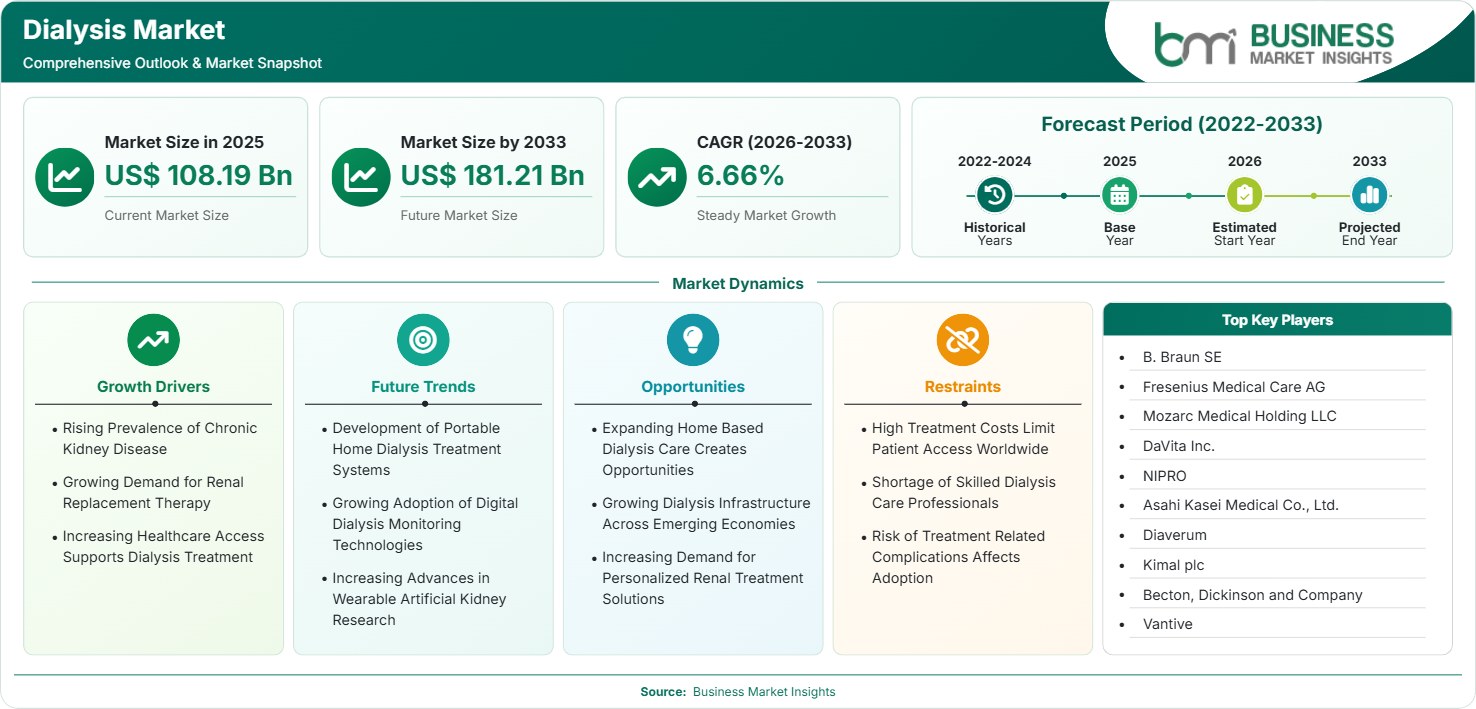
The Dialysis Market size was valued at US$ 108.19 Billion in 2025 and is projected to reach US$ 181.21 Billion by 2033, growing at a CAGR of 6.66% during 2026–2033, driven by rising kidney failure treatment needs, expanding dialysis access, home-based care adoption, technological innovation, and opportunities in connected treatment systems.

Report Coverage
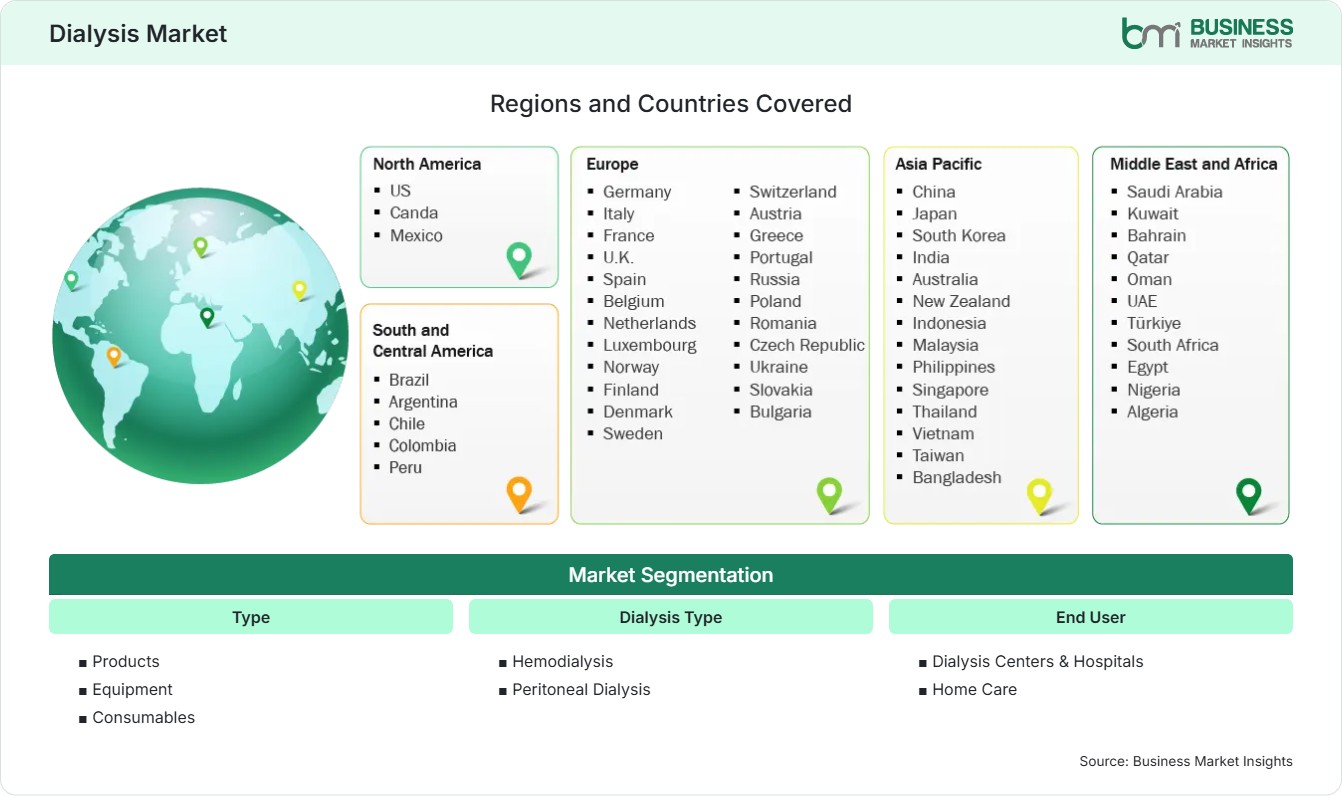
  • Type: Products, Equipment, Consumables
  • Dialysis Type: Hemodialysis, Peritoneal Dialysis
  • End User: Dialysis Centers & Hospitals, Home Care
US$ 108.19 Bn Market size in 2025
US$ 181.21 Bn Market Size by 2033
6.66% CAGR, 2026 - 2033
2026-2033 Forecast Period

AI Overview

Dialysis Market Summary

  • North America Region: North America holds an estimated 37%–40% share in 2025 and is projected to grow at a 5.9%–6.4% CAGR during 2026–2033. Demand is supported by established treatment infrastructure, reimbursement coverage, home dialysis expansion, technological upgrades, and opportunities in remote monitoring, integrated care delivery, and patient-centered renal services. The US is expected to grow at a 6.0%–6.5% CAGR.
  • Fastest Growing Region: Asia Pacific holds an estimated 25%–28% share in 2025 and is projected to expand at a 7.4%–8.2% CAGR through 2033. Expanding healthcare access, rising chronic kidney disease detection, treatment infrastructure investment, urban hospital development, and increasing availability of dialysis technologies are creating substantial opportunities across major and emerging economies.
  • Leading Segment: Consumables hold an estimated 43%–47% share in 2025 and are projected to grow at a 6.7%–7.3% CAGR, supported by recurring treatment requirements, increasing procedure volumes, infection-control priorities, and continued demand for dialyzers, tubing, concentrates, catheters, and other essential treatment supplies.
  • High Growth Segment: Home Care holds an estimated 18%–22% share in 2025 and is projected to advance at a 7.8%–8.6% CAGR, driven by patient preference for treatment flexibility, remote monitoring capabilities, portable equipment, supportive reimbursement policies, and healthcare providers seeking alternatives to capacity-constrained treatment facilities.
  • Key Market Opportunity: Connected home dialysis, remote patient monitoring, portable equipment, localized treatment networks, and integrated renal care models offer strong opportunities for providers and manufacturers addressing access, convenience, and long-term treatment management.
  • Major Market Players: B. Braun SE, Fresenius Medical Care AG, Mozarc Medical Holding LLC, DaVita Inc., NIPRO, Asahi Kasei Medical Co., Ltd., Diaverum, Kimal plc, Becton, Dickinson and Company, and Vantive.
Strategic Insights

Dialysis Market: Strategic Insights

Dialysis Market Strategic Framework
FREE PDF
Request your free sample
Request free sample
Stakeholder View

Key Takeaways

  • Recurring treatment requirements create a resilient value chain centered on equipment manufacturers, consumable suppliers, service providers, clinical networks, home-care support, and long-term patient management.
  • Home-based treatment offers one of the strongest strategic opportunities as healthcare systems seek greater flexibility, reduced facility dependence, and improved convenience for suitable patients.
  • Product innovation is increasingly focused on portable systems, remote monitoring, treatment automation, data connectivity, and technologies that simplify therapy management for patients and caregivers.
  • Asia Pacific presents a compelling growth opportunity because healthcare infrastructure is expanding while diagnosis capabilities and access to specialized renal treatment continue to improve.
  • Investment activity is likely to favor integrated care capabilities, digital treatment platforms, service networks, and technologies that improve continuity between dialysis facilities, hospitals, and home settings.
  • Long-term competitive success will depend on reliable supply chains, affordability, clinical support, treatment quality, digital interoperability, and the ability to adapt solutions to different healthcare environments.
Geographic Outlook

Dialysis Market Regional Highlights

North America Dialysis Market

North America accounted for 37%–40% share in 2025 and is projected to expand at a 5.9%–6.4% CAGR through 2033. Market share remains supported by established renal care infrastructure, specialized treatment providers, advanced equipment availability, and growing interest in home-based treatment models.

  • Established treatment networks continue to support demand for reliable equipment, recurring consumables, clinical services, and technologies that improve workflow efficiency across high-volume dialysis environments.
  • Home treatment expansion is encouraging investment in patient training, remote monitoring, portable equipment, digital connectivity, and service models capable of supporting treatment outside traditional facilities.
  • Providers are increasingly integrating renal care services with broader chronic disease management, creating opportunities for coordinated monitoring and improved continuity across treatment settings.
  • Innovation remains focused on usability, automation, infection prevention, treatment personalization, and systems designed to support efficient clinical decision-making and long-term patient management.

US Dialysis Market

The US represents approximately 31%–34% of global share in 2025 and is expected to grow at a 6.0%–6.5% CAGR through 2033. Dialysis Market growth is supported by extensive treatment infrastructure and continuing efforts to improve care flexibility. Home treatment adoption, connected care models, and integrated renal services are influencing investment priorities.

  • Home-based treatment models are receiving greater attention as providers seek to expand patient choice and reduce dependence on facility-centered care delivery.
  • Digital connectivity is supporting remote monitoring, communication, treatment oversight, and improved coordination between patients, caregivers, clinicians, and specialized renal care providers.
  • Demand for recurring consumables remains important because treatment frequency creates continuous requirements for reliable supplies and strong distribution capabilities.
  • Integrated care approaches are encouraging closer coordination between dialysis services, hospitals, physicians, and home-care providers throughout the patient treatment journey.

Europe Dialysis Market

Europe held an estimated 24%–27% share in 2025 and is projected to grow at a 6.1%–6.7% CAGR through 2033. Germany, France, and the United Kingdom remain major markets, while Central and Eastern European countries offer additional expansion potential. Dialysis Market share is supported by established healthcare systems, specialized treatment infrastructure, and increasing interest in efficient care delivery.

  • Germany remains a major market due to its extensive healthcare infrastructure and strong demand for specialized renal treatment equipment, services, and recurring clinical supplies.
  • France continues to support adoption through organized healthcare delivery and increasing emphasis on treatment quality, patient convenience, and coordinated chronic disease management.
  • The United Kingdom presents opportunities in connected care, treatment modernization, home-based services, and technologies that improve operational efficiency across renal care pathways.
  • Central and Eastern European markets offer growth potential as healthcare investment supports greater treatment capacity and improved access to specialized renal services.

Asia Pacific Dialysis Market

Asia Pacific accounted for 25%–28% share in 2025 and is expected to grow at a 7.4%–8.2% CAGR through 2033. China, Japan, and India are major markets, while Southeast Asian countries provide substantial expansion potential. Dialysis Market growth is supported by improving healthcare access, greater chronic kidney disease awareness, and investment in hospital infrastructure.

  • China supports substantial demand through expanding healthcare capacity, improving renal disease management, and continued investment in hospital and specialized treatment infrastructure.
  • India presents strong opportunities as dialysis access expands beyond major urban centers and healthcare providers seek more affordable and scalable treatment solutions.
  • Japan remains an important market with advanced treatment infrastructure and continued demand for high-quality equipment, consumables, and technologies supporting efficient renal care.
  • Southeast Asian countries are expanding specialized healthcare services, supporting opportunities for treatment providers, equipment manufacturers, consumable suppliers, and connected care solutions.

Rest of World Dialysis Market

Rest of World represented approximately 9%–12% share in 2025 and is projected to advance at a 6.8%–7.5% CAGR through 2033. South and Central America are supported by improving access to chronic disease treatment, with Brazil representing a major regional market. The Middle East and Africa are driven by hospital investment and expanding specialist services. Saudi Arabia, the UAE, and selected African markets offer growth opportunities through healthcare modernization and capacity expansion.

  • Brazil remains a significant regional market because expanding specialist healthcare services support increased demand for renal treatment infrastructure and recurring dialysis supplies.
  • Middle Eastern healthcare investment is strengthening opportunities for advanced treatment equipment, specialized centers, connected care, and improved access to chronic disease management.
  • Saudi Arabia offers potential through healthcare modernization, expanded specialist capacity, and investment in technologies that support efficient long-term treatment delivery.
  • African markets present longer-term opportunities as healthcare infrastructure develops, although affordability, workforce availability, and treatment accessibility remain important challenges.
Global Market Geography
FREE PDF
Request your free sample
Request free sample
Segment Analysis

Dialysis Market Segmentation

Type

The Type segment is led by consumables, which account for an estimated 43%–47% share in 2025 and are expected to grow at a 6.7%–7.3% CAGR through 2033. Recurring treatment needs support continuous demand across this category. The Dialysis Market scope extends from durable equipment to frequently replaced supplies, creating different purchasing cycles and supplier strategies across treatment settings.

  • Products: Product demand includes supporting treatment technologies and accessories designed to improve therapy delivery, safety, workflow efficiency, and compatibility with different clinical and home-care environments.
  • Equipment: Equipment adoption is supported by replacement requirements, capacity expansion, automation, portability, and growing demand for systems capable of supporting connected and patient-centered treatment models.
  • Consumables: Consumables generate recurring demand because dialysis procedures require essential treatment supplies, creating sustained purchasing requirements across hospitals, dialysis centers, and home-based care settings.

Dialysis Type

Hemodialysis remains the dominant dialysis modality, accounting for an estimated 70%–74% share in 2025 and projected to grow at a 6.2%–6.8% CAGR through 2033. Dialysis Market trends increasingly reflect demand for treatment flexibility, patient convenience, and technology-supported care across multiple therapy pathways.

  • Hemodialysis: Hemodialysis remains widely used because established treatment infrastructure, clinical familiarity, and ongoing technological improvements support its application across hospitals and dedicated treatment centers.
  • Peritoneal Dialysis: Peritoneal dialysis is gaining attention through home-based treatment potential, greater scheduling flexibility, and innovations that simplify monitoring, supply management, and patient support.

End User

Dialysis Centers & Hospitals represent the leading end-user category, accounting for an estimated 76%–80% share in 2025 and growing at a 6.0%–6.6% CAGR through 2033. Dedicated facilities continue to manage large treatment volumes, while Home Care demonstrates stronger expansion potential. Dialysis Market share is gradually influenced by patient preferences and healthcare strategies favoring flexible treatment delivery.

  • Dialysis Centers & Hospitals: Specialized facilities remain essential because they provide trained personnel, treatment infrastructure, emergency support, and centralized management for patients requiring regular renal replacement therapy.
  • Home Care: Home care adoption is supported by convenience, patient independence, remote monitoring, and healthcare strategies aimed at expanding treatment access beyond conventional facility-based delivery models.
Market Forces

Dialysis Market Dynamics

Key Market Drivers

Expanding Need for Long-Term Renal Replacement Therapy

There will continue to be demand for renal replacement therapy, thus driving growth in the market. Dialysis is not a one-off procedure but an ongoing need, meaning health care providers have continuous needs throughout the process. The Dialysis Market is likely to experience growth owing to better diagnosis and the availability of specialized health care. There are also investments being made in treatment capacity to cater to the operational needs related to the process of treatment. Manufacturers benefit when they offer reliable and consistent products as well as health care services. This creates demand for scalable solutions that work well in both large treatment centers and decentralized health care environments.

Greater Focus on Flexible and Patient-Centered Treatment

Treatment models that make therapy more convenient and are in harmony with the individual requirements of patients are now receiving more attention by healthcare professionals. This trend raises the demand for innovations that make it possible to simplify the therapy process and make the right treatment available without having to stay at traditional medical centers. In this respect, trends of the Dialysis Market show a tendency towards the flexibility of the treatment process rather than its being dependent upon one particular place of care. Such parameters as equipment usability, telepresence, and patient education are becoming essential aspects of adoption. Pathways for treatment are another way providers benefit through reduced strain on central facilities.

Technology Innovation Improves Treatment Management

Innovations in technology will enhance the process of managing and monitoring the therapy of dialysis treatments. Automation and connectivity, among other aspects, have the potential to increase the efficiency in the treatment process as well as assist in the oversight of the process by clinicians. Innovations are being developed with a view to making improvements to ease complexity and ensure consistent delivery of the treatment. There is a need for innovations in the Dialysis Market that will be useful in meeting the needs for clinical and operational purposes. Innovations may further help in ensuring better communication between the patients and healthcare professionals. In light of increased emphasis on better utilization of resources by service providers, demand for technological equipment that comprises robust hardware along with monitoring and services via software will definitely grow.

Key Market Opportunities

Home-Based Care Models Create New Treatment Pathways

Home treatment offers tremendous potential for suppliers and providers who wish to extend their reach outside conventional facilities. However, the use of home treatment will rely on factors such as equipment ease of use, training, support, logistics, and telemedicine monitoring. According to the Dialysis Market Forecasts, solutions designed to meet these challenges offer an opportunity to generate value from the service and supplies over time. Additionally, the option of home treatment provides the chance to engage in telemedicine monitoring. Companies capable of providing a system solution and not just equipment may gain a competitive advantage. The future of growth will hinge upon adapting the home-care approach in light of new compensation schemes and patient capabilities.

Emerging Markets Offer Opportunities for Treatment Capacity Expansion

Healthcare facilities in developing countries are growing their specialist offerings and building an infrastructure that would be able to sustain chronic disease treatment. This opens up new avenues for companies offering equipment, consumables, services, and distributors. The market entry process could demand product adaptations based on affordability, availability of labor, and infrastructure considerations. Partnerships in the local market will facilitate training, maintenance, and supply chain security. A promising environment is provided by those countries in which the treatment capacity continues to be centralized in urban centers and where healthcare facilities are looking to expand. Sustainable engagement is possible by striking the right balance between cutting-edge technologies and affordable delivery mechanisms.

Connected Care Platforms Support Integrated Renal Services

The possibilities offered by connectivity make it possible to create connections between devices, patients, health practitioners, and treatment providers. The connected platform could provide assistance in monitoring and managing treatment, communication, workflow, and, more generally, in coordinating care for patients with renal diseases. This does not mean that the focus will be only on device sales but on software services, which will help companies maintain relationships with their customers. Solutions in the future would probably combine remote monitoring with education and clinical support. Interoperability is going to stay relevant due to the complexity of the information environment at treatment providers.

Market Restraints and Challenges

High Treatment Costs Can Restrict Access and Adoption

Factor: Dialysis involves the use of specific equipment and recurring supplies, skilled staff, infrastructure, and continuous clinical support. Impact: Excessively high costs of treatment could pose a restriction on access, especially in situations where insurance coverages and public health infrastructures are limited. Treatment providers will be faced with challenges of maintaining the quality of treatment while at the same time keeping costs low. Equipment acquisition could also present a challenge to small health institutions trying to start or develop their specialized programs. Cost considerations will inform procurement strategies. Solving this problem will need solutions that will enhance effective resource use, lower maintenance costs, and ensure consistent treatment delivery without imposing unbearable financial burdens.

Workforce and Infrastructure Gaps Challenge Treatment Expansion

Factor: Effective dialysis delivery depends on trained clinical personnel, reliable water and power systems, equipment maintenance, and dependable supply chains. Impact: Infrastructure limitations can restrict treatment capacity and create interruptions that affect service availability. Emerging healthcare markets may face particular challenges when expanding specialized renal services beyond major urban centers. Workforce shortages can also limit the ability to operate additional treatment facilities. Manufacturers and providers must therefore support training, maintenance, technical service, and logistics. Expansion strategies that address infrastructure realities and local operational requirements are more likely to achieve sustainable long-term adoption.

Company Analysis

Competitive Landscape

The Dialysis Market analysis reflects competition across integrated renal care providers, equipment manufacturers, consumable specialists, catheter suppliers, and companies developing technologies for conventional and home-based treatment. Competitive differentiation increasingly depends on product reliability, treatment support, geographic service coverage, digital capabilities, supply continuity, and the ability to support healthcare providers throughout the patient care journey.

Company Name

Overview

Products and Services relevant to this market

B. Braun SE

Global healthcare company with extensive capabilities across medical technologies, infusion therapy, hospital solutions, and renal care systems.

Dialysis equipment, hemodialysis systems, consumables, water treatment technologies, related accessories, and clinical solutions supporting renal therapy across multiple treatment environments.

Fresenius Medical Care AG

Global provider of kidney care products and services with broad operations across dialysis treatment, equipment, and integrated care delivery.

Dialysis machines, dialyzers, bloodlines, concentrates, home dialysis technologies, treatment services, renal care programs, and supporting clinical infrastructure.

Mozarc Medical Holding LLC

Kidney health technology company focused on developing and delivering products and solutions for patients requiring renal replacement therapy.

Hemodialysis equipment, home dialysis technologies, consumables, renal care solutions, and product platforms supporting treatment delivery across clinical and home settings.

DaVita Inc.

Kidney care services provider operating dialysis treatment centers and supporting patients requiring long-term renal care and clinical management.

In-center dialysis services, home dialysis support, kidney care management, clinical services, patient education, and integrated treatment programs.

NIPRO

Global medical technology company with expertise in dialysis, pharmaceutical, vascular, and healthcare equipment and consumable technologies.

Dialysis machines, dialyzers, blood tubing, concentrates, catheters, related consumables, and technologies supporting renal replacement therapy.

Asahi Kasei Medical Co., Ltd.

Medical technology company specializing in therapeutic systems, blood purification, membrane technologies, and products supporting renal treatment.

Dialyzers, blood purification products, membrane technologies, filtration systems, therapeutic devices, and related solutions supporting hemodialysis applications.

Diaverum

International renal care provider focused on delivering specialized dialysis services and long-term support for people with kidney disease.

In-center dialysis, home dialysis support, renal care services, clinical management, patient education, and coordinated treatment programs.

Kimal plc

Medical device company specializing in vascular access and related technologies used across critical care and specialized therapeutic applications.

Dialysis catheters, vascular access devices, insertion technologies, related accessories, and products supporting reliable access for renal replacement therapy.

Becton, Dickinson and Company

Global medical technology company providing products and solutions across medication delivery, diagnostics, interventional procedures, and healthcare systems.

Vascular access technologies, catheters, infusion solutions, medical devices, clinical workflow products, and supporting technologies relevant to dialysis treatment environments.

Vantive

Kidney care company focused on therapies and technologies supporting patients with kidney disease across acute and chronic treatment settings.

Hemodialysis systems, peritoneal dialysis technologies, acute renal therapies, connected treatment solutions, consumables, and services supporting kidney care delivery.

Trust & Transparency

Research Methodology

The market analysis combines proprietary research with secondary data from government agencies, company disclosures, regulatory filings, industry databases and expert interviews. Market estimates are validated through data triangulation, cross-market benchmarking and analyst review.

View Full Research Methodology

Questions Answered

Frequently Asked Questions

How can a Dialysis Market Report support strategic planning?

The report can help stakeholders evaluate treatment trends, segment opportunities, regional priorities, competitive positioning, technology directions, care delivery models, and areas requiring investment or partnership development.

How is digital technology changing dialysis care?

Digital technologies can support remote monitoring, communication, treatment oversight, workflow coordination, and better information exchange between patients, clinicians, and healthcare providers.

Why is home dialysis gaining attention?

Home treatment can provide greater scheduling flexibility and reduce dependence on frequent visits to specialized facilities. Its expansion depends on appropriate patient selection, training, equipment usability, clinical support, and reliable logistics.

Why are consumables important in renal treatment?

Consumables are required repeatedly throughout the treatment process. Their recurring use creates continuous demand for supplies such as filters, tubing, concentrates, access-related products, and other components needed for safe therapy delivery.

What is the difference between hemodialysis and peritoneal dialysis?

Hemodialysis uses equipment to filter blood outside the body, while peritoneal dialysis uses the abdominal lining as a natural filtering membrane. The appropriate treatment depends on clinical requirements, patient circumstances, and care preferences.

Access the Full Dialysis Market Report

Get segment-level forecasts, regional estimates, competitive benchmarking, company profiles and downloadable Excel datasets.

Access the full Dialysis Market Report
350 pages PDF & Excel | 2026-08-31