
Ventilator Market Outlook: Size, Share, Trends, Growth Analysis, Competitive Landscape & Forecast, 2022-2033

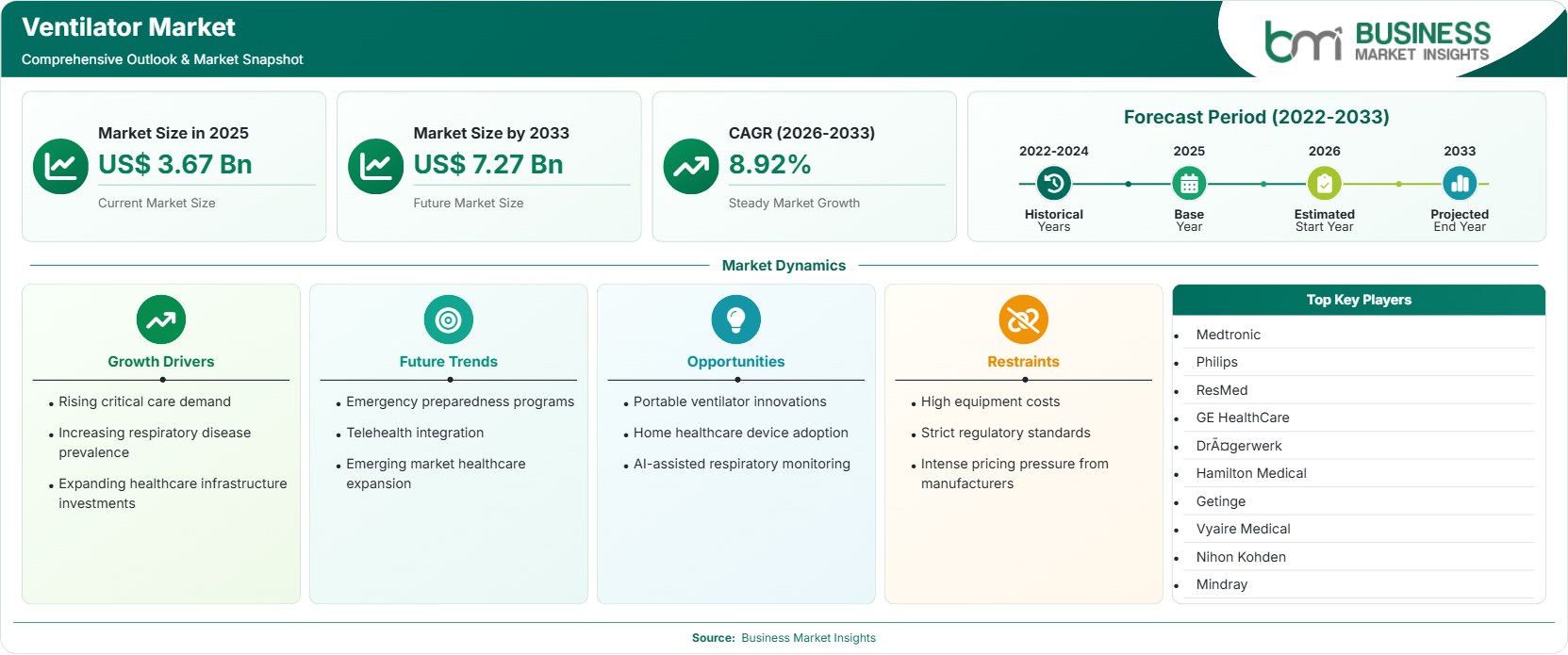
The Ventilator Market size was valued at US$ 3.67 billion in 2025 and is projected to reach US$ 7.27 billion by 2033, growing at a CAGR of 8.92% during 2026–2033, driven by rising critical care demand, increasing respiratory disease prevalence, expanding healthcare infrastructure investments, portable ventilator innovations, home healthcare device adoption, and AI-assisted respiratory monitoring.

Report Coverage
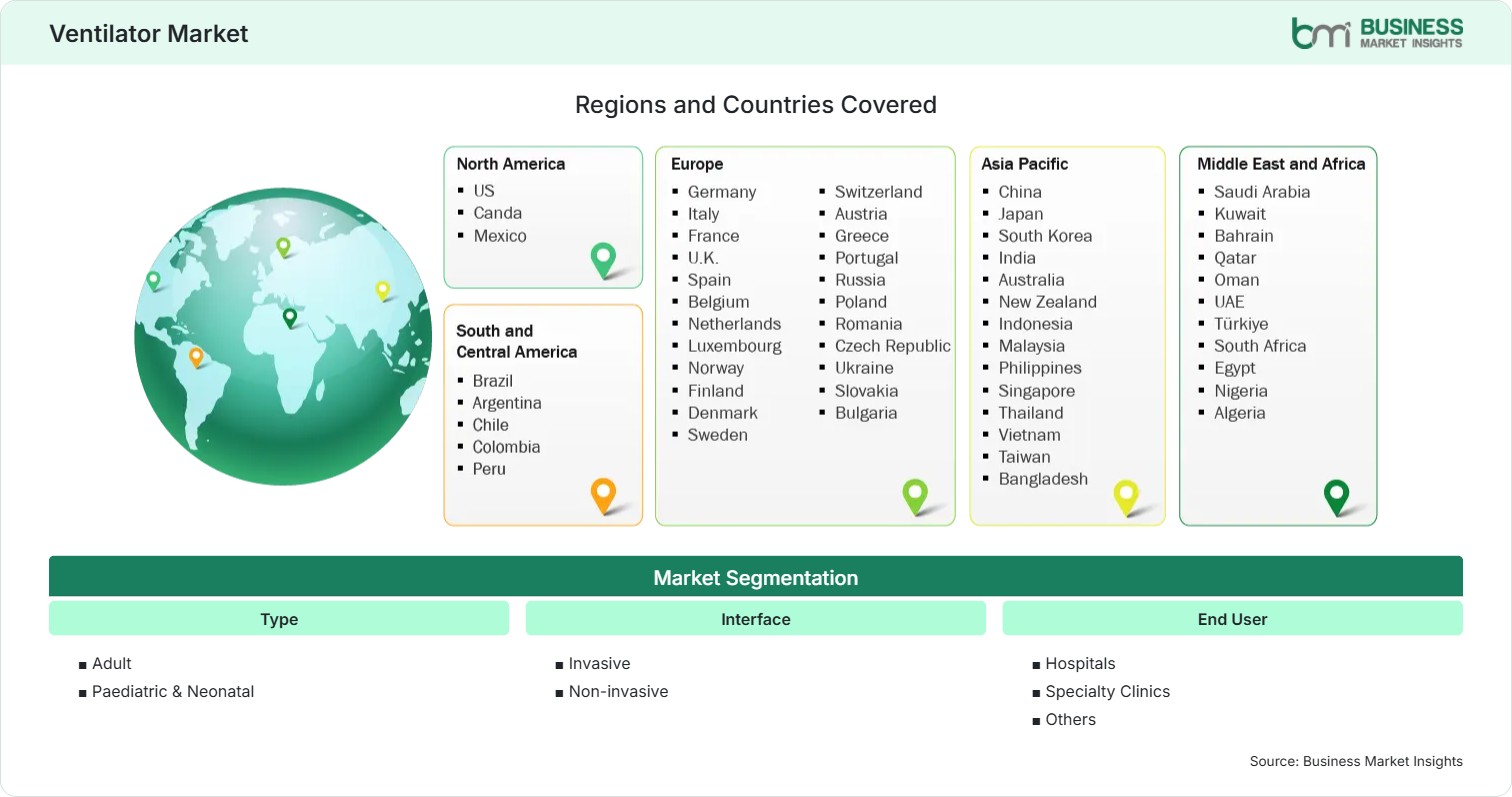
  • Type: Adult, Paediatric & Neonatal
  • Interface: Invasive, Non-invasive
  • End User: Hospitals, Specialty Clinics, Others
US$ 3.67 Bn Market size in 2025
US$ 7.27 Bn Market Size by 2033
8.92% CAGR, 2026 - 2033
2026-2033 Forecast Period

01 AI Overview

Ventilator Market Summary

  • North America Region: North America holds a market share of 35%–39% in 2025, growing with a CAGR of 8.1%–8.6% during 2026–2033 influenced by advanced healthcare infrastructure, increasing ICU capacity, respiratory disorder burden, and adoption of technologically advanced ventilation systems. The U.S. market demonstrates consistent growth with a CAGR of 8.2%–8.7% during 2026–2033, supported by rising critical care investments, hospital modernization, and demand for connected respiratory devices.
  • Fastest Growing Region: Asia Pacific holds a market share of 25%–29% in 2025, growing with a CAGR of 9.8%–10.4% during 2026–2033 influenced by expanding healthcare access, increasing hospital infrastructure, rising respiratory disease cases, and government investments in critical care capabilities.
  • Leading Segment: Adult ventilators hold a market share of 70%–74% in 2025, growing with a CAGR of 8.5%–9.0% during 2026–2033 influenced by higher adult respiratory disease prevalence, intensive care requirements, and increasing adoption across hospitals and emergency care settings.
  • High Growth Segment: Non-invasive ventilators represent a high-growth segment, supported by increasing preference for less invasive respiratory support methods, home-based care adoption, improved patient comfort, and technological advancements in respiratory therapy solutions.
  • Key Market Opportunity: Portable ventilation devices, artificial intelligence-enabled respiratory monitoring, and home healthcare adoption are creating opportunities for manufacturers to develop connected, cost-effective, and patient-centric respiratory care solutions.
  • Major Market Players: Medtronic, Philips, ResMed, GE HealthCare, Drägerwerk, Hamilton Medical, Getinge, Vyaire Medical, Nihon Kohden, Mindray.
02 Strategic Insights

Ventilator Market: Strategic Insights

Ventilator Market Strategic Framework
FREE PDF
Request your free sample
Request free sample
03 Stakeholder View

Key Takeaways

  • The ventilator ecosystem includes medical device manufacturers, healthcare providers, component suppliers, and technology companies collaborating to improve respiratory care delivery and patient outcomes.
  • Non-invasive and portable ventilation solutions present strong growth potential due to increasing home healthcare adoption, reduced hospitalization requirements, and demand for patient-friendly respiratory support.
  • Artificial intelligence, remote monitoring, and connected healthcare technologies are transforming ventilator systems by enabling automated adjustments, predictive insights, and improved clinical decision-making.
  • Asia Pacific represents a major investment opportunity due to expanding healthcare infrastructure, increasing critical care capacity, and rising demand for respiratory equipment.
  • Leading companies are focusing on product innovation, strategic partnerships, regulatory approvals, and geographic expansion to strengthen their competitive position in respiratory care markets.
04 Geographic Outlook

Ventilator Market Regional Highlights

North America Ventilator Market

North America accounted for 35%–39% of the global market in 2025 and is projected to expand at a 8.1%–8.6% CAGR during 2026–2033. The region maintains a leading position due to advanced healthcare infrastructure, high intensive care capacity, strong medical device adoption, and increasing demand for respiratory support technologies. The Ventilator Market share in North America is supported by rising chronic respiratory disease prevalence, hospital modernization initiatives, and investments in connected healthcare solutions. The United States represents the major contributor due to advanced critical care facilities and continuous innovation in respiratory equipment.

  • The United States drives regional demand through advanced ICU infrastructure, increasing respiratory disease management requirements, and adoption of technologically advanced ventilators.
  • Canada supports market development through healthcare modernization programs, hospital investments, and growing demand for respiratory therapy equipment.
  • Healthcare providers are adopting smart ventilators with monitoring capabilities to improve patient management and clinical efficiency.
  • Increasing demand for portable and home-care ventilation solutions is expanding applications beyond traditional hospital environments.

US Ventilator Market

The U.S. represented approximately 30%–34% of global revenue in 2025 and is expected to grow at a 8.2%–8.7% CAGR during 2026–2033. The country remains a major market due to strong healthcare expenditure, advanced intensive care infrastructure, and increasing adoption of innovative respiratory technologies. The Ventilator Market growth in the U.S. is influenced by rising respiratory disease burden, aging population demographics, and increasing demand for critical care equipment. Hospitals and healthcare providers are investing in next-generation ventilators with improved automation, connectivity, and patient monitoring capabilities.

  • Hospitals are upgrading respiratory care units with advanced ventilation systems to improve critical care outcomes.
  • Increasing prevalence of chronic respiratory conditions is supporting long-term demand for ventilation therapies.
  • Home healthcare adoption is encouraging demand for compact and easy-to-use respiratory support devices.
  • Medical technology companies are focusing on connected solutions and AI-enabled ventilation capabilities.

Europe Ventilator Market

Europe accounted for approximately 25%–29% of global revenue in 2025 and is anticipated to register a 8.0%–8.5% CAGR during 2026–2033. The region benefits from established healthcare systems, strong medical device regulations, and increasing demand for advanced respiratory care technologies. Germany, the United Kingdom, France, and Italy represent key markets due to their developed hospital infrastructure and investments in intensive care capabilities. European countries are focusing on healthcare digitization, patient monitoring improvements, and adoption of efficient respiratory equipment.

  • Germany contributes significantly through advanced healthcare facilities, medical technology manufacturing, and strong demand for critical care equipment.
  • The United Kingdom supports Ventilator market expansion through healthcare infrastructure investments and increasing respiratory disease management needs.
  • France and Italy are adopting advanced ventilation technologies across hospitals and specialty healthcare facilities.
  • European manufacturers are emphasizing product innovation, safety standards, and energy-efficient medical equipment designs.
  • Rising elderly populations and chronic respiratory conditions are increasing demand for respiratory support solutions.

Asia Pacific Ventilator Market

Asia Pacific represented 25%–29% of global revenue in 2025 and is expected to grow at a 9.8%–10.4% CAGR during 2026–2033. The region is the fastest-growing Ventilator market due to expanding healthcare infrastructure, increasing hospital capacity, rising respiratory disease prevalence, and improving access to advanced medical devices. China, India, Japan, and South Korea are key contributors supported by healthcare investments, government initiatives, and growing critical care requirements. Manufacturers are increasingly targeting emerging economies with affordable and portable ventilation solutions.

  • China supports regional growth through large healthcare investments, medical equipment manufacturing, and increasing ICU capacity expansion.
  • India is experiencing rising demand due to healthcare infrastructure development and increasing access to respiratory care services.
  • Japan and South Korea contribute through advanced medical technology adoption and strong healthcare systems.
  • Government healthcare initiatives are improving availability of critical care equipment across developing countries.
  • Portable ventilators are gaining adoption due to increasing demand for flexible respiratory support solutions.

Rest of World Ventilator Market

The Rest of World region, comprising South and Central America, and the Middle East and Africa segments generated around 7%-10% of the world revenue share in 2025 and is expected to grow at a 8.5%-9.2% CAGR over 2033. The growth is driven by the development of healthcare infrastructure, increased investment in medical equipment, and increased awareness about respiratory disease treatment. Brazil, Mexico, Saudi Arabia, and South Africa are some of the prominent Ventilator markets because of their efforts towards modernizing the healthcare sector and rising requirements for critical care technologies.

South and Central American countries are improving hospital capabilities through investments in medical infrastructure and respiratory care equipment.

  • Brazil contributes through healthcare expansion, increasing hospital investments, and growing demand for intensive care solutions.
  • Mexico benefits from healthcare modernization and increasing adoption of advanced medical devices.
  • Middle Eastern countries are investing in specialty hospitals and critical care infrastructure development.
  • South Africa supports regional demand through healthcare improvement programs and respiratory disease management initiatives.
  • International partnerships are improving access to advanced ventilator technologies across developing healthcare markets.
Global Market Geography
FREE PDF
Request your free sample
Request free sample
05 Segment Analysis

Ventilator Market Segmentation

Type

The adult ventilator segment is the fastest-growing and most dominant one, holding about 70% to 74% of the Ventilator market share in 2025 and having an annual growth rate of 8.5% to 9.0% between 2026 and 2033. This segment is supported by high prevalence of chronic respiratory illnesses, increasing admissions in ICUs, and growing need for respiratory assistance due to aging population. The hospitals and critical care centers are upgrading themselves with advanced adult ventilators equipped with automatic control systems and monitoring facilities.

  • Adult: Adult ventilators dominate due to widespread use in intensive care units, emergency departments, and long-term respiratory care settings. Technological improvements are enhancing patient monitoring, ventilation accuracy, and treatment outcomes.
  • Paediatric & Neonatal: Paediatric and neonatal ventilators are gaining importance due to increasing focus on specialized newborn care and improved survival rates for premature infants. Advanced precision ventilation technologies support delicate respiratory requirements.

Interface

Invasive ventilators form the foremost segment of the interface segment, having a Ventilator market share of around 55%–60% in 2025 and a CAGR of 8.3%–8.8% between 2026–2033. The importance of invasive ventilators continues to be high in critical care settings because of the need for mechanical ventilation support to the patients. However, the growing cases of admission in ICU settings and the increasing adoption of advanced life support systems continue to drive the growth of invasive ventilators. Nonetheless, non-invasive ventilators have gained wider adoption owing to their comfort, safety, and usage in home healthcare facilities.

  • Invasive: Invasive ventilation provides respiratory support through endotracheal tubes or tracheostomy systems and remains widely used for severe respiratory conditions requiring intensive clinical management.
  • Non-invasive: Non-invasive ventilation is expanding due to rising preference for comfortable respiratory support methods, reduced hospitalization duration, and increasing adoption in home-based and chronic respiratory care.

End User

Hospitals form the dominant end-user segment, holding about 75%-80% of the Ventilator market share in 2025 and registering a CAGR of 8.7%-9.2% from 2026 to 2033. Hospitals are the major end users of the ventilators owing to their high demand in ICU, emergency rooms, surgery departments, and respiratory therapy departments. Growth in healthcare infrastructure spending, critical care capacity expansion, and deployment of advanced monitoring solutions is boosting the hospitals' demands. Health care providers are gradually incorporating ventilators in their facilities with connectivity, automation, and enhanced patient safety systems.

  • Hospitals: Hospitals account for the largest adoption due to critical care requirements, emergency preparedness, surgical procedures, and increasing demand for advanced respiratory management solutions.
  • Specialty Clinics: Specialty clinics are adopting ventilators for respiratory therapy, chronic disease management, and outpatient care applications. Growing focus on specialized respiratory services is supporting segment expansion.
  • Others: Other end users include home healthcare providers, rehabilitation centers, and long-term care facilities. Increasing home-based respiratory support adoption is creating new opportunities for portable ventilation solutions. Top of Form

Bottom of Form

06 Market Forces

Ventilator Market Dynamics

Key Market Drivers

Rising critical care demand

Rising critical care demand is increasing adoption of ventilators across hospitals and intensive care units as healthcare systems expand capacity for managing severe respiratory conditions. Increases in admission cases associated with acute respiratory distress syndrome, surgical complications, and critical conditions have prompted the healthcare professionals to consider investing in advanced ventilation systems. This is attributed to the increase in the construction of ICU facilities, emergency preparedness activities, and demands for respiratory supportive equipment. Integration of connected health care system and advanced respiratory solutions is one of the key Ventilator Market trends.

Increasing respiratory disease prevalence

The rising incidence of respiratory diseases such as chronic obstructive pulmonary disease, asthma-related problems, pneumonia, and respiratory infections worldwide has increased demand for mechanical ventilation. The rising awareness of respiratory health management has prompted earlier diagnosis of respiratory diseases, which would help in the adoption of ventilation technology.

Expanding healthcare infrastructure investments

Expanding healthcare infrastructure investments are creating stronger demand for ventilators through increased hospital capacity development, intensive care expansion, and modernization of medical facilities. Governments and healthcare organizations are investing in critical care infrastructure, particularly in emerging economies where access to advanced respiratory equipment is improving. Increasing healthcare expenditure and infrastructure modernization programs are expected to support long-term demand for ventilator technologies across developed and developing markets.

Key Market Opportunities

Portable ventilator innovations

Innovations in portable ventilators are opening up new prospects as more hospitals look for flexible respiratory care options for use during emergencies, transportation, and for home-based care. New battery technologies and smaller design concepts have enabled manufacturers to produce portable ventilators that perform better and reliably. Portable ventilators allow patients to move around and help them breathe outside conventional hospitals. Integrating connectivity solutions in portable ventilators is expected to make their usage even more prevalent going forward and help Ventilator Market forecasts.

Home healthcare device adoption

Home healthcare device adoption is emerging as a major opportunity due to increasing preference for remote patient management and long-term respiratory therapy outside hospitals. Patients with chronic respiratory conditions are increasingly using home ventilation solutions to improve quality of life and reduce healthcare costs. Technological advancements are enabling compact, easy-to-operate devices with remote monitoring and data-sharing capabilities. Growing aging populations, rising chronic disease prevalence, and expansion of home healthcare services are encouraging manufacturers to develop efficient ventilation systems designed for personalized and continuous respiratory support.

AI-assisted respiratory monitoring

AI-assisted respiratory monitoring offers novel possibilities in terms of efficient management of ventilation using predictive analytics, automatic adjustments, and immediate patient assessment. The artificial intelligence systems are capable of assessing the breathing patterns of patients and assist in making decisions for ventilations. Medical institutions are now interested in developing intelligent respiratory systems that will help make work more efficient and improve the results for patients. With the development of precision medicine and automation in healthcare systems, AI-assisted ventilators are likely to become more relevant.

Market Restraints and Challenges

High equipment costs

High equipment costs create challenges for healthcare providers, particularly in developing regions where access to advanced respiratory technologies remains limited.

Factor: The use of advanced ventilators comes with a hefty cost because of their complicated design and need for monitoring technology.

Impact: Expenses for purchase and operation can prevent small healthcare organizations from adopting these devices. Companies are working on making cost-effective models and simple solutions to make it more accessible.

Strict regulatory standards

Strict regulatory standards create compliance challenges for ventilator manufacturers due to requirements related to safety, performance, quality management, and clinical reliability. Factor: Regulations for medical devices necessitate thorough testing, documentation, certification procedures, and quality monitoring before such products are available on the market.

Impact: Regulatory intricacies can result in longer timelines in product development, higher costs in production, and even delays in the commercialization process of new ventilation devices. Manufacturers need to allocate more resources on compliance-related aspects in order to comply with regulatory standards. Even though stringent standards can help ensure patient safety, it is one of the key factors that manufacturers consider.

07 Company Analysis

Competitive Landscape

The competitive environment is shaped by technological innovation, respiratory care expertise, product portfolio expansion, regulatory compliance capabilities, and global distribution networks. Ventilator Market analysis indicates that leading companies are focusing on advanced ventilation technologies, connected monitoring systems, portable device development, and AI-enabled respiratory solutions to strengthen their market position. Companies are investing in next-generation ventilators that improve patient outcomes, enhance clinical workflow efficiency, and support applications across hospitals, specialty clinics, emergency care, and home healthcare settings.

Company Name

Overview

Products and Services relevant to this market

Medtronic

A global medical technology company providing respiratory care solutions and critical care equipment for healthcare providers worldwide.

Mechanical ventilators, respiratory monitoring systems, airway management products, and critical care technologies for hospital applications.

Philips

A leading healthcare technology company offering connected respiratory care solutions and patient monitoring systems.

ICU ventilators, non-invasive ventilation devices, respiratory therapy solutions, sleep and home ventilation equipment.

ResMed

A respiratory care technology company specializing in digital health solutions and devices for sleep and breathing disorders.

Non-invasive ventilators, bilevel devices, respiratory care platforms, cloud-based patient monitoring solutions.

GE HealthCare

A global healthcare technology provider offering medical devices and digital solutions for critical care environments.

ICU ventilators, anesthesia systems, respiratory monitoring technologies, and integrated critical care solutions.

Drägerwerk AG & Co. KGaA

A medical and safety technology company recognized for advanced respiratory and intensive care equipment.

Intensive care ventilators, emergency ventilation systems, anesthesia workstations, and respiratory monitoring solutions.

Hamilton Medical AG

A specialist in intelligent ventilation technology focused on critical care and emergency respiratory support.

ICU ventilators, transport ventilators, intelligent ventilation modes, and respiratory management systems.

Getinge AB

A healthcare technology company providing solutions for intensive care, surgical, and life science applications.

Mechanical ventilators, respiratory care systems, critical care equipment, and hospital workflow solutions.

Vyaire Medical, Inc.

A respiratory care company focused on ventilation, respiratory diagnostics, and airway management technologies.

Ventilators, breathing circuits, respiratory monitoring systems, airway management products, and pulmonary diagnostics solutions.

Nihon Kohden Corporation

A Japanese medical technology company providing patient monitoring and critical care equipment.

Ventilators, patient monitoring systems, respiratory care devices, and integrated hospital monitoring solutions.

Mindray Medical International Limited

A medical device manufacturer offering healthcare solutions across patient monitoring and life-support applications.

Ventilators, anesthesia machines, patient monitoring systems, and critical care equipment for hospitals and clinics.

08 Industry Activity

Recent Developments

June, 2026

Dräger announced FDA clearance for Evita V800 Software 3.10, adding advanced ventilation capabilities and workflow enhancements for its Evita V800 intensive care ventilator platform.

July, 2025

Medtronic plc implemented the discontinuation of service, support, and spare parts availability for selected Newport HT70 and e360 ventilator models as part of its previously announced transition strategy for its respiratory business portfolio.

June, 2025

Getinge AB introduced a neonatal option for its Servo-c ventilator, enabling the system to support respiratory care for premature newborns (from 500 g) as well as pediatric and adult patients with enhanced leakage compensation and personalized ventilation capabilities.

May, 2025

Hamilton Medical AG announced a partnership with Philips to implement Service-Oriented Device Connectivity (SDC), enabling seamless interoperability between Hamilton ventilators and Philips critical care systems to improve ICU workflows.

10 Trust & Transparency

Research Methodology

The market analysis combines proprietary research with secondary data from government agencies, company disclosures, regulatory filings, industry databases and expert interviews. Market estimates are validated through data triangulation, cross-market benchmarking and analyst review.

View Full Research Methodology

11 Questions Answered

Frequently Asked Questions

What insights does the Market Report provide?

The Ventilator Market Report provides analysis of market size, segmentation, regional performance, competitive landscape, technology trends, growth drivers, challenges, and future opportunities. The report supports healthcare companies, investors, and stakeholders in understanding market dynamics and identifying areas for expansion within respiratory care technologies.

What opportunities are emerging in the Market?

Key opportunities include portable ventilator innovations, home healthcare adoption, and AI-assisted respiratory monitoring. Growing demand for remote patient management, increasing chronic respiratory conditions, and healthcare decentralization are encouraging manufacturers to develop compact, connected, and efficient ventilation solutions for hospitals and home care environments.

How are AI technologies influencing ventilator development?

AI technologies are improving ventilator performance through automated ventilation adjustments, predictive monitoring, and data-driven respiratory management. AI-assisted systems help healthcare professionals optimize treatment settings, identify changes in patient conditions, and improve clinical decision-making. These advancements are supporting the development of smarter and more connected respiratory care solutions.

Which ventilator type holds the largest market share?

Adult ventilators hold the largest market share due to their extensive use in intensive care units, emergency departments, and surgical care settings. The segment benefits from increasing cases of chronic respiratory disorders, aging populations, and higher demand for mechanical ventilation support among adult patients requiring critical respiratory assistance.

What factors are driving the growth of the Ventilator Market?

The market is driven by increasing critical care requirements, rising respiratory disease prevalence, expanding healthcare infrastructure, and growing adoption of advanced respiratory support technologies. Hospitals are investing in intelligent ventilation systems, while demand for portable and home-based devices is increasing due to the shift toward flexible and patient-centric respiratory care solutions.

Access the Full Ventilator Market Report

Get segment-level forecasts, regional estimates, competitive benchmarking, company profiles and downloadable Excel datasets.

Access the full Ventilator Market Report
350 pages PDF & Excel | 2026-07-28