
Biobanking Market Outlook: Size, Share, Trends, Growth Analysis, Competitive Landscape & Forecast, 2022-2033

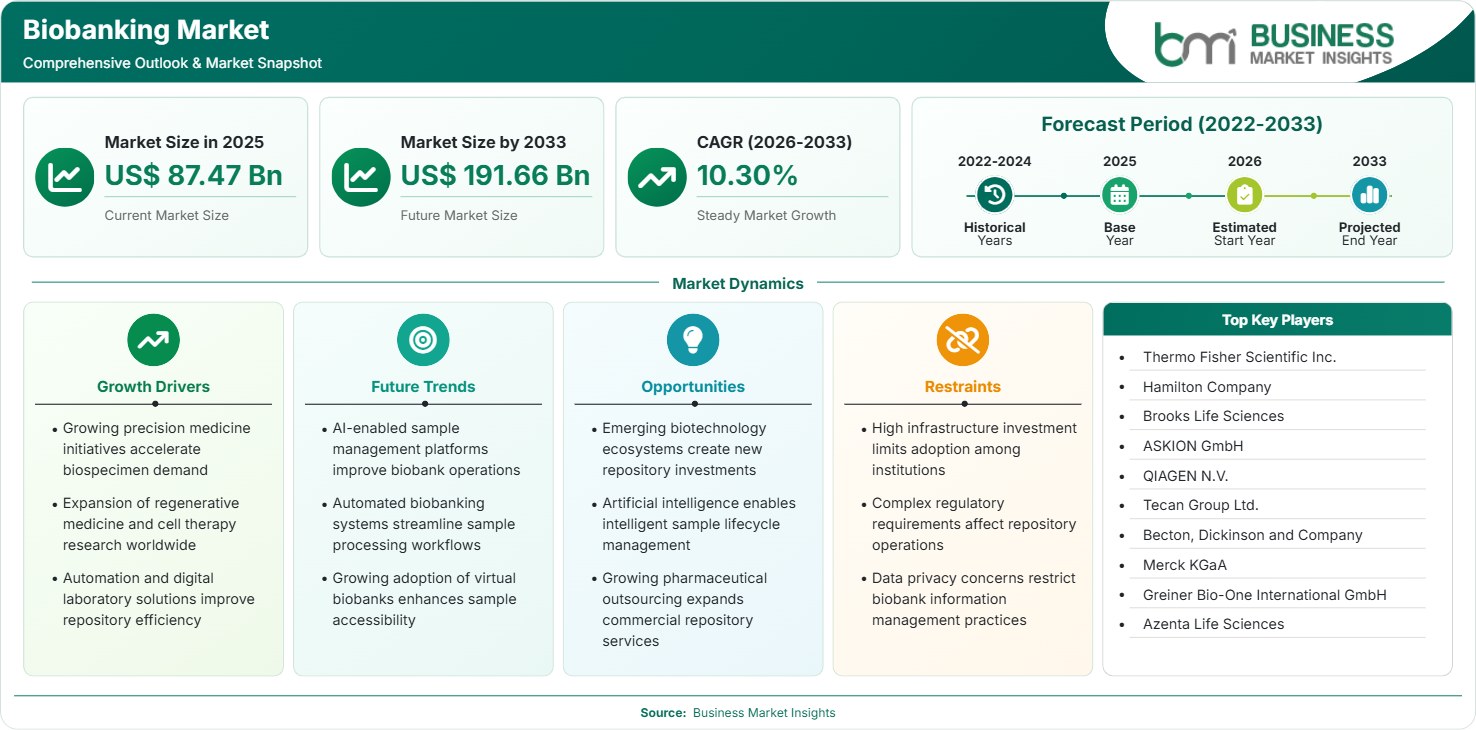
The Biobanking Market size was valued at US$ 87.47 billion in 2025 and is projected to reach US$ 191.66 billion by 2033, growing at a CAGR of 10.30% during 2026–2033. Rising investments in precision medicine, expanding genomic research programs, and increasing adoption of regenerative medicine are accelerating demand, while advances in automated sample preservation and digital biobank management continue creating long-term commercialization opportunities.

Report Coverage
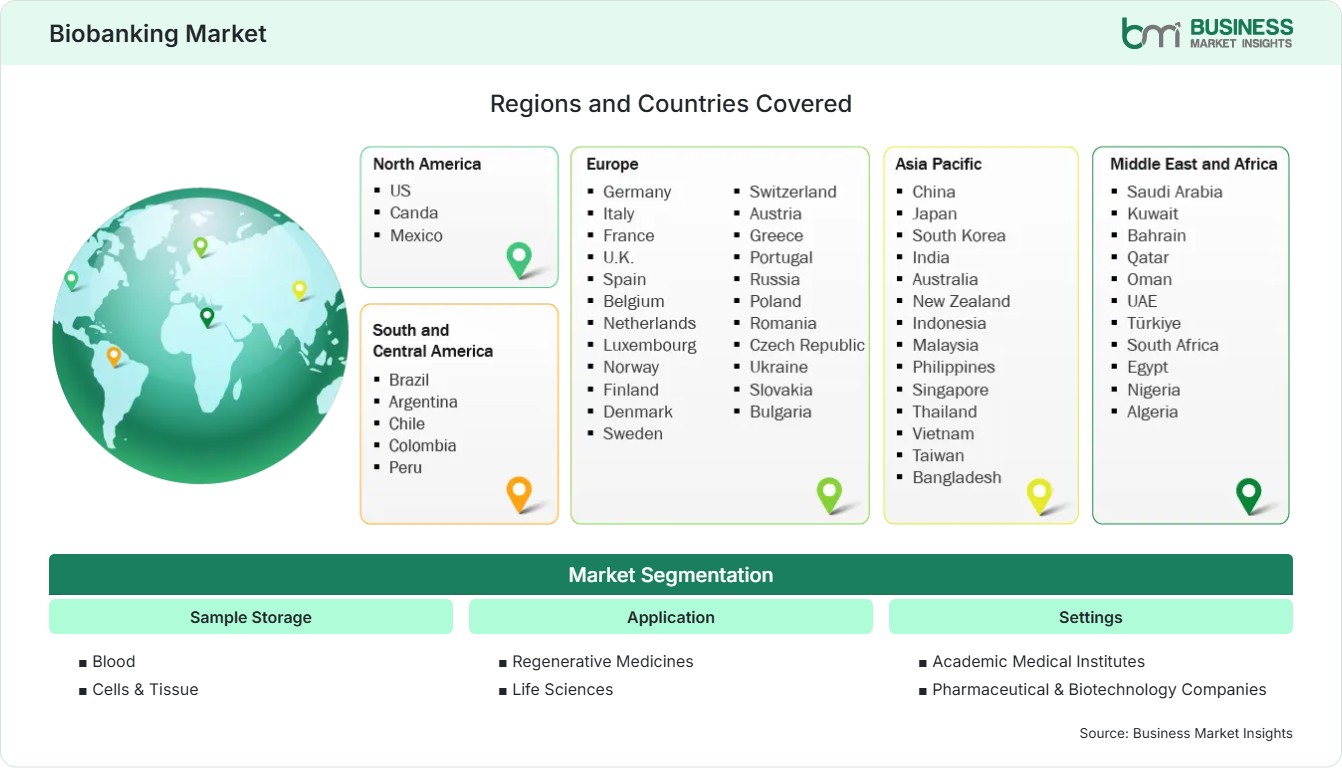
  • Sample Storage: Blood, Cells & Tissue
  • Application: Regenerative Medicines, Life Sciences
  • Settings: Academic Medical Institutes, Pharmaceutical & Biotechnology Companies
US$ 87.47 Bn Market size in 2025
US$ 191.66 Bn Market Size by 2033
10.30% CAGR, 2026 - 2033
2026-2033 Forecast Period

01 AI Overview

Biobanking Market Summary

  • North America Region: North America holds 36%–39% market share in 2025, growing with a CAGR of 9.6%–10.0% during 2026–2033. Strong government funding for biomedical research, widespread precision medicine initiatives, and extensive pharmaceutical R&D continue supporting large-scale sample repositories. The United States accounts for 79%–82% of the regional revenue and is expected to expand at a CAGR of 9.7%–10.1% through sustained genomic research investments.
  • Fastest Growing Region: Asia Pacific accounts for 24%–27% biobanking market share in 2025 and is projected to grow at a CAGR of 11.8%–12.4% through expanding biotechnology investments, increasing clinical trial activity, national genome initiatives, and rapidly improving laboratory infrastructure supporting long-term biospecimen preservation.
  • Leading Segment: Sample Storage represents 58%–61% market share in 2025 and is anticipated to register a CAGR of 9.8%–10.3% owing to increasing demand for high-quality biospecimen preservation.
  • High Growth Segment: Regenerative Medicines accounts for 33%–36% market share in 2025 while advancing at a CAGR of 11.7%–12.3% because expanding stem cell research, cell therapy commercialization, and personalized medicine initiatives require large volumes of well-characterized biological specimens.
  • Key Market Opportunity: Growing integration of artificial intelligence and automated sample tracking is enabling scalable, interoperable biobank ecosystems supporting precision medicine research across global healthcare institutions.
  • Major Market Players: Thermo Fisher Scientific Inc., Hamilton Company, Brooks Life Sciences, ASKION GmbH, QIAGEN N.V., Tecan Group Ltd., Becton, Dickinson and Company, Merck KGaA, Greiner Bio-One International GmbH, and Azenta Life Sciences.
02 Strategic Insights

Biobanking Market: Strategic Insights

biobanking-market-market-strategic-framework
FREE PDF
Request your free sample
Request free sample
03 Stakeholder View

Key Takeaways

1. Long-term value creation increasingly depends on integrated ecosystems combining automated sample storage, laboratory information management systems, genomic databases, and standardized quality management rather than standalone storage infrastructure.

2. Regenerative medicine, precision oncology, and translational research initiatives can bring about the greatest commercial prospects, as there will be an increase in the need for high-quality and traceable biospecimens for advanced therapies.

3. Artificial intelligence, robotic handling systems, automated cryogenic systems, and digital specimen tracking are changing operational efficiencies, decreasing processing mistakes, helping with compliance, and allowing greater repository use in the biobanking market.

4. Asia Pacific presents an attractive investment environment due to expanding biotechnology funding, national genome sequencing initiatives, increasing pharmaceutical manufacturing capacity, and continued establishment of modern biomedical research facilities.

5. Collaborations are being made between biotech firms, pharmaceutical manufacturers, research hospitals, and academia, which is helping in the growth of repositories and at the same time providing commercial opportunities in the precision healthcare business.

6. Venture funding and technology acquisitions increasingly target digital laboratory platforms, automation providers, cryogenic storage innovators, and genomic data management specialists capable of supporting future large-scale biospecimen networks.

04 Geographic Outlook

Biobanking Market Regional Highlights

North America Biobanking Market

North America accounted for 36%–39% of the global revenue in 2025 and is projected to expand at a CAGR of 9.6%–10.0% during 2026–2033. The region benefits from extensive biomedical research funding, mature clinical research infrastructure, and widespread adoption of precision medicine. Strong collaboration among pharmaceutical companies, academic medical centers, and government agencies continues to strengthen large-scale biospecimen repositories. The Biobanking Market share remains highest in this region due to established regulatory frameworks and advanced laboratory automation.

  • The United States dominates regional demand through large genomic initiatives and significant investments in translational medicine, supporting continuous repository expansion and technology modernization.
  • Canada continues strengthening national biobank networks through government-supported precision health initiatives and biotechnology companies.
  • Growing deployment of automated cryogenic storage, robotic sample retrieval systems, and AI-enabled inventory management is improving operational efficiency while reducing specimen handling variability across leading facilities.
  • Pharmaceutical outsourcing organizations increasingly utilize regional repositories for biomarker discovery, clinical trial support, and companion diagnostic development, creating sustained commercial opportunities for solution providers.
  • Rising investments in digital laboratory infrastructure and interoperable data platforms are enabling standardized biospecimen management across multi-center research collaborations throughout North America.

US Biobanking Market

The United States represented approximately 79%–82% of North American revenue in 2025 and is forecast to register a CAGR of 9.7%–10.1% through 2033. Strong NIH-supported biomedical research, extensive pharmaceutical innovation, and expanding cell and gene therapy development continue driving repository capacity expansion. Large academic medical institutions in the biobanking market maintain comprehensive biospecimen collections supporting translational research and commercialization.

  • Federal investments in cancer research, precision medicine, and rare disease programs continue increasing demand for standardized, high-quality biological sample preservation across academic and commercial laboratories.
  • Pharmaceutical companies increasingly establish strategic collaborations with research hospitals to accelerate biomarker validation, genomic sequencing, and advanced therapeutic development using well-characterized specimen collections.
  • Automation technologies, digital laboratory management platforms, and cloud-enabled sample tracking continue improving repository scalability while supporting regulatory compliance and operational efficiency.
  • Increasing commercialization of regenerative medicine products is encouraging long-term investment in cryogenic storage technologies, integrated data management, and advanced quality assurance systems.

Europe Biobanking Market

Europe held 28%–31% of global revenue in 2025 and is anticipated to grow at a CAGR of 9.9%–10.4% during the forecast period. Strong public healthcare systems, harmonized research frameworks, and expanding multinational clinical studies continue supporting repository development. Germany remains the leading market, while the United Kingdom demonstrates the fastest expansion with an estimated 10.6%–11.1% CAGR supported by genomics initiatives and biotechnology investments.

  • Germany benefits from strong pharmaceutical manufacturing capabilities, established biomedical research institutes, and advanced laboratory infrastructure supporting extensive biospecimen preservation activities.
  • The United Kingdom continues expanding genomic medicine programs through increased sequencing capacity, collaborative research networks, and investment in precision healthcare infrastructure.
  • France strengthens national research capabilities by integrating academic institutions, biotechnology firms, and healthcare providers within standardized biobanking networks supporting translational medicine in the biobanking market.
  • Nordic countries continue emphasizing digital laboratory integration, ethical governance, and high-quality biospecimen management to facilitate international collaborative research programs.
  • European regulatory alignment enhances interoperability among repositories while supporting cross-border scientific collaboration and pharmaceutical research activities.

Asia Pacific Biobanking Market

Asia Pacific represented 24%–27% of global revenue in 2025 and is projected to achieve the highest CAGR of 11.8%–12.4% through 2033. Expanding biotechnology industries, rising healthcare expenditure, and increasing government support for genomic medicine continue strengthening regional infrastructure. China leads regional demand, whereas India records the fastest growth with an estimated 12.6%–13.2% CAGR supported by expanding life sciences investments.

  • China continues investing heavily in national genomic research initiatives, precision medicine programs, and advanced biomedical laboratories supporting large-scale repository development.
  • India experiences accelerating demand due to expanding biotechnology startups, increasing clinical research activity, and stronger public-private partnerships within healthcare innovation ecosystems.
  • Japan emphasizes regenerative medicine research, stem cell banking, and advanced cryogenic technologies while maintaining high standards for specimen quality and laboratory automation.
  • South Korea continues expanding digital healthcare infrastructure and precision oncology research, encouraging investment in integrated biospecimen management platforms in the biobanking market.
  • Regional pharmaceutical manufacturing expansion supports increasing utilization of standardized repositories for biomarker discovery, vaccine research, and personalized therapeutic development.

Rest of World Biobanking Market

The Rest of World region contributed 8%-10% of global revenue in 2025 and is projected to grow at a CAGR of 10.5%-11.0% from 2026 to 2033. South and Central America are continuously building their biomedical research capabilities by establishing partnerships with universities, whereas the Middle East and Africa are leveraging their efforts to modernize their health care systems, genomics strategies, and biotechnology investments in selected countries.

Investment in healthcare infrastructure, international cooperation in research, and development of laboratory facilities continue to help build the repositories despite funding and labor constraints.

  • Brazil remains the leading South & Central American market through expanding biomedical research institutions, pharmaceutical collaboration, and increasing public investment in healthcare innovation.
  • The United Arab Emirates demonstrates the fastest regional expansion with a projected 11.4%–11.9% CAGR, supported by precision medicine initiatives and national genomics strategies.
  • Saudi Arabia continues investing in biotechnology, academic research infrastructure, and healthcare digitalization, strengthening long-term demand for advanced biospecimen storage technologies.
  • South Africa maintains leadership across Africa through established medical research institutions, international clinical trial participation, and improving laboratory capabilities.
  • International partnerships with academic organizations and pharmaceutical companies continue accelerating technology transfer, workforce development, and adoption of globally standardized biobanking practices.
global-market-geography
FREE PDF
Request your free sample
Request free sample
05 Segment Analysis

Biobanking Market Segmentation

Sample Storage

Sample storage held around 58%-61% market share in 2025 and is expected to grow at a CAGR of 9.8%-10.3% from 2026-2033. Increased expenditure on automated cryopreservation technology, standardized sample-handling processes, and robotic inventory management systems continues to drive adoption rates within research organizations. The Biobanking Market scope continues to expand as pharmaceutical companies, academic institutions, and biotechnology firms prioritize the long-term preservation of high-quality biospecimens for precision medicine and translational research.

  • Blood: Blood remains the most widely preserved biospecimen because of its extensive utilization in genomic sequencing, biomarker identification, disease surveillance, clinical diagnostics, and population-based research requiring standardized long-term storage conditions.
  • Cells & Tissue: Cells and tissue specimens experience increasing demand as regenerative medicine, stem cell research, oncology investigations, and personalized therapeutic development require highly viable biological materials preserved under controlled cryogenic environments.

Application

Application-based demand is led by regenerative medicine, with the segment representing 47%–50% of the market in 2025 while advancing at a CAGR of 11.7%–12.3% through the forecast period. Continued expansion of cell therapy development, precision oncology research, and advanced biologics manufacturing is increasing reliance on standardized biospecimen repositories. The Biobanking Market trends increasingly reflect stronger integration between genomic research, clinical trials, and personalized therapeutic development.

  • Regenerative Medicines: Regenerative medicine generates substantial repository demand because stem cell therapies, tissue engineering, and gene editing programs require well-characterized, high-quality biological samples supporting reproducible clinical and preclinical research.
  • Life Sciences: Life sciences applications continue expanding through increasing pharmaceutical discovery programs, molecular diagnostics, translational medicine, and biomarker validation activities requiring secure, traceable, and quality-controlled biospecimen preservation.

Settings

Academic Medical Institutes and Pharmaceutical & Biotechnology Companies together constitute the primary operational environments, as this category accounts for 61% – 64% of total income in 2025 and is expected to have a CAGR of 10.2% – 10.7%. The increasing number of collaborative research projects, translational medicine projects, and clinical trials is fueling the demand for automated repository infrastructure equipped with automation, digital sample tracking, and regulatory-compliant quality management systems.

  • Academic Medical Institutes: Academic institutions maintain extensive specimen repositories supporting population health studies, translational research, precision medicine initiatives, and collaborative international scientific programs across multiple therapeutic disciplines.
  • Pharmaceutical & Biotechnology Companies: Pharmaceutical and biotechnology organizations increasingly invest in dedicated repositories to accelerate drug discovery, biomarker development, companion diagnostics, and regulatory-compliant clinical research through secure long-term biospecimen management.
06 Market Forces

Biobanking Market Dynamics

Key Market Drivers

Growing precision medicine initiatives accelerate biospecimen demand

The emergence of precision medicine is changing the face of biomedical research by increasing the need to collect large volumes of high-quality biological specimens linked to genomics and clinical datasets. The ongoing expansion of large sequencing projects, population health projects, and precision oncology initiatives is driving demand for repositories in hospitals, research institutions, and pharmaceutical firms. The World Health Organization has continued to emphasize genomics and personalized medicine as key foundations for the future treatment of diseases, while many other national genomics projects have continued to increase specimen collection volumes. Increasing collaboration between academia, biotechnology firms, and healthcare institutions is supporting the use of repositories.

Expansion of regenerative medicine and cell therapy research worldwide

Commercialization of regenerative medicine is generating an immense need for cryogenic storage of living cells and tissues, and other biological specimens. Regenerative medicines based on stem cell therapies, tissue engineering, and genetic modification treatments need a standard system for cryogenic storage, monitoring, and tracking. There is increased demand from regulatory authorities for documentation of biological specimen integrity, motivating labs to upgrade their storage systems. An increasing number of clinical trials using cell and gene therapies in oncology, immunology, and rare diseases are contributing to the need for larger storage-capacity facilities.

Automation and digital laboratory solutions improve repository efficiency

Robotics, artificial intelligence, cloud-based laboratory management systems, and automated monitoring technologies are changing how repositories operate globally. Automation of sample acquisition is not only more accurate but also improves storage quality and increases laboratory efficiency. Monitoring technology connected to the internet tracks all aspects, from storage temperature to equipment performance and sample condition, minimizing potential operational risks from specimen deterioration. Incorporating these digital solutions into laboratory work will enhance compliance, ease auditing, and facilitate collaboration among many research organizations.

Key Market Opportunities

Emerging biotechnology ecosystems create new repository investments

The rapid growth of biotech companies in Asia Pacific, the Middle East, and certain nations in Latin America has provided several business opportunities for vendors offering bio-repository products, lab automation systems, and cryogenic solutions. Governments have been continuously investing in advanced medical technologies, biomedical innovation parks, and translational medicine infrastructure to boost their domestic life sciences capabilities. Increased private-public partnerships also promote the creation of biospecimen banks in the region. Long-term Biobanking Market Forecasts indicate an expanding demand for integrated repository solutions that support large-scale genomic studies, vaccine development, and personalized therapeutic research while meeting evolving international quality standards.

Artificial intelligence enables intelligent sample lifecycle management

The application of artificial intelligence is opening new opportunities in repository management through optimized inventory planning, predictive maintenance, sample prioritization, and quality control. The application of machine learning aims to increase the efficiency of identifying storage abnormalities and reduce unnecessary sample transportation in automated laboratories. The integration of laboratory information management systems increases transparency and accelerates research processes. Future intelligent laboratories are expected to incorporate robotics, cloud-based computational analysis, and digital pathology into pharmaceutical research platforms. The mentioned technologies improve the efficiency of laboratory operations and ensure that specimens are traceable worldwide.

Growing pharmaceutical outsourcing expands commercial repository services

CROs, CDMOs, and specialized laboratory services increasingly need biospecimens that can be preserved on a scalable basis to conduct clinical trials worldwide. Through outsourcing, pharmaceutical companies can save on infrastructure setup and gain access to cutting-edge technologies. Multinational clinical trials and personalized medicine programs will continue to generate demand for specialized repository services that include regulatory compliance, logistics automation, and digital documentation systems. Commercial repository companies thus have an opportunity to expand their service portfolio.

Market Restraints and Challenges

High infrastructure investment limits adoption among institutions

Factor: Modern facilities require considerable funding for cryogenic storage, robotics, laboratory information management software, power backup systems, and environmental monitoring systems.

Impact: Installation-related expenses are too high for small hospitals, university laboratories, and biotechnology firms due to insufficient research funding. Operating expenses will be higher due to maintenance, staffing, and regulatory requirements. Facilities are installed step by step, not entirely due to a lack of financial resources. A lack of money may create problems during the automation process.

Complex regulatory requirements affect repository operations

Factor: Biospecimen banks need to comply with laws governing informed consent, confidentiality, international data transfer, specimen ownership, and biological specimen storage.

Impact: Compliance with regulations increases the administrative burden and the time required to obtain approvals and update policies within research organizations. Disagreement in national laws makes collaboration and the exchange of specimens internationally challenging. Proper handling of information, including genome information, requires ongoing costs for compliance purposes.

07 Company Analysis

Competitive Landscape

The competitive landscape is marked by consistent efforts to enhance lab automation, intelligent cryopreservation, robotic systems, digital laboratory information management systems, and holistic biospecimens lifecycle management systems. According to the Biobanking Market analysis, the top players have been consolidating their product offerings through technological innovation, collaboration with research institutions, and expanded sample storage facilities to support precision medicine, genomics, regenerative medicine, and pharmaceutical research.

Company Name

Overview

Products and Services Relevant to this Market

Thermo Fisher Scientific Inc.

Global life sciences company providing laboratory technologies, analytical instruments, and integrated research solutions supporting pharmaceutical and academic customers.

Automated biobanking systems, ultra-low temperature freezers, laboratory automation, sample storage equipment, laboratory information solutions, consumables, and biospecimen management technologies.

Hamilton Company

Leading developer of laboratory automation and precision liquid handling technologies serving research, biotechnology, and clinical laboratories worldwide.

Automated sample storage systems, robotic liquid handling platforms, laboratory automation solutions, specimen management, and integrated workflow technologies.

Brooks Life Sciences

Specialized provider of automated sample management, genomic services, and advanced cryogenic storage technologies for biomedical research organizations.

Automated biobank repositories, cryogenic storage systems, sample management software, genomic services, and biological specimen logistics.

ASKION GmbH

German biotechnology company focused on automated cryogenic preservation and intelligent biospecimen storage technologies for research laboratories.

Automated biobanking platforms, cryogenic storage systems, controlled-rate freezers, sample handling technologies, and repository automation solutions.

QIAGEN N.V.

International biotechnology company delivering molecular diagnostics, genomic technologies, and sample preparation solutions supporting precision medicine.

Sample preparation systems, molecular analysis technologies, nucleic acid preservation, laboratory automation, and genomic workflow solutions.

Tecan Group Ltd.

Swiss laboratory automation specialist serving pharmaceutical, biotechnology, and academic research institutions with advanced workflow technologies.

Robotic laboratory automation, liquid handling systems, integrated sample processing, laboratory software, and automated workflow solutions.

Becton, Dickinson and Company

Global medical technology company providing specimen collection, diagnostics, laboratory equipment, and healthcare solutions across multiple clinical settings.

Blood collection systems, specimen handling products, laboratory automation, diagnostic consumables, and biospecimen management technologies.

Merck KGaA

Science and technology company supporting pharmaceutical manufacturing, life sciences research, and laboratory operations through comprehensive product portfolios.

Cell preservation reagents, laboratory chemicals, cryopreservation media, analytical solutions, and life sciences workflow products.

Greiner Bio-One International GmbH

International manufacturer specializing in laboratory consumables, specimen collection technologies, and diagnostic products for biomedical research.

Sample collection tubes, cryogenic storage products, laboratory plastics, specimen transport systems, and biobanking consumables.

Azenta Life Sciences

Life sciences technology provider focused on automated sample management, genomic services, and secure biological specimen storage solutions.

Automated repositories, cryogenic storage, laboratory information systems, genomic services, sample logistics, and integrated biospecimen management.


10 Trust & Transparency

Research Methodology

The market analysis combines proprietary research with secondary data from government agencies, company disclosures, regulatory filings, industry databases and expert interviews. Market estimates are validated through data triangulation, cross-market benchmarking and analyst review.

View Full Research Methodology

11 Questions Answered

Frequently Asked Questions

What does the market report typically cover?

A comprehensive Biobanking Market Report generally evaluates market size, technology trends, competitive landscape, regional outlook, segmentation analysis, investment opportunities, regulatory developments, and strategic initiatives influencing long-term industry expansion.

Which organizations are the primary end users?

Academic medical institutes and pharmaceutical & biotechnology companies represent the largest end-user groups because they require long-term biospecimen preservation for translational research, clinical trials, biomarker discovery, and drug development programs.

Which region dominates the global market?

North America remains the leading regional market because of strong biomedical research funding, mature healthcare infrastructure, advanced laboratory automation adoption, and extensive collaboration between pharmaceutical companies and academic research institutions.

Which application segment offers the highest future growth potential?

Regenerative medicine is expected to deliver the strongest growth due to increasing commercialization of cell therapies, stem cell research, tissue engineering, and personalized therapeutic development requiring standardized biological sample preservation.

What is driving demand for biobanking services globally?

Growing precision medicine initiatives, increasing genomic sequencing, expanding regenerative medicine research, and rising pharmaceutical R&D investments are driving demand for high-quality biospecimen storage, automation, and digital repository management solutions worldwide.

Access the Full Biobanking Market Report

Get segment-level forecasts, regional estimates, competitive benchmarking, company profiles and downloadable Excel datasets.

Access the full Biobanking Market Report
350 pages PDF & Excel | 2026-08-03