
Artificial Intelligence in Drug Discovery Market Outlook: Size, Share, Trends, Growth Analysis, Competitive Landscape & Forecast, 2026-2033

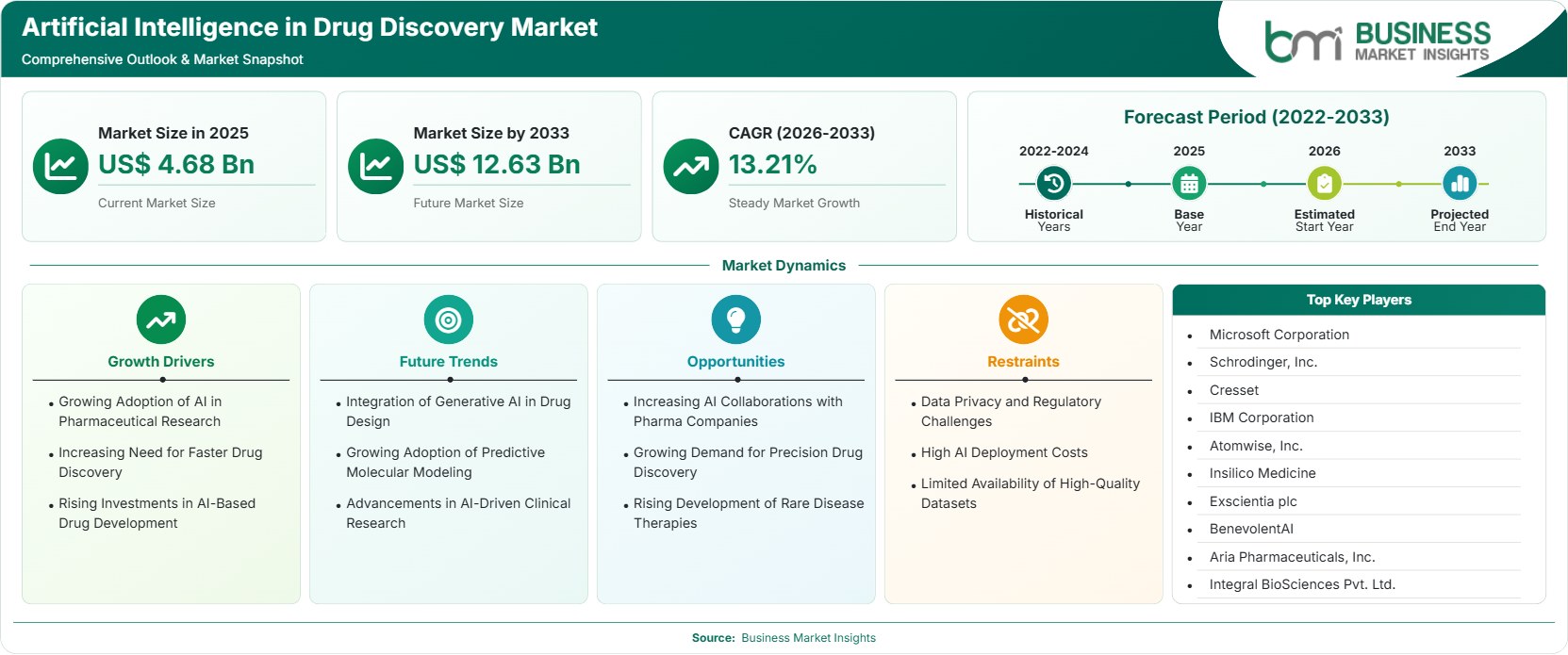
The Artificial Intelligence in Drug Discovery Market size was valued at US$ 4.68 Billion in 2025 and is projected to reach US$ 12.63 Billion by 2033, growing at a CAGR of US$ 13.21% during 2026–2033, driven by AI-enabled research acceleration, precision medicine adoption, and expanding pharmaceutical innovation investments.

Report Coverage
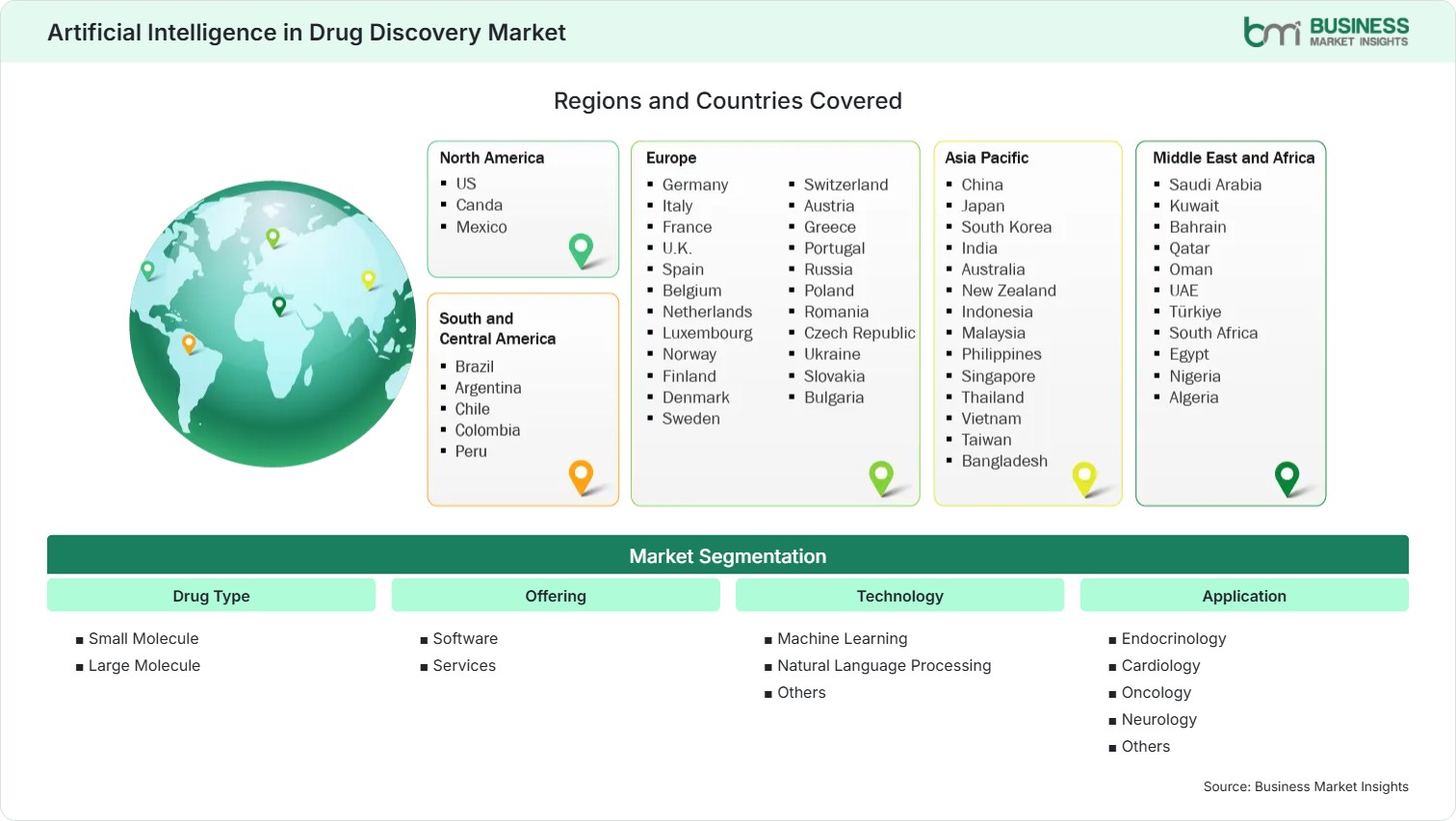
  • Drug Type: Small Molecule, Large Molecule
  • Offering: Software, Services
  • Technology: Machine Learning, Natural Language Processing, Others
  • Application: Endocrinology, Cardiology, Oncology, Neurology, Others
  • End-user: Pharmaceutical & Biotechnological Companies, Academic & Research Institutes, Others
US$ 4.68 Bn Market size in 2025
US$ 12.63 Bn Market Size by 2033
13.21% CAGR, 2026 - 2033
2026-2033 Forecast Period

01 AI Overview

Artificial Intelligence in Drug Discovery Market Summary

  • North America Region: North America holds a 38%–42% share in 2025, expanding at a CAGR of 12.5%–13.5% through 2033, supported by advanced pharmaceutical ecosystems, AI infrastructure, venture funding, and regulatory progress. The US market shows strong adoption with a CAGR of 12.8%–13.8% due to pharma partnerships and computational research expansion.
  • Fastest Growing Region: Asia Pacific records a 22%–26% share in 2025, growing at a CAGR of 14.0%–15.0% during 2026–2033, supported by biotechnology investments, government AI initiatives, expanding clinical research capabilities, and rising pharmaceutical manufacturing activities.
  • Leading Segment: Software represents the leading segment with a 55%–59% share in 2025, achieving a CAGR of 13.5%–14.5% through 2033, driven by machine learning platforms, predictive modelling tools, cloud deployment, and scalable drug discovery workflows.
  • High Growth Segment: Large Molecule drug discovery demonstrates a 40%–44% share in 2025, advancing at a CAGR of 14.0%–15.0%, supported by biologics development, complex molecule analysis, antibody research, and AI-powered therapeutic discovery platforms.
  • Key Market Opportunity: Increasing integration of generative AI, multi-omics analysis, and automated research platforms creates opportunities for pharmaceutical companies to reduce discovery timelines, optimize pipelines, and improve success rates across complex therapeutic areas.
  • Major Market Players: Microsoft Corporation, Schrödinger, Inc., Cresset, IBM Corporation, Atomwise, Inc., Insilico Medicine, Exscientia plc, BenevolentAI, Aria Pharmaceuticals, Inc., and Integral BioSciences Pvt. Ltd.
02 Strategic Insights

Artificial Intelligence in Drug Discovery Market: Strategic Insights

artificial-intelligence-in-drug-discovery-market-market-strategic-framework
FREE PDF
Request your free sample
Request free sample
03 Stakeholder View

Key Takeaways

  • The ecosystem is evolving from isolated computational tools toward integrated AI discovery platforms connecting data providers, software developers, research organizations, and pharmaceutical companies across the value chain.
  • Small molecule discovery remains a major commercial focus, while biologics and complex therapeutic research provide additional growth opportunities through advanced modelling, protein analysis, and predictive simulation capabilities.
  • Generative AI, deep learning architectures, and natural language processing are becoming central innovation areas, enabling automated literature analysis, molecular design, and faster hypothesis generation.
  • Asia Pacific presents an attractive investment landscape due to expanding biotechnology clusters, increasing research expenditure, and government-backed digital transformation initiatives in countries including China, India, and South Korea.
  • Strategic partnerships, acquisitions, and technology collaborations are increasing as pharmaceutical companies seek proprietary AI capabilities, specialized datasets, and scalable computational platforms to strengthen discovery pipelines.
  • Integration of AI with laboratory automation and real-world data analytics is creating new opportunities for improving research efficiency, validation processes, and personalized therapeutic development.
04 Geographic Outlook

Artificial Intelligence in Drug Discovery Market Regional Highlights

North America Artificial Intelligence in Drug Discovery Market

North America maintains a leading position with a 38%–42% share in 2025 and is projected to expand at a CAGR of 12.5%–13.5% during 2026–2033. The region benefits from established pharmaceutical companies, advanced computing infrastructure, strong venture capital activity, and extensive AI research capabilities. The Artificial Intelligence in Drug Discovery Market share remains concentrated due to early adoption among biotechnology firms and academic institutions.

  • The United States dominates regional demand through strong pharmaceutical investment, advanced AI startups, and extensive partnerships between technology companies and drug developers. Adoption continues through cloud-based discovery platforms and computational biology solutions.
  • Canada supports regional expansion through biotechnology innovation hubs, government research programs, and collaborations between universities and pharmaceutical companies focused on AI-assisted therapeutic development.
  • AI infrastructure investments from technology providers are improving access to scalable computing resources, enabling smaller biotechnology firms to implement advanced modelling and predictive analytics solutions.
  • Regulatory initiatives supporting digital health innovation are encouraging pharmaceutical companies to integrate AI tools into discovery workflows while maintaining compliance with evolving healthcare standards.

US Artificial Intelligence in Drug Discovery Market

The US market represents a 34%–38% share in 2025 and is estimated to grow at a CAGR of 12.8%–13.8% between 2026–2033. The country leads due to pharmaceutical research concentration, technology innovation, and strong academic ecosystems. The Artificial Intelligence in Drug Discovery Market growth is supported by partnerships between major technology firms, biotechnology companies, and research organizations developing advanced computational platforms.

  • The US pharmaceutical sector is adopting AI solutions for target identification, molecular design, and clinical candidate prioritization, improving efficiency across discovery pipelines and reducing research complexity.
  • Silicon Valley and biotechnology clusters continue attracting investment toward AI-driven drug development companies, creating innovation networks connecting software engineers, scientists, and pharmaceutical researchers.
  • Federal research funding and academic collaborations are expanding AI applications in oncology, neurology, and rare disease programs requiring advanced computational analysis.

Europe Artificial Intelligence in Drug Discovery Market

Europe accounts for a 24%–28% share in 2025 and is forecast to grow at a CAGR of 12.0%–13.0% through 2033. The region benefits from strong biomedical research capabilities, regulatory focus on responsible AI adoption, and pharmaceutical innovation centers. Leading countries include Germany, the United Kingdom, and Switzerland, while the United Kingdom demonstrates a CAGR of 13.0%–14.0% due to expanding AI biotechnology investments.

  • Germany supports adoption through advanced pharmaceutical manufacturing, research institutions, and collaborations focused on computational drug discovery and biotechnology innovation.
  • The United Kingdom remains a high-growth market due to AI-focused biotechnology companies, academic research excellence, and government initiatives supporting healthcare technology development.
  • Switzerland benefits from its global pharmaceutical ecosystem, increasing demand for AI-enabled research platforms, and strong investments from multinational drug developers.
  • European regulatory developments around trustworthy AI are influencing platform design, encouraging transparent models and responsible implementation in pharmaceutical research environments.

Asia Pacific Artificial Intelligence in Drug Discovery Market

Asia Pacific represents a 22%–26% share in 2025 and is expected to register the fastest growth with a CAGR of 14.0%–15.0% during 2026–2033. The region is gaining momentum through biotechnology expansion, rising pharmaceutical research spending, and government-backed AI initiatives. China, India, Japan, and South Korea are emerging as important innovation centers, with China achieving a CAGR of 14.5%–15.5%.

  • China is accelerating AI adoption through biotechnology investments, large-scale healthcare datasets, and government programs supporting pharmaceutical innovation and computational research capabilities.
  • India is expanding its role through cost-effective research services, growing biotechnology companies, and increasing use of AI platforms for drug screening and development.
  • Japan and South Korea are investing in AI-enabled healthcare technologies, strengthening pharmaceutical research capabilities through advanced analytics and automation.
  • Regional technology partnerships are increasing as pharmaceutical companies seek localized AI solutions, specialized datasets, and scalable platforms for discovery applications.

Rest of World Artificial Intelligence in Drug Discovery Market

Rest of World contributes a 8%–12% share in 2025 and is projected to grow at a CAGR of 10.5%–11.5% from 2026–2033. South and Central America are gradually adopting AI solutions through biotechnology modernization, while Middle East and Africa markets are developing digital healthcare infrastructure. Brazil, Israel, and the United Arab Emirates represent important emerging markets, with Israel recording a CAGR of 12.0%–13.0%.

  • Brazil is increasing biotechnology investments and research partnerships, creating opportunities for AI-based discovery platforms supporting pharmaceutical innovation and healthcare modernization.
  • Middle Eastern countries are developing healthcare technology ecosystems through investment programs, digital transformation strategies, and partnerships with global technology providers.
  • Israel benefits from a strong technology sector, startup ecosystem, and scientific research base supporting AI applications in biotechnology and drug discovery.
  • Africa is witnessing gradual adoption through research collaborations, improving healthcare infrastructure, and initiatives focused on strengthening pharmaceutical development capabilities.
  • Emerging markets are attracting investors seeking growth opportunities as AI adoption expands beyond traditional pharmaceutical hubs and supports decentralized research models.
global-market-geography
FREE PDF
Request your free sample
Request free sample
05 Segment Analysis

Artificial Intelligence in Drug Discovery Market Segmentation

Drug Type

The Drug Type segment remains a fundamental category, with Small Molecule holding a 56%–60% share in 2025 and expanding at a CAGR of 12.5%–13.5% through 2033. AI platforms are widely used for molecular screening, structure prediction, and optimization. The Artificial Intelligence in Drug Discovery Market scope continues expanding as researchers apply computational approaches to both established and emerging therapeutic areas.

  • Small Molecule: Small molecule applications dominate discovery workflows through AI-powered screening, molecular optimization, and predictive modelling supporting faster therapeutic candidate identification.
  • Large Molecule: Large molecule research is advancing through AI-driven protein modelling, antibody engineering, and biologics optimization for complex therapeutic development.

Offering

The Offering segment is led by Software solutions, accounting for a 55%–59% share in 2025 with a CAGR of 13.5%–14.5% through 2033. Software platforms enable pharmaceutical companies to manage complex datasets, automate workflows, and improve predictive accuracy. Services complement adoption by providing specialized expertise, implementation support, and customized AI research solutions.

  • Software: AI software platforms provide computational modelling, machine learning algorithms, and integrated research environments for pharmaceutical discovery applications.
  • Services: Services support organizations through consulting, implementation, data management, and customized AI development for drug research workflows.

Artificial Intelligence in Drug Discovery Market: Segmentation Size and Share Analysis

Technology

The Technology segment represents a critical component of AI-enabled discovery workflows, with Machine Learning accounting for a 48%–52% share in 2025 and achieving a CAGR of 13.8%–14.8% during 2026–2034. AI technologies improve molecular prediction, data interpretation, and research efficiency. The Artificial Intelligence in Drug Discovery Market trends indicate rising adoption of advanced algorithms capable of processing complex biological information.

  • Machine Learning: Machine learning enables predictive modelling, compound analysis, and target identification by processing large biological datasets across pharmaceutical research pipelines.
  • Natural Language Processing: Natural language processing supports scientific literature analysis, data extraction, and knowledge discovery by converting complex biomedical information into actionable research insights.
  • Others: Other technologies include deep learning, generative AI, and reinforcement learning approaches supporting advanced drug design and automated research processes.

Application

The Application segment is expanding as AI platforms become integrated into therapeutic research areas. Oncology represents the leading application with a 32%–36% share in 2025 and a CAGR of 13.5%–14.5% through 2034. Growing demand for targeted therapies, biomarker discovery, and personalized treatment approaches is increasing AI deployment across multiple disease categories.

  • Endocrinology: AI applications in endocrinology support hormone-related research, metabolic disease analysis, and identification of therapeutic candidates through predictive modelling.
  • Cardiology: AI tools assist cardiovascular research by analyzing biological data, identifying risk factors, and accelerating discovery of potential treatment options.
  • Oncology: Oncology adoption is increasing through AI-assisted biomarker identification, precision medicine development, and complex cancer therapy research.
  • Neurology: AI platforms support neurological research by enabling analysis of complex datasets related to brain disorders and neurodegenerative disease mechanisms.

End-user

The End-user segment is primarily driven by Pharmaceutical & Biotechnological Companies, which represent a 60%–64% share in 2025 and grow at a CAGR of 13.0%–14.0% during 2026–2034. Companies are adopting AI platforms to improve discovery productivity, optimize pipelines, and reduce research timelines. Academic institutions also contribute through collaborative innovation programs and advanced scientific research.

  • Pharmaceutical & Biotechnological Companies: These organizations represent the largest user group due to investments in AI platforms, computational research, and digital transformation strategies.
  • Academic & Research Institutes: Research institutions utilize AI technologies for experimental validation, scientific discovery, and collaborations with biotechnology organizations.
06 Market Forces

Artificial Intelligence in Drug Discovery Market Dynamics

Key Market Drivers

Growing Adoption of AI in Pharmaceutical Research

Adoption of artificial intelligence in pharmaceutical research is growing because organizations are looking forward to more efficient target identification, compound screening, and molecular optimization. The Artificial Intelligence in Drug Discovery Market growth is being fueled by the growing availability of biological data and developments in computational infrastructure. Companies operating in the global pharmaceutical industry are adopting artificial intelligence platforms in order to save their efforts in the process of research and ensure accuracy of decision making. The trends of market indicate that organizations are moving towards the automation of drug discovery processes, and machines help researchers to understand molecular interactions.

Increasing Need for Faster Drug Discovery

The demand for shorter drug discovery timelines is encouraging pharmaceutical companies to adopt AI-based approaches capable of analysing extensive datasets rapidly. Conventional drug discovery processes usually take several years to research and evaluate them clinically, hence the need for computational approaches. The Artificial Intelligence in Drug Discovery Market is boosted by the need to enhance research efficiency amid the increasing cost of development. Biotech companies are increasingly using AI-based models in their early-stage development process, while large pharmaceutical companies are adopting these technologies in their digital transformation plans.

Rising Investments in AI-Based Drug Development

AI-enabled drug discovery is becoming an attractive field for investment as venture capitalists, pharmaceuticals, and technology corporations begin realizing its potential. Investment is facilitating the growth of better algorithms, data sets, and research infrastructure. The Artificial Intelligence in Drug Discovery Market trends show a growing focus on generative AI, predictive models, and automation of experiments. Strategic alliances between corporations are being forged to marry the expertise of the pharmaceutical industry and the power of AI. Growing investments are also fostering the creation of tailor-made solutions that target oncology, rare diseases, and complicated therapeutic areas.

Key Market Opportunities

Increasing AI Collaborations with Pharma Companies

Partnerships between technology companies providing AI solutions and pharmaceutical companies have opened up possibilities for quick commercialization of these solutions. Through partnerships, drug companies will be able to leverage the advanced algorithms, computing power, and unique data sets provided by the technology companies, without having to develop them all internally. The Artificial Intelligence in Drug Discovery Market Forecasts point out that such alliances will play a key role in the future, as companies look for scalable platforms for optimizing their research. Such partnerships will grow within the fields of oncology, rare diseases, and precision medicine.

Growing Demand for Precision Drug Discovery

Precision medicine initiatives are increasing demand for AI solutions capable of analysing patient-specific biological information and identifying targeted therapeutic approaches. AI platforms support biomarker discovery, molecular analysis, and personalized treatment development by integrating diverse healthcare datasets. Growing adoption of precision drug discovery creates opportunities for companies developing advanced analytics tools and predictive models. Pharmaceutical organizations are investing in AI capabilities to improve therapeutic accuracy and address complex diseases. Expansion of personalized medicine programs across developed and emerging markets is expected to increase demand for specialized computational platforms.

Rising Development of Rare Disease Therapies

AI technologies are creating new opportunities in rare disease research by enabling analysis of limited datasets and improving identification of potential therapeutic pathways. Drug developers are using machine learning models to understand disease mechanisms, prioritize compounds, and support orphan drug development. The ability of AI platforms to integrate genomic and clinical information provides advantages in areas where traditional research methods face limitations. Increasing attention toward rare disease treatment development is encouraging pharmaceutical companies and biotechnology firms to invest in AI-driven discovery approaches with specialized applications.

Market Restraints and Challenges

Data Privacy and Regulatory Challenges

Data privacy requirements and evolving regulatory frameworks create challenges for AI adoption in pharmaceutical research environments. Factor: Increasing dependence on sensitive biological, genomic, and clinical datasets requires strict governance systems, which can increase compliance complexity and implementation timelines. Impact: Organizations may experience slower deployment of AI platforms when validation standards, data protection requirements, and regulatory expectations remain unclear. Regulatory bodies are developing guidelines for responsible AI usage, but differences across regions create operational challenges for global pharmaceutical companies. Effective data management strategies and transparent AI models are becoming essential for maintaining trust while expanding computational drug discovery applications.

High AI Deployment Costs

Factor: High investment requirements for computing infrastructure, specialized software, skilled personnel, and data acquisition create financial barriers for smaller biotechnology companies. Impact: Limited access to resources can delay AI adoption among emerging organizations and research institutions seeking advanced discovery capabilities. Developing and maintaining AI platforms requires continuous investment in algorithm improvement, cybersecurity, and technical expertise. Although cloud-based solutions are reducing entry barriers, pharmaceutical companies must balance technology expenditure with measurable research outcomes. Cost optimization strategies, partnerships, and shared computational resources are becoming important approaches for improving accessibility across the market.

07 Company Analysis

Competitive Landscape

The Artificial Intelligence in Drug Discovery Market analysis highlights a competitive environment shaped by technology companies, specialized AI developers, pharmaceutical solution providers, and research-focused organizations. Leading participants are expanding capabilities through platform development, strategic collaborations, and investments in machine learning, computational chemistry, and drug discovery automation.

Company Name

Overview

Products and Services relevant to this market

Microsoft Corporation

Global technology company providing cloud computing and AI infrastructure solutions for healthcare innovation.

Azure AI platforms, cloud services, machine learning tools, and computational resources for drug discovery workflows.

Schrödinger, Inc.

Computational science company specializing in molecular simulation and software-driven drug discovery solutions.

Molecular design software, computational chemistry platforms, and AI-supported therapeutic discovery technologies.

Cresset

Scientific software provider focused on chemistry-based research and molecular modelling solutions.

Drug design software, computational chemistry tools, and AI-enabled molecular analysis services.

IBM Corporation

Technology company delivering enterprise AI, analytics, and computing solutions for healthcare organizations.

AI platforms, data analytics solutions, cloud computing, and research optimization technologies.

Atomwise, Inc.

Artificial intelligence biotechnology company focused on machine learning applications in drug discovery.

AI molecular screening platforms, virtual screening services, and compound discovery solutions.

Insilico Medicine

AI-driven biotechnology company developing computational drug discovery and therapeutic solutions.

Generative AI platforms, target identification systems, and AI-designed drug candidates.

Exscientia plc

Precision medicine company applying AI technologies to automate drug discovery processes.

AI drug design platforms, precision discovery tools, and automated research solutions.

BenevolentAI

AI biotechnology company using machine learning for biomedical research and therapeutic development.

Knowledge graphs, AI discovery platforms, and disease research solutions.

Aria Pharmaceuticals, Inc.

Biotechnology organization focused on AI-enabled pharmaceutical research and therapeutic innovation.

AI-based drug development approaches and computational research capabilities.

Integral BioSciences Pvt. Ltd.

Biotechnology service provider supporting pharmaceutical research and development activities.

Research services, computational biology support, and drug discovery assistance solutions.

10 Trust & Transparency

Research Methodology

The market analysis combines proprietary research with secondary data from government agencies, company disclosures, regulatory filings, industry databases and expert interviews. Market estimates are validated through data triangulation, cross-market benchmarking and analyst review.

View Full Research Methodology

11 Questions Answered

Frequently Asked Questions

What role does generative AI play in drug discovery?

Generative AI supports molecular design, compound optimization, and hypothesis generation by creating predictive models capable of assisting researchers in identifying potential therapeutic candidates.

What is covered in the Artificial Intelligence in Drug Discovery Market Report?

The market report covers market dynamics, segmentation, regional analysis, competitive landscape, emerging technologies, growth opportunities, and industry developments through 2033.

How does AI improve drug development efficiency?

AI improves efficiency by automating data analysis, predicting molecular behaviour, prioritizing promising candidates, and reducing unnecessary experimental cycles during early discovery stages.

Which therapeutic areas benefit most from AI-based drug discovery?

Oncology, neurology, rare diseases, and precision medicine applications are among the major areas benefiting from AI because they require advanced analysis of complex biological information.

What factors are accelerating adoption of AI in pharmaceutical research?

AI adoption is increasing due to demand for faster candidate identification, improved molecular prediction, rising availability of biological datasets, and growing partnerships between technology companies and pharmaceutical organizations.

Access the Full Artificial Intelligence in Drug Discovery Market Report

Get segment-level forecasts, regional estimates, competitive benchmarking, company profiles and downloadable Excel datasets.

Access the full Artificial Intelligence in Drug Discovery Market Report
350 pages PDF & Excel | 2026-08-05