
Antipsychotic Drugs Market Outlook: Size, Share, Trends, Growth Analysis, Competitive Landscape & Forecast, 2026–2033

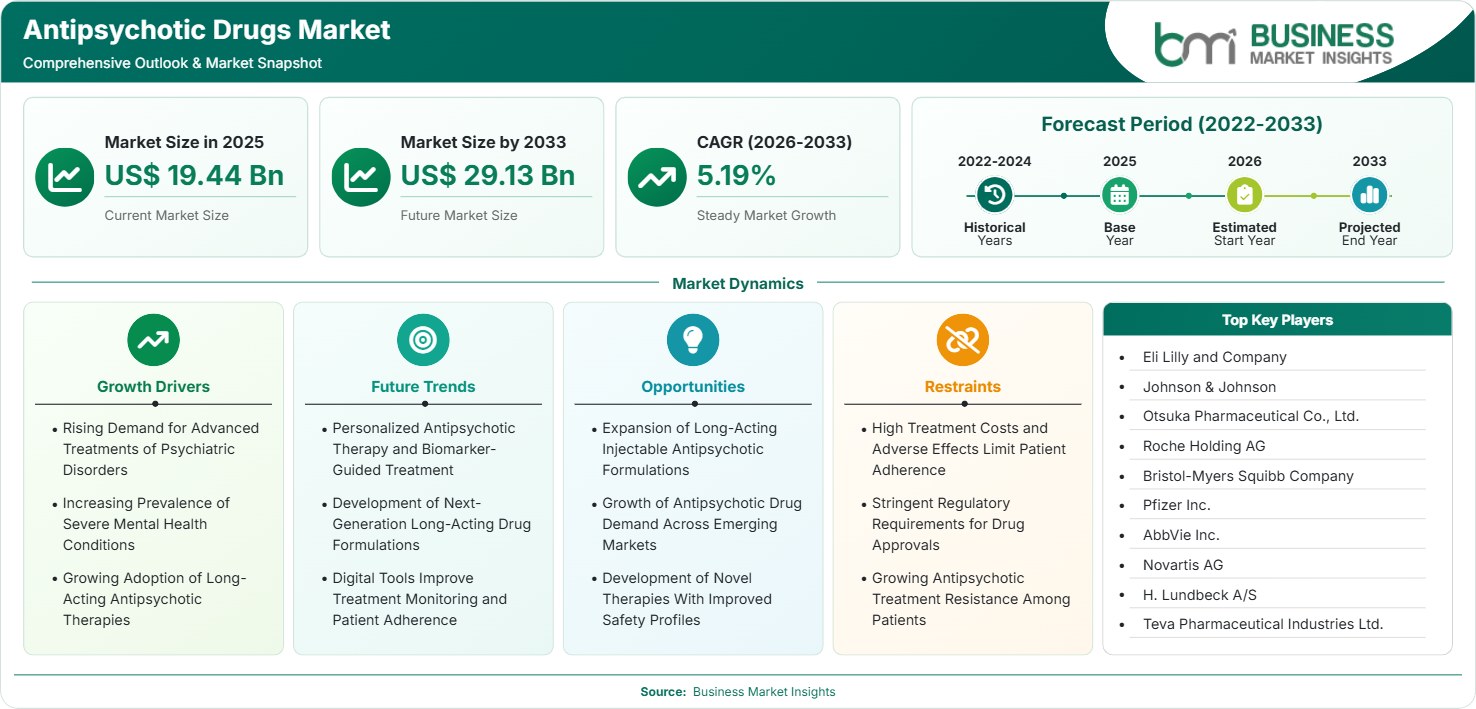
The Antipsychotic Drugs Market size was valued at US$ 19.44 Billion in 2025 and is projected to reach US$ 29.13 Million by 2033, growing at a CAGR of 5.19% during 2026–2033, driven by treatment innovation, rising psychiatric disease burden, long-acting therapies, emerging-market access, and improved safety-focused drug development.

Report Coverage
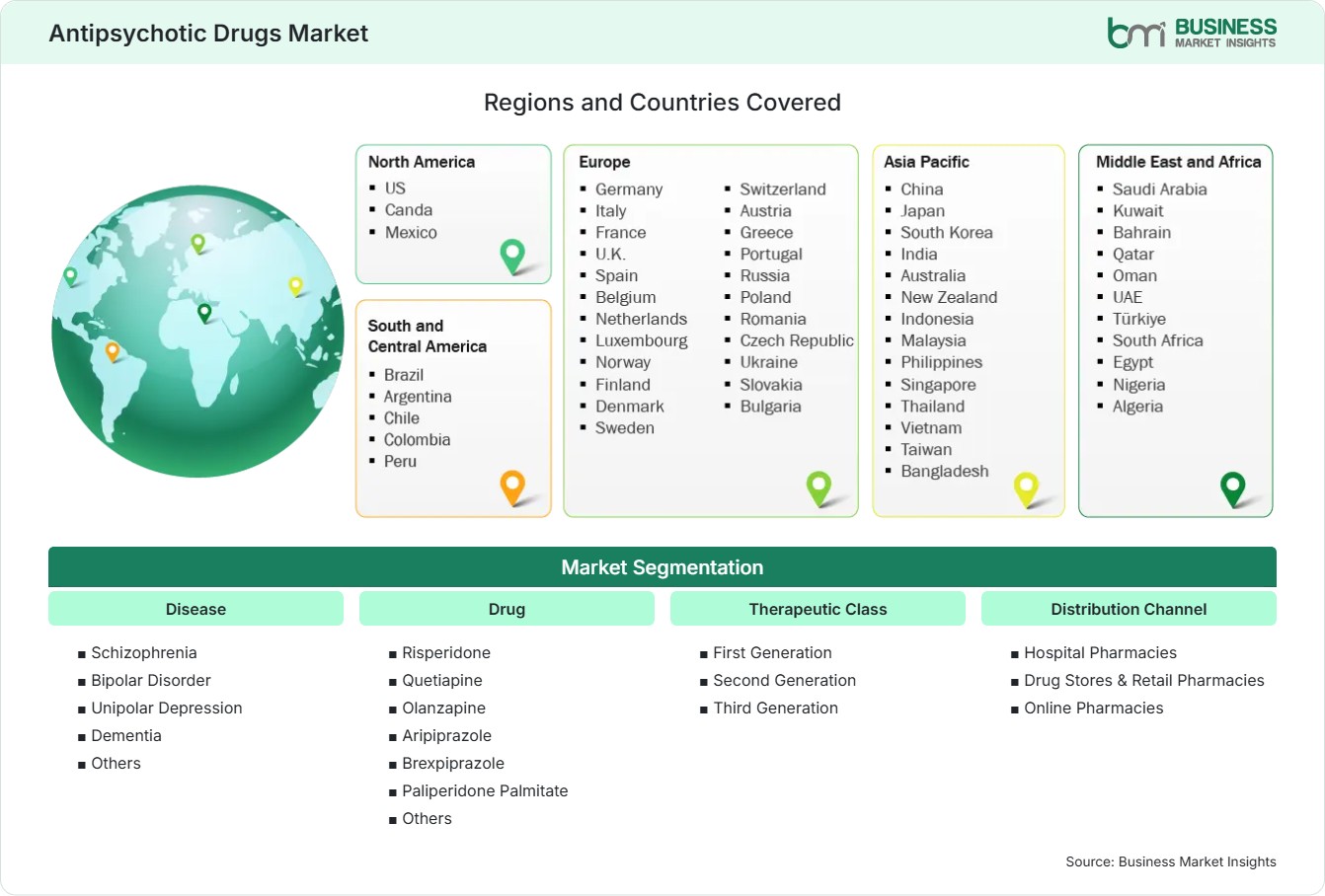
  • Disease: Schizophrenia, Bipolar Disorder, Unipolar Depression, Dementia, Others
  • Drug: Risperidone, Quetiapine, Olanzapine, Aripiprazole, Brexpiprazole, Paliperidone Palmitate, Others
  • Therapeutic Class: First Generation, Second Generation, Third Generation
  • Distribution Channel: Hospital Pharmacies, Drug Stores & Retail Pharmacies, Online Pharmacies
US$ 19.44 Bn Market size in 2025
US$ 29.13 Bn Market Size by 2033
5.19% CAGR, 2026 - 2033
2026-2033 Forecast Period

AI Overview

Antipsychotic Drugs Market Summary

  • North America Region: North America holds 30%–33% Antipsychotic Drugs Market share in 2025, growing at a CAGR of 4.80%–5.20%, supported by established psychiatric care infrastructure, high diagnosis rates, treatment innovation, reimbursement availability, and adoption of long-acting therapies. The US market is projected to grow at a 4.90%–5.30% CAGR from 2026–2033, supported by advanced treatment access and extensive specialty-care networks.
  • Fastest Growing Region: Asia Pacific holds 24%–27% share in 2025 and is projected to grow at a CAGR of 5.80%–6.30%, driven by expanding psychiatric healthcare infrastructure, increasing diagnosis, improving medicine accessibility, urbanization, and growing awareness of severe mental health disorders.
  • Leading Segment: Schizophrenia accounts for 48%–52% share in 2025 and is projected to grow at a CAGR of 5.30%–5.70%, supported by chronic treatment requirements, relapse prevention, increasing use of long-acting therapies, and continuing innovation in schizophrenia pharmacotherapy.
  • High Growth Segment: Paliperidone Palmitate is projected to register a CAGR of 6.40%–6.90%, supported by long-acting administration, reduced dosing frequency, adherence-focused treatment strategies, and increasing clinical acceptance of injectable formulations for chronic schizophrenia management.
  • Key Market Opportunity: Expansion of long-acting injectable formulations provides an attractive opportunity as treatment providers seek sustained drug delivery, improved adherence, fewer daily dosing requirements, and reduced relapse risk.
  • Major Market Players: Eli Lilly and Company, Johnson & Johnson, Otsuka Pharmaceutical Co., Ltd., Roche Holding AG, Bristol-Myers Squibb Company, Pfizer Inc., AbbVie Inc., Novartis AG, H. Lundbeck A/S, Teva Pharmaceutical Industries Ltd.
Strategic Insights

Antipsychotic Drugs Market: Strategic Insights

Antipsychotic Drugs Market Strategic Framework
FREE PDF
Request your free sample
Request free sample
Stakeholder View

Key Takeaways

  • The supply ecosystem spans originator pharmaceuticals, generic manufacturers, contract development organizations, specialty distributors, hospitals, pharmacies, and digital care providers.
  • Long-acting injectable products provide the strongest structural opportunity within chronic schizophrenia treatment because they address adherence challenges and reduce daily medication burden.
  • Innovation is moving beyond conventional dopamine antagonism toward novel mechanisms and formulations designed to improve tolerability and address broader symptom profiles.
  • Asia Pacific offers an attractive expansion case because diagnosis, psychiatric infrastructure, and medicine accessibility are improving from a relatively underpenetrated base.
  • Strategic competition is increasingly shaped by lifecycle management, formulation extensions, generic entry, licensing, and pipeline acquisitions.
  • Market access strategies are becoming as important as clinical differentiation because treatment affordability and reimbursement influence adherence and continuity.
Geographic Outlook

Antipsychotic Drugs Market Regional Highlights

North America Antipsychotic Drugs Market

North America represented 30%–33% share in 2025 and North America Antipsychotic Drugs Market forecast to grow at a CAGR of 4.80%–5.20% during 2026–2033. Strong psychiatric infrastructure, established reimbursement systems, specialist availability, and extensive pharmaceutical commercialization support regional demand. The region also benefits from rapid adoption of differentiated therapies and long-acting injectables.

  • The United States dominates regional demand because of extensive psychiatric treatment infrastructure, high pharmaceutical spending, established specialty-care networks, and broad availability of innovative therapies.
  • Canada provides additional growth through expanding mental-health services, public healthcare coverage, and increasing attention to treatment continuity for severe psychiatric conditions.
  • Long-acting injectable adoption is strengthening as clinicians seek treatment approaches that reduce daily adherence requirements and support consistent medication exposure.
  • Generic competition remains commercially important, encouraging originator companies to differentiate through formulations, dosing intervals, clinical evidence, and patient-support programs.

US Antipsychotic Drugs Market

The US Antipsychotic Drugs Market represented 25%–28% of global demand in 2025 and is projected to grow at a CAGR of 4.90%–5.30% through 2033. The country benefits from extensive specialist networks, established pharmaceutical reimbursement channels, and broad availability of branded, generic, oral, and injectable treatments. Regulatory activity is also encouraging innovation in mechanisms and formulations, supporting continued product differentiation.

  • Long-acting injectable treatments remain strategically important because providers can monitor administration directly while reducing dependence on daily patient medication routines.
  • Novel mechanisms are increasing competitive differentiation, with the 2024 approval of Cobenfy demonstrating renewed development interest beyond traditional dopamine-receptor approaches.
  • Generic availability creates pricing pressure while increasing treatment accessibility, encouraging branded manufacturers to emphasize clinical differentiation and lifecycle management.

Europe Antipsychotic Drugs Market

Europe Antipsychotic Drugs Market accounted for 27%–30% share in 2025 and is expected to grow at a CAGR of 4.50%–4.90% during 2026–2033. Germany, France, the United Kingdom, Italy, and Spain remain important markets because of established healthcare systems and psychiatric treatment capacity. Germany and France provide strong commercial opportunities, while Poland and selected Central European markets offer higher-growth potential as healthcare access and diagnosis improve.

  • Germany remains a leading market because of extensive hospital infrastructure, specialist availability, and established reimbursement pathways for psychiatric medicines.
  • France, the United Kingdom, Italy, and Spain support regional demand through mature healthcare systems and established psychiatric treatment networks.
  • European healthcare systems increasingly emphasize treatment effectiveness, pharmacoeconomic evidence, and appropriate medicine utilization, influencing product access decisions.
  • Long-acting therapies can benefit from adherence-oriented treatment strategies, particularly where healthcare providers prioritize relapse prevention and continuity of care.

Asia Pacific Antipsychotic Drugs Market

Asia Pacific Antipsychotic Drugs Market represented 24%–27% share in 2025 and is projected to grow at a CAGR of 5.80%–6.30% through 2033. China, Japan, India, South Korea, and Australia are leading markets, while India, Indonesia, Vietnam, and selected Southeast Asian countries provide higher-growth opportunities. Expanding healthcare infrastructure, urbanization, increasing awareness, and improving access to psychiatric services are strengthening regional treatment demand.

  • China provides substantial opportunity because healthcare infrastructure is expanding and psychiatric diagnosis and treatment access are improving across major urban centers.
  • India offers strong growth potential through increasing mental-health awareness, expanding private healthcare, broader medicine distribution, and improving specialist availability.
  • Japan and South Korea provide mature markets where treatment innovation, aging populations, and established psychiatric care systems support sustained pharmaceutical demand.

Rest of World Antipsychotic Drugs Market

Rest of World accounted for 12%–15% share in 2025 and is projected to grow at a CAGR of 4.20%–4.70% through 2033. South and Central America are supported by expanding healthcare access, increasing awareness, and improving pharmaceutical distribution, with Brazil and Mexico leading demand. Brazil and Mexico provide the strongest Latin American opportunities because of their comparatively developed healthcare infrastructure and large patient populations. Argentina, Colombia, and Chile offer additional potential as psychiatric treatment access improves. The Middle East is supported by healthcare modernization, while Saudi Arabia and the United Arab Emirates are prominent markets.

  • Brazil combines a large population with established pharmaceutical distribution and expanding attention to mental-health treatment accessibility.
  • Mexico benefits from improving private healthcare capacity and increasing availability of specialty medicines across urban treatment centers.
  • Saudi Arabia and the United Arab Emirates are investing in healthcare infrastructure, creating opportunities for advanced psychiatric treatment access.
  • South Africa represents a regional opportunity as specialist psychiatric services and medicine availability continue developing.
Global Market Geography
FREE PDF
Request your free sample
Request free sample
Segment Analysis

Antipsychotic Drugs Market Segmentation

Disease

Disease segment is led by schizophrenia, which represented 48%–52% share in 2025 and is projected to grow at a CAGR of 5.30%–5.70% between 2026–2033. Chronic treatment requirements, relapse prevention, and increasing adoption of long-acting therapies support segment expansion.

  • Schizophrenia: Schizophrenia dominates demand because treatment is typically long term. Long-acting injectable therapies are strengthening adherence-focused management and supporting continued pharmaceutical innovation.
  • Bipolar Disorder: Bipolar disorder generates demand for antipsychotics used in acute and maintenance treatment. Product selection increasingly considers efficacy, tolerability, and symptom-specific therapeutic requirements.
  • Unipolar Depression: Antipsychotics are used mainly as adjunctive treatments for selected patients with inadequate antidepressant response. Product differentiation focuses on efficacy and tolerability.
  • Dementia: Antipsychotic use in dementia remains clinically restricted because of safety concerns. Demand is concentrated around carefully selected behavioral and psychiatric symptoms requiring pharmacological intervention.

Drug

Drug segment remains highly competitive because established molecules coexist with newer formulations, generic versions, and lifecycle extensions. Paliperidone Palmitate is projected to register the strongest growth at 6.40%–6.90% during 2026–2033. The Antipsychotic Drugs Market trends increasingly favor extended-release formulations, differentiated delivery technologies, and therapies addressing adherence and tolerability concerns.

  • Risperidone: Risperidone maintains broad clinical use across psychiatric indications, supported by established efficacy, multiple formulations, and extensive market familiarity.
  • Quetiapine: Quetiapine benefits from broad clinical utilization across schizophrenia, bipolar disorder, and adjunctive depression treatment, supported by extensive physician experience.
  • Olanzapine: Olanzapine remains an established atypical antipsychotic with strong efficacy recognition, although metabolic considerations influence prescribing and treatment selection.
  • Aripiprazole: Aripiprazole benefits from differentiated receptor activity and oral and long-acting formulations, supporting use across multiple psychiatric treatment pathways.
  • Brexpiprazole: Brexpiprazole is gaining attention through expanded therapeutic applications and its established schizophrenia and adjunctive depression indications.
  • Paliperidone Palmitate: Paliperidone Palmitate benefits from extended dosing intervals and adherence-focused administration, making it increasingly relevant to chronic schizophrenia management.

Therapeutic Class

Therapeutic Class segment is undergoing gradual transition toward second- and third-generation therapies as clinicians prioritize efficacy, tolerability, and broader symptom management. Second Generation represents the dominant class, while Third Generation benefits from newer mechanisms and differentiated pharmacology.

  • First Generation: First-generation antipsychotics remain relevant for selected clinical situations and cost-sensitive treatment settings. Their established efficacy supports continued utilization despite tolerability considerations.
  • Second Generation: Second-generation drugs dominate modern treatment because of broad indications, extensive clinical experience, and diversified formulations spanning oral and long-acting injectable therapies.
  • Third Generation: Third-generation therapies emphasize pharmacological differentiation and improved tolerability. Continued innovation may expand their role where clinicians seek alternatives to established treatment profiles.

Distribution Channel

Distribution Channel segment is supported by hospital-based treatment, retail prescription access, and growing digital pharmacy infrastructure. Hospital Pharmacies remain particularly important for acute psychiatric care and injectable administration, while online pharmacies provide increasing convenience for stable patients receiving ongoing prescriptions. Channel development is influenced by prescription regulations, reimbursement structures, medication monitoring, and the increasing use of specialty pharmacy services.

  • Hospital Pharmacies: Hospital pharmacies remain essential for acute psychiatric treatment, inpatient care, and administration of selected long-acting injectable therapies under clinical supervision.
  • Drug Stores & Retail Pharmacies: Retail pharmacies provide broad access to oral antipsychotics and maintenance prescriptions, particularly for patients receiving stable community-based treatment.
  • Online Pharmacies: Online pharmacies are expanding convenience for maintenance therapy through digital prescription processing, home delivery, and recurring medication fulfillment where regulations permit.
Market Forces

Antipsychotic Drugs Market Dynamics

Key Market Drivers

Rising Demand for Advanced Treatments of Psychiatric Disorders

Growing clinical demand for antipsychotic treatments that offer effective symptom management, greater therapeutic spectrum, and increased tolerance levels is driving the pharmaceutical manufacturers towards developing antipsychotic treatments. This trend is opening up commercial opportunities for novel drug mechanism, extended-release formulation, and patient-oriented therapy development. Manufacturers are also working on those formulations that offer reduced dosing frequency and increased adherence rates. All this is helping in the Antipsychotic Drugs Market growth by making the competition move towards clinical differentiation.

Increasing Prevalence of Severe Mental Health Conditions

The constant demand for treatment of schizophrenia, bipolar disorder, depression and other related mental illnesses generates a significant need for medication on a continuous basis. Increased demand willl help in increase in the prescription rates of these drugs across hospitals, specialized facilities, retail pharmacies and community care. Severe mental illnesses that often necessitate continued maintenance therapy in order to manage symptoms and prevent any relapses. Recognition of mental illnesses has prompted healthcare systems to increase their capacity for treatment and diagnosis.

Growing Adoption of Long-Acting Antipsychotic Therapies

Treatment adherence remains a major challenge in chronic psychiatric care, encouraging clinicians to consider long-acting injectable formulations for appropriate patients. Greater adoption of injectable therapies can shift prescription value toward higher-differentiation products while reducing reliance on daily oral administration. FDA documents identify multiple long-acting injectable options in the US, including monthly, six-week, two-month, and longer-duration regimens. This evolution is strengthening Antipsychotic Drugs Market trends around treatment persistence, clinical administration, and reduced medication-management burden.

Key Market Opportunities

Expansion of Long-Acting Injectable Antipsychotic Formulations

The development of extended-release injectable formulations can help to solve the issue of compliance and increase the visibility of healthcare professionals in the administration of treatment. Extended dosing periods enable premium positioning, lifecycle management, and reimbursement differentiation. There are currently injectable drugs with monthly, quarterly, and biannual dosing intervals, providing a business case for moving towards extended formulations. Future opportunities include formulations requiring fewer healthcare visits, improved injection tolerability, and simplified initiation protocols.

Growth of Antipsychotic Drug Demand Across Emerging Markets

Expanding healthcare infrastructure, rising psychiatric awareness, and improved medicine accessibility are increasing treatment opportunities across developing economies. Pharmaceutical companies can expand patient reach through localized pricing, generic portfolios, physician education, and partnerships with healthcare providers. Emerging markets often have lower treatment penetration than developed markets, creating room for volume expansion as diagnosis improves. Companies can also adapt distribution strategies to fragmented healthcare systems by combining hospital channels, retail pharmacies, specialty distributors, and digital services.

Development of Novel Therapies with Improved Safety Profiles

Safety and tolerability limitations associated with established antipsychotics create demand for medicines offering improved metabolic, neurological, cardiovascular, or other risk profiles. Developers able to demonstrate meaningful safety advantages can achieve stronger physician acceptance and differentiate products in crowded therapeutic markets. Regulatory innovation is reinforcing this opportunity by encouraging novel mechanisms and targeted indications. Safety-focused innovation therefore provides a major route for premium positioning and lifecycle expansion.

Market Restraints and Challenges

High Treatment Costs and Adverse Effects Limit Patient Adherence

Factor: Branded drugs, injection route, monitoring, and side effects can increase the burden on patients and reduce their inclination to continue treatment. Impact: Incomplete adherence leads to non-adherence and reduced value of the treatment regimen, especially if drug payment is partial or patient costs are high. Established antipsychotics may also produce metabolic, neurological, cardiovascular, or other adverse effects that require monitoring and treatment adjustment.

Stringent Regulatory Requirements for Drug Approvals

Factor: The approval of antipsychotic drugs demands substantial data pertaining to their effectiveness, safety, pharmacokinetic properties, drug-drug interactions, adverse effects, and risk management. Impact: Development costs, long-term clinical trials, and uncertain regulations can lead to delays in the market introduction of antipsychotics and decrease the return on investment from failed development projects.

Company Analysis

Competitive Landscape

The Antipsychotic Drugs Market analysis highlights a competitive environment comprising diversified drug manufacturers, neuroscience experts, originators and companies that have proven generic competencies. Competitive positioning is influenced by clinical differentiation, formulation technologies, long acting injectable portfolios, regulatory excellence, geographic reach and lifecycle management.

Company Name

Overview

Products and Services relevant to this market

Eli Lilly and Company

Global pharmaceutical company with extensive neuroscience and mental-health research capabilities.

Antipsychotic and psychiatric medicines, clinical development, lifecycle management, and specialty pharmaceutical commercialization.

Johnson & Johnson

Diversified healthcare company with a major schizophrenia franchise and extensive long-acting injectable capabilities.

Risperidone and paliperidone-based schizophrenia therapies, including monthly, three-month, and six-month injectable formulations.

Otsuka Pharmaceutical Co., Ltd.

Japanese pharmaceutical company with a strong neuroscience portfolio and established antipsychotic franchise.

Aripiprazole and brexpiprazole products, schizophrenia treatments, psychiatric research, and lifecycle development.

Roche Holding AG

Global healthcare company with pharmaceutical research spanning neuroscience and complex disease areas.

Neuroscience medicines, clinical development capabilities, research platforms, and specialty pharmaceutical services.

Bristol-Myers Squibb Company

Global biopharmaceutical company with extensive experience in central nervous system medicines.

Psychiatric medicines, clinical research, drug development, commercialization, and specialty-care products.

Pfizer Inc.

Global pharmaceutical company with broad therapeutic capabilities and extensive international commercialization infrastructure.

Prescription medicines, psychiatric treatment products, clinical development, manufacturing, and global distribution.

AbbVie Inc.

Research-driven biopharmaceutical company with expanding neuroscience and specialty-care capabilities.

Neuroscience medicines, clinical development, specialty pharmaceutical commercialization, and patient-support programs.

Novartis AG

Global pharmaceutical company with broad innovative-medicine research and advanced clinical development capabilities.

Neuroscience research, specialty medicines, clinical development, manufacturing, and international pharmaceutical distribution.

H. Lundbeck A/S

Specialized pharmaceutical company focused strongly on brain diseases and psychiatric disorders.

Antipsychotic and neuroscience medicines, clinical research, psychiatric treatment solutions, and specialty-care commercialization.

Teva Pharmaceutical Industries Ltd

Global pharmaceutical company with extensive generic and specialty medicine capabilities.

Generic and specialty antipsychotic medicines, oral formulations, manufacturing, and broad international distribution.

Trust & Transparency

Research Methodology

The market analysis combines proprietary research with secondary data from government agencies, company disclosures, regulatory filings, industry databases and expert interviews. Market estimates are validated through data triangulation, cross-market benchmarking and analyst review.

View Full Research Methodology

Questions Answered

Frequently Asked Questions

How do generic medicines influence competition?

Generic entry expands affordability and patient access while placing pricing pressure on originator products. Originator companies increasingly respond through formulation extensions, differentiated delivery, new indications, and patient-support strategies.

Why is safety differentiation important for new antipsychotics?

Antipsychotics can involve metabolic, neurological, cardiovascular, and other safety considerations. Products demonstrating a more favorable benefit-risk profile can potentially achieve stronger physician adoption and improve treatment persistence.

What is changing in antipsychotic drug development?

Development is moving toward novel mechanisms, improved tolerability, extended-release delivery, and treatments addressing specific symptom domains. The 2024 approval of Cobenfy demonstrates renewed interest in mechanisms beyond traditional dopamine targeting.

How are long-acting formulations changing psychiatric treatment?

Long-acting formulations reduce the frequency of administration and can address daily medication adherence challenges. Longer dosing intervals also create opportunities for differentiated products and improved treatment continuity.

Which disease indication represents the largest treatment opportunity in Antipsychotic Drugs Market report?

Schizophrenia represents the largest opportunity because treatment is typically chronic and requires ongoing symptom management. Long-acting formulations, maintenance therapy, and relapse-prevention strategies provide recurring commercial demand.

Access the Full Antipsychotic Drugs Market Report

Get segment-level forecasts, regional estimates, competitive benchmarking, company profiles and downloadable Excel datasets.

Access the full Antipsychotic Drugs Market Report
350 pages PDF & Excel | 2026-08-20
Similar Research

Related Market Reports