
AI in Pharma and Biotech Market Outlook: Size, Share, Trends, Growth Analysis, Competitive Landscape & Forecast, 2026-2033

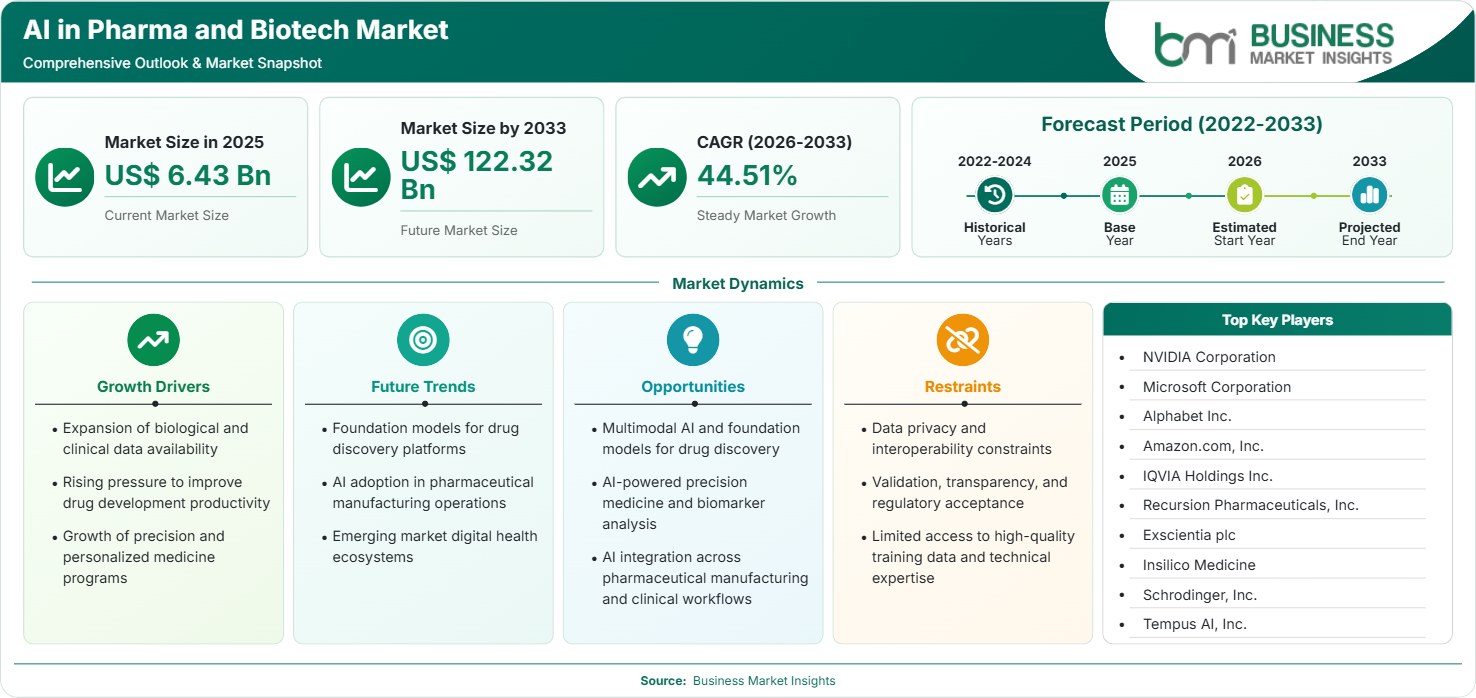
The AI in Pharma and Biotech Market size was valued at US$ 6.43 Billion in 2025 and is projected to reach US$ 122.32 Billion by 2033, growing at a CAGR of 44.51% during 2026–2033, driven by accelerated drug discovery, rising clinical trial complexity, expanding multimodal datasets, precision medicine adoption, and increasing strategic partnerships between pharmaceutical companies and AI technology providers.

Report Coverage
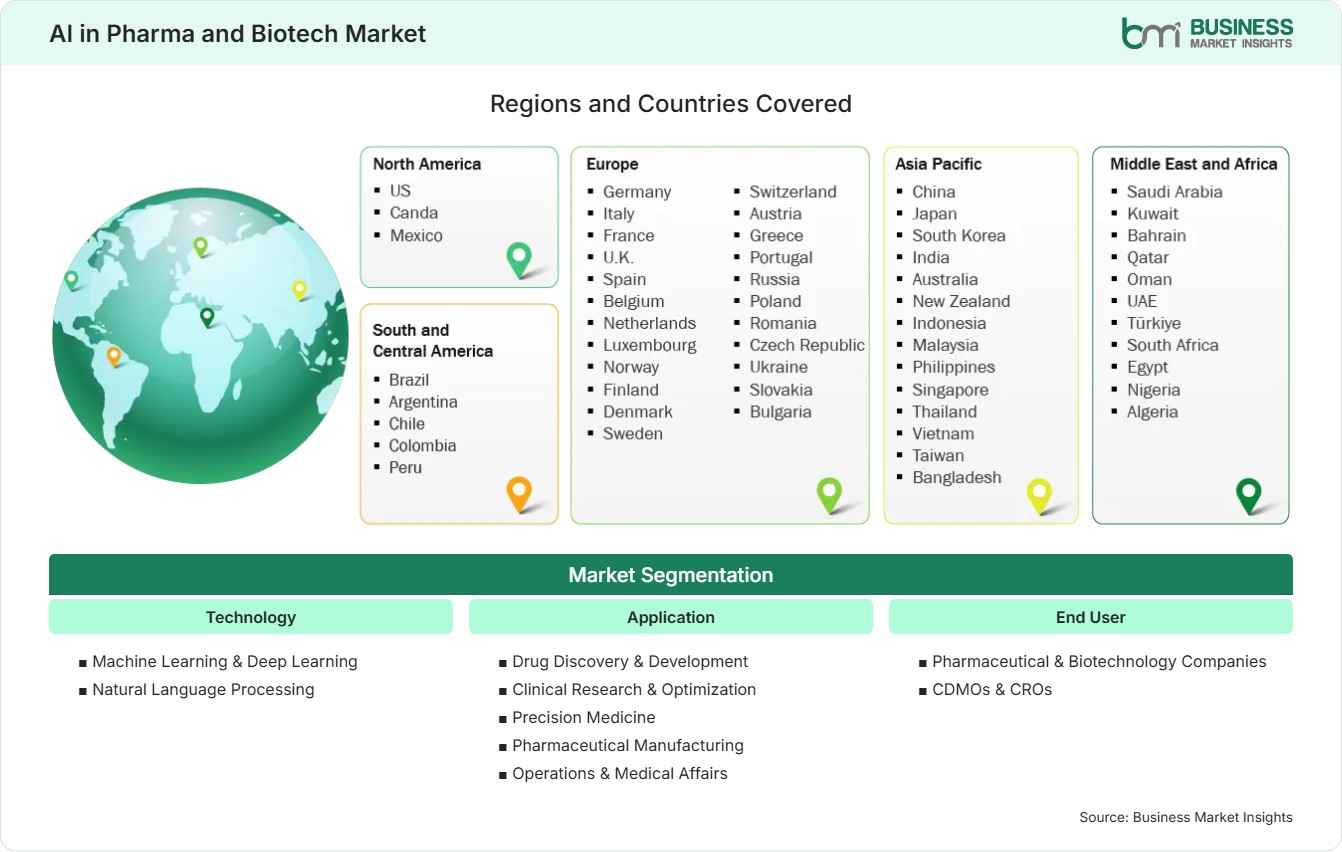
  • Technology: Machine Learning & Deep Learning, Natural Language Processing
  • Application: Drug Discovery & Development, Clinical Research & Optimization, Precision Medicine, Pharmaceutical Manufacturing, Operations & Medical Affairs
  • End User: Pharmaceutical & Biotechnology Companies, CDMOs & CROs
US$ 6.43 Bn Market size in 2025
US$ 122.32 Bn Market Size by 2033
44.51% CAGR, 2026 - 2033
2026-2033 Forecast Period

AI Overview

AI in Pharma and Biotech Market Summary

  • North America Region: North America holds a market share of 41%–44% in 2025, growing at a CAGR of 42%–45% during 2026–2033, supported by strong biopharma R&D spending, advanced cloud infrastructure, extensive genomic databases, regulatory openness toward AI-enabled development pathways, and growing pharmaceutical-AI collaborations. The U.S. benefits from large-scale clinical datasets and digital drug-development programs, advancing at 43%–46% CAGR.
  • Fastest Growing Region: Asia Pacific accounts for a 24%–27% share in 2025 and is expected to expand at 47%–50% CAGR during 2026–2033, driven by biotechnology investments, government-supported innovation ecosystems, expanding healthcare digitization, large patient pools, localized AI platforms, and increasing pharmaceutical manufacturing modernization.
  • Leading Segment: Drug Discovery & Development represents a 34%–37% share in 2025 and advances at 45%–48% CAGR during 2026–2033, fueled by target identification optimization, molecular modeling, candidate screening acceleration, reduced development timelines, lower attrition rates, and expanding pharmaceutical research investments.
  • High Growth Segment: Precision Medicine contributes 14%–17% share in 2025 and grows at 48%–51% CAGR during 2026–2033, supported by genomic profiling, biomarker discovery, personalized therapeutic strategies, patient stratification advances, real-world evidence integration, and increasing rare-disease research applications.
  • Key Market Opportunity: Integration of foundation models, multimodal biological datasets, and federated learning architectures enables scalable discovery workflows, broader clinical insights, improved productivity, and more efficient therapeutic development across global healthcare ecosystems.
  • Major Market Players: NVIDIA Corporation, Microsoft Corporation, Alphabet Inc., Amazon.com, Inc., IQVIA Holdings Inc., Recursion Pharmaceuticals, Inc., Exscientia plc, Insilico Medicine, Schrodinger, Inc., Tempus AI, Inc.
Strategic Insights

AI in Pharma and Biotech Market: Strategic Insights

AI in Pharma and Biotech Market Strategic Framework
FREE PDF
Request your free sample
Request free sample
Stakeholder View

Key Takeaways

  • The ecosystem increasingly combines pharmaceutical companies, cloud providers, AI specialists, CROs, and genomic data platforms, creating integrated value chains that shorten discovery-to-clinical timelines.
  • Precision medicine, rare-disease therapeutics, and oncology-focused applications offer the strongest commercial upside because AI improves biomarker identification and patient stratification efficiency.
  • Multimodal foundation models are becoming a core innovation direction, enabling simultaneous analysis of molecular, imaging, genomic, and clinical datasets.
  • Asia Pacific presents a compelling investment case due to expanding biotechnology clusters in China, India, Singapore, and South Korea alongside strong digital-health initiatives.
  • Strategic acquisitions, platform collaborations, and AI-biopharma partnerships continue increasing as organizations seek proprietary datasets and differentiated algorithms.
  • Manufacturing optimization and predictive quality management are emerging as important revenue opportunities beyond drug discovery applications.
Geographic Outlook

AI in Pharma and Biotech Market Regional Highlights

North America AI in Pharma and Biotech Market

North America maintains leadership with 41%–44% AI in Pharma and Biotech Market share in 2025 and records a 42%–45% CAGR through 2033. Regional dominance reflects strong biotechnology innovation, extensive clinical research infrastructure, advanced cloud adoption, and substantial pharmaceutical R&D expenditure. Leading academic institutions, technology companies, and biopharma enterprises collaborate extensively to accelerate data-driven therapeutic development. AI deployment continues expanding from drug discovery into manufacturing optimization, clinical analytics, pharmacovigilance, and commercial decision support.

  • Large healthcare datasets improve model training quality and support advanced therapeutic research workflows.
  • Strong venture capital activity accelerates commercialization of AI-enabled biotechnology platforms.
  • Strategic technology partnerships enhance computational capabilities and biological data integration.
  • Regulatory engagement encourages responsible AI implementation across healthcare and pharmaceutical activities.

US AI in Pharma and Biotech Market

The U.S. accounts for 78%–82% of North American revenue share and advances at a 43%–46% CAGR. Market leadership stems from pharmaceutical innovation, biotechnology funding, advanced computing resources, and robust clinical trial activity. Major drug developers increasingly deploy AI across target identification, molecule design, trial management, and real-world evidence generation. Federal support for biomedical research and extensive genomic initiatives further reinforce competitive positioning.

  • AI-supported oncology research remains a major investment priority.
  • Large life-science technology partnerships strengthen innovation pipelines.
  • Growing rare-disease research creates demand for precision analytical platforms.
  • Expansion of cloud-native research environments enhances scalability.

Europe AI in Pharma and Biotech Market

Europe has a 26-29% market share in 2025, growing at a CAGR of 43-46%. Factors driving growth in the European market include robust pharmaceutical production facilities, effective research organizations, and health data management systems. Germany leads adoption within the region, whereas the fastest-growing country market in Europe is the UK, with a CAGR of 45-48%. The regulations that emphasize data governance and responsible use of AI facilitate sustainable deployment in therapeutic research and clinical trials.

  • Cross-border health-data programs improve research collaboration.
  • Germany leads adoption through pharmaceutical and industrial innovation strength.
  • The United Kingdom attracts AI-biotech investments and startup formation.
  • Precision medicine initiatives continue expanding across major healthcare systems.

Asia Pacific AI in Pharma and Biotech Market

The Asia-Pacific region has a market share of 24%-27% for 2025 and exhibits the highest regional growth rate of 47%-50%. Fast biotechnology investments, digitization of healthcare, and pharmaceutical production have contributed to adoption. The biggest revenue contributor in the region is China, while the fastest-growing country in the market is India, with a 49%-52% CAGR. Expanding genomic research, government-backed innovation programs, and increasing use of AI in clinical development are strengthening competitive capabilities across the region.

  • China benefits from large datasets and biotechnology investments.
  • India experiences rapid growth through digital-health and life-science initiatives.
  • South Korea strengthens capabilities in precision medicine applications.
  • Singapore remains a regional innovation hub for biotech partnerships.

Rest of World AI in Pharma and Biotech Market

Rest of World contributes 7%–10% share and expands at a 44%–47% CAGR. South & Central America increasingly adopt data-driven pharmaceutical research tools, particularly in Brazil. In the Middle East and Africa, adoption is led by Saudi Arabia and the United Arab Emirates through healthcare digitization and biotechnology investment initiatives. Regional growth reflects rising clinical research participation, pharmaceutical modernization, and increasing cloud-enabled analytical capabilities.

  • Brazil leads adoption within South & Central America through expanding biotechnology activity.
  • Saudi Arabia supports healthcare AI investments under national transformation programs.
  • UAE innovation initiatives attract health-technology partnerships and research projects.
  • Increased clinical trial participation supports analytical platform demand.
Global Market Geography
FREE PDF
Request your free sample
Request free sample
Segment Analysis

AI in Pharma and Biotech Market Segmentation

Technology

Technology contributes to the fundamental creation of value in the industry through extensive use in research and development. The segment is estimated to contribute about 35%–38% market share in 2025 and grow with a CAGR of 44%–47%. The scope of AI in Pharma and Biotech Market is growing due to the increasing use of computational tools in biology.

  • Machine Learning & Deep Learning: Widely used for molecular prediction, target identification, toxicity assessment, and therapeutic optimization, enabling higher research efficiency and improved discovery outcomes across drug development programs.
  • Natural Language Processing: Accelerates literature mining, clinical document review, regulatory intelligence gathering, pharmacovigilance monitoring, and knowledge extraction from unstructured healthcare information sources.

Application

Applications remain the category that creates the most value, with Drug Discovery & Development leading. It accounts for 34%–37% market share in 2025 and grows at a 45%–48% CAGR. AI in Pharma and Biotech Market trends show increased usage across all therapy lifecycle stages, from target discovery to post-market evidence generation.

  • Drug Discovery & Development: Supports candidate identification, molecular optimization, predictive toxicology, and development acceleration while reducing attrition risks during research workflows.
  • Clinical Research & Optimization: Enhances patient recruitment, protocol design, site selection, and trial monitoring efficiency through advanced predictive analytics.
  • Precision Medicine: Enables biomarker identification, genomic interpretation, patient segmentation, and individualized therapeutic decision-making across multiple disease areas.
  • Pharmaceutical Manufacturing: Improves process optimization, equipment performance, yield enhancement, predictive maintenance, and product quality management.
  • Operations & Medical Affairs: Supports commercial forecasting, scientific communications, stakeholder engagement, and insights generation from healthcare data ecosystems.

End User

End-users are mainly influenced by research and development organizations and biotech innovators. The market is dominated by this category of users, at 38%–41% in 2025, with a forecast CAGR of 44%–47%. Collaboration and development services continue to contribute to their growth across varied organizational structures.

  • Pharmaceutical & Biotechnology Companies: Lead adoption through significant R&D investment, extensive datasets, and strategic integration of AI into discovery and development workflows.
  • CDMOs & CROs: Utilize intelligent analytics to optimize development services, clinical operations, manufacturing activities, and client project execution efficiency.
Market Forces

AI in Pharma and Biotech Market Dynamics

Key Market Drivers

Expansion of Biological and Clinical Data Availability

The rapid increase in genomic sequencing, electronic health records, imaging repositories, and real-world evidence datasets is creating powerful foundations for AI-assisted pharmaceutical innovations. In the past decade, global sequencing capacity has increased significantly, and ongoing healthcare digitalization efforts have produced datasets that can be analyzed with advanced algorithms. AI technology enhances therapeutic target discovery by incorporating diverse biological knowledge that cannot be assessed through traditional methods. Increasing data availability leads to more accurate predictions, better patient segmentation, and enhanced decision-making, thereby increasing the acceptance of this technology in research-based pharmaceutical and biotech companies.

Rising Pressure to Improve Drug Development Productivity

Drug development processes remain costly and lengthy, motivating companies to enhance research efficiency. Artificial intelligence technologies enable processes such as virtual screening, molecular optimization, and predictive modeling, thereby ensuring greater efficiency at all stages of discovery. With the ability to identify potential drugs earlier and filter out unsuitable candidates, AI facilitates better management of development costs and more efficient use of resources. Intelligent technologies are seen by pharmaceutical companies as critical infrastructure rather than just experimental tools. Adoption is promoted by the growing collaboration of AI vendors and drug companies.

Growth of Precision and Personalized Medicine Programs

The healthcare industry has been placing greater emphasis on patient-specific treatment methods based on individual genetic, molecular, and clinical profiles. The use of artificial intelligence in this process facilitates biomarker discovery, genomic analysis, and appropriate patient subgrouping. Precision medicine programs are being developed for cancer, rare diseases, and chronic conditions around the globe. AI in the Pharma and Biotech Market growth depends on market trends, as current algorithms facilitate understanding of biological connections. Due to the growing need for individualized treatments, businesses allocate significant funds to intelligent platforms that enable the creation of targeted medications.

Key Market Opportunities

Foundation Models for Drug Discovery Platforms

Large-scale biological foundation models create opportunities to transform early-stage therapeutic development. These systems can analyze multimodal datasets including genomic, proteomic, transcriptomic, imaging, and clinical information. There is an increasing trend in pharmaceutical companies’ investments in reusable AI architectures that can be used to pursue multiple therapeutic programs simultaneously. According to AI in Pharma and Biotech Market Forecasts, there is great promise in platform business models that can deliver sustained value across drug pipelines. Companies that can create their own datasets and biological models have a unique competitive advantage in research-intensive therapeutic areas.

AI Adoption in Pharmaceutical Manufacturing Operations

Manufacturing remains underexploited relative to discovery applications, making it an ideal area for growth. Intelligent systems can help enhance process monitoring, quality management, predictive maintenance, and manufacturing efficiency. With the rising complexity of biologic and advanced therapies manufacturing processes, there is an increasing need for solutions to help ensure consistent quality. Combining with automation systems further strengthens the value proposition. Implementing predictive manufacturing approaches could help reduce costs and ensure compliance, investment rationale for both established pharmaceutical companies and contract manufacturing organizations.

Emerging Market Digital Health Ecosystems

The rapid adoption of healthcare technology in developing nations' economies has created new opportunities for implementing AI-powered pharmaceutical technologies. There is growing governmental support for innovations in biotechnology, healthcare data systems, and research technology. The large patient base, increased research activity in the area, and improved digital infrastructure have created favorable conditions for implementing these technologies. Collaboration between technology firms, healthcare providers, and pharmaceutical companies can expedite the process. Organizations establishing an early presence in these ecosystems may benefit from access to new datasets, research networks, and future commercial opportunities.

Market Restraints and Challenges

Data Privacy and Interoperability Constraints

Factor: Regulatory requirements governing patient information, cross-border data sharing, and health-data governance create implementation complexity. Impact: Organizations frequently encounter barriers when integrating datasets from multiple institutions, limiting model scalability and reducing analytical efficiency. Variations in data standards, documentation practices, and privacy obligations increase operational costs and prolong deployment timelines. Pharmaceutical organizations must invest heavily in governance frameworks, cybersecurity, and compliance capabilities before realizing full value from AI initiatives. These challenges slow adoption in multi-jurisdictional programs despite growing demand for advanced analytical solutions.

Validation, Transparency, and Regulatory Acceptance

Factor: Many advanced AI models operate as complex systems with limited explainability. Impact: Regulatory scrutiny increases when algorithms influence high-stakes decisions related to therapeutic development or clinical outcomes. Organizations often require extensive validation, reproducibility testing, and documentation before deployment. Lack of standardized evaluation frameworks can create uncertainty regarding model reliability and long-term performance. Additional verification requirements may increase implementation timelines, development expenditure, and operational complexity. Addressing transparency concerns remains essential for broader use across regulated pharmaceutical and biotechnology environments.

Company Analysis

Competitive Landscape

AI in Pharma and Biotech Market analysis indicates competition is shaped by cloud providers, AI platform developers, pharmaceutical data specialists, and computational drug-discovery innovators.

Company Name

Overview

Products and Services relevant to this market

NVIDIA Corporation

Provides advanced accelerated computing infrastructure powering large-scale biological and pharmaceutical AI workloads.

GPUs, AI frameworks, BioNeMo platform, high-performance computing solutions for drug discovery.

Microsoft Corporation

Supports life-science digital transformation through cloud, analytics, and responsible AI capabilities.

Azure AI, healthcare data platforms, analytics, machine learning infrastructure.

Alphabet Inc.

Expands AI innovation through advanced research and computational biology initiatives.

Google Cloud, AI models, life-science analytics and research platforms.

Amazon.com, Inc.

Delivers scalable computing and data-management capabilities for pharmaceutical organizations.

AWS cloud, machine learning services, healthcare analytics solutions.

IQVIA Holdings Inc.

Major healthcare data and analytics company supporting research and commercialization.

Clinical analytics, real-world evidence, AI-enabled healthcare intelligence.

Recursion Pharmaceuticals, Inc.

Biotechnology innovator focused on AI-driven therapeutic discovery.

Computational biology platform, drug discovery and development solutions.

Exscientia plc

Pioneer in AI-enabled molecule design and precision discovery workflows.

AI drug-design platform, precision medicine research capabilities.

Insilico Medicine

Specializes in generative AI for therapeutic discovery and development.

Drug discovery software, target identification and molecule generation.

Schrodinger, Inc.

Computational chemistry and molecular simulation specialist.

Physics-based modeling, drug discovery software platforms.

Tempus AI, Inc.

Focuses on precision medicine using clinical and molecular data assets.

Genomics analytics, clinical intelligence and AI-driven insights.

Trust & Transparency

Research Methodology

The market analysis combines proprietary research with secondary data from government agencies, company disclosures, regulatory filings, industry databases and expert interviews. Market estimates are validated through data triangulation, cross-market benchmarking and analyst review.

View Full Research Methodology

Questions Answered

Frequently Asked Questions

What does the AI in Pharma and Biotech Market Report typically evaluate?

The report examines technology adoption, application trends, regional performance, competitive dynamics, investment activity, regulatory influences, and future growth opportunities across pharmaceutical and biotechnology industries.

How does AI support precision medicine initiatives?

AI analyzes genomic, molecular, and clinical information to identify biomarkers, classify patient populations, and improve individualized treatment strategies.

Which region offers the strongest growth potential?

Asia Pacific demonstrates the highest growth potential due to biotechnology investments, healthcare digitization initiatives, and expanding pharmaceutical research ecosystems.

Which application area generates the highest revenue?

Drug Discovery & Development remains the leading application segment because AI improves target identification, compound screening, and candidate optimization efficiency.

What is driving AI adoption in pharmaceutical research?

Increasing drug-development costs, expanding biological datasets, and demand for faster therapeutic discovery are encouraging pharmaceutical companies to deploy AI across research, clinical development, and operational functions.

Access the Full AI in Pharma and Biotech Market Report

Get segment-level forecasts, regional estimates, competitive benchmarking, company profiles and downloadable Excel datasets.

Access the full AI in Pharma and Biotech Market Report
350 pages PDF & Excel | 2026-08-31