
AI in Oncology Market Outlook: Size, Share, Trends, Growth Analysis, Competitive Landscape & Forecast, 2026-2033

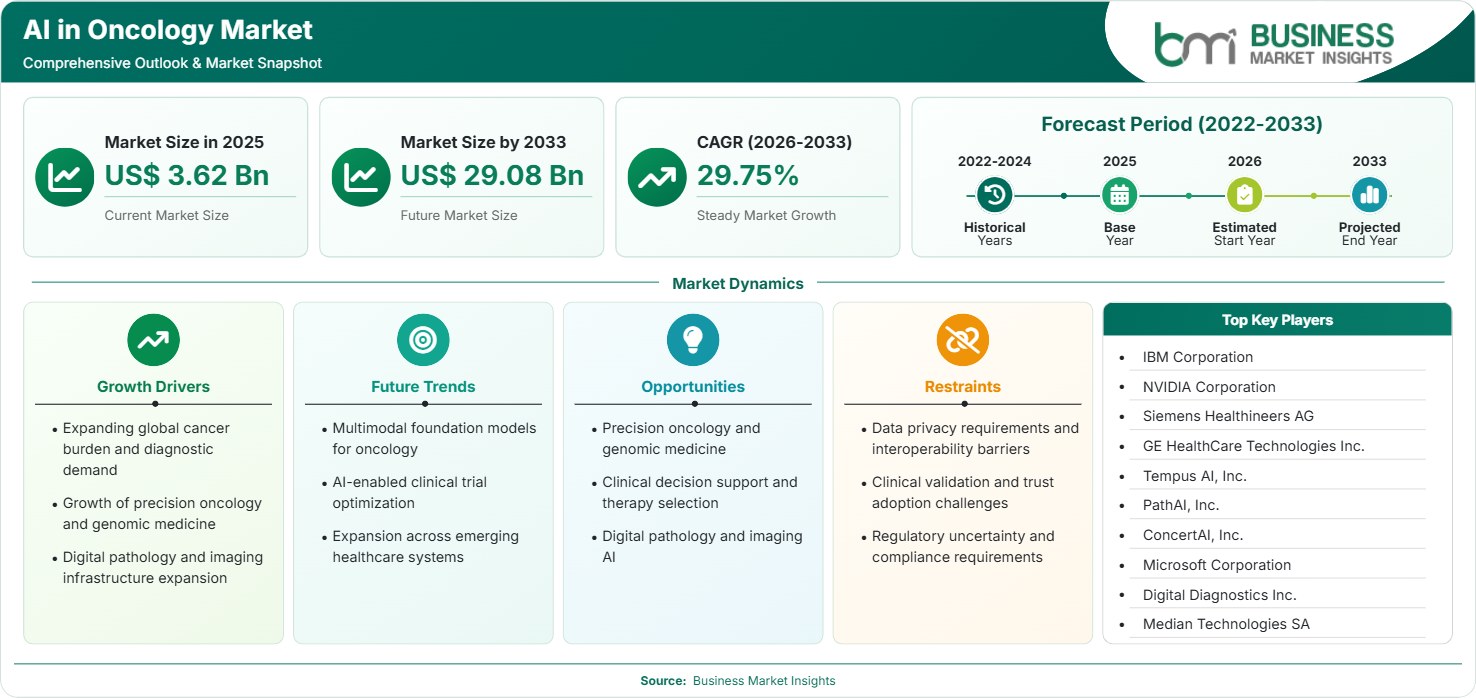
The AI in Oncology Market size was valued at US$ 3.62 Billion in 2025 and is projected to reach US$ 29.08 Billion by 2033, growing at a CAGR of 29.75% during 2026–2033. Rising cancer incidence, expanding medical imaging datasets, precision medicine adoption, and AI-enabled clinical decision-making are accelerating industry expansion while creating opportunities in biomarker discovery and personalized therapies.

Report Coverage
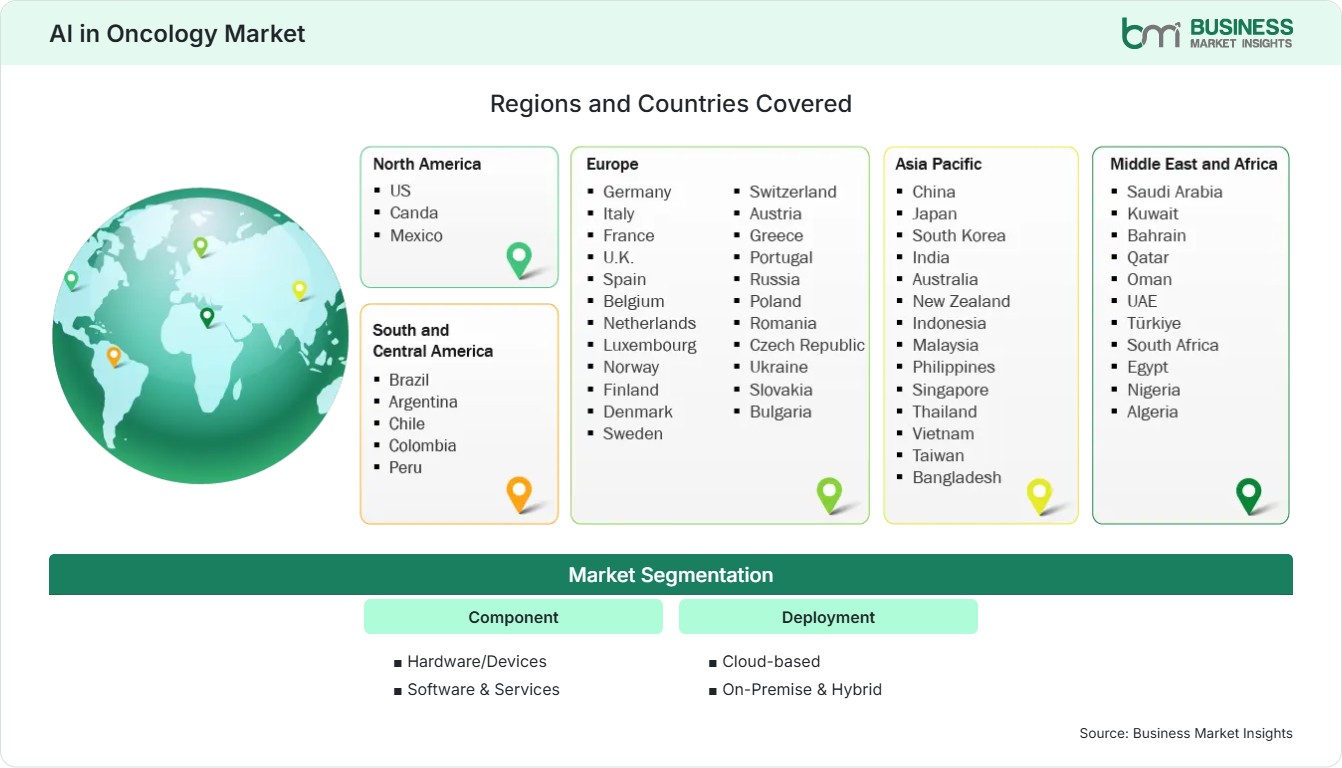
  • Component: Hardware/Devices, Software & Services
  • Deployment: Cloud-based, On-Premise & Hybrid
US$ 3.62 Bn Market size in 2025
US$ 29.08 Bn Market Size by 2033
29.75% CAGR, 2026 - 2033
2026-2033 Forecast Period

AI Overview

AI in Oncology Market Summary

  • North America Region: North America holds a market share of 40%–43% in 2025, growing with a CAGR of 28%–31% during 2026–2033, driven by advanced oncology infrastructure, strong AI funding, regulatory support, precision medicine programs, imaging digitization, biopharma collaborations, clinical workflow automation, cancer data availability, reimbursement progress, and real-world evidence integration opportunities. Brief U.S. analysis: The U.S. accounts for 78%–82% of regional revenue and is advancing at 29%–32% CAGR through precision oncology implementation.
  • Fastest Growing Region: Asia Pacific holds a market share of 22%–25% in 2025, growing with a CAGR of 32%–35% during 2026–2033, supported by healthcare digitization, expanding cancer screening programs, AI investments, imaging infrastructure upgrades, genomic research initiatives, government innovation policies, specialist shortages, cloud deployment adoption, and increasing oncology patient pools.
  • Leading Segment: Software & Services holds a market share of 65%–68% in 2025, growing with a CAGR of 30%–33% during 2026–2033, supported by scalable analytics platforms, clinical workflow integration, pathology automation, cloud accessibility, continuous algorithm enhancement, enterprise deployments, decision-support utilization, radiology optimization, and growing interoperability requirements.
  • High Growth Segment: Clinical Decision Support & Therapy Selection holds a market share of 19%–22% in 2025, growing with a CAGR of 33%–36% during 2026–2033, fueled by precision treatment planning, genomic interpretation, multidisciplinary care coordination, real-world evidence integration, targeted therapy matching, biomarker identification, and value-based oncology management.
  • Key Market Opportunity: Multimodal oncology platforms integrating imaging, pathology, genomic, and clinical datasets enable earlier risk identification, optimized therapy selection, improved trial recruitment, stronger pharmaceutical partnerships, and scalable precision care delivery.
  • Major Market Players: IBM Corporation, NVIDIA Corporation, Siemens Healthineers AG, GE HealthCare Technologies Inc., Tempus AI, Inc., PathAI, Inc., ConcertAI, Inc., Microsoft Corporation, Digital Diagnostics Inc., Median Technologies SA.
Strategic Insights

AI in Oncology Market: Strategic Insights

AI in Oncology Market Strategic Framework
FREE PDF
Request your free sample
Request free sample
Stakeholder View

Key Takeaways

  • The industry value chain increasingly links imaging vendors, genomic testing firms, cloud providers, hospitals, and pharmaceutical companies through interoperable data ecosystems.
  • Clinical decision support and therapy selection applications offer the strongest revenue upside as oncology treatment becomes increasingly personalized.
  • Multimodal AI models combining pathology, radiology, genomic, and clinical datasets are redefining cancer diagnostics and therapeutic planning.
  • Asia Pacific provides a compelling investment case due to rapid healthcare digitalization, large cancer populations, and supportive innovation policies.
  • Strategic partnerships, acquisitions, and co-development agreements between technology companies and biopharma organizations are accelerating commercialization.
  • Explainable AI and validated clinical evidence are becoming critical procurement requirements among large healthcare providers.
Geographic Outlook

AI in Oncology Market Regional Highlights

North America AI in Oncology Market

North America represents 40%–43% market share in 2025 and records a 28%–31% CAGR through 2033. The region benefits from mature cancer centers, widespread data digitization, strong venture funding, and rapid AI integration into clinical workflows. The region maintains leadership through regulatory engagement, extensive oncology research programs, and precision medicine adoption. The AI in Oncology Market share remains highest in North America due to established infrastructure and large-scale deployment capabilities.

  • Advanced pathology digitization supports algorithm training and routine clinical implementation.
  • Pharmaceutical collaborations accelerate biomarker discovery and patient stratification initiatives.
  • Academic medical centers continue expanding real-world oncology data repositories.
  • Regulatory pathways encourage commercialization of AI-enabled oncology platforms.
  • Strong reimbursement discussions support broader provider investment decisions.

US AI in Oncology Market

The United States accounts for 78%–82% of North American revenue and advances at 29%–32% CAGR. Major cancer institutes, research funding programs, cloud adoption, and technology innovation contribute to leadership. Large healthcare networks are implementing AI solutions to improve diagnostic consistency, workflow efficiency, and clinical decision support outcomes across oncology specialties and precision medicine programs.

  • Large genomic databases strengthen predictive modeling and biomarker identification capabilities.
  • Commercial partnerships between technology firms and hospitals accelerate deployment.
  • Cancer research funding continues supporting translational AI innovation programs.
  • Integrated delivery networks increasingly adopt AI-enabled treatment planning tools.

Europe AI in Oncology Market

Europe captures 27%–30% AI in Oncology Market share in 2025 and grows at 27%–30% CAGR through AI in the Oncology Market Forecast Period. Regional growth is supported by public healthcare digitization, cancer screening initiatives, and robust data governance frameworks. Germany remains the leading market while Spain and selected Nordic countries demonstrate faster adoption rates. Regional collaborations enhance AI validation and evidence generation.

  • Germany leads adoption with strong healthcare technology infrastructure.
  • Spain records one of the fastest regional expansion rates through digital health investments.
  • EU data initiatives strengthen interoperability and oncology research collaboration.
  • Precision medicine programs increase demand for therapy selection solutions.
  • Research networks accelerate multicenter validation of oncology algorithms.

Asia Pacific AI in Oncology Market

Asia Pacific holds 22%–25% AI in Oncology Market share and exhibits the highest regional CAGR of 32%–35% through 2033. Large patient populations, expanding imaging infrastructure, and national AI policies support adoption. China leads regional revenue while India demonstrates among the fastest expansion rates. Public and private investments accelerate commercialization and healthcare integration across oncology settings.

  • China remains the largest regional contributor due to healthcare technology scale.
  • India benefits from digital health initiatives and growing oncology investments.
  • Japan advances precision medicine deployment across leading cancer centers.
  • Cloud infrastructure expansion improves accessibility of advanced analytics tools.
  • Local technology developers strengthen regional innovation ecosystems.

Rest of World AI in Oncology Market

Rest of World accounts for 8%–10% AI in Oncology Market share in 2025 and expands at 29%–32% CAGR through 2033. South and Central America are benefiting from diagnostic modernization initiatives. Middle East and Africa markets are supported by healthcare investments, specialty oncology centers, and national transformation programs. Brazil leads Latin America while the UAE demonstrates stronger adoption momentum.

  • Brazil dominates regional demand through expanding oncology infrastructure.
  • UAE investments support advanced cancer care and digital transformation strategies.
  • Growing specialist shortages increase utility of AI-enabled workflow solutions.
  • International partnerships improve access to advanced oncology technologies.
  • Digitization programs expand clinical data availability and research capabilities.
Global Market Geography
FREE PDF
Request your free sample
Request free sample
Segment Analysis

AI in Oncology Market Segmentation

Component

Component segment adoption is shaped by rising demand for scalable software, advanced computing infrastructure, and integrated analytics platforms. The segment records broad expansion, with Software & Services holding 65%–68% share in 2025 and advancing at 30%–33% CAGR. The AI in Oncology Market scope continues expanding as providers prioritize interoperable solutions and clinical workflow optimization.

  • Hardware/Devices: Growth is driven by high-performance computing systems, imaging hardware integration, edge-processing capabilities, and infrastructure upgrades supporting increasingly complex oncology algorithms.
  • Software & Services: Dominant category benefiting from cloud accessibility, analytics platforms, workflow integration, decision-support capabilities, and recurring revenue business models.

Deployment

Deployment preferences vary according to security requirements, scalability needs, and institutional infrastructure. Cloud-based models continue gaining traction due to flexibility and lower implementation complexity. The deployment segment maintains strong growth momentum with increasing emphasis on interoperability, remote access, and enterprise-wide oncology analytics integration.

  • Cloud-based: Strong adoption driven by scalability, collaborative environments, accelerated deployment, and reduced infrastructure burden across healthcare organizations.
  • On-Premise & Hybrid: Favored among organizations requiring tighter governance, localized control, regulatory compliance, and customized integration environments.

Technology

Technology evolution underpins competitive differentiation, with advanced algorithms enabling greater diagnostic precision and predictive performance. Machine learning and deep learning solutions account for the majority of deployments due to versatile analytical capabilities and increasing clinical validation across oncology applications.

  • Machine Learning & Deep Learning: Supports image interpretation, tumor detection, outcome prediction, and treatment optimization across diverse cancer care pathways.
  • Natural Language Processing: Enables extraction of actionable insights from clinical notes, pathology reports, and research literature.
  • Others: Includes emerging computational frameworks supporting multimodal analysis and advanced predictive modeling.

Indication

Cancer-specific adoption patterns reflect disease prevalence, screening intensity, and available clinical datasets. Breast and lung cancer applications currently generate significant demand due to large patient populations and extensive imaging utilization across diagnosis and treatment workflows.

  • Breast Cancer: Benefits from mammography screening programs, imaging datasets, and early detection requirements.
  • Lung Cancer: Strong utilization supported by screening expansion and radiology-focused AI innovation.
  • Prostate Cancer: Increasing adoption across imaging interpretation and treatment planning functions.
  • Colorectal Cancer: Growth supported by screening initiatives and pathology automation opportunities.
  • Brain Tumor: Advanced analytics improve tumor segmentation and monitoring precision.

Application

Application demand is driven by measurable clinical and economic outcomes. Screening and diagnosis remain foundational revenue contributors, while therapy selection represents the fastest-evolving opportunity with increasing precision oncology adoption.

  • Screening & Diagnosis: Enhances detection accuracy, prioritization, and workflow efficiency across imaging environments.
  • Pathology: Supports slide interpretation, biomarker identification, and workload management.
  • Radiation Oncology: Improves contouring accuracy and treatment planning optimization.
  • Clinical Decision Support & Therapy Selection: Delivers personalized recommendations through genomic, clinical, and imaging data integration.

End User

End-user demand reflects varying operational objectives, research priorities, and investment capacities. Healthcare providers remain primary adopters, while pharmaceutical companies increasingly leverage oncology AI for drug development and patient identification.

  • Pharmaceutical & Biotechnology Companies: Utilize AI for biomarker discovery, target identification, and trial optimization.
  • Healthcare Providers: Focus on diagnostic efficiency, treatment planning, and clinical workflow enhancement.
Market Forces

AI in Oncology Market Dynamics

Key Market Drivers

Expanding Global Cancer Burden and Diagnostic Demand

Global cancer incidence continues increasing, creating sustained demand for scalable diagnostic solutions. According to WHO estimates, there are many new oncology cases each year, which puts more strain on pathology and radiology services. AI increases productivity, decreases diagnosis variation, and helps detect diseases earlier. Health care organizations that are struggling with rising numbers of patients have been increasingly adopting automated technology solutions. Growing screening programs and imaging usage only help reinforce this trend. All of this drives the market development forward.

Growth of Precision Oncology and Genomic Medicine

Precision oncology strategies require interpretation of complex genomic and clinical information. AI solutions enable fast analysis of biomarker therapy response, and the pharmaceutical industry's need to identify treatment opportunities makes greater use of computational approaches in their R&D. The increasing volume of sequencing data creates a huge need for analysis that cannot be done by humans. Improvements in algorithms lead to better decision-making quality and treatment personalization.

Digital Pathology and Imaging Infrastructure Expansion

The medical field has been advancing efforts to digitize pathology slides and radiology records to create databases for building sophisticated algorithms. With the increasing capacity for data storage, use of cloud computing, and interoperable standards, implementation becomes much easier. The AI in Oncology Market trends indicate strong demand for integrated imaging analytics capable of reducing turnaround times and improving consistency. Growing institutional investments strengthen deployment prospects across developed and emerging healthcare markets.

Key Market Opportunities

Multimodal Foundation Models for Oncology

The integration of genomic, imaging, pathology, and clinical data is creating a transformative shift in oncology. AI-based multimodal foundation models can leverage multiple patient data sources to derive more valuable insights, enabling more precise diagnoses, treatments, and personalized health management plans. Moreover, such platforms advance drug development through biomarker discovery and trial design. The businesses that manage to build and prove the effectiveness of their models will have an edge in the competition through better prediction abilities. More collaboration between all these sectors is needed to unlock business opportunities and create value.

AI-Enabled Clinical Trial Optimization

Clinical trial identification and patient enrollment remain significant challenges in oncology research, often delaying drug development and increasing costs. AI-assisted software can go through large amounts of healthcare data, identify suitable patients, and make the process of recruitment much faster. With a better match between patients and trials, the process becomes more efficient and helps achieve better results. Nowadays, more pharmaceutical firms are willing to allocate resources to developing data-driven recruitment and monitoring technologies, as these are more likely to succeed. With an increasing specialization in oncology treatments, there will be more demand for such smart technologies.

Expansion Across Emerging Healthcare Systems

Many new healthcare markets are increasingly investing in digitization, electronic health records, telemedicine services, and diagnostic technology. This ensures that a favorable environment is created for deploying oncology AI solutions, which can be easily scaled. The use of cloud deployment solutions minimizes the amount of on-premise IT infrastructure needed, allowing greater access to cutting-edge solutions in cancer care. Moreover, cancer control programs have become more concentrated on early detection, diagnosis, and treatment of patients. Providers that offer affordable, clinically tested, and easy-to-implement AI solutions are well positioned to capitalize on significant growth potential in Asia, Latin America, and certain Middle Eastern countries.

Market Restraints and Challenges

Data Privacy Requirements and Interoperability Barriers

Factor: Data from oncology involves the collection of very sensitive genomic, imaging, clinical, and patient data, which should be handled in accordance with strict privacy, cybersecurity, and data management standards. Both healthcare organizations and technology companies have to address many different regulatory requirements in relation to collecting this data.

Impact: Challenges that healthcare organizations face in adopting technology include complex issues related to privacy and system incompatibility, which can increase implementation costs and time. Integrating modern technologies into an existing system requires considerable effort and expertise. There are also varying regulations in different countries.

Clinical Validation and Trust Adoption Challenges

Factor: Healthcare providers need substantial clinical evidence to demonstrate that the AI-enabled oncology recommendation system is safe and reliable. The developers have to undergo extensive testing and validation procedures to demonstrate their effectiveness and performance.

Impact: Strict validation procedures could delay procurement and adoption and increase costs related to research, testing, and development. Differences in patient populations, diseases, treatments, and healthcare settings could also affect performance and impede the solution's widespread adoption. Therefore, healthcare organizations would be hesitant to implement the solution on a larger scale until there is sufficient real-world evidence to support its effectiveness.

Company Analysis

Competitive Landscape

The AI in Oncology Market analysis highlights competition across healthcare technology providers, oncology-focused AI developers, imaging companies, and precision medicine platforms.

Company Name

Overview

Products and Services relevant to this market

IBM Corporation

Enterprise AI and healthcare analytics provider supporting oncology decision support and research activities.

Watson-based analytics, clinical data interpretation, healthcare AI solutions, research informatics.

NVIDIA Corporation

Leading AI infrastructure company enabling advanced healthcare and life sciences computing environments.

GPUs, AI frameworks, healthcare computing platforms, medical imaging acceleration tools.

Siemens Healthineers AG

Global medical technology leader with strong imaging and oncology capabilities.

Imaging systems, AI-enabled diagnostics, radiation oncology software, clinical workflow solutions.

GE HealthCare Technologies Inc.

Healthcare technology company integrating AI across imaging and oncology workflows.

Diagnostic imaging, AI analytics, oncology workflow software, precision care platforms.

Tempus AI, Inc.

Precision medicine company focused on data-driven oncology innovation.

Genomics, multimodal datasets, clinical decision tools, oncology analytics platforms.

PathAI, Inc.

Specialist in AI-powered pathology and biomarker research solutions.

Digital pathology software, biomarker tools, clinical trial support applications.

ConcertAI, Inc.

Oncology-focused real-world evidence and AI analytics provider.

Clinical data platforms, trial analytics, care pathway intelligence solutions.

Microsoft Corporation

Technology provider supporting healthcare AI deployments through cloud infrastructure.

Azure AI, healthcare cloud services, analytics platforms, interoperability capabilities.

Digital Diagnostics Inc.

Developer of autonomous and diagnostic AI technologies for healthcare applications.

AI diagnostic software, image analysis tools, clinical workflow enhancement solutions.

Median Technologies SA

Imaging analytics specialist focused on oncology and clinical development.

Imaging biomarkers, AI-driven diagnostic solutions, oncology trial support services.

Trust & Transparency

Research Methodology

The market analysis combines proprietary research with secondary data from government agencies, company disclosures, regulatory filings, industry databases and expert interviews. Market estimates are validated through data triangulation, cross-market benchmarking and analyst review.

View Full Research Methodology

Questions Answered

Frequently Asked Questions

What is the long-term industry outlook through 2033?

Strong adoption of precision medicine, multimodal analytics, cloud platforms, and digital pathology solutions is expected to sustain rapid expansion across global healthcare systems.

What does an AI in Oncology Market Report typically evaluate?

It assesses market size, technology adoption, regional dynamics, competitive positioning, regulatory developments, investment trends, and future revenue opportunities across segments.

How do pharmaceutical companies benefit from oncology AI?

AI improves biomarker discovery, patient stratification, target identification, and clinical trial efficiency, helping reduce development timelines and enhance research productivity.

What application area offers the highest growth potential?

Clinical decision support and therapy selection exhibit the strongest upside because healthcare providers increasingly rely on integrated genomic, imaging, and clinical insights.

What factors are accelerating adoption of AI in cancer care?

Growing cancer incidence, digitized pathology workflows, expanding genomic datasets, and demand for precision treatment decisions are supporting broader implementation across oncology settings.

Access the Full AI in Oncology Market Report

Get segment-level forecasts, regional estimates, competitive benchmarking, company profiles and downloadable Excel datasets.

Access the full AI in Oncology Market Report
350 pages PDF & Excel | 2026-09-02