Interventional Oncology Market Regional Highlights
North America Interventional Oncology Market
North America holds a 38%–43% share in 2025 and is projected to grow at a CAGR of 8.5%–10.5% during 2026–2033. The region benefits from advanced oncology infrastructure, established interventional radiology services, and access to sophisticated imaging technologies. Interventional Oncology Market share is supported by established cancer centers and high adoption of minimally invasive interventions. Market growth is also supported by technology upgrades, physician expertise, clinical research, and expanding use of ablation and embolization procedures.
- US cancer centers are expanding image-guided intervention capabilities, supporting adoption of advanced ablation and embolization technologies.
- Established reimbursement pathways and specialized clinical expertise support broader use of interventional oncology procedures.
- Hospitals are integrating interventional oncology into multidisciplinary cancer treatment programs to improve patient management.
- Technology upgrades are encouraging providers to replace older systems with more precise imaging and treatment platforms.
US Interventional Oncology Market
The US represents a 34%–39% share of the global market in 2025 and is projected to grow at a CAGR of 8.7%–10.7% through 2033. The country has extensive cancer treatment infrastructure, specialized interventional radiology services, and advanced imaging capabilities. Demand is supported by increasing preference for minimally invasive interventions and continued investment in oncology technologies. Interventional Oncology Market adoption is also strengthened by established cancer centers, clinical research activity, and expanding applications of ablation and embolization procedures.
- Specialized cancer centers are increasing access to image-guided procedures and advanced minimally invasive treatment options.
- Clinical research is supporting development of new ablation technologies and broader applications across different tumor types.
- Advanced imaging infrastructure enables precise treatment planning, targeting, and monitoring during interventional oncology procedures.
Europe Interventional Oncology Market
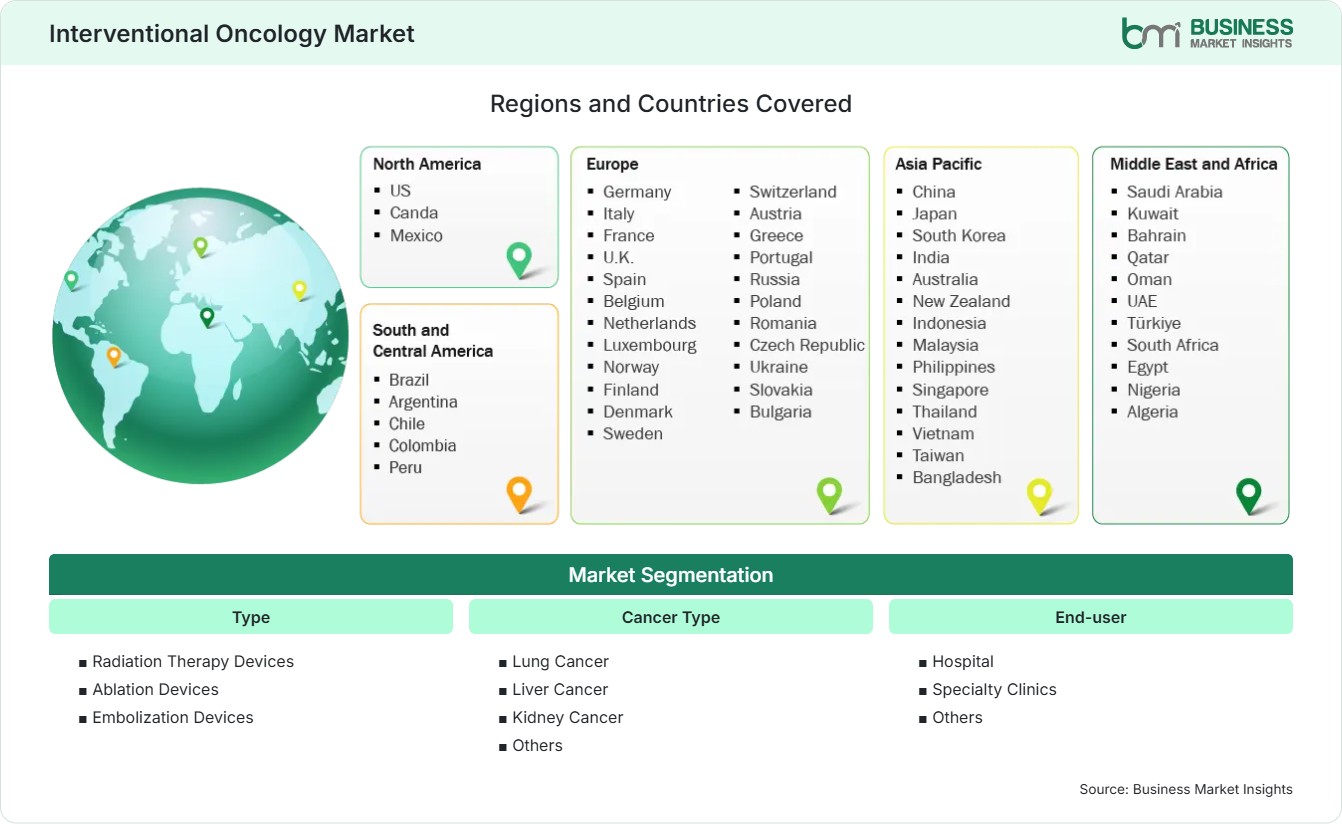
Europe accounts for a 27%–32% share in 2025 and is forecast to expand at a CAGR of 8.0%–10.0% during 2026–2033. Germany, France, the UK, Italy, and Spain represent leading markets, while Eastern European countries offer additional growth opportunities. Germany is projected to grow at a CAGR of 8.5%–10.5%, while Poland could reach 10.5%–12.5%. Expanding cancer care infrastructure, minimally invasive treatment adoption, and technology modernization are supporting regional demand.
- Germany and France provide strong opportunities through established oncology networks and advanced interventional treatment capabilities.
- The UK is expanding multidisciplinary cancer care, supporting integration of image-guided interventions within specialized treatment pathways.
- Southern European markets are increasing healthcare investment and improving access to advanced oncology technologies.
- Eastern European countries offer longer-term opportunities as hospitals modernize equipment and expand specialized cancer services.
Asia Pacific Interventional Oncology Market
Asia Pacific holds a 20%–25% share in 2025 and is projected to register a CAGR of 11.5%–13.5% during 2026–2033, making it the fastest-growing regional market. China, Japan, South Korea, India, and Australia represent major demand centers. India is projected to grow at a CAGR of 12.0%–14.0%, while China could expand at 11.5%–13.5%. Rising cancer prevalence, healthcare investment, and expanding treatment infrastructure are supporting adoption.
- China is expanding specialized cancer treatment capacity, creating demand for advanced ablation and embolization technologies.
- India offers substantial opportunities as hospitals increase oncology investment and develop specialized interventional treatment services.
- Japan and South Korea benefit from advanced healthcare infrastructure and established adoption of image-guided medical technologies.
- Australia provides opportunities through specialized cancer centers and continued investment in advanced treatment technologies.
Rest of World Interventional Oncology Market
South and Central America account for a 6%–9% share in 2025 and are projected to expand at a CAGR of 8.5%–10.5% during 2026–2033. Brazil, Mexico, and Argentina lead regional demand as healthcare providers improve oncology services. The Middle East and Africa represent a 7%–10% share and are projected to grow at a CAGR of 9.5%–11.5%, supported by healthcare investment and specialized cancer infrastructure.
Brazil and Mexico offer opportunities through expanding cancer treatment capacity, while Gulf countries are investing in advanced hospitals and specialized medical services. The UAE and Saudi Arabia represent leading markets, whereas South Africa provides opportunities through established oncology centers. Growth remains linked to equipment investment, specialist availability, healthcare financing, and access to advanced imaging infrastructure.
- Gulf countries are investing in advanced healthcare facilities, creating opportunities for image-guided cancer intervention technologies.
- Brazil and Mexico are expanding oncology services, supporting demand for minimally invasive cancer treatment solutions.
- South Africa provides opportunities through established medical centers and increasing interest in advanced oncology technologies.
- Healthcare infrastructure development across emerging markets is gradually improving access to specialized interventional procedures.