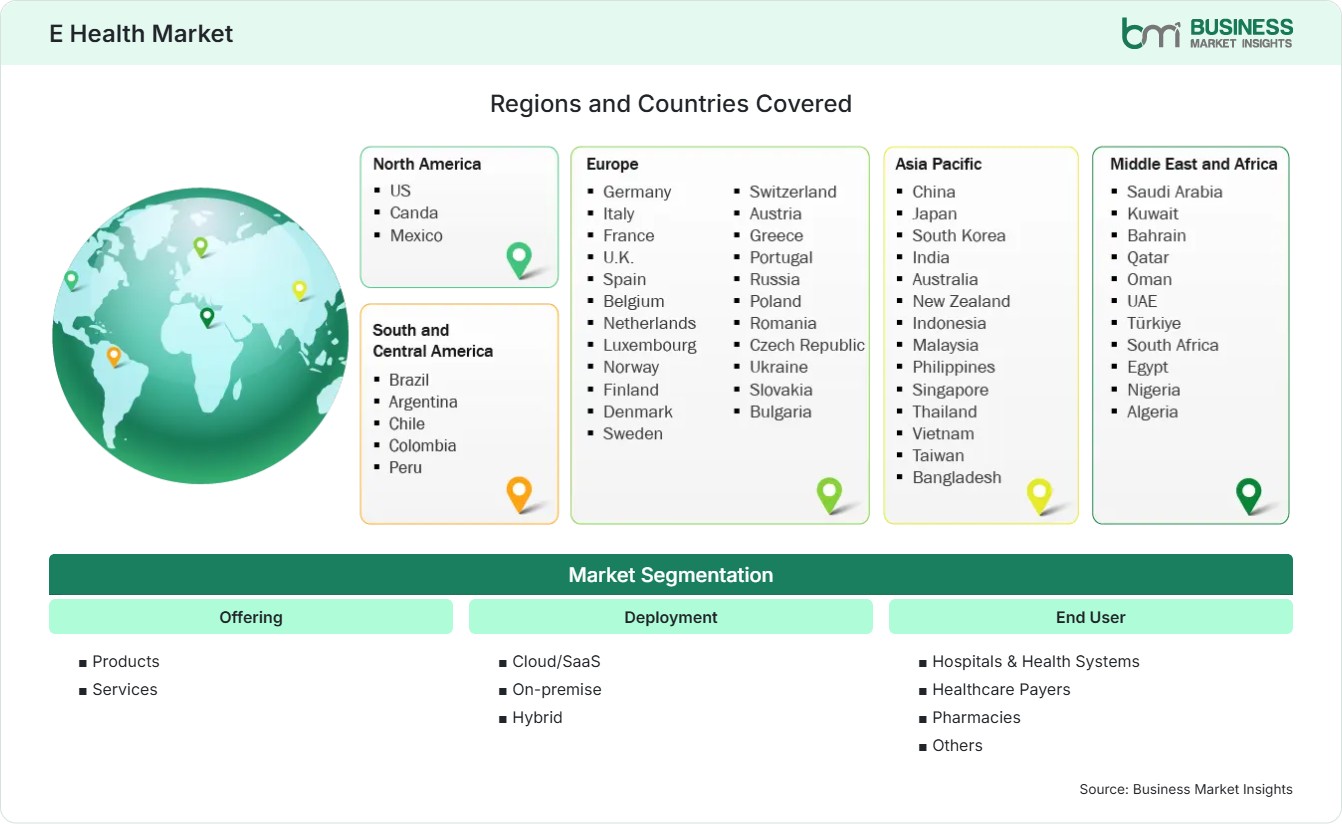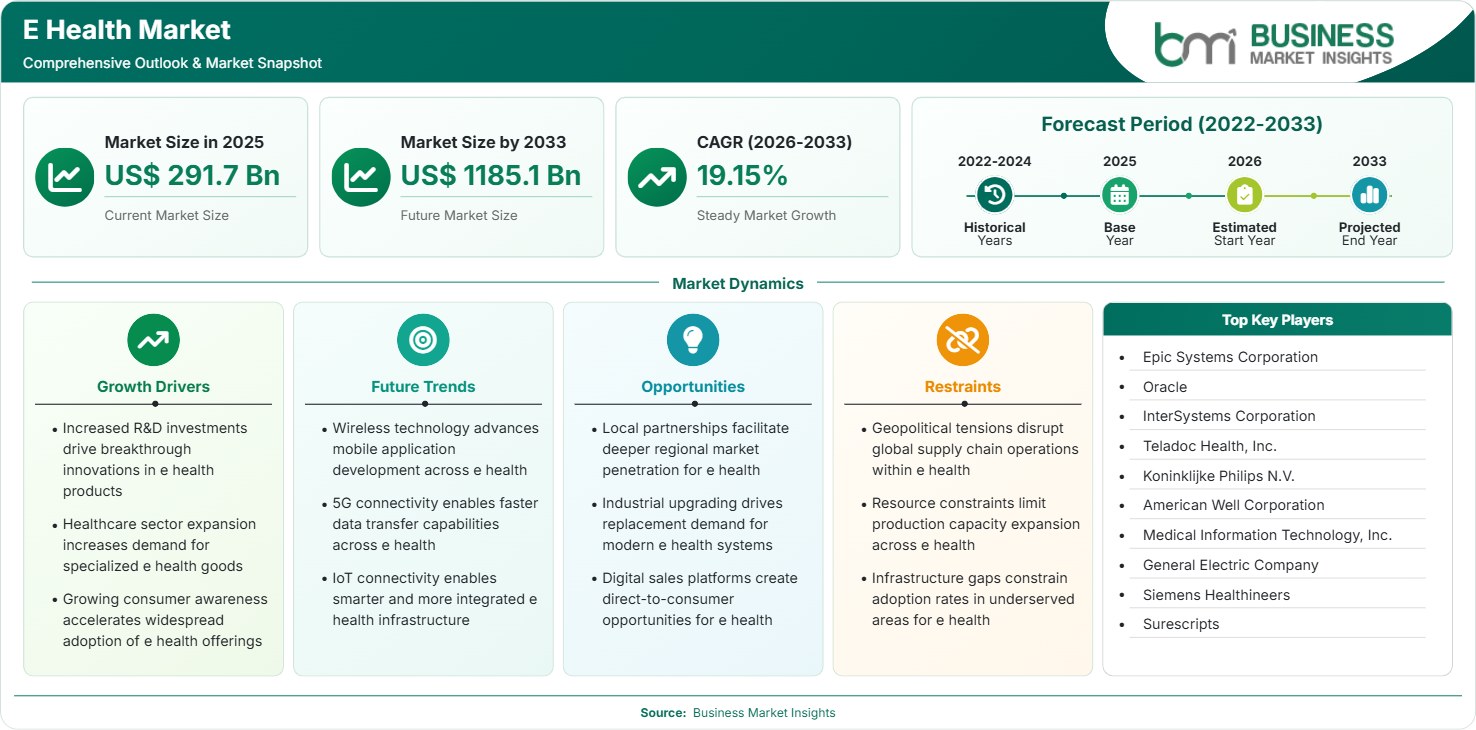
E Health Market Regional Highlights
North America E-Health Market
North America accounted for 37%–40% of the E-Health Market share in 2025 and is projected to register a CAGR of 17.8%–18.5% during 2026–2033. Strong healthcare IT investments, widespread electronic health record adoption, advanced cloud infrastructure, and favorable reimbursement frameworks continue to strengthen regional leadership. AI-enabled clinical decision support, connected medical devices, and interoperability initiatives remain major investment priorities. Digital transformation across hospitals, payers, and pharmacy networks continues accelerating adoption of integrated healthcare platforms while improving operational efficiency and patient outcomes.
- Healthcare providers continue replacing legacy systems with cloud-based digital platforms, enabling secure health information exchange, predictive analytics, AI-assisted diagnostics, and remote patient engagement while reducing operational costs and administrative complexity across integrated delivery networks.
- Federal digital health initiatives, interoperability regulations, and cybersecurity investments continue encouraging healthcare organizations to modernize electronic medical records, improve patient data accessibility, and strengthen digital resilience across healthcare ecosystems.
- Remote patient monitoring adoption continues expanding due to increasing chronic disease prevalence, aging demographics, and reimbursement support, encouraging hospitals to improve continuity of care while reducing unnecessary hospital admissions.
- Pharmaceutical companies, insurers, and healthcare technology providers increasingly collaborate on integrated digital platforms supporting electronic prescribing, patient engagement, and value-based healthcare delivery throughout the regional healthcare ecosystem.
- Growing venture capital investments in healthcare artificial intelligence, digital therapeutics, and predictive analytics continue accelerating commercialization opportunities for innovative healthcare software developers and technology providers.
US E-Health Market
The United States represented nearly 78%–81% of the North American E-Health Market in 2025 while advancing at a CAGR of 18.0%–18.7% through 2033. Healthcare organizations continue investing in AI-powered diagnostics, enterprise electronic health records, cloud migration, telehealth expansion, and interoperability solutions. Government incentives, strong private healthcare expenditure, and mature healthcare IT infrastructure reinforce long-term digital healthcare adoption across providers, insurers, pharmacies, and integrated health systems.
- Major hospital networks continue deploying enterprise-wide AI platforms to automate clinical documentation, improve workflow efficiency, enhance diagnostic accuracy, and optimize patient care delivery across multiple specialties.
- Telehealth utilization remains robust across primary care, behavioral health, chronic disease management, and specialist consultations, supported by reimbursement reforms and increasing patient acceptance of virtual healthcare services.
- Healthcare cybersecurity remains a strategic investment priority as providers strengthen ransomware protection, secure cloud migration, and compliance with evolving healthcare data privacy regulations.
- Strategic partnerships between healthcare providers and technology companies continue accelerating innovation across artificial intelligence, predictive analytics, precision medicine, and digital patient engagement platforms.
Europe E-Health Market
Europe captured approximately 27%–30% E-Health Market share in 2025 and is expected to expand at a CAGR of 18.2%–19.0% through 2033. Regional healthcare modernization programs, interoperability mandates, and increasing digital health funding continue supporting technology adoption. Germany remains the leading national market, while Spain demonstrates one of the fastest growth trajectories with an estimated CAGR of 20.0%–21.0%, supported by healthcare digitalization initiatives and expanding telemedicine infrastructure.
- European Union digital health policies continue promoting cross-border health information exchange, standardized interoperability, and secure electronic health records across member countries.
- Germany maintains regional leadership through advanced hospital digitization, medical imaging innovation, and continuous investments in AI-enabled clinical workflow optimization.
- Spain records rapid expansion due to national telemedicine programs, increasing healthcare technology investments, and strong government initiatives supporting digital healthcare accessibility.
- Healthcare providers increasingly implement cloud-based patient engagement platforms that improve communication, appointment management, and personalized healthcare delivery across public and private healthcare systems.
- Medical device manufacturers continue integrating connected monitoring technologies with hospital information systems, strengthening digital care coordination throughout European healthcare networks.
Asia Pacific E-Health Market
Asia Pacific represented 24%–27% of the E-Health Market in 2025 and is forecast to achieve the highest CAGR of 22.0%–23.5% between 2026 and 2033. Rapid healthcare infrastructure expansion, government-backed digital health strategies, growing internet connectivity, and rising smartphone penetration continue supporting widespread digital healthcare adoption. China remains the largest regional market, while India demonstrates the fastest growth with an estimated CAGR of 23.5%–24.5% supported by expanding digital public health initiatives.
- China continues investing heavily in AI-powered hospitals, cloud healthcare platforms, and integrated health information exchanges supporting nationwide healthcare modernization objectives.
- India experiences rapid adoption through expanding digital health missions, increasing telemedicine utilization, and rising investments in cloud-enabled hospital information systems.
- Japan continues strengthening elderly care through remote monitoring technologies, connected healthcare devices, and predictive analytics supporting long-term chronic disease management.
- Southeast Asian countries increasingly implement digital health platforms to improve healthcare accessibility across rural populations while reducing healthcare delivery disparities.
- Regional technology companies continue partnering with hospitals to develop scalable cloud-based healthcare ecosystems supporting integrated clinical and administrative operations.
Rest of World E-Health Market
The Rest of World region accounted for 8%–10% E-Health Market share in 2025 and is projected to register a CAGR of 18.8%–19.8% through 2033. Healthcare modernization, expanding internet access, and increasing investments in digital infrastructure continue driving adoption across South & Central America and the Middle East & Africa.
Brazil leads South & Central America through expanding telemedicine regulations and healthcare digitization initiatives, while the United Arab Emirates records one of the strongest growth rates at 20.5%–21.5% CAGR, supported by smart healthcare investments, AI integration, and national digital transformation strategies.
- Brazil continues strengthening digital healthcare through electronic medical records implementation, remote consultation expansion, and public healthcare modernization programs improving nationwide healthcare accessibility.
- Gulf countries increasingly invest in AI-enabled hospitals, smart healthcare infrastructure, and integrated patient information systems supporting healthcare diversification strategies.
- South Africa continues expanding digital health capabilities through public-private partnerships, telemedicine deployment, and cloud healthcare infrastructure investments addressing healthcare accessibility challenges.
- International development organizations continue supporting healthcare digitization projects that improve disease surveillance, digital patient records, and healthcare workforce productivity across developing economies.
- Mobile health platforms continue expanding throughout emerging markets by providing affordable healthcare access, remote consultations, medication adherence support, and digital patient education.