
AI in Clinical Trials Market Outlook: Size, Share, Trends, Growth Analysis, Competitive Landscape & Forecast, 2026-2033

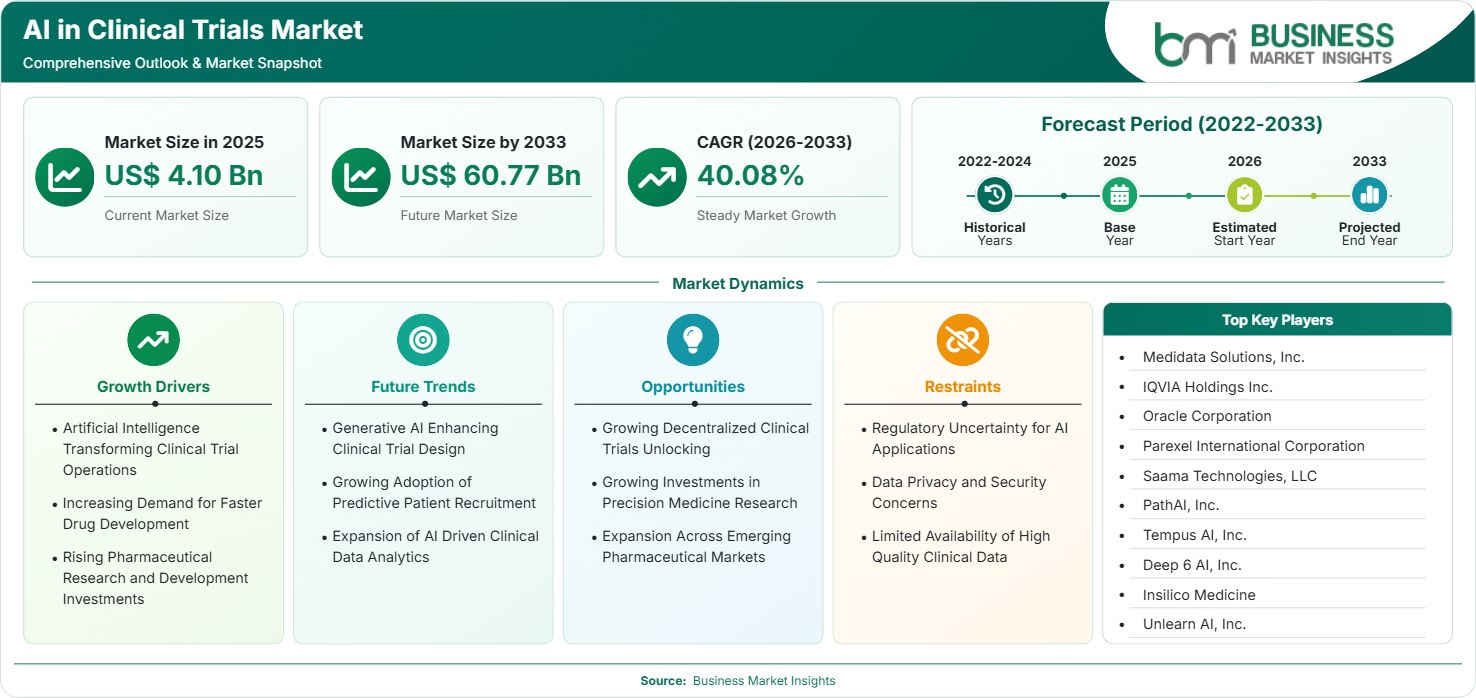
The AI in Clinical Trials Market size was valued at US$ 4.10 Billion in 2025 and is projected to reach US$ 60.77 Billion by 2033, growing at a CAGR of 40.08% during 2026–2033, driven by expanding AI-enabled patient recruitment, predictive analytics, decentralized trials, and increasing pharmaceutical investments creating substantial commercialization opportunities.

Report Coverage
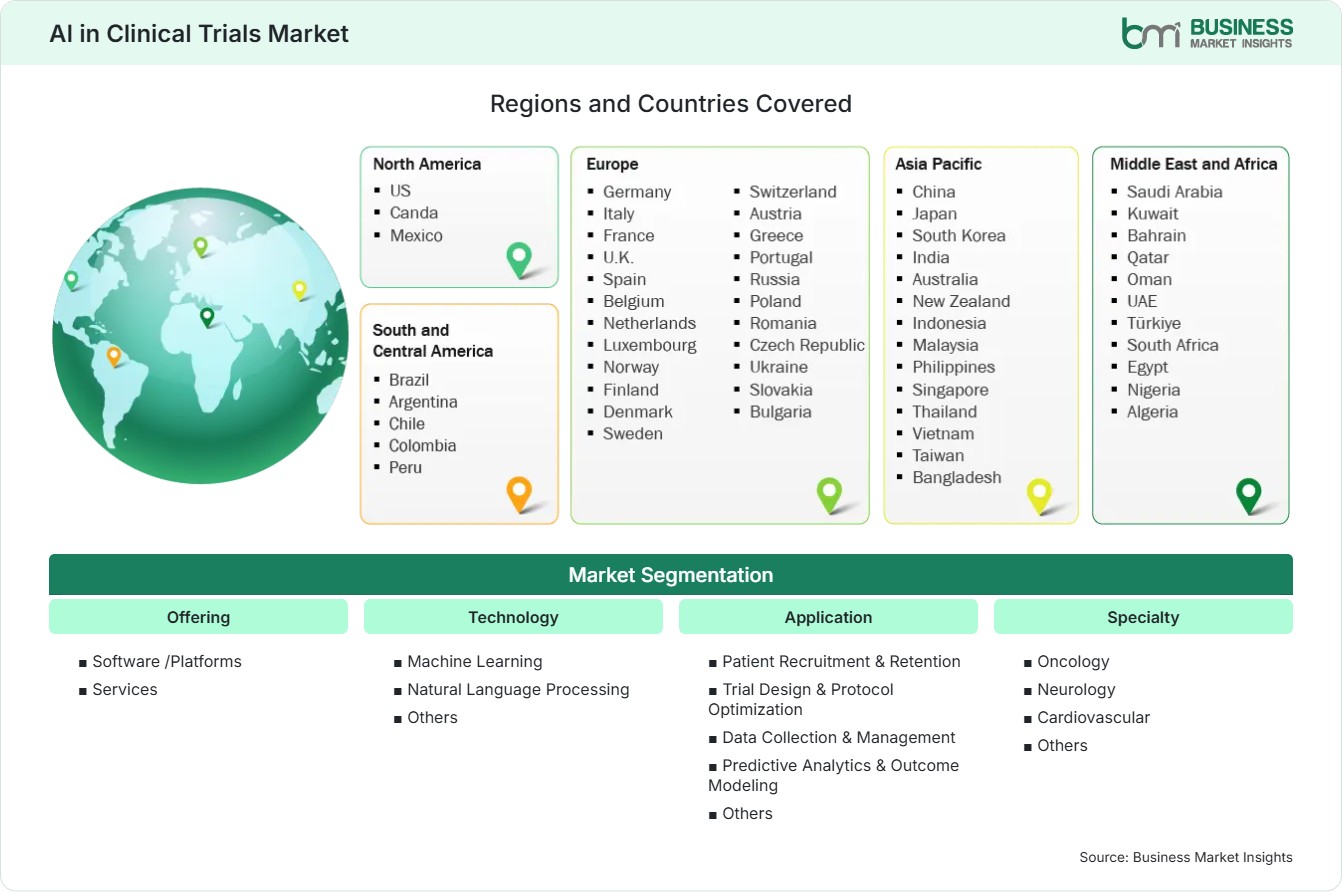
  • Offering: Software /Platforms, Services
  • Technology: Machine Learning, Natural Language Processing, Others
  • Application: Patient Recruitment & Retention, Trial Design & Protocol Optimization, Data Collection & Management, Predictive Analytics & Outcome Modeling, Others
  • Specialty: Oncology, Neurology, Cardiovascular, Others
  • End User: Pharmaceutical Companies, Contract Research Organizations , Others
US$ 4.10 Bn Market size in 2025
US$ 60.77 Bn Market Size by 2033
40.08% CAGR, 2026 - 2033
2026-2033 Forecast Period

AI Overview

AI in Clinical Trials Market Summary

  • North America Region: North America holds 39%–42% market share in 2025, growing at a CAGR of 39%–41% during 2026–2033, supported by strong pharmaceutical R&D, AI innovation, advanced healthcare infrastructure, favorable regulatory initiatives, and expanding partnerships between biotechnology companies, technology providers, and research organizations accelerating clinical development efficiency. The U.S. benefits from advanced AI ecosystems and extensive pharmaceutical research activities, recording an estimated CAGR of 39.5%–41.5%.
  • Fastest Growing Region: Asia Pacific accounts for 23%–26% market share in 2025 and advances at a CAGR of 42%–44% through 2026–2033 due to increasing clinical research investments, expanding biotechnology industries, supportive government initiatives, digital healthcare transformation, and broader adoption of artificial intelligence across pharmaceutical development ecosystems.
  • Leading Segment: Software / Platforms command 61%–64% market share in 2025 while expanding at a CAGR of 41%–43%, driven by automated trial management, predictive modeling, patient identification, workflow optimization, regulatory compliance capabilities, and enterprise-wide digital transformation initiatives among pharmaceutical organizations and CROs.
  • High Growth Segment: Predictive Analytics & Outcome Modeling represents 17%–20% market share during 2025 and records a CAGR of 44%–46%, supported by demand for real-world evidence integration, intelligent forecasting, biomarker identification, adaptive trial methodologies, and improved clinical decision-making across therapeutic development.
  • Key Market Opportunity: Growing adoption of decentralized clinical trials, multimodal healthcare datasets, cloud-based AI platforms, and precision medicine initiatives creates significant opportunities for intelligent automation, improved recruitment, optimized protocols, and accelerated regulatory submissions globally.
  • Major Market Players: Medidata Solutions, Inc., IQVIA Holdings Inc., Oracle Corporation, Parexel International Corporation, Saama Technologies, LLC, PathAI, Inc., Tempus AI, Inc., Deep 6 AI, Inc., Insilico Medicine, and Unlearn AI, Inc.
Strategic Insights

AI in Clinical Trials Market: Strategic Insights

AI in Clinical Trials Market Strategic Framework
FREE PDF
Request your free sample
Request free sample
Stakeholder View

Key Takeaways

  • The value chain is shifting toward integrated digital ecosystems where AI software vendors, cloud providers, CROs, pharmaceutical manufacturers, healthcare institutions, and data analytics specialists collaborate to improve protocol execution and trial efficiency.
  • Patient recruitment, protocol optimization, and predictive outcome modeling represent the strongest commercial opportunities because sponsors increasingly prioritize faster enrollment, lower dropout rates, and improved operational performance across multicenter clinical studies.
  • Innovation is moving beyond conventional machine learning toward generative AI, digital twins, multimodal analytics, federated learning, and explainable artificial intelligence, enabling more adaptive clinical trial designs while improving regulatory confidence and decision transparency.
  • Asia Pacific offers one of the strongest long-term investment opportunities due to expanding pharmaceutical manufacturing, supportive digital health initiatives, growing patient populations, increasing CRO capabilities, and rising investments in biotechnology research infrastructure.
  • Organizations investing early in interoperable AI platforms with robust cybersecurity, regulatory compliance, and scalable cloud infrastructure are better positioned to capture future demand from increasingly digital and decentralized clinical development programs.
Geographic Outlook

AI in Clinical Trials Market Regional Highlights

North America AI in Clinical Trials Market

North America accounts for approximately 39%–42% of the global market in 2025 and is projected to expand at a CAGR of 39%–41% through 2033. Strong pharmaceutical innovation, extensive healthcare digitization, advanced AI research, and favorable funding environments continue supporting regional leadership. The AI in Clinical Trials Market share remains dominant because of mature regulatory frameworks, extensive real-world healthcare datasets, and sustained investment in precision medicine initiatives.

  • Pharmaceutical companies increasingly integrate AI throughout protocol design, patient recruitment, and clinical monitoring to improve operational efficiency, reduce recruitment delays, and enhance regulatory documentation across complex multinational studies.
  • Government-backed biomedical research programs and extensive academic collaborations encourage artificial intelligence innovation while supporting commercialization of scalable clinical trial software platforms and advanced predictive analytics technologies.
  • Cloud computing adoption enables secure management of large clinical datasets, facilitating remote monitoring, decentralized trials, and real-time decision support while improving collaboration among sponsors, CROs, and healthcare providers.

US AI in Clinical Trials Market

The United States AI in Clinical Trials Market contributes approximately 81%–84% of North American revenue during 2025 while advancing at a CAGR of 39.5%–41.5% through 2033. Strong pharmaceutical pipelines, extensive venture capital investment, mature healthcare infrastructure, and high adoption of cloud computing reinforce national leadership. Federal initiatives supporting trustworthy artificial intelligence and increasing digital health investments continue strengthening long-term industry competitiveness.

  • Large pharmaceutical organizations increasingly adopt AI to optimize protocol development, reduce recruitment costs, and improve participant diversity across multicenter global clinical programs.
  • Leading academic medical centers continue generating extensive healthcare datasets supporting advanced predictive modeling, biomarker discovery, and precision medicine research initiatives.
  • Expanding collaborations between biotechnology companies and AI startups accelerate commercialization of innovative clinical trial software while improving data interoperability and regulatory readiness.

Europe AI in Clinical Trials Market

Europe AI in Clinical Trials Market represents approximately 27%–30% of global revenue during 2025 while expanding at a CAGR of 38%–40% through 2033. Strong regulatory oversight, collaborative biomedical research, and digital healthcare modernization encourage broader AI implementation across clinical development. Germany leads regional adoption, while the United Kingdom records one of the fastest expansion rates with a CAGR of 40%–42%, supported by vibrant life sciences innovation and growing digital health investments.

  • Cross-border clinical research collaborations improve access to diverse patient populations while supporting AI-powered recruitment and decentralized clinical trial management.
  • Pharmaceutical manufacturers increasingly deploy intelligent analytics to strengthen protocol compliance, optimize resource allocation, and improve operational efficiency across multinational research programs.
  • European health data initiatives encourage secure data sharing, enabling more accurate machine learning models and accelerating development of personalized therapies.
  • Growing biotechnology investments continue stimulating demand for AI-enabled platforms supporting adaptive trial designs and advanced predictive analytics.

Asia Pacific AI in Clinical Trials Market

Asia Pacific AI in Clinical Trials Market accounts for 23%–26% of global revenue in 2025 and is projected to register the fastest CAGR of 42%–44% through 2033. China represents the largest regional market owing to expanding pharmaceutical manufacturing, while India demonstrates one of the fastest growth rates with a CAGR of 43%–45%, supported by increasing CRO activity, digital healthcare initiatives, skilled clinical research professionals, and rising biotechnology investments.

  • Large patient populations improve participant recruitment efficiency, making the region increasingly attractive for multinational clinical research programs requiring diverse demographic representation.
  • Governments continue investing in digital health infrastructure, artificial intelligence research, and biotechnology innovation to strengthen domestic pharmaceutical competitiveness and clinical research capabilities.
  • Expanding contract research organizations increasingly deploy AI-powered workflow automation to reduce operational costs while improving trial quality and regulatory compliance.
  • Cloud computing adoption and electronic health record integration continue improving accessibility of structured clinical datasets for predictive modeling and precision medicine applications.

Rest of World AI in Clinical Trials Market

The Rest of World region represents approximately 8%–10% of global revenue during 2025 and is anticipated to grow at a CAGR of 37%–39% through 2033. Brazil leads South and Central America through expanding pharmaceutical research investments, while the United Arab Emirates demonstrates one of the highest regional growth rates because of healthcare digitalization, biotechnology initiatives, and increasing government support for medical innovation ecosystems.

  • Brazil continues strengthening biotechnology investments while attracting multinational pharmaceutical companies seeking broader patient recruitment opportunities and cost-efficient clinical development.
  • Gulf countries increasingly invest in digital healthcare ecosystems supporting artificial intelligence deployment across medical research, precision medicine, and advanced healthcare analytics.
  • International partnerships improve technology transfer, workforce development, and regulatory capabilities while supporting regional clinical research competitiveness.
  • Expanding healthcare infrastructure and cloud adoption improve opportunities for scalable AI-based clinical trial management platforms across emerging economies.
Global Market Geography
FREE PDF
Request your free sample
Request free sample
Segment Analysis

AI in Clinical Trials Market Segmentation

Offering

Software / Platforms account for approximately 61%–64% market share during 2025 and are expected to register a CAGR of 41%–43% through 2033 owing to expanding enterprise AI adoption, cloud deployment, workflow automation, and predictive analytics. The AI in Clinical Trials Market scope continues broadening as pharmaceutical companies increasingly integrate intelligent digital platforms throughout the complete clinical development lifecycle.

  • Software / Platforms: Enterprise AI platforms automate protocol development, recruitment, clinical monitoring, analytics, and regulatory documentation while improving operational efficiency and enabling scalable digital transformation across pharmaceutical research organizations.
  • Services: Professional consulting, implementation, integration, validation, regulatory support, and managed AI services help sponsors successfully deploy intelligent clinical development solutions while maintaining compliance and operational continuity.

Technology

Machine Learning represents approximately 46%–49% of market revenue in 2025 and is forecast to expand at a CAGR of 41%–43% through 2033 due to extensive predictive modeling, patient stratification, and automated clinical decision support capabilities.

  • Machine Learning: Algorithms identify recruitment candidates, predict outcomes, optimize protocols, detect operational risks, and continuously improve analytical performance using expanding clinical datasets and real-world evidence.
  • Natural Language Processing: NLP technologies efficiently extract valuable information from clinical notes, scientific literature, regulatory documents, and electronic health records to improve trial planning and participant identification.

Application

Patient Recruitment & Retention contributes approximately 27%–30% of total market revenue during 2025 and is projected to record a CAGR of 40%–42% because recruitment efficiency remains among the highest priorities for pharmaceutical sponsors.

  • Patient Recruitment & Retention: Artificial intelligence identifies eligible participants, predicts dropout risks, improves diversity, and enhances recruitment efficiency while reducing enrollment timelines across complex clinical programs.
  • Trial Design & Protocol Optimization: Intelligent analytics improve protocol quality, optimize inclusion criteria, reduce amendments, and strengthen operational feasibility before trial initiation.
  • Data Collection & Management: AI automates data validation, quality monitoring, anomaly detection, and workflow management while improving consistency across decentralized and multinational clinical studies.
  • Predictive Analytics & Outcome Modeling: Advanced predictive models estimate clinical outcomes, optimize resource allocation, identify treatment responders, and strengthen evidence generation for regulatory decision-making.

Specialty

Oncology accounts for approximately 34%–37% of market revenue in 2025 while advancing at a CAGR of 41%–43% because cancer studies generate extensive datasets requiring sophisticated AI-supported analytical capabilities.

  • Oncology: AI accelerates biomarker identification, patient matching, adaptive trial design, and precision medicine development while improving recruitment efficiency for increasingly targeted cancer therapies.
  • Neurology: Artificial intelligence supports complex neurological research by improving patient classification, disease progression prediction, and endpoint monitoring across long-duration clinical studies.
  • Cardiovascular: AI-powered analytics enhance risk prediction, participant monitoring, and outcome assessment, enabling more efficient evaluation of innovative cardiovascular therapies.

End User

Pharmaceutical Companies represent approximately 56%–59% of market revenue in 2025 and are expected to grow at a CAGR of 40%–42% through 2033 as sponsors increasingly adopt AI solutions to accelerate drug discovery, clinical operations, and regulatory submissions. AI adoption among end users is driven by demand for cost optimization, improved trial success rates, and faster commercialization of innovative therapies.

  • Pharmaceutical Companies: Drug manufacturers deploy AI platforms for recruitment optimization, trial forecasting, data analysis, and evidence generation to improve clinical development efficiency and reduce operational complexity.
  • Contract Research Organizations (CROs): CROs integrate AI technologies to enhance trial execution, automate workflows, improve monitoring capabilities, and provide advanced analytical services for pharmaceutical sponsors.
Market Forces

AI in Clinical Trials Market Dynamics

Key Market Drivers

Artificial Intelligence Transforming Clinical Trial Operations

Artificial intelligence is reshaping clinical workflows through automated recruitment, intelligent monitoring, predictive analytics, and improved data management. The AI in Clinical Trials Market growth is fueled by the rising need for better and efficient decision-making capabilities among the various pharmaceutical research programs. As per industry reports, there is a tremendous amount of structured and unstructured data produced through global clinical trials, which is fueling the need for AI-driven decision-making mechanisms. There is a rising trend within the market where there is a growing use of generative AI, machine learning models, and automated documentation.

Increasing Demand for Faster Drug Development

The rising cost and complexity of pharmaceutical development are encouraging sponsors to adopt AI solutions that shorten clinical timelines and improve probability of success. AI-powered analytics support faster protocol creation, patient segmentation, and outcome prediction by analyzing extensive healthcare datasets. Pharmaceutical companies increasingly prioritize technologies that reduce trial delays, improve recruitment performance, and optimize resource allocation. The growing adoption of precision medicine further strengthens demand for AI platforms capable of identifying suitable patient populations and evaluating treatment responses.

Rising Pharmaceutical Research and Development Investments

Increasing global pharmaceutical research expenditure is accelerating demand for artificial intelligence solutions across clinical development operations. Digital transformation projects have gained increased attention among biotech firms and pharmaceutical companies to ensure efficiency and maintain competitive advantage. The AI in Clinical Trials Market trends are increasing investment in areas like oncology, orphan drugs, and personalized medicine opens doors for more adoption of AI. There is an increasing partnership being formed between pharmaceutical firms, technology companies, and research organizations that is leading to innovations as well as commercialization of the clinical trial platform.

Key Market Opportunities

Growing Decentralized Clinical Trials Unlocking

Decentralized clinical trials provide a huge business opportunity for the AI platform due to the requirements for sophisticated technology in order to perform the research remotely. An AI platform will be able to process information about patients in real time, use more efficient methods of recruiting and provide decision-making support for the trials. Growing acceptance of the remote research techniques by pharmaceutical companies and research institutions results in growing demand for an advanced artificial intelligence platform. Moreover, the opportunity is boosted by increased regulatory acceptance of the digital approach to clinical trials in leading health markets.

Growing Investments in Precision Medicine Research

Precision medicine initiatives are creating opportunities for AI providers by increasing demand for advanced analytics capable of identifying treatment responders and developing personalized therapies. The capabilities of artificial intelligence can incorporate genomic data, clinical data, images, and biomarker data to aid targeted clinical development. Rising investment in cancer treatments, immunotherapies, and rare diseases is widening the addressable market for artificial intelligence technology. AI in Clinical Trials Market Forecast shows strong prospects for companies creating tools specifically suited for precision medicine applications and drug discovery.

Expansion Across Emerging Pharmaceutical Markets

Emerging pharmaceutical markets provide significant opportunities as healthcare infrastructure improves and clinical research activity expands. Countries across Asia Pacific, Latin America, and the Middle East are investing in biotechnology capabilities, digital health infrastructure, and research modernization. The implementation of AI technology can enable such areas to overcome operational difficulties through better recruitment processes, data handling, and regulatory documentation. The increasing cooperation of pharmaceutical corporations from around the world with regional organizations engaged in research activities contributes to the adoption of AI.

Market Restraints and Challenges

Regulatory Uncertainty for AI Applications

Factor: Evolving regulatory frameworks for artificial intelligence in healthcare create uncertainty regarding validation standards, algorithm transparency, and approval processes. Impact: This uncertainty can slow adoption among pharmaceutical companies requiring strict compliance before integrating AI into critical clinical workflows. Regulatory agencies continue developing guidance for responsible AI usage, but differences across regions create implementation complexity. Companies must invest in validation procedures, explainable models, and compliance infrastructure to ensure acceptance. These requirements increase deployment timelines and may restrict adoption among smaller organizations with limited resources.

Data Privacy and Security Concerns

Factor: Increasing dependence on sensitive patient datasets creates cybersecurity and privacy challenges for AI-enabled clinical trial platforms. Impact: Data protection requirements can increase operational complexity and restrict information sharing between research organizations, technology providers, and healthcare institutions. Clinical trial data includes personal health information requiring strong encryption, access controls, and governance mechanisms. Organizations must maintain compliance with privacy regulations while ensuring AI models receive sufficient quality data for accurate performance.

Company Analysis

Competitive Landscape

The competitive environment is shaped by technology providers, clinical research organizations, and AI-focused healthcare innovators developing platforms for automation, predictive analytics, patient recruitment, and trial optimization. The AI in Clinical Trials Market analysis highlights increasing collaboration between pharmaceutical companies and software providers as organizations seek scalable solutions for complex clinical workflows.

Company Name

Overview

Products and Services relevant to this market

Medidata Solutions, Inc.

Medidata provides cloud-based clinical development technology supporting pharmaceutical and biotechnology organizations with advanced research management capabilities.

AI-enabled clinical trial platforms, patient analytics, trial design optimization, data management, and decentralized trial solutions.

IQVIA Holdings Inc.

IQVIA combines healthcare intelligence, advanced analytics, and clinical research expertise to support global pharmaceutical development programs.

AI-powered clinical analytics, patient recruitment solutions, real-world evidence platforms, and trial management services.

Oracle Corporation

Oracle delivers enterprise healthcare technologies supporting clinical research organizations with integrated data and analytics infrastructure.

Clinical trial management systems, AI analytics, healthcare data platforms, and automated research workflows.

Parexel International Corporation

Parexel is a global contract research organization offering technology-enabled clinical development services for pharmaceutical sponsors.

AI-supported trial operations, patient engagement platforms, regulatory services, and clinical data solutions.

Saama Technologies, LLC

Saama develops artificial intelligence and analytics solutions focused on accelerating clinical research and improving operational efficiency.

AI-based clinical data analytics, automation platforms, trial intelligence solutions, and predictive insights.

PathAI, Inc.

PathAI specializes in artificial intelligence solutions for pathology and healthcare research applications.

AI pathology platforms, biomarker analysis, clinical research support, and diagnostic data interpretation solutions.

Tempus AI, Inc.

Tempus AI develops data-driven healthcare technologies using artificial intelligence to improve precision medicine research.

Clinical data analytics, machine learning platforms, genomic insights, and personalized medicine research tools.

Deep 6 AI, Inc.

Deep 6 AI provides AI-based clinical trial matching technologies designed to improve patient identification.

AI patient recruitment platforms, electronic health record analysis, and trial matching solutions.

Insilico Medicine

Insilico Medicine develops AI technologies for drug discovery and pharmaceutical research acceleration.

AI drug discovery platforms, target identification, predictive modeling, and therapeutic development solutions.

Unlearn AI, Inc.

Unlearn AI focuses on AI-generated digital twins and advanced clinical trial methodologies.

Digital twin technology, trial optimization platforms, predictive patient modeling, and clinical research acceleration tools.

Trust & Transparency

Research Methodology

The market analysis combines proprietary research with secondary data from government agencies, company disclosures, regulatory filings, industry databases and expert interviews. Market estimates are validated through data triangulation, cross-market benchmarking and analyst review.

View Full Research Methodology

Questions Answered

Frequently Asked Questions

What insights are covered in the AI in Clinical Trials Market Report?

The report provides analysis of market dynamics, technology adoption, competitive developments, segmentation trends, regional opportunities, and growth strategies influencing artificial intelligence applications in clinical research.

How will regulations influence future AI adoption in clinical research?

Regulatory development will determine how quickly AI solutions are integrated into clinical workflows. Clear validation standards, transparency requirements, and compliance frameworks will support wider adoption among healthcare organizations.

Why are pharmaceutical companies investing in AI-based clinical platforms?

Pharmaceutical companies are adopting AI platforms to reduce development costs, improve research productivity, enhance trial success probabilities, and accelerate the transition of innovative therapies from discovery stages to commercialization.

What role does AI play in patient recruitment for clinical studies?

AI identifies suitable participants by analyzing healthcare records, eligibility criteria, and clinical datasets. This improves recruitment accuracy, reduces screening time, and helps sponsors reach targeted patient populations more effectively.

How does artificial intelligence improve clinical trial efficiency?

Artificial intelligence improves clinical trials by automating patient identification, optimizing study protocols, analyzing complex datasets, and supporting predictive decision-making.

Access the Full AI in Clinical Trials Market Report

Get segment-level forecasts, regional estimates, competitive benchmarking, company profiles and downloadable Excel datasets.

Access the full AI in Clinical Trials Market Report
350 pages PDF & Excel | 2026-08-21