
Healthcare Personal Protective Equipment Market Outlook: Size, Share, Trends, Growth Analysis, Competitive Landscape & Forecast, 2026-2033

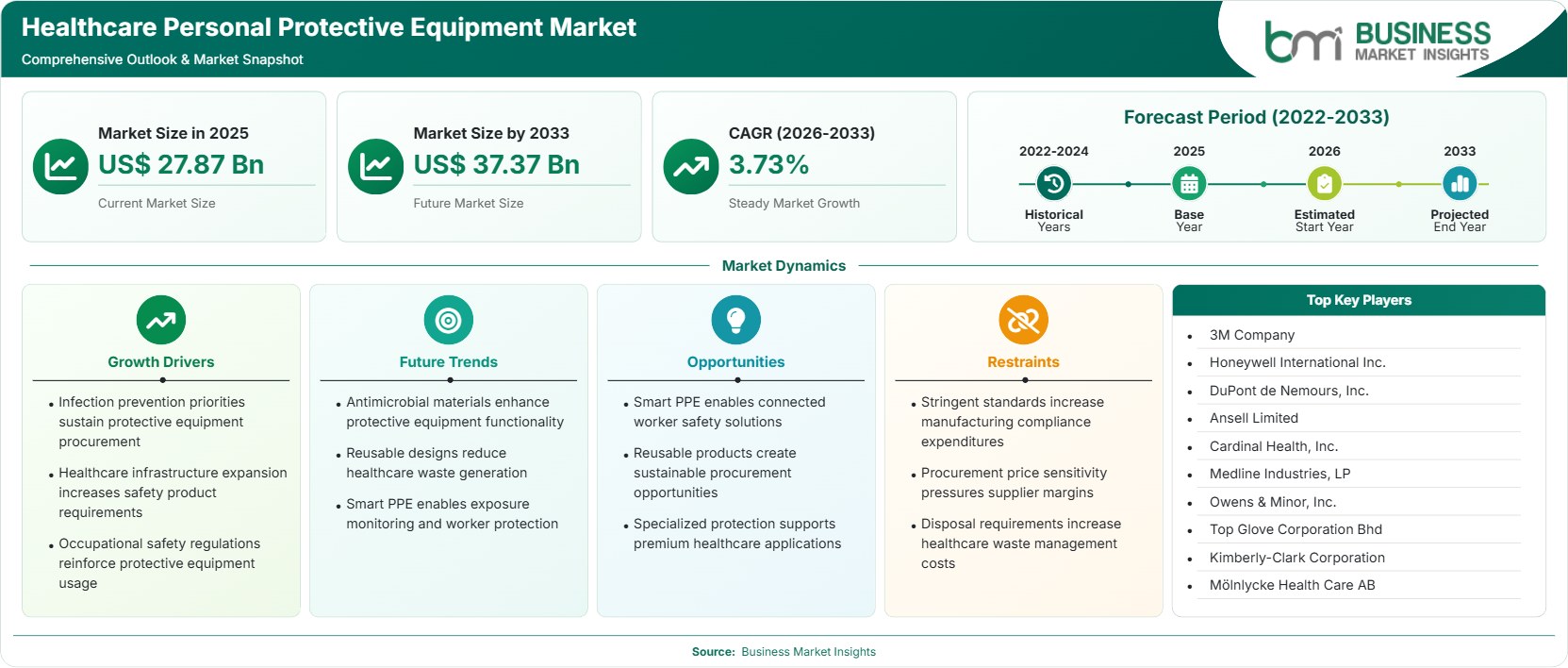
The Healthcare Personal Protective Equipment Market size was valued at US$ 27.87 Billion in 2025 and is projected to reach US$ 37.37 Billion by 2033, growing at a CAGR of 3.73% during 2026–2033. Key growth drivers include infection prevention mandates, increasing surgical volumes, healthcare workforce safety requirements, and supply chain localization initiatives. Opportunities are emerging through sustainable PPE materials, smart protective products, and expanding healthcare access across developing economies.

Report Coverage
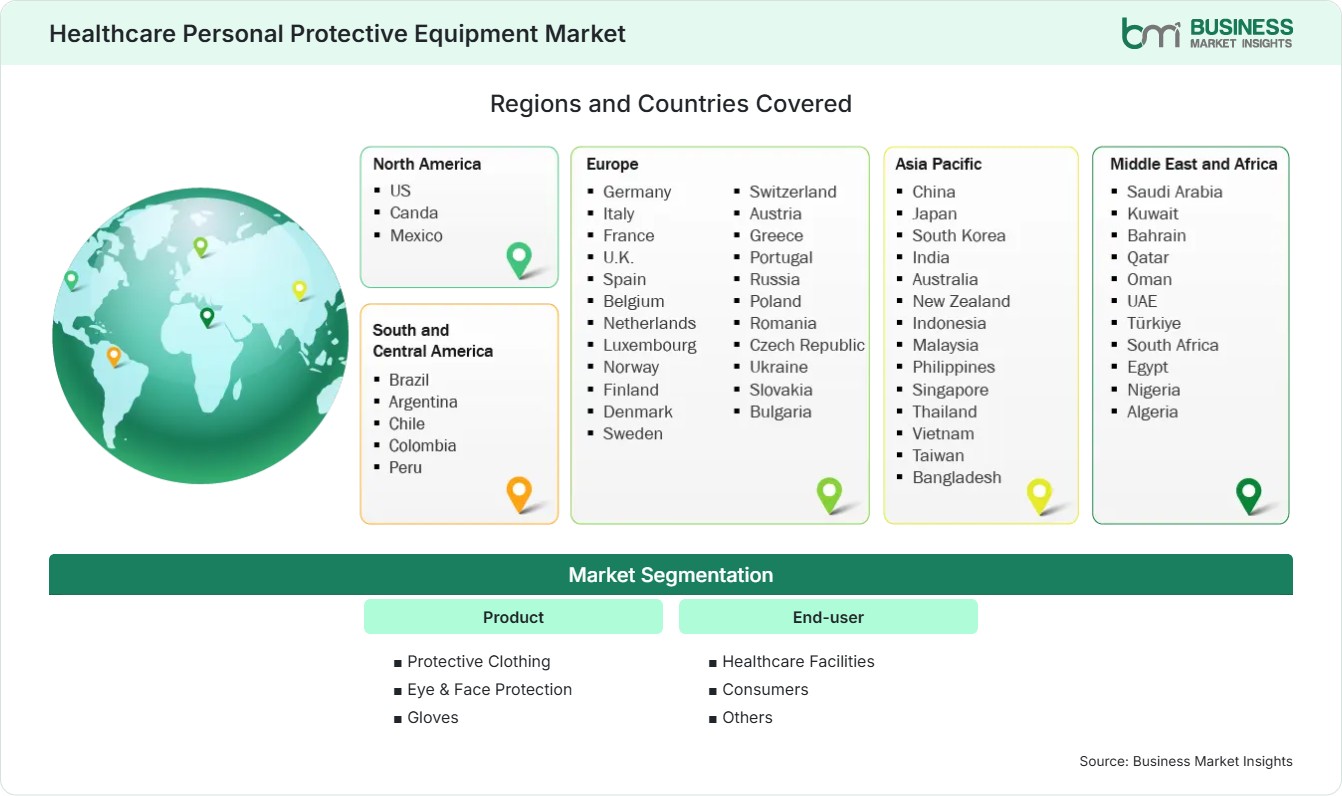
  • Product: Protective Clothing, Eye & Face Protection, Gloves
  • End-user: Healthcare Facilities, Consumers, Others
US$ 27.87 Bn Market size in 2025
US$ 37.37 Bn Market Size by 2033
3.73% CAGR, 2026 - 2033
2026-2033 Forecast Period

AI Overview

Healthcare Personal Protective Equipment Market Summary

  • North America Region: North America holds a market share of 36%–39% in 2025, growing at a CAGR of 3.1%–3.5% during 2026–2033. Growth is supported by hospital procurement programs, infection-control compliance, stockpile modernization, occupational safety standards, domestic manufacturing expansion, reusable-product adoption, and preparedness investments across healthcare systems. US market benefits from advanced healthcare infrastructure and strategic stockpile programs, growing at 3.2%–3.6% CAGR.
  • Fastest Growing Region: Asia Pacific holds 26%–29% share in 2025 and is projected to grow at 4.8%–5.3% CAGR during 2026–2033. Growth is driven by healthcare infrastructure upgrades, rising surgical procedure volumes, expanding healthcare coverage, manufacturing capacity additions, healthcare workforce expansion, public health readiness initiatives, and regulatory strengthening.
  • Leading Segment: Gloves account for a 41%–44% share in 2025 with a CAGR of 3.4%–3.8%. Demand remains supported by examination procedures, infection prevention protocols, chronic disease treatment expansion, outpatient care growth, healthcare worker protection requirements, procurement standardization, and broad usage across clinical environments.
  • High Growth Segment: Eye & Face Protection represents a 23%–26% share in 2025 and is expected to grow at 4.4%–4.9% CAGR. Growth stems from respiratory infection awareness, enhanced workplace safety requirements, broader mask utilization, premium respirator adoption, emergency preparedness strategies, and product innovations improving comfort and filtration efficiency.
  • Key Market Opportunity: Sustainable and reusable protective equipment solutions offer substantial opportunity as healthcare providers seek waste reduction, procurement efficiency, lifecycle cost optimization, environmental compliance, and resilient supply programs without compromising infection-prevention performance.
  • Major Market Players: 3M Company, Honeywell International Inc., DuPont de Nemours, Inc., Ansell Limited, Cardinal Health, Inc., Medline Industries, LP, Owens & Minor, Inc., Top Glove Corporation Bhd, Kimberly-Clark Corporation, Mölnlycke Health Care AB.
Strategic Insights

Healthcare Personal Protective Equipment Market: Strategic Insights

Healthcare Personal Protective Equipment Market Strategic Framework
FREE PDF
Request your free sample
Request free sample
Stakeholder View

Key Takeaways

  • PPE value chains are increasingly shifting toward regionalized manufacturing and multi-source procurement strategies to reduce vulnerabilities exposed during global supply disruptions.
  • Eye and face protection products present notable upside due to expanding respiratory protection adoption, occupational safety compliance, and institutional preparedness programs.
  • Product development is moving toward reusable materials, improved breathability, ergonomic designs, and enhanced filtration performance to improve user compliance.
  • Asia Pacific offers a compelling investment case driven by healthcare infrastructure expansion, rising healthcare expenditure, and strong manufacturing ecosystems.
  • Strategic acquisitions and long-term supply agreements are becoming important competitive tools as suppliers seek greater market access and healthcare system integration.
  • Sustainability initiatives are influencing product specifications as hospitals increasingly evaluate lifecycle costs and environmental impacts during procurement decisions.
Geographic Outlook

Healthcare Personal Protective Equipment Market Regional Highlights

North America Healthcare Personal Protective Equipment Market

North America accounted for approximately 36%–39% of the Healthcare Personal Protective Equipment Market share in 2025 and is expected to expand at a CAGR of 3.1%–3.5% through 2033. Large healthcare spending, stringent worker safety regulations, and extensive hospital procurement programs support steady demand. Strategic national stockpile replenishment, increasing outpatient procedures, and infection-control compliance continue to underpin purchasing activity. Healthcare systems increasingly prioritize domestic sourcing capabilities and supplier diversification to strengthen resilience against future disruptions while sustaining product availability across care settings.

  • Strategic stockpile modernization programs continue supporting demand for respirators, gowns, gloves, and emergency preparedness inventories.
  • Healthcare facilities increasingly adopt long-term procurement agreements to improve supply continuity and pricing visibility.
  • Regulatory compliance requirements strengthen utilization across hospitals, ambulatory centers, and long-term care facilities.
  • Domestic manufacturing investments enhance supply security and reduce dependence on concentrated sourcing locations.

US Healthcare Personal Protective Equipment Market

The United States represents approximately 79%–82% of regional revenue and is projected to grow at 3.2%–3.6% CAGR. Demand is supported by high procedural volumes, healthcare-acquired infection prevention initiatives, and worker safety requirements. Federal preparedness programs and hospital purchasing groups continue driving procurement consistency. Growth remains moderate yet resilient as healthcare providers maintain inventory optimization strategies while investing in higher-performance protective equipment with enhanced comfort and protection characteristics.

  • Large integrated healthcare systems increasingly standardize suppliers to improve procurement efficiency and quality control.
  • Rising outpatient treatment volumes support recurring demand for disposable protective products.
  • Preparedness funding continues encouraging product stockpiling and strategic reserve management.
  • Adoption of advanced respiratory protection solutions increases in high-risk clinical environments.

Europe Healthcare Personal Protective Equipment Market

Europe held 28%–31% share in 2025 and is forecast to grow at 3.5%–3.9% CAGR. Regulatory harmonization, healthcare workforce safety requirements, and sustainability targets are shaping procurement decisions. Germany remains the leading market, while Central and Eastern European countries demonstrate faster expansion supported by healthcare investments. Regional manufacturers benefit from localization strategies and quality-focused purchasing frameworks. Sustainability considerations influence demand for recyclable materials and reusable protective clothing solutions.

  • Germany leads regional demand with mature hospital infrastructure and stringent healthcare safety standards.
  • Poland and Romania show faster adoption linked to healthcare capacity expansion programs.
  • Sustainability targets are supporting interest in reusable gowns and waste-reduction initiatives.
  • Public procurement reforms encourage transparent sourcing and product quality benchmarking.

Asia Pacific Healthcare Personal Protective Equipment Market

Asia Pacific had a market share of 26% to 29% in 2025 and is showing rapid growth at 4.8% to 5.3%. China is a leader in regional manufacturing capabilities, and India shows great consumption growth owing to its expanding healthcare infrastructure. Growing trends in medical tourism, a growing healthcare workforce, and greater public health awareness drive acceptance. Investment in hospitals and testing facilities creates greater demand for protective devices.

  • China remains a leading manufacturing hub with broad export and domestic consumption strengths.
  • India exhibits strong growth supported by healthcare access expansion and hospital development projects.
  • Southeast Asian markets benefit from improving healthcare coverage and rising healthcare expenditure.
  • Local production initiatives strengthen supply security while supporting regional distribution networks.

Rest of World Healthcare Personal Protective Equipment Market

Rest of World represented a 9%–11% share in 2025 and is expected to grow at 4.0%–4.5% CAGR. South and Central America benefit from healthcare modernization programs and expanding infection-control investments.

Middle East and Africa markets are supported by healthcare infrastructure development, rising hospital construction activity, and government healthcare spending. Brazil remains the largest regional market, while Saudi Arabia and the UAE demonstrate strong growth through healthcare transformation initiatives and expanded healthcare capacity.

  • Brazil leads demand across South and Central America through hospital modernization investments.
  • Mexico demonstrates growing procurement activity linked to healthcare access improvements.
  • Saudi Arabia benefits from healthcare infrastructure expansion and workforce protection priorities.
  • UAE accelerates adoption through advanced healthcare facility development and preparedness strategies.
Global Market Geography
FREE PDF
Request your free sample
Request free sample
Segment Analysis

Healthcare Personal Protective Equipment Market Segmentation

Product

The product category accounted for the entire market, representing diverse protection needs. Gloves still hold the largest market share due to their widespread use during procedures, whereas respiratory and face protection products are becoming increasingly popular due to infection control concerns. The Healthcare Personal Protective Equipment market scope continues to grow due to product development, sustainability initiatives, and safety regulations within the healthcare sector.

  • Protective Clothing: Demand is supported by infection prevention requirements, surgical applications, and healthcare worker safety initiatives. Product innovation focuses on comfort, barrier performance, and sustainability.
  • Coveralls: Increasing use in high-risk environments and emergency response situations supports utilization, particularly where full-body protection remains essential.
  • Isolation Gowns: Widely used in hospitals and outpatient settings to reduce cross-contamination risks and meet infection-control protocols.
  • Eye & Face Protection: Growing emphasis on respiratory safety and worker protection supports increasing adoption across healthcare environments.
  • Face Mask: Continues to represent a foundational protective category because of broad daily usage across healthcare functions.
  • N95 Respirators and Surgical Masks: Demand is driven by superior filtration needs, outbreak preparedness planning, and regulatory compliance policies.
  • Safety Goggles: Adoption increases in settings requiring splash protection and enhanced eye safety during procedures.
  • Gloves: Adoption is driven by infection prevention requirements, protection from hazardous substances, and stringent hygiene and safety regulations across healthcare and industrial settings.

End-user

Healthcare institutions have a 68%-72% market share in 2025 and are expected to grow at a 3.5%-3.9% CAGR. Hospitals are the primary purchasers due to the high volume of procedures performed and the need to prevent infections. The consumer segment continues to grow through campaigns focused on health awareness and preparation purchases. The Healthcare Personal Protective Equipment Market share is still held by institutional healthcare settings.

  • Healthcare Facilities: Dominant demand source supported by recurring procurement cycles, worker safety mandates, and infection-prevention protocols.
  • Consumers: Demand influenced by personal health awareness, travel requirements, seasonal health concerns, and emergency preparedness practices.
Market Forces

Healthcare Personal Protective Equipment Market Dynamics

Key Market Drivers

Expansion of Infection Prevention Protocols

Healthcare institutions have continued to improve their infection control policies by learning from various global health threats. The WHO guidelines and hospital accreditation policies underscore the proper use of PPE during all medical procedures and patient interactions. The growing concern about preventing healthcare-associated infections is driving repeat purchases. Protective equipment is being incorporated more into healthcare risk management, rather than only as emergency purchases. The increased demand in all healthcare facilities guarantees steady consumption. High quality and training are other factors driving demand across developed and emerging healthcare markets.

Growing Surgical and Diagnostic Procedure Volumes

Greater expansion of surgical procedures, an aging population, and rising needs for managing chronic diseases will lead to increased use of protective products. Each surgical procedure environment uses various types of PPE such as gloves, masks, goggles, and gowns. As usage of healthcare services rises, so do the procurement volumes. An increase in ambulatory care and diagnostic facilities adds to demand. Regulatory requirements for both staff and patient safety also enhance the demand. The expansion of healthcare services in emerging countries increases volumes, creating predictable demand for replacement and replenishment across major product categories.

Supply Chain Resilience and Localization Efforts

Resilient sourcing strategies have been emphasized by governments and healthcare organizations after disruptions to their global supply chain networks. The regional manufacturing strategy, inventory visibility, and supplier diversification will increase product availability and streamline the procurement process. Healthcare organizations are increasingly interested in partnering with suppliers that have strong production capabilities and expertise in regulatory compliance. Regional manufacturing also contributes to achieving emergency readiness goals and enhances inventory security.

Key Market Opportunities

Sustainable and Reusable PPE Development

Increasing efforts to reduce medical waste without compromising safety performance are driving hospitals. The use of reusable gowns, recyclable products, and sustainable design in manufacturing provides significant avenues for manufacturers. The procurement process in hospitals considers life-cycle economics and is no longer restricted to acquisition costs alone. Sustainable suppliers that can offer solutions that comply with the regulations could benefit from better market positioning. Healthcare Personal Protective Equipment Market Forecasts now factor in environmental considerations in purchasing decisions, creating commercial opportunities for innovative suppliers pursuing differentiation through sustainability and circular-economy initiatives.

Smart and Connected Protective Equipment

Emerging sensing technologies, compliance management, and environmental detection features present possibilities for future generations of products. Smart PPE could increase employee safety, training program efficiency, and operational transparency. In hospitals looking to adopt digital transformation strategies, there might be more interest in smart PPE. Developers of PPEs with monitoring features could enter high-value health care markets. The development could improve product differentiation in a market with relatively uniform traditional products.

Healthcare Infrastructure Expansion in Emerging Markets

The rapid development of hospitals, as well as the growth in the size of the healthcare workforce and greater investment in public health across Asia, the Middle East, and Latin America, is driving significant potential demand that is yet to be realized. The increase in treatment capability automatically drives up the need for protective equipment. International companies and domestic producers may capitalize on this by developing distribution partnerships and production. These markets are expected to contribute a growing share of future incremental demand.

Market Restraints and Challenges

Pricing Pressure and Margin Compression

Procurement departments in healthcare facilities are becoming increasingly concerned with cost-effectiveness and competitive bidding. Buyer power is high. Suppliers are under margin pressure, especially in categories where products are considered commodity items, e.g., gloves and masks. Organizations that purchase large volumes frequently aim to secure lower-cost deals, which limits price flexibility. Suppliers have to weigh cost, regulatory considerations, product effectiveness, and availability. Competition is intense because regional and global suppliers fight for deals with institutions. Cost pressures will likely lead to consolidation in the long run.

Raw Material Volatility and Supply Uncertainty

Variations in polymer and nitrile prices, packaging materials, and transport costs. Pricing and planning for the manufacturing process have become more difficult for companies. Variations in raw material availability complicate procurement and inventory management. Healthcare organizations could face long lead times or cost variations during periods of supply disruption. Many manufacturers adapt to that by diversifying their suppliers, maintaining inventory, and investing in local production. Nevertheless, input volatility remains a persistent challenge affecting operational planning and profitability.

Company Analysis

Competitive Landscape

Healthcare Personal Protective Equipment Market analysis indicates competition centered on product quality, regulatory compliance, manufacturing scale, distribution reach, and healthcare customer relationships.

Company Name

Overview

Products and Services relevant to this market

3M Company

Global industrial and healthcare technology leader with extensive respiratory protection expertise and healthcare distribution reach.

N95 respirators, surgical masks, protective eyewear, infection-prevention solutions, and worker-safety products.

Honeywell International Inc.

Diversified technology company with strong presence in respiratory and industrial safety solutions.

Respiratory protection devices, face protection, filtration technologies, and safety equipment.

DuPont de Nemours, Inc.

Advanced materials company known for protective fabrics and barrier technologies.

Protective clothing, coveralls, healthcare safety materials, and infection-protection garments.

Ansell Limited

Specialist protective solutions manufacturer serving healthcare and industrial sectors worldwide.

Surgical gloves, examination gloves, protective apparel, and infection-control solutions.

Cardinal Health, Inc.

Major healthcare services and medical products company with broad provider relationships.

Surgical apparel, gloves, masks, gowns, and healthcare distribution services.

Medline Industries, LP

Leading medical supplies manufacturer and distributor supporting healthcare facilities globally.

Masks, gowns, gloves, protective apparel, and clinical consumables.

Owens & Minor, Inc.

Healthcare logistics and products provider serving hospitals and care facilities.

Medical gloves, masks, protective apparel, sourcing, and distribution solutions.

Top Glove Corporation Bhd

One of the world's largest glove manufacturers with broad healthcare presence.

Examination gloves, surgical gloves, and healthcare hand-protection products.

Kimberly-Clark Corporation

Consumer and professional hygiene products company with a healthcare safety portfolio.

Face masks, protective apparel, infection-prevention and hygiene products.

Mölnlycke Health Care AB

Medical solutions company focused on surgical and healthcare protection products.

Surgical gowns, procedure packs, protective clothing, and wound-care solutions.

Trust & Transparency

Research Methodology

The market analysis combines proprietary research with secondary data from government agencies, company disclosures, regulatory filings, industry databases and expert interviews. Market estimates are validated through data triangulation, cross-market benchmarking and analyst review.

View Full Research Methodology

Questions Answered

Frequently Asked Questions

What does a Healthcare Personal Protective Equipment Market Report typically evaluate?

A Market Report generally assesses market size, competitive positioning, technology trends, regulatory developments, regional opportunities, and future growth prospects.

How are emerging markets affecting industry development?

Emerging markets are increasing demand through hospital construction, workforce expansion, healthcare modernization, and broader healthcare access initiatives.

What is the most promising future opportunity?

Sustainable and reusable PPE solutions represent a major opportunity as healthcare providers prioritize waste reduction and long-term cost management.

Which region leads global revenue generation?

North America leads revenue generation due to strong healthcare expenditure, safety regulations, strategic stockpile programs, and mature procurement systems.

Which product category generates the highest demand?

Gloves generate the highest demand because they are used across nearly every patient interaction, diagnostic procedure, and surgical activity within healthcare facilities.

Access the Full Healthcare Personal Protective Equipment Market Report

Get segment-level forecasts, regional estimates, competitive benchmarking, company profiles and downloadable Excel datasets.

Access the full Healthcare Personal Protective Equipment Market Report
350 pages PDF & Excel | 2026-09-16
Similar Research

Related Market Reports